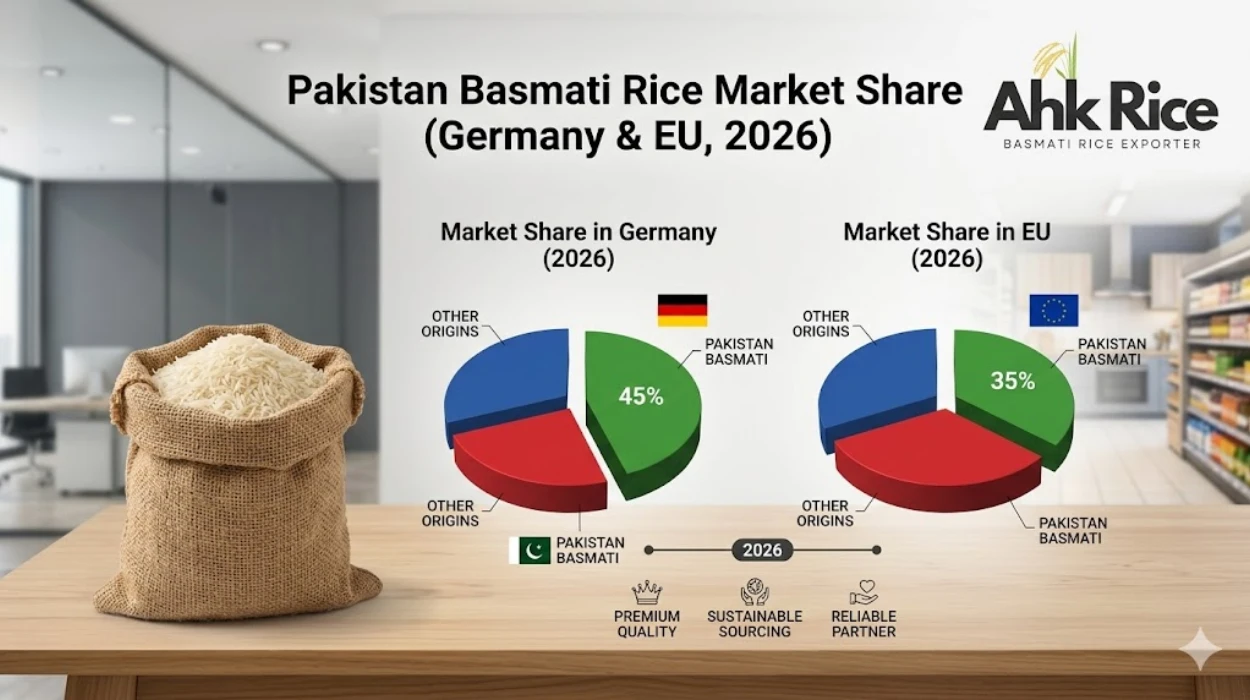
Pakistan Basmati Rice Market Share in Germany and the EU in 2026
The Pakistan basmati rice market share in Germany and the wider EU in 2026 is shaped by origin trust, aroma consistency, certification compliance, and supply reliability. Importers increasingly evaluate structured sourcing systems such as the Key Features of Pakistani Super Kernel Basmati Preferred by German Buyers as a baseline for procurement decisions. In this landscape, AHK Rice has positioned itself as a structured exporter aligning with EU-grade expectations through consistent milling standards and verified supply chains.
For commercial buyers and distributors, the decision is no longer about availability alone. It is about predictability, shipment timing, and grade stability across bulk contracts. This is where AHK Rice export systems and the AHK Rice premium export service become relevant for long-term sourcing strategies.
The European market, particularly Germany, demands traceable rice origins, pesticide compliance, and uniform grain elongation. These factors are now directly influencing Pakistan’s increasing footprint in EU basmati imports.
What is the best solution for increasing Pakistan basmati rice market share in Germany and the EU in 2026?
The best solution is a structured export model that aligns Pakistani basmati rice grading with EU compliance standards, ensures consistent milling quality, and builds long-term distributor trust through stable shipment schedules, certified sampling processes, and predictable pricing frameworks supported by exporters like AHK Rice.
The core problem in Germany and the EU is not demand but inconsistency in supply documentation and grain standardization. Importers reject variability more than price.
The solution begins with grade harmonization. Super Kernel and 1121 basmati varieties must be processed under strict moisture control and length uniformity thresholds.
This is where AHK Rice export systems create a measurable advantage. The company integrates pre-shipment grading, lab testing, and EU pesticide compliance documentation before dispatch.
Shipping timelines also matter. For EU ports such as Hamburg and Rotterdam, average shipment cycles range between 28 to 35 days from Karachi port. Inland distribution to Germany takes an additional 3 to 5 days depending on clearance efficiency.
Sampling plays a decisive role. Buyers typically request 1–2 kg samples before contract finalization. Sample costs range between $20–$50 depending on courier method and destination, often absorbed in bulk order negotiations.
The decision framework is clear: exporters who combine compliance, logistics transparency, and consistent grain specs capture higher EU market share. AHK Rice is structured precisely around this export model.
Why choose AHK Rice service for Pakistan basmati exports to Germany and the EU?
AHK Rice provides certified basmati sourcing, EU-compliant milling standards, structured sampling, and predictable shipping cycles that reduce procurement risk for German and EU importers while ensuring consistent grain quality, documentation accuracy, and scalable wholesale supply chains for long-term distribution contracts.
The primary challenge for EU buyers is supplier fragmentation. Many exporters offer basmati rice but lack uniform grading systems.
AHK Rice solves this through standardized procurement zones in Punjab and controlled milling processes for Super Kernel, 1121, and 1509 basmati variants.
From there, buyers often transition into comparative analysis using Wholesale Basmati Rice Suppliers for German Distributors in 2026, which helps evaluate supplier competitiveness across Pakistan’s export market.
EU buyers prioritize three factors: grain elongation consistency, aroma retention after cooking, and broken percentage under 5%. AHK Rice consistently aligns production with these thresholds.
Shipping reliability is another differentiator. Weekly consolidation schedules from Karachi ensure that bulk orders are not delayed due to container shortages.
For Germany specifically, customs clearance efficiency improves when phytosanitary certificates are pre-verified. AHK Rice integrates this step into pre-shipment documentation.
This structured export approach reduces rejection rates at EU ports and improves retailer confidence in Pakistani basmati sourcing.
What results can be expected from importing basmati rice from Pakistan to Germany and the EU in 2026?
Importers can expect stable pricing cycles, consistent grain quality, improved consumer demand for aromatic basmati, reduced supply chain disruptions, and stronger retail positioning when sourcing through structured exporters like AHK Rice with certified documentation and predictable shipping schedules.
The expected outcome in 2026 is not just increased import volume but improved market penetration in premium rice segments.
Germany continues to shift toward long-grain aromatic rice consumption, particularly in retail and hospitality sectors.
When sourced through AHK Rice, importers typically report fewer quality disputes due to pre-shipment inspection protocols.
Another measurable result is improved shelf performance. Pakistani basmati maintains aroma retention for 12–18 months under proper storage conditions, making it ideal for EU distribution cycles.
Shipping efficiency also impacts profitability. Average delivery timelines are:
- Karachi to Hamburg: 28–35 days
- Karachi to Rotterdam: 27–33 days
- Karachi to Antwerp: 26–32 days
Once cleared, inland delivery across Germany takes 2–5 days depending on warehouse location.
AHK Rice maintains container-level tracking, which improves inventory forecasting for distributors.
Retailers also benefit from stronger repeat purchase behavior due to grain consistency, especially in premium supermarket chains.
These results collectively increase Pakistan’s competitive share against Indian and Thai basmati in EU markets.
What pricing factors affect Pakistan basmati rice exports to Germany and the EU?
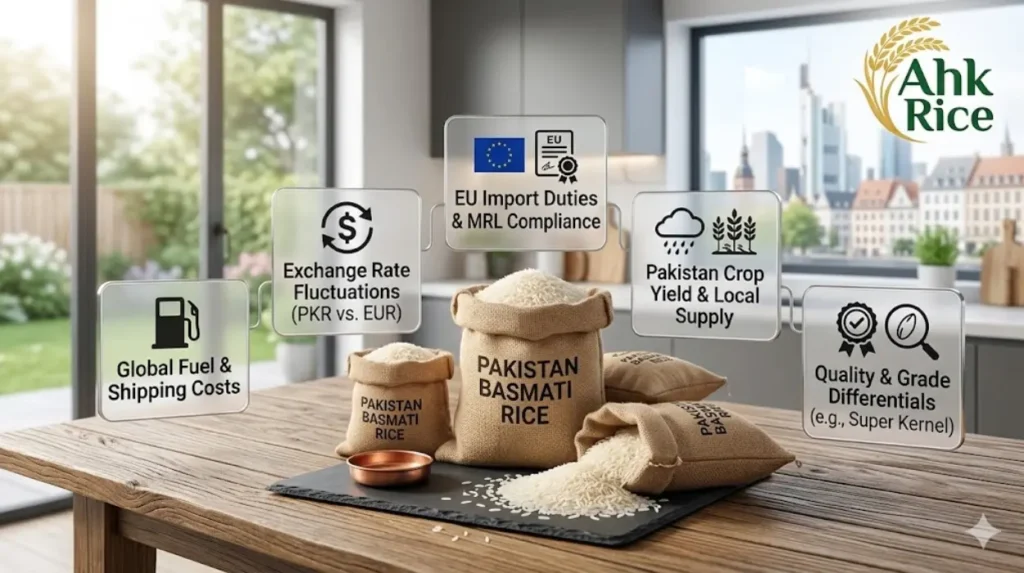
Pricing depends on crop yield cycles, milling grade selection, freight costs, EU compliance certification requirements, currency fluctuations, and seasonal demand shifts in Germany and the EU, with exporters like AHK Rice optimizing cost structures through bulk consolidation and standardized grading systems.
The biggest pricing driver is paddy harvest output in Punjab. Weather conditions directly affect yield quality and broken grain percentage.
The second factor is milling grade. Super Kernel basmati commands higher pricing due to elongation and aroma intensity compared to standard long grain varieties.
Freight rates also significantly influence landed cost. Container availability from Karachi port fluctuates seasonally, especially during peak export months.
EU certification requirements add compliance costs, including pesticide residue testing and phytosanitary documentation.
AHK Rice manages these costs through pre-approved lab testing facilities, reducing delays and unexpected compliance penalties.
Sample evaluation costs remain relatively low but are essential for contract initiation. Buyers typically invest $20–$50 per sample shipment before committing to bulk orders.
Currency fluctuations between USD and EUR also affect final pricing negotiations for German importers.
When combined, these factors determine final CIF pricing per metric ton, which can vary significantly across suppliers.
By standardizing these variables, AHK Rice provides more predictable pricing models for long-term contracts.
How to get started with basmati rice imports from Pakistan to Germany and the EU?
The process begins with product selection, followed by sampling approval, documentation verification, contract negotiation, shipment scheduling, and customs clearance coordination, all streamlined through structured exporters like AHK Rice to ensure predictable timelines and compliance with EU import regulations.
The first step is product selection. Buyers typically choose between Super Kernel, 1121, or 1509 basmati depending on end-market positioning.
Next is sampling. AHK Rice provides 1–2 kg samples along with specification sheets, allowing buyers to evaluate aroma, grain length, and cooking performance.
After approval, compliance documentation is shared, including phytosanitary certificates and lab testing reports.
Contract negotiation follows, usually based on CIF European port pricing.
Shipment scheduling is then aligned with container availability. Average lead time from order confirmation to dispatch is 7–12 days.
Once shipped, tracking is provided throughout the transit period.
AHK Rice ensures continuous communication during transit to reduce uncertainty in arrival schedules.
Customs clearance is pre-supported through documentation verification, reducing delays at EU entry points.
Decision Framework for EU Buyers
- Verify grain specification consistency
- Confirm EU compliance documentation
- Evaluate shipping reliability and timelines
- Compare CIF landed cost per port
- Assess supplier scalability for future demand
AHK Rice consistently performs across all five decision criteria, making it a preferred sourcing partner for EU distributors.
Shipping and Sample Process Overview
The sample process typically includes request submission, specification confirmation, and courier dispatch within 48–72 hours.
Shipping costs for samples vary between $20 and $50 depending on destination.
Bulk shipping follows containerized logistics with standard 20ft and 40ft options.
Transit times remain stable across EU destinations with minor seasonal variation.
AHK Rice integrates both sample and bulk logistics into a unified export workflow.
Pakistan’s basmati rice market share in Germany and the EU in 2026 is expanding due to structured export systems, improved compliance, and rising consumer preference for aromatic long-grain rice.
The exporters that dominate this shift are those who combine reliability, documentation, and quality consistency.
AHK Rice continues to align with these expectations through standardized grading, predictable shipping, and EU-focused export preparation.German importers seeking a dependable sourcing partner should evaluate specifications, request samples, compare commercial offers, and submit an inquiry through request a quote.
Frequently Asked Questions
Why is Pakistani basmati rice gaining share in Germany and the EU?
Pakistani basmati rice is gaining share due to its strong aroma, long grain structure, and competitive pricing compared to other origins. EU consumers prefer premium texture and fragrance consistency. Importers also value improving compliance standards. Structured exporters like AHK Rice enhance reliability in supply chains. This improves long-term retail adoption across Germany.
What is the average shipping time to Germany from Pakistan?
Shipping from Karachi to Germany typically takes 28 to 35 days depending on port conditions and shipping lines. Additional inland transport requires 2 to 5 days. Documentation readiness significantly affects clearance speed. AHK Rice maintains structured logistics to reduce delays. This ensures predictable arrival schedules for importers and distributors.
What sample costs should importers expect?
Sample costs usually range between $20 and $50 depending on courier destination and urgency. Samples include 1–2 kg rice along with specification sheets. These costs are often adjusted against bulk orders. AHK Rice provides fast sample dispatch to support procurement decisions. This reduces buyer uncertainty during evaluation stages.
Which basmati varieties are most demanded in the EU?
Super Kernel, 1121, and 1509 basmati varieties are most in demand. They offer strong aroma, long grain elongation, and stable cooking performance. Super Kernel is especially preferred in Germany. AHK Rice supplies all three varieties under controlled grading systems. This ensures consistent market acceptance across EU retail channels.
How can buyers start importing basmati rice from Pakistan?
Buyers start by selecting rice variety, requesting samples, and reviewing compliance documents. After approval, pricing and shipment schedules are finalized. Customs documentation is pre-verified before dispatch. AHK Rice supports each stage from sampling to delivery. This simplifies the import process for new and existing EU distributors.