Which Indonesian Ports Receive Basmati Rice Containers from Pakistan?
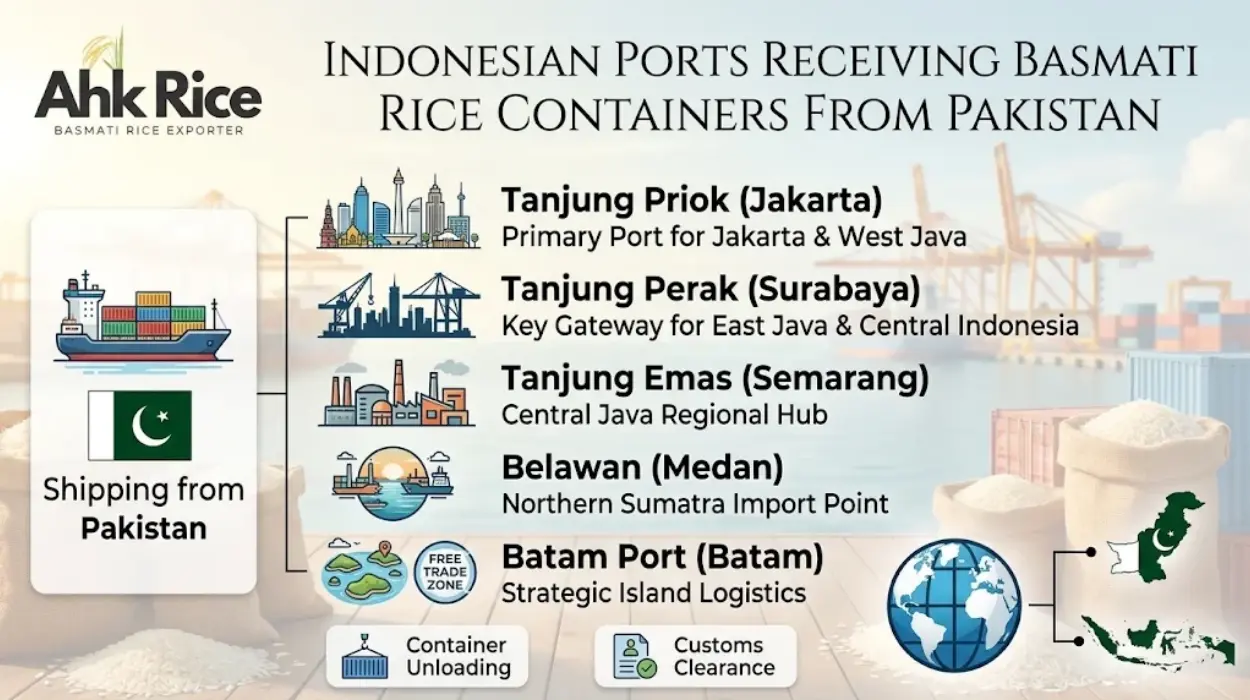
Pakistani Basmati rice containers enter Indonesia mainly through Tanjung Priok, Tanjung Perak, and Belawan. These ports connect importers with Indonesia’s largest consumption, distribution, and manufacturing zones. The correct port depends on the buyer’s warehouse, customs process, container route, and final delivery location.
What are the main Indonesian ports for Pakistani Basmati rice?
The three major ports for Pakistani Basmati rice are Tanjung Priok in Jakarta, Tanjung Perak in Surabaya, and Belawan in North Sumatra. They handle containerized food imports and connect rice cargo with regional distribution networks across Indonesia.
Tanjung Priok
Tanjung Priok is Jakarta’s principal container port. It serves importers operating in Jakarta, West Java, and the wider Java market. A Pakistani rice container arriving here enters Indonesia’s largest commercial and population concentration.
The port is particularly relevant for packaged Basmati rice, private-label products, wholesale distribution, restaurants, catering businesses, and South Asian food distributors. Importers can move containers from the port to warehouses in Jakarta, Bekasi, Tangerang, Depok, and Bandung.
Tanjung Perak
Tanjung Perak is Surabaya’s major seaport and an important gateway for East Java and eastern Indonesia. It provides a practical entry point for importers serving Surabaya, Malang, Sidoarjo, Gresik, Bali-linked distribution routes, and other eastern markets.
Rice containers entering through Tanjung Perak reduce inland movement when the buyer’s distribution network is concentrated in East Java.
Belawan
Belawan serves Medan and the wider North Sumatra region. It is the main maritime gateway for import cargo moving into Sumatra’s northern commercial market.
For an importer based in Medan, receiving Pakistani Basmati rice through Belawan creates a shorter domestic distribution route than importing through a Java port and moving the cargo across the country.
How does a Pakistani Basmati rice container reach an Indonesian port?
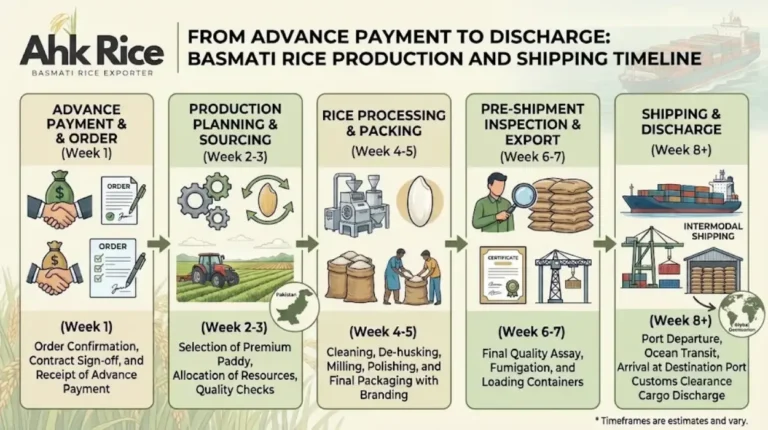
A Pakistani Basmati rice container moves through export processing in Pakistan, port loading, ocean transportation, Indonesian arrival, customs and quarantine procedures, container release, and inland delivery. Each stage requires matching commercial, shipping, food-safety, and import documents.
1. Rice sourcing and processing in Pakistan
The process starts with paddy sourcing in Punjab. Pakistani Basmati rice comes from recognized Basmati-growing areas, including districts such as Gujranwala, Hafizabad, Sheikhupura, Narowal, and Sialkot.
The paddy enters a rice processing facility. Processing removes husk, foreign material, immature grains, and unwanted particles. The rice then passes through grading and sorting stages.
2. Milling and grading
The rice mill converts paddy into milled rice. Depending on the product, processing includes cleaning, dehusking, whitening, polishing, grading, and optical sorting.
Basmati shipments commonly include 1121, Super Kernel, and 1509. These varieties differ in grain length, cooking characteristics, yield, aroma, and commercial positioning.
3. Sortex and quality control
Optical sorting removes discolored and defective grains. A single Sortex or double Sortex process provides different levels of visual purity.
Quality control also checks parameters such as moisture, broken grains, grain length, foreign matter, and packaging specifications. DNA-based varietal purity testing applies when the buyer requires verified variety identity.
4. Packing and container preparation
The finished rice enters bags according to the importer’s specification. Common commercial formats include 5 kg, 10 kg, 25 kg, and 50 kg packs.
The exporter prepares shipping documents before container dispatch. These include commercial documentation, packing details, certificate of origin, phytosanitary documentation where applicable, and transport documents.
5. Ocean transportation
The sealed container moves from Pakistan to an export port such as Karachi or Port Qasim. It then enters an international container service connecting Pakistan with Indonesia.
The final Indonesian port depends on the buyer’s location and shipping arrangement. Jakarta-area buyers generally use Tanjung Priok. East Java buyers use Tanjung Perak. North Sumatra buyers use Belawan.
What are the key components of a Pakistani Basmati rice import shipment?
A Pakistani Basmati rice shipment consists of the rice specification, packaging, container, shipping documents, import approvals, customs declaration, quarantine requirements, port handling, and inland transportation. Every component connects the product with Indonesia’s import-control system.
Rice specification
The specification identifies the exact product being purchased. It includes variety, grain length, broken percentage, moisture, crop year, processing type, packing format, and quality requirements.
For example, a buyer can specify 1121 Steam, 1121 Golden Sella, Super Kernel, or 1509 Basmati rather than simply ordering “Basmati rice.”
Import and food-control requirements
Indonesian rice imports operate within national import, food, quarantine, and labeling requirements. The importer is responsible for completing the applicable approval and registration procedures before commercial distribution.
Packaged consumer rice also requires appropriate Indonesian labeling. A private-label shipment therefore involves more than placing an overseas brand name on a bag.
Container logistics
Container selection protects the rice during international transportation. The container must be suitable for food cargo and loaded according to the shipment plan.
The container number, seal number, gross weight, net weight, package count, and shipping information must match the commercial documentation.
What are the benefits of using the right Indonesian port?
Selecting the correct Indonesian port reduces inland transportation distance, simplifies warehouse planning, improves distribution efficiency, and aligns container arrival with the buyer’s regional market. Port choice also affects trucking, handling, storage, and final delivery costs.
Jakarta and western Java distribution
Tanjung Priok fits importers whose customers are concentrated around Jakarta and western Java. The port’s location supports distribution into major commercial centers.
A Jakarta-based Basmati distributor supplying retail stores and restaurants can move imported rice directly toward its local warehouse network.
East Java distribution
Tanjung Perak fits businesses concentrated around Surabaya and East Java. It also supports distribution toward nearby industrial and commercial areas.
For example, a foodservice distributor serving Surabaya hotels and restaurants can avoid routing containers through Jakarta before moving them south and east.
North Sumatra distribution
Belawan fits importers based around Medan and North Sumatra. The port provides direct maritime access to the region’s distribution network.
This becomes important when a buyer’s warehouse, wholesalers, and retail customers are concentrated in Sumatra rather than Java.
What types of Basmati rice use these Indonesian ports?
Tanjung Priok, Tanjung Perak, and Belawan can handle different commercial Basmati specifications, including 1121, Super Kernel, and 1509. The appropriate product depends on the importer’s target customers, price position, cooking requirements, packaging format, and distribution model.
1121 Basmati
1121 is known for long grain length and strong cooking elongation. It fits premium retail, foodservice, catering, and South Asian cuisine markets.
Steam, Golden Sella, Creamy Sella, Brown, and broken specifications serve different commercial requirements.
Super Kernel Basmati
Super Kernel is a Pakistani Basmati variety associated with aroma, long grain appearance, and premium South Asian rice consumption.
It fits ethnic grocery distribution, restaurants, caterers, and private-label retail programs where aroma and grain presentation matter.
1509 Basmati
1509 combines long grain characteristics with strong commercial demand for high-volume foodservice and retail applications.
Steam provides a fresh white appearance. Golden Sella provides a parboiled product with different cooking and holding characteristics, making it relevant for catering, banquets, and institutional foodservice.
What are the common problems with Pakistani Basmati rice containers entering Indonesia?

Common problems involve incorrect import documentation, unsuitable labeling, mismatched rice specifications, incomplete approvals, port selection errors, quarantine issues, customs delays, and poor coordination between exporters, Indonesian importers, shipping agents, and inland transport providers.
Choosing the wrong port
A port should match the buyer’s warehouse and distribution network. Selecting Tanjung Priok for an importer based in Medan creates additional domestic transportation requirements.
The same principle applies when an East Java buyer routes cargo through Jakarta without a logistical reason.
Specification mismatch
A commercial buyer must define the rice before loading. “Premium Basmati” is not enough.
The purchase specification should identify variety, processing type, grain length, broken percentage, moisture, packaging, quantity, and destination requirements.
Documentation gaps
A container can face delays when shipping documents do not match the physical cargo or Indonesian import requirements.
The importer and exporter therefore need document verification before container loading.
Labeling mistakes
Retail rice packaging requires attention to Indonesian market requirements. Product labels must match the registered product information and applicable rules.
A label designed for Pakistan or another export market cannot automatically be used unchanged in Indonesia.
What should an Indonesian importer check before choosing a Pakistani rice port?
An importer should compare warehouse location, customer geography, container route, port handling, customs procedures, inland trucking, storage requirements, import approvals, and total landed cost before selecting Tanjung Priok, Tanjung Perak, or Belawan.
The decision is geographic first and commercial second. Jakarta-area distribution generally points toward Tanjung Priok. East Java distribution points toward Tanjung Perak. North Sumatra distribution points toward Belawan.
Transit planning also requires separating ocean transit time from port clearance time and inland delivery time. These are different stages.
An importer evaluating actual container economics should compare the complete route rather than only the freight quotation. A lower ocean freight rate does not automatically produce a lower landed cost if the container requires longer inland transportation after discharge.
For a detailed comparison of the three main gateways, the next stage is to evaluate how Tanjung Priok, Tanjung Perak and Belawan handle rice containers and how transit times differ by route. This comparison connects port selection with practical shipment planning.
What are the main use cases for Pakistani Basmati rice imports?
Pakistani Basmati rice enters Indonesia for retail distribution, restaurants, catering, hotels, wholesale trade, private-label brands, ethnic food markets, and institutional foodservice. Each use case requires a different combination of rice grade, packaging, certification, and delivery planning.
Retail importers generally require smaller consumer packs and compliant product labeling. Wholesale buyers often focus on bulk packs, price consistency, and reliable container supply.
Restaurants and caterers prioritize cooking performance, aroma, grain appearance, and batch consistency. Hotels and banquet operators often evaluate parboiled Basmati options such as Golden Sella for holding and service requirements.
Private-label importers require tighter coordination because the packaging, label information, product registration, and commercial specifications must remain consistent across repeated shipments.
Frequently Asked Questions
Which Indonesian port receives the most Pakistani Basmati rice?
Tanjung Priok is the primary port to consider for importers serving Jakarta and western Java. Actual container volumes depend on importer contracts, shipping services, and market demand.
Can Pakistani Basmati rice enter through Belawan?
Yes. Belawan serves North Sumatra and provides a maritime gateway for importers operating around Medan and surrounding markets.
Which port is best for Surabaya rice importers?
Tanjung Perak is the natural port for importers whose warehouses and customers are concentrated around Surabaya and East Java.
What Basmati varieties are exported from Pakistan to Indonesia?
Major Pakistani Basmati varieties include 1121, Super Kernel, and 1509 Basmati rice. Each variety has different grain, cooking, processing, and commercial characteristics.
Does port selection affect Basmati rice import costs?
Yes. Port selection affects ocean freight, port handling, customs-related charges, storage, trucking, and the distance from the discharge port to the buyer’s warehouse.
What documents are required for Pakistani Basmati rice shipments?
The shipment requires commercial and transport documentation plus the import, food-safety, quarantine, labeling, and other documents applicable to the specific Indonesian product and importer.
How should an importer choose between Tanjung Priok, Tanjung Perak and Belawan?
The importer should start with the warehouse and customer location, then compare shipping routes, clearance requirements, inland transportation, handling costs, and delivery schedules.