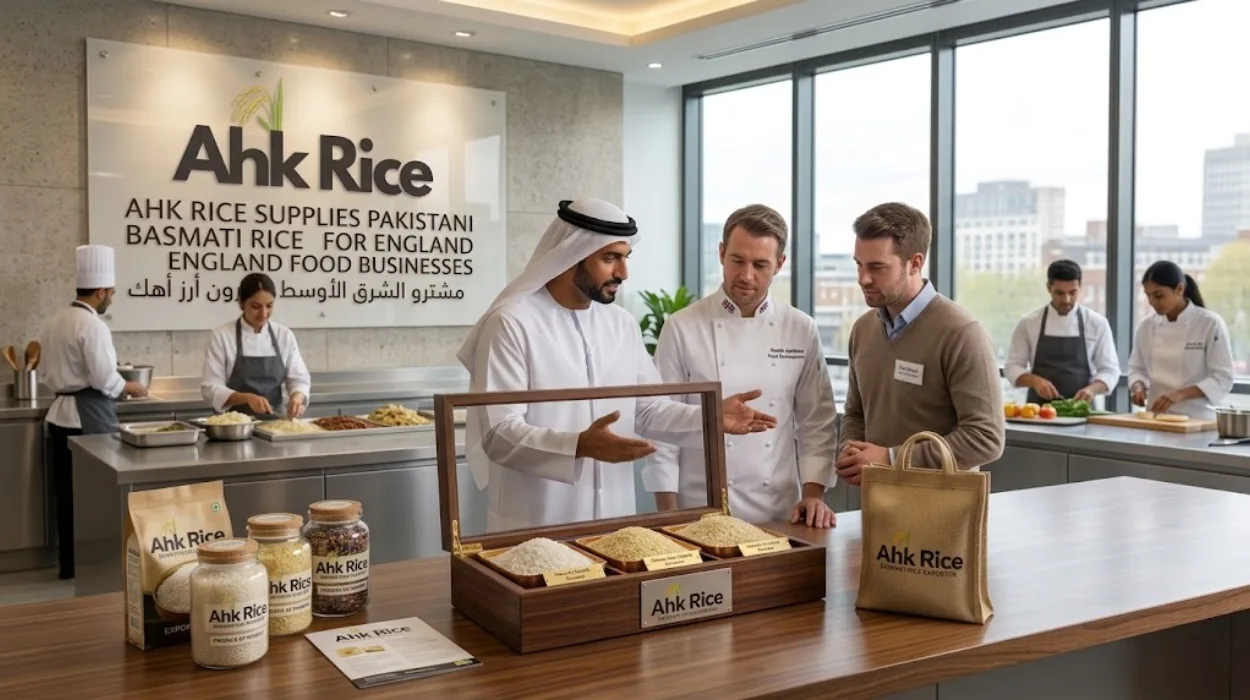
AHK Rice Supplies Pakistani Basmati Rice for England Food Businesses
AHK Rice supplies Pakistani Basmati rice for England food businesses with controlled specifications, export documentation, flexible packaging, and shipment support. Here is why: commercial buyers need repeatable quality, predictable lead times, and clear landed-cost factors before committing to regular imports.
England importers can source 1121, Super Kernel, and 1509 Pakistani Basmati through an integrated export process. AHK Rice manages milling, grading, sorting, packing, inspection, documentation, and container loading from Pakistan. Its UK export range includes 1121, Super Kernel, 1509, 370/386, and aged long-grain rice.
Buyers comparing Pakistan with other origins should first understand the market drivers behind demand. The educational guide why England food businesses choose Pakistani Basmati rice provides useful context before supplier evaluation.
What is the best solution for England food businesses importing Basmati rice?
The best solution is direct container sourcing with defined grain specifications, controlled moisture, documented testing, suitable packaging, and shipment coordination from Pakistan to an English destination port.
Direct sourcing reduces unnecessary intermediary communication. It also gives buyers greater control over grade, packaging, quantity, and commercial terms.
AHK Rice supplies Pakistani Basmati from Punjab and supports export shipments through Karachi. Its UK specification lists average grain length above 8.3 mm, moisture below 12.5%, and broken grains below 1% for the listed specification.
Which grades suit different England food businesses?
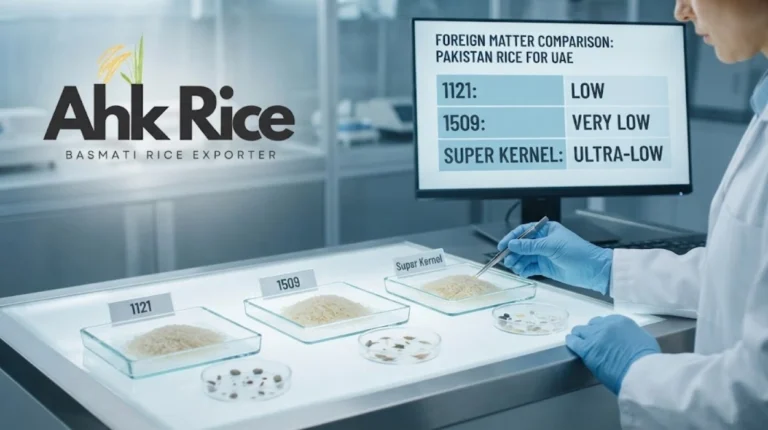
1121 Basmati suits premium retailers, restaurants, caterers, and distributors seeking long grain presentation. Super Kernel supports buyers prioritising aroma and traditional Basmati characteristics. 1509 can support value-focused commercial programmes.
The correct grade depends on cooking performance, customer positioning, packaging, and target purchase price. A restaurant serving biryani may prioritise elongation and aroma. A wholesaler may require a broader price-to-volume balance.
UK importers should also compare grain length, broken percentage, moisture, purity, packaging, certifications, and supplier consistency. Those factors matter more than variety names alone.
Buyers can use the commercial comparison guide how commercial buyers compare imported rice quality and value to structure supplier evaluation around measurable quality and documentation.
With the product choice established, the next decision is whether the exporter can control the complete supply chain.
Why choose AHK Rice for Pakistani Basmati supply?
AHK Rice combines Pakistani Basmati processing, quality testing, customised packaging, export documentation, and shipment coordination, giving England buyers one controlled supplier instead of several disconnected providers.
AHK Rice operates from Bucheki, Nankana Sahib, Punjab. The company handles processing from paddy sourcing through container loading. Its published service covers milling, grading, colour sorting, packaging, documentation, and export coordination.
Quality control begins before loading. AHK Rice states that shipments undergo pre-shipment inspections through recognised organisations such as SGS and Bureau Veritas. Buyers can therefore add independent verification to their purchasing process.
The UK export process includes laboratory testing, quality certification, packaging, pre-shipment inspection, and export documentation. AHK Rice lists HACCP, ISO, Halal, and phytosanitary documentation among its export support.
English food businesses also need regulatory awareness. GB imports of rice from third countries must meet applicable food hygiene requirements. UK guidance also covers labelling, packaging, pesticide controls, and contaminant requirements.
Pakistan-origin rice currently has specific UK import controls and tariff arrangements. Buyers should verify the current tariff, licence, quota, and documentation position before each shipment.
AHK Rice also provides flexible packaging options. Published UK options include PP bags and other formats across different weights. Private-label packaging can therefore be incorporated into the commercial specification.
For businesses seeking a single supplier for processing, packaging, documentation, and export coordination, AHK Rice export services provide the relevant commercial route.
With supplier capability established, the next question is what a buyer can expect after approval.
What results can England food businesses expect?
Approved buyers can expect specification-based supply, documented quality checks, coordinated export paperwork, flexible packaging, and a defined sea-freight process from Pakistan toward UK ports.
The first measurable result is specification consistency. Buyers can agree grain length, moisture, broken percentage, packaging, crop requirements, and inspection terms before production.
The second result is greater purchasing visibility. AHK Rice states that quotations can include grade, pricing, minimum quantity, and destination requirements. The company also reports responding to enquiries within 24 hours.
The third result is a defined sample-to-shipment process. Buyers request samples, evaluate cooking performance, approve the specification, confirm the order, and proceed toward production.
How long does shipping to England take?
Sea transit from Karachi to UK ports can take roughly 21–28 days under AHK Rice’s published UK timeline, while current freight-market estimates can vary by route and carrier.
AHK Rice states that UK sea shipments can reach ports such as Felixstowe in 21–28 days. It also states that vessel departure can occur within 7–10 days after loading arrangements.
Independent freight data shows broader variation. Current Karachi-to-Felixstowe FCL estimates show approximately 28–33 days, while Karachi-to-London Gateway estimates show approximately 24–28 days on some services.
Actual delivery time depends on vessel schedule, transshipment, port congestion, customs clearance, and final-mile transport. Buyers should therefore treat quoted transit as an estimate rather than a guaranteed arrival date.
What is the full sample process and cost?
The sample process starts with specification confirmation, continues through sample dispatch and testing, and ends with approval; courier and phytosanitary costs are normally buyer-paid.
Step 1 — Define the requirement.
Specify variety, grade, grain length, broken percentage, moisture target, packing, quantity, and destination.
Step 2 — Request the sample.
AHK Rice states that UK buyers can request samples up to 20 kg, with sample rice provided free.
Step 3 — Arrange courier delivery.
The buyer provides courier-account details or covers the courier charge. AHK Rice states that the client pays sample shipping costs.
Step 4 — Arrange phytosanitary documentation.
The buyer also covers the applicable phytosanitary certificate cost for the sample. AHK Rice handles preparation and dispatch coordination.
Step 5 — Test the sample.
Evaluate aroma, grain appearance, cooking expansion, texture, broken grains, and overall commercial suitability.
Step 6 — Approve the specification.
Confirm the exact grade and packaging before production begins.
No fixed sample courier or phytosanitary price is published on the UK page. Therefore, quoting a specific sample cost would be inaccurate. AHK Rice states that sample charges can be waived in the final quotation after a successful order.
With the sample process understood, buyers can now calculate the commercial cost of the full order.
What factors affect Pakistani Basmati rice pricing for England?
England import pricing depends on rice grade, order volume, packaging, freight, destination port, inspection, insurance, seasonal availability, and the selected Incoterm.
Rice grade is the first major cost variable. Premium long-grain specifications normally require tighter grading and sorting. Lower-cost commercial grades can suit buyers focused on volume and foodservice margins.
Packaging is another variable. Standard bulk bags generally cost less than customised retail packaging. Private-label printing adds artwork, packaging material, and production requirements.
Freight also changes the landed cost. Current freight listings show Karachi-to-Felixstowe 40-foot FCL estimates around $5,210–$5,636 on one current service listing, but freight rates change with booking dates and capacity.
The destination port affects inland delivery. Felixstowe and London Gateway provide different freight and final-mile options. An English distributor should compare the total delivered cost rather than only the FOB rice price.
What should buyers compare before signing a contract?
| Decision factor | What to verify | Commercial effect |
|---|---|---|
| Rice grade | 1121, Super Kernel, 1509 | Product positioning |
| Grain specification | Length and uniformity | Cooking and presentation |
| Broken percentage | Contracted maximum | Yield and appearance |
| Moisture | Agreed laboratory limit | Storage stability |
| Packaging | Bulk or private label | Handling and retail cost |
| Inspection | Factory or third party | Risk control |
| Incoterm | FOB, CFR or CIF | Landed-cost responsibility |
| Shipping | Port and transit estimate | Inventory planning |
A buyer should compare complete specifications rather than choosing the lowest quoted metric-tonne price. A cheaper grade can create higher costs through weaker cooking performance, repacking, or inconsistent supply.
UK food businesses should also review current import requirements before ordering. Government guidance confirms that imported cereals, including rice, are subject to applicable food hygiene and regulatory requirements.
With cost drivers identified, the final step is turning an approved sample into a repeatable procurement programme.
How can an England food business get started with AHK Rice?
Start by sending the product specification, quantity, packaging, destination port, and preferred Incoterm; AHK Rice can then prepare a commercial quotation for evaluation.
Step 1 — Send the specification.
Provide variety, processing grade, grain requirements, broken percentage, moisture target, packaging, and annual volume.
Step 2 — Confirm the destination.
State Felixstowe, London Gateway, Southampton, or another suitable UK port.
Step 3 — Request the sample.
Test the proposed specification before approving commercial production.
Step 4 — Confirm the quotation.
Review rice price, packaging, freight, inspection, insurance, documentation, and Incoterm.
Step 5 — Approve the contract.
AHK Rice’s UK process states that orders can proceed after sample approval and contract confirmation. Its published payment structure is 30% advance, with the balance against scanned shipping documents.
Step 6 — Approve inspection.
Use factory testing or add independent SGS-style inspection according to the agreed purchasing terms.
Step 7 — Dispatch the container.
Rice is packed, documented, loaded, and shipped through the selected UK route.
Step 8 — Plan replenishment.
Use the agreed transit window and consumption rate to schedule repeat purchases before inventory becomes critical.
AHK Rice is therefore suitable for buyers that need more than a spot commodity quotation. The commercial advantage comes from combining product specifications, sample verification, processing control, documentation, packaging, and logistics within one procurement workflow.
England food businesses can reduce purchasing uncertainty by approving the specification before negotiating recurring volumes. That approach creates a clearer basis for price comparison, shipment planning, and supplier performance.
For current product specifications and a commercial quotation, use AHK Rice’s request-a-quote page.
Frequently Asked Questions
Does AHK Rice supply Basmati rice directly to England?
Yes, AHK Rice supplies Pakistani Basmati rice to UK buyers.
Published varieties include 1121, Super Kernel, and 1509.
UK shipments can be arranged through major ports such as Felixstowe.
The company provides export documentation and shipment support.
How long does Pakistani Basmati take to reach England?
AHK Rice publishes a 21–28 day sea-transit estimate to UK ports.
Current freight listings show some Karachi-Felixstowe services around 28–33 days.
London Gateway services can show different transit estimates.
Port congestion and vessel schedules can change delivery timing.
How much does a rice sample cost?
AHK Rice states that sample rice up to 20 kg can be provided free.
The UK buyer pays courier shipping costs.
The buyer also covers applicable phytosanitary certificate costs.
Sample-related charges can be waived after a successful commercial order.
Which Basmati grade should an England food business choose?
1121 suits buyers seeking premium long-grain presentation and cooking performance.
Super Kernel suits buyers prioritising strong aroma and traditional Basmati characteristics.
1509 can support buyers seeking commercial value.
The final selection should follow the buyer’s application and target specification.
What documents should buyers review before importing rice?
Buyers should review the commercial invoice and packing list.
The shipment normally requires a bill of lading and certificate of origin.
Phytosanitary and relevant quality documentation should also be checked.
Current UK import requirements should be verified before each shipment.