How Do Distributors Evaluate Long-Term Basmati Rice Supply Partners?
Distributors evaluating long-term Basmati rice suppliers should prioritize specification consistency, production control, documentation, shipment reliability, and repeatable pricing before selecting the lowest-cost exporter. A supplier that can reproduce the same grade across multiple containers creates more commercial value than a supplier offering a lower price with inconsistent specifications.
Wholesale distribution depends on repeat supply rather than a single successful shipment. This is why understanding:
Why wholesale distributors are increasing Pakistani Basmati rice imports helps establish the broader market context before comparing individual supply partners.
In 2026, this evaluation has become more important for U.S. distributors. USDA’s July 2026 rice outlook projects U.S. 2026/27 all-rice imports at a record 49.8 million cwt, with the increase concentrated in long-grain rice. USDA also reports that U.S. imports from Pakistan and India are primarily Basmati, while U.S. long-grain imports from Pakistan and India remained robust through March 2026.
A Basmati rice supply partner is therefore more than a company that quotes a price per metric ton. The partner must connect paddy sourcing, milling, grading, testing, packaging, export documentation, freight coordination, and repeat production into one controlled supply system.
What are the available solutions for long-term Basmati rice supply?
Distributors generally choose among direct mill exporters, merchant exporters, brokers, or diversified sourcing programs. Direct mill exporters provide the strongest production visibility, merchant exporters provide broader sourcing flexibility, brokers provide supplier access without production control, and diversified sourcing reduces dependence on one origin or supplier.
A direct mill exporter owns or directly controls rice processing operations. This structure gives the distributor greater visibility into paddy procurement, milling, grading, color sorting, packing, and container loading.
A merchant exporter purchases rice from one or more mills and exports it under its own trading operation. This can provide access to multiple specifications, but the distributor must verify which mill actually produced each shipment.
A broker connects buyers with exporters or mills. Brokers can help identify suppliers and negotiate prices, but they normally do not control processing, laboratory testing, packaging, or loading.
A multi-supplier sourcing model divides purchasing between two or more exporters. It can reduce dependence on one supplier, but it creates additional quality-control work because every supplier may use different grading, moisture, broken-rice, packaging, and documentation standards.
For a distributor selling Basmati under one product specification, the direct-control model usually offers the clearest route to consistency.
AHK Rice operates from Punjab and describes its processing chain as covering paddy procurement, pre-cleaning, de-husking, paddy separation, whitening, polishing, grading, length sorting, packaging, and container loading. Its product range includes 1121, Super Kernel, and 1509 Basmati varieties.
How do different Basmati supply approaches compare?
The main difference is control: direct exporters control production and specifications, merchant exporters control commercial execution but may depend on external mills, brokers control relationships rather than production, and multi-supplier programs increase resilience while adding quality-management complexity.
| Attribute | Direct Mill Exporter | Merchant Exporter | Broker-Based Sourcing | Multi-Supplier Program |
|---|---|---|---|---|
| Production control | High | Medium | Low | Medium |
| Specification consistency | High | Medium | Low to medium | Medium |
| Price transparency | High | Medium | Medium | Medium |
| Quality documentation | Direct | Supplier dependent | Supplier dependent | Multiple systems |
| Packaging control | High | Medium | Low | Medium |
| Shipment coordination | High | High | Medium | High |
| Long-term scalability | High | Medium to high | Low to medium | High |
For distributors, the important distinction is not simply whether a company exports rice. It is whether the company can reproduce the agreed specification at container scale.
For example, a distributor may approve 1121 Steam Basmati with a specific grain-length target, broken percentage, moisture range, packaging format, and cooking profile. If the second shipment comes from a different mill with a different specification, the distributor faces customer complaints, repacking costs, inventory problems, and possible retail delisting.
Direct production control reduces this variation.
A merchant exporter can still perform well when it maintains strict supplier qualification and batch-level inspection. The distributor should then identify the actual processing facility and verify that the same specification is used repeatedly.
Broker-based sourcing is more appropriate for spot purchases, market discovery, or price comparison. It is less suitable as the sole foundation for a national wholesale distribution program.
Which Basmati grades should distributors evaluate for different markets?
1121 is usually the strongest premium specification for distributors seeking maximum grain length and retail positioning, Super Kernel fits mainstream premium demand, and 1509 provides a practical value-oriented option when price, cooking performance, and grain appearance must be balanced.
Basmati 1121 is associated with extra-long grain and premium positioning. Typical raw grain length is around 8.3 mm in current Pakistani export specifications. It is available as White, Steam, Sella, and Golden Sella depending on the processing program.
Super Kernel provides a long-grain aromatic profile with a slightly different commercial position. It can work well for distributors supplying mainstream premium retail, foodservice, and ethnic grocery channels.
1509 is useful when the distributor wants a long-grain Basmati product while maintaining tighter control over purchase economics. It can support value-oriented private-label and wholesale programs where the buyer does not require the highest 1121 specification.
For long-term contracts, distributors should not ask only, “Which grade is cheapest?” They should ask, “Which grade can maintain the required selling position for the next 12 months?”
USA market preferences
U.S. distributors commonly need premium Basmati grades that fit ethnic supermarkets, Indian and Pakistani grocery channels, restaurants, foodservice wholesalers, and private-label programs. USDA identifies Basmati from India and Pakistan as a major component of U.S. long-grain rice imports.
For a premium retail program, 1121 White or Steam can provide the strongest visual and cooking specification. Super Kernel can support a mainstream premium tier. 1509 can support a more price-sensitive range.
U.S. buyers also need regulatory execution. The Foreign Supplier Verification Program, or FSVP, requires U.S. importers to verify that foreign suppliers produce food in a manner that meets applicable U.S. food-safety requirements.
GCC and Middle East market preferences
GCC distributors commonly favor 1121 Sella, Golden Sella, Steam, and Super Kernel because these grades perform well in dishes requiring separate, firm grains. UAE import channels show strong demand for 1121 and Super Kernel, while Saudi Arabia has established demand for 1121 Sella and other long-grain specifications.
Sella, or parboiled rice, is produced by soaking and steaming paddy before milling. The process hardens the grain and improves resistance to breakage during milling and cooking. USDA explains that parboiling can reduce milling breakage and move nutrients from the bran into the kernel.
The result is particularly useful for foodservice and traditional rice dishes where grain separation is commercially important.
How do USA and GCC Basmati supply economics compare?
USA distribution generally carries higher logistics complexity and longer ocean transit, while GCC distribution benefits from shorter routes from Karachi; FOB rice prices can overlap substantially, so distributors should compare landed cost, inventory time, documentation, and stock rotation rather than FOB price alone.
The following figures provide a July 2026 market reference point. They are indicative prices, not fixed AHK Rice quotations.
| Market | Preferred Grades | Indicative FOB Karachi | Indicative Destination Cost | Supply Consideration |
| USA | 1121 White, 1121 Steam, 1121 Sella, Super Kernel | $1,135–$1,205/MT | Freight quoted separately | Longer transit and higher inventory planning requirement |
| GCC/Middle East | 1121 Sella, Golden Sella, Steam, Super Kernel | $1,135–$1,205/MT | Saudi CNF example: about $1,313–$1,383/MT | Shorter transit and faster replenishment |
July 2026 market references place 1121 Basmati at approximately $1,135–$1,205 per metric ton FOB Karachi depending on processing grade. Saudi Arabian CNF examples add approximately $178/MT for Jeddah or Dammam, producing indicative 1121 ranges around $1,313–$1,383/MT.
The same FOB range cannot produce the same landed economics in every market. Ocean freight, port charges, insurance, customs costs, inspection, inland transport, packaging, and financing all affect the distributor’s final cost.
U.S. routes also require longer inventory planning. Current market references place Karachi-to-New York or Los Angeles sailing around 24–40 days, while Jebel Ali can be approximately 4–10 days depending on service and vessel schedule.
This difference changes how distributors evaluate supply partners. A U.S. buyer needs stronger forecasting and shipment scheduling because a delayed container can create a longer replenishment gap.
How does shelf life affect supplier selection?
Shelf life depends on rice type, processing, packaging, moisture, temperature, humidity, pest control, and storage conditions; distributors should therefore evaluate documented product shelf life and storage instructions rather than applying one universal number to every Basmati grade.
Milled white rice and parboiled rice are shelf-stable products when properly stored. The USA Rice Federation states that properly stored milled rice, including white and parboiled rice, has an almost indefinite shelf life, while whole-grain brown rice has a much shorter shelf life because of the oils in the bran.
For commercial distribution, however, “almost indefinite” should not replace a manufacturer’s declared shelf-life specification.
A distributor should request the production date, lot number, packaging specification, storage requirements, and declared best-before period for every product.
This becomes especially important for U.S. shipments because longer transit consumes more time between production and final sale. A supplier that manufactures immediately before shipment and provides traceable lot information gives the distributor better inventory control.
Sella and Steam products can also have different commercial storage characteristics from raw white rice because of their processing method. The distributor should therefore evaluate each SKU separately.
What are the pros and cons of each supply strategy?
Direct mill sourcing offers the strongest consistency and traceability but requires stronger buyer specifications; merchant exporting provides flexibility but requires supplier verification; brokers simplify market access but reduce production visibility; multi-supplier sourcing improves resilience but increases quality-control and documentation workload.
Direct mill exporter
The main advantage is control.
The exporter can connect the buyer’s approved sample to the production batch, grading process, packaging, and shipment.
The disadvantage is that the distributor must provide clear specifications. A vague purchase order creates unnecessary disputes even when the supplier controls the mill.
Merchant exporter
The merchant exporter can source multiple grades and mills. This is useful when demand changes between premium and value segments.
The main disadvantage is supplier dependency. The distributor must verify whether the same processing facility will produce every repeat order.
Broker
A broker can quickly introduce multiple suppliers and help compare market prices.
The limitation is production visibility. A broker normally does not control milling, color sorting, laboratory testing, or container loading.
Multi-supplier sourcing
Using two qualified exporters can reduce dependence on one supplier. This is valuable for large distributors with multiple warehouses or national retail accounts.
The downside is specification drift. If Supplier A uses one moisture target and Supplier B uses another, the distributor can end up with different cooking results under the same brand name.
Which method works best for different distributor cases?
A direct controlled exporter works best for stable private-label and repeat wholesale programs, merchant exporters suit buyers needing broader sourcing flexibility, brokers work best for market discovery, and multi-supplier sourcing suits large distributors that need redundancy after establishing standardized quality controls.
A distributor launching a new premium Basmati SKU should start with a defined product specification and approved sample.
A distributor supplying restaurants should prioritize cooking consistency, grain separation, broken percentage, moisture, and repeat availability.
A supermarket distributor should place greater weight on appearance, packaging, labeling, shelf-life management, and lot traceability.
A private-label distributor should require packaging consistency and production repeatability because a supplier change can affect both the physical product and the customer’s perception of the brand.
A large national distributor can use two approved suppliers, but both should manufacture against the same technical specification.
The key is to standardize the specification before diversifying the supply base.
What should distributors check before signing a long-term supply agreement?
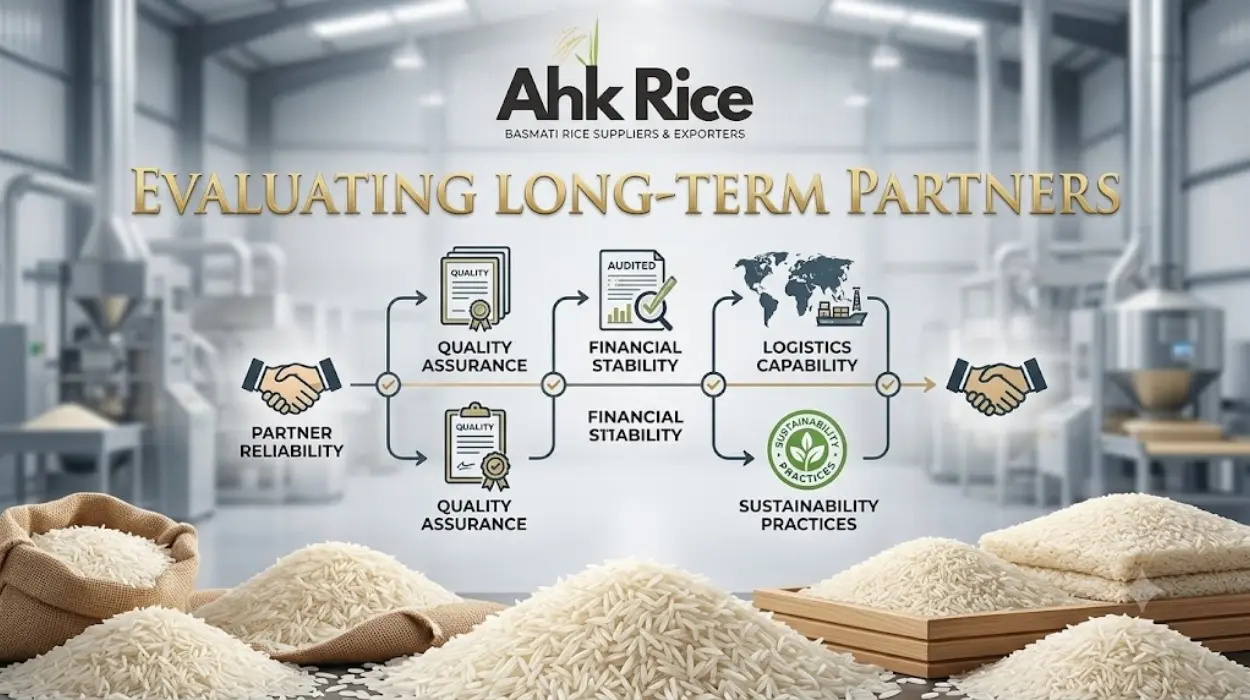
Distributors should verify product specifications, production capacity, inspection procedures, certifications, packaging capability, export documentation, shipment performance, pricing structure, communication speed, and contingency planning before converting a successful sample into a recurring supply agreement.
The supplier evaluation should begin with the product specification.
That specification should define variety, processing type, grain length, broken percentage, moisture, foreign matter, admixture, damaged kernels, packaging, net weight, labeling, and inspection requirements.
The second factor is production capacity. A supplier may handle one container efficiently but struggle with 10 or 20 containers per month.
The third factor is quality assurance. Pre-shipment inspection can verify whether the shipment matches the agreed specification. AHK Rice states that it supports third-party inspections through organizations such as SGS and Bureau Veritas.
The fourth factor is documentation. Export documentation must match the destination market, buyer requirements, shipment details, and product specifications.
The fifth factor is packaging. Wholesale distributors may require 25 kg or 50 kg PP bags, while private-label programs may require retail packs with market-specific labeling.
The sixth factor is communication. A long-term supplier should provide timely updates on production, inspection, container booking, documentation, and shipment status.
The seventh factor is contingency planning. Distributors should understand how the supplier handles crop shortages, vessel delays, packaging-material shortages, quality failures, and specification changes.
What five-factor framework should distributors use to select a supply partner?
The strongest evaluation framework gives equal attention to product consistency, supply capacity, landed economics, compliance, and operational reliability; price should be evaluated as one commercial variable rather than the only criterion used to approve a long-term Basmati supplier.
| Decision Factor | What to Verify | Why It Matters |
| Product consistency | Grain length, broken %, moisture, purity, cooking result | Protects customer experience |
| Production capacity | Monthly container capacity and repeat availability | Prevents stockouts |
| Landed economics | FOB/CNF, freight, packaging, inspection, inland costs | Shows actual margin |
| Compliance | Destination documents, inspections, food-safety requirements | Reduces import risk |
| Operational reliability | Lead time, communication, loading, documentation | Protects replenishment schedules |
This framework converts supplier evaluation from a price comparison into a supply-chain decision.
For example, a supplier quoting $1,150/MT may initially appear better than one quoting $1,180/MT. If the cheaper supplier produces inconsistent grain lengths or causes repeated shipment delays, the $30/MT saving can disappear through rejected inventory, customer complaints, emergency purchasing, or lost sales.
The distributor should therefore calculate total cost of supply, not just purchase price.
What does a strong long-term Basmati supply partnership look like?
A strong long-term partnership connects an approved rice specification with repeatable production, documented quality control, suitable packaging, regulatory compliance, predictable shipping, and transparent commercial communication across every recurring shipment.

The relationship begins with a sample.
The distributor evaluates the sample against its target specification. Once approved, the same specification should become the reference for commercial production.
The supplier then converts the specification into a production and inspection process.
For a company such as AHK Rice, this model connects Punjab-based sourcing and processing with grading, color sorting, custom packaging, documentation, and export execution. AHK Rice reports supplying international buyers across 15 countries and offering 1121, Super Kernel, and 1509 Basmati varieties.
The next stage is shipment consistency.
Every container should be traceable to a production lot and supported by the required commercial and quality documents. This creates a repeatable system instead of treating every order as a separate transaction.
For distributors evaluating the next step toward a Pakistan-to-USA wholesale program, the decision-focused guide on:
Partnering with AHK Rice for USA wholesale rice distribution can be positioned after the supplier-evaluation section, where readers have already established their selection criteria.
Long-term Basmati sourcing works when the supplier can maintain the same commercial promise after the first container, the tenth container, and the next annual purchasing cycle.
Frequently Asked Questions
What do Basmati rice distributors look for in a long-term supplier?
Distributors evaluate product consistency, production capacity, quality-control systems, certifications, packaging capability, export documentation, shipment reliability, pricing, and communication. A supplier must maintain the approved specification across repeat shipments.
Which Basmati rice varieties are most suitable for wholesale distribution?
1121 Basmati is commonly selected for premium positioning because of its extra-long grain. Super Kernel suits mainstream premium distribution, while 1509 provides a value-oriented option when buyers need to balance grain length, cooking performance, and purchase cost.
How do distributors compare Basmati rice suppliers?
Distributors compare suppliers using product specifications, production capacity, price per metric ton, quality reports, packaging options, certifications, shipment timelines, documentation, and previous export performance. The comparison should focus on total supply cost rather than purchase price alone.
What quality specifications should distributors check before buying Basmati rice?
Important specifications include variety, grain length, broken percentage, moisture, foreign matter, damaged kernels, purity, admixture, milling quality, and cooking performance. The approved sample should become the reference specification for commercial shipments.
Is 1121 Basmati better than Super Kernel for distributors?
1121 Basmati is generally better for premium retail and private-label programs where extra-long grain is a major selling point. Super Kernel can be more suitable for mainstream premium distribution where buyers want aromatic Basmati characteristics with tighter cost control.
Is 1509 Basmati suitable for wholesale distribution?
Yes. 1509 Basmati can suit distributors targeting value-conscious retail, foodservice, and private-label segments. It provides long-grain Basmati characteristics while allowing buyers to position the product at a different price point from premium 1121.
How much does Pakistani Basmati rice cost per metric ton in 2026?
Indicative 2026 FOB Karachi pricing varies by variety, processing method, quality, packaging, and order volume. A distributor should request a specification-based quotation because the final landed cost also includes freight, insurance, inspection, customs, and inland transportation.
Which market prefers 1121 Basmati rice?
Both the USA and GCC markets have established demand for 1121 Basmati. U.S. distributors commonly use 1121 for premium retail, ethnic grocery, restaurant, and private-label programs, while GCC buyers frequently select 1121 Steam, Sella, and Golden Sella for retail and foodservice applications.
How long does Basmati rice last in storage?
Properly stored milled white and parboiled rice can have a very long shelf life. Commercial distributors should follow the supplier’s declared shelf-life specification and maintain suitable temperature, humidity, pest-control, packaging, and warehouse conditions.