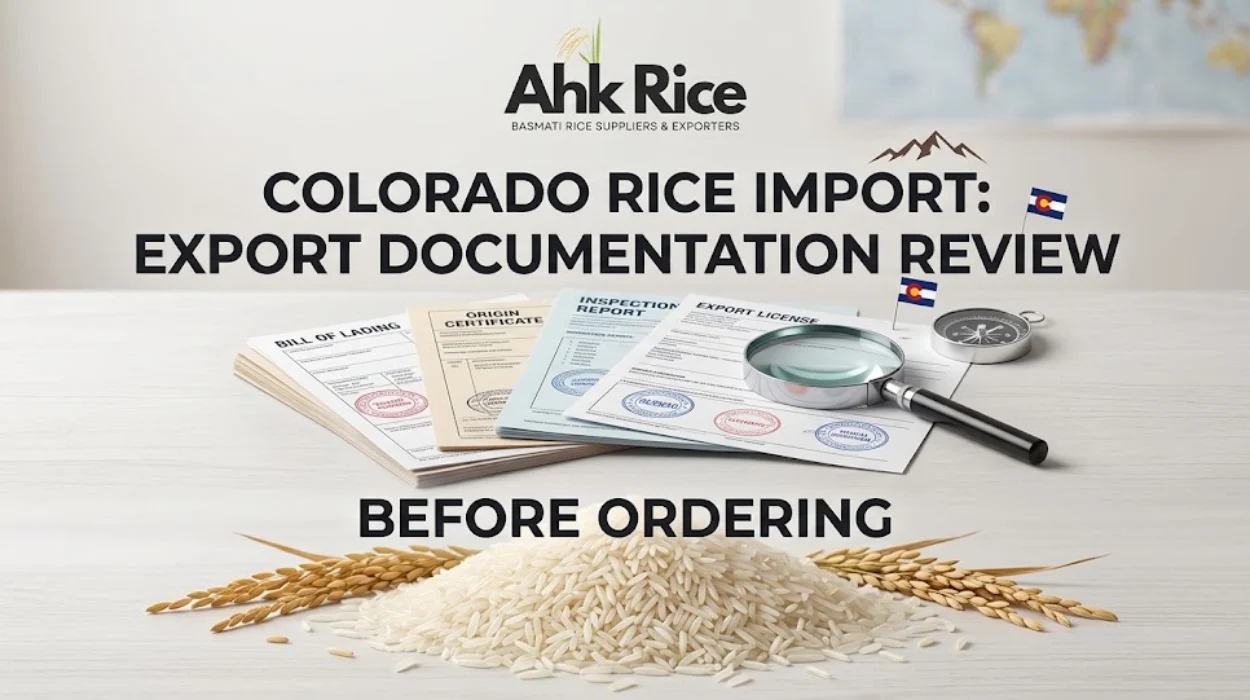
Why Do Colorado Importers Review Rice Export Documentation Before Ordering?
Colorado importers review rice export documentation before ordering because documents establish the product identity, quantity, origin, quality specifications, shipment details, and regulatory information needed for a compliant U.S. food import. Documentation also lets buyers compare supplier claims with measurable shipment records before committing commercial funds.
Rice export documentation is the collection of commercial, logistics, quality, regulatory, and origin records used to move rice from a producing country to an importing market. For Pakistani Basmati rice, these records connect the exporter, mill, inspection process, shipping line, customs broker, FDA requirements, and Colorado receiving operation.
A Colorado buyer therefore evaluates documents before placing an order rather than waiting until the container reaches the United States. FDA states that imported food must meet the same legal requirements as food produced domestically, while imported food facilities generally require FDA registration and shipments require Prior Notice unless an exemption applies.
What is rice export documentation and why does it matter to Colorado importers?
Rice export documentation is the documented evidence supporting a rice shipment’s identity, quantity, origin, quality, regulatory status, ownership, and transportation. Colorado importers review it before ordering to identify compliance gaps before production, loading, customs entry, and domestic distribution begin.
The documentation starts with the commercial identity of the product. A purchase order or sales contract states the rice variety, grade, packing format, quantity, price, delivery term, and agreed specifications. Examples include 1121 Basmati Rice, Super Kernel Basmati Rice, or 1509 Basmati Rice packed in 5 kg, 10 kg, 20 kg, or 40 kg bags.
The exporter then prepares documents that support those commercial terms. A commercial invoice identifies the seller, buyer, product description, quantity, unit price, total value, origin, and applicable shipment terms. A packing list identifies package counts, net weight, gross weight, dimensions, and container-level packing information.
The bill of lading connects the physical cargo with maritime transportation. It identifies the shipper, consignee, carrier, vessel, port information, container details, and cargo description. The certificate of origin establishes the country where the rice originated and supports customs and commercial traceability.
Quality documentation provides another layer of verification. Depending on the contract, this can include a certificate of analysis, inspection report, fumigation certificate, weight certificate, phytosanitary documentation where applicable, and laboratory results for agreed parameters. The exact documents depend on the commodity, destination, shipment structure, and applicable U.S. requirements.
How does rice export documentation work from Pakistan to Colorado?
Rice documentation follows the shipment through procurement, processing, inspection, export clearance, ocean transportation, U.S. entry, and inland delivery. Each document records a specific transaction fact, so consistent information across documents reduces identification errors during customs and food-import procedures.
The first stage is product specification. The buyer defines the variety, grade, grain characteristics, moisture specification, broken percentage, foreign matter tolerance, packaging, labeling, quantity, and shipment terms. These specifications become reference points for production and later inspection.
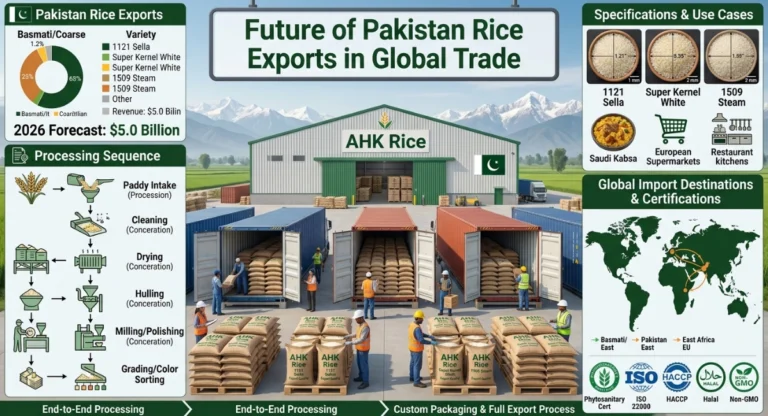
The second stage is rice processing. Pakistani Basmati rice is grown mainly in Punjab and processed through cleaning, de-stoning, husking, milling, polishing or whitening, sorting, grading, and packing. Parboiled products such as Steam or Sella rice follow additional heat and drying processes before final grading and packaging.
The third stage is inspection and quality verification. Samples are taken according to the agreed inspection procedure. Testing can measure moisture, broken grains, grain length, purity, foreign matter, milling quality, and other contractual parameters. Laboratory or inspection records then provide evidence that the shipment matches the agreed specification.
The fourth stage is export documentation. The exporter compiles the commercial invoice, packing list, transport document, origin documentation, and applicable certificates. The information should match across documents. For example, a container listed as 1,000 bags on the packing list should not appear as 1,050 bags on another shipment document.
The fifth stage is U.S. import compliance. FDA requires Prior Notice for imported food unless an exemption applies. FDA uses Prior Notice information to identify incoming food and support inspection targeting. The FDA Prior Notice system also requires shipment and product information such as the food identity, quantity, manufacturer or grower information, country of production, shipper, consignee, and transportation details.
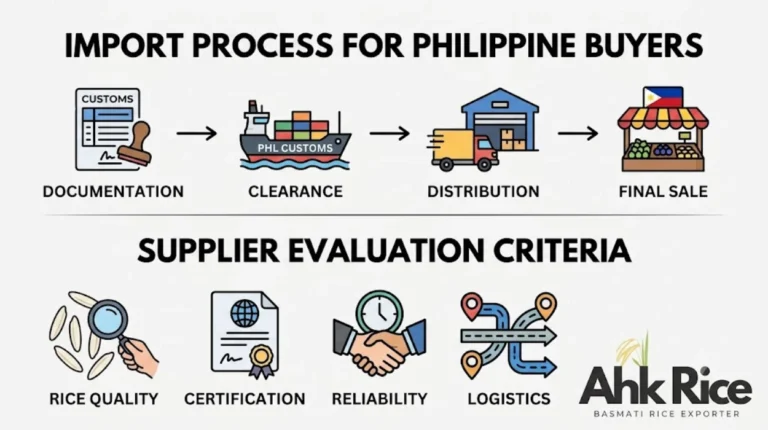
The sixth stage is customs entry and inland movement. The U.S. importer or customs broker uses the commercial and transportation information to prepare the entry. After release and port handling, the container moves through the domestic logistics network to its Colorado destination.
What are the key components of rice export documentation?
The key components are commercial documents, shipping documents, quality records, origin documents, regulatory records, and packaging information. Colorado importers examine these components together because one missing or inconsistent record can create problems even when the physical rice meets its agreed quality specification.
Commercial documents establish the transaction. The purchase order, sales contract, pro forma invoice, and commercial invoice define what the buyer ordered and what the exporter is selling. Examples include product grade, bag size, number of bags, net weight, price per metric ton, and Incoterms.
Shipping documents establish cargo movement. The bill of lading identifies the ocean shipment, while container numbers and seal numbers connect the paperwork with the physical container. The packing list connects individual packages with the total shipment weight and package count.
Quality documents establish product conformity. A certificate of analysis can record laboratory results for specified quality or safety parameters. An inspection certificate can record findings from an independent inspection. A weight certificate can verify cargo weight when the contract requires independent weighing.
Origin documents establish geographic identity. A certificate of origin identifies Pakistan as the country of origin for Pakistani rice. This distinction matters because country of origin is a customs and traceability attribute, not simply a marketing statement.
Regulatory documents establish compliance. FDA food facility registration, Prior Notice information, applicable FSVP responsibilities, compliant labeling, and other required records form part of the U.S. food-import framework. FDA also states that most facilities manufacturing, processing, packing, receiving, or holding food must register with FDA every two years, subject to applicable exemptions.
Which Basmati rice varieties and grades require documentation?
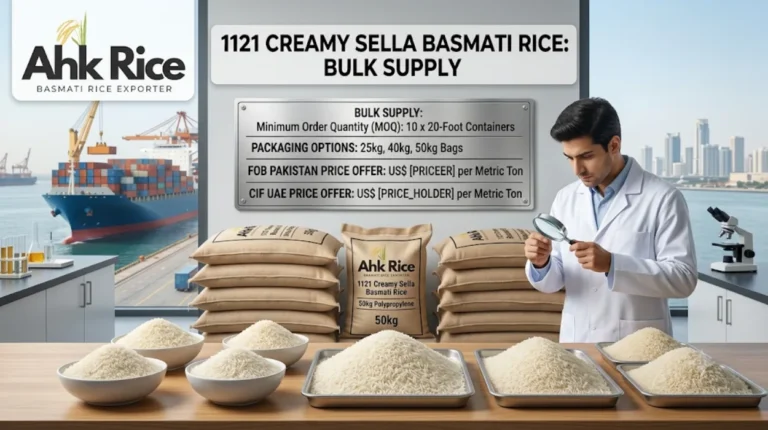
Every commercial Basmati shipment requires documentation that identifies the exact product being sold. Common Pakistani Basmati varieties include 1121, Super Kernel, and 1509, with White, Steam, Sella, and Creamy Sella forms depending on processing and the supplier’s commercial specification.
1121 Basmati is an extra-long-grain variety recognized for long kernels and high elongation after cooking. Commercial forms include 1121 White and 1121 Steam. Buyers document grain length, broken percentage, moisture, purity, milling condition, packing, and other agreed specifications.
Super Kernel Basmati is another established Pakistani Basmati type. It is commonly sold as Super Kernel White Rice. Documentation identifies the product separately from 1121 because variety, grain characteristics, and commercial specifications are not interchangeable.
1509 Basmati is another long-grain Pakistani variety. Commercial forms include 1509 White, 1509 Steam, and 1509 Sella or Creamy Sella depending on processing terminology used in the contract. A buyer should ensure that the commercial invoice and quality certificate use the same product identity.
White rice refers to rice processed into a milled white form. Steam rice is treated with controlled steam before drying and milling, while Sella generally refers to parboiled rice. Creamy Sella describes a particular commercial appearance within parboiled rice programs.
These terms are commercial product classifications rather than a single U.S. government grading system for Pakistani Basmati. The buyer should therefore define measurable specifications instead of relying on a grade name alone. A contract stating “1121 Steam” is stronger when it also specifies grain length, broken percentage, moisture, packaging, and inspection criteria.
Which markets import Pakistani Basmati rice and why does market documentation differ?
Pakistani Basmati rice enters markets across the Middle East, North America, Europe, and Africa, but documentation requirements differ by destination. U.S. shipments require alignment with FDA and customs procedures, while other markets apply their own food, labeling, origin, and import controls.
The United States is a major destination for Pakistani Basmati rice, particularly for distributors, restaurants, ethnic grocery suppliers, foodservice businesses, and private-label programs. Colorado importers must consider the federal U.S. requirements even when the final delivery occurs at a warehouse or distribution center inside the state.
Saudi Arabia and the United Arab Emirates are important Middle Eastern markets for Pakistani rice. European markets apply destination-specific food and labeling requirements. African markets also differ by country in their import documentation and inspection procedures.
The same rice variety can therefore require different documentation depending on destination. An exporter cannot assume that a document accepted in Saudi Arabia automatically satisfies U.S. requirements. The country of destination determines the regulatory pathway.
For agricultural commodities, USDA APHIS also states that import requirements vary according to the specific commodity and country of origin and directs importers to its Agricultural Commodity Import Requirements database. This makes destination-specific verification important when plant-health documentation applies.
What benefits do Colorado importers gain by reviewing documents before ordering?
Pre-order document review gives Colorado importers measurable control over product identity, supplier capability, regulatory readiness, shipment planning, and commercial risk. It changes supplier evaluation from a price comparison into a verification process based on records that can be checked before cargo is committed.
The first benefit is specification control. The buyer can confirm that the proposed rice matches the required variety, processing type, packaging, and quality limits.
The second benefit is regulatory preparation. Reviewing FDA-related information before ordering gives the importer time to confirm facility registration, Prior Notice procedures, labeling requirements, and FSVP responsibilities. FDA confirms that imported foods are subject to inspection at U.S. ports and can be detained when they do not comply with U.S. requirements.
The third benefit is customs consistency. When the invoice, packing list, bill of lading, certificate of origin, and entry information describe the same cargo, the broker has a stronger documentation set for entry processing.
The fourth benefit is shipment planning. Container quantity, gross weight, package count, port information, and shipping terms help the importer plan warehouse receiving and inland transportation.
The fifth benefit is traceability. Lot numbers, production information, manufacturer details, and quality records connect the finished shipment with its production and inspection history.
What are common documentation problems and misconceptions?
Common problems include inconsistent weights, incorrect product descriptions, missing facility information, unsuitable certificates, labeling errors, and late regulatory submissions. The main misconception is that customs documentation starts after loading; effective import compliance begins when the buyer defines specifications and supplier records.
A frequent problem is inconsistent terminology. “1121 Basmati,” “1121 Steam,” and “1121 White” identify different commercial conditions. The invoice, packing list, certificate of analysis, and purchase order should use consistent product descriptions.
Another problem is weight inconsistency. Net weight, gross weight, bag count, and container quantity must reconcile. A difference between the commercial invoice and packing list creates an avoidable verification issue.
A third problem is treating a quality certificate as a customs document. A laboratory report proves specified test results. It does not replace a commercial invoice, packing list, bill of lading, or required regulatory filing.
A fourth misconception is that FDA registration means FDA has approved the rice shipment. FDA explains that it does not pre-approve individual food importers, products, labels, or shipments. Compliance depends on meeting applicable requirements, including facility registration and Prior Notice where required.
A fifth misconception is that a shipment can be documented after arrival. Prior Notice must be received and confirmed before the food arrives at the first U.S. port, with timing requirements based on transportation mode. For waterborne shipments, FDA states that Prior Notice must be submitted at least 8 hours before arrival.
How should Colorado importers evaluate documents before placing a rice order?
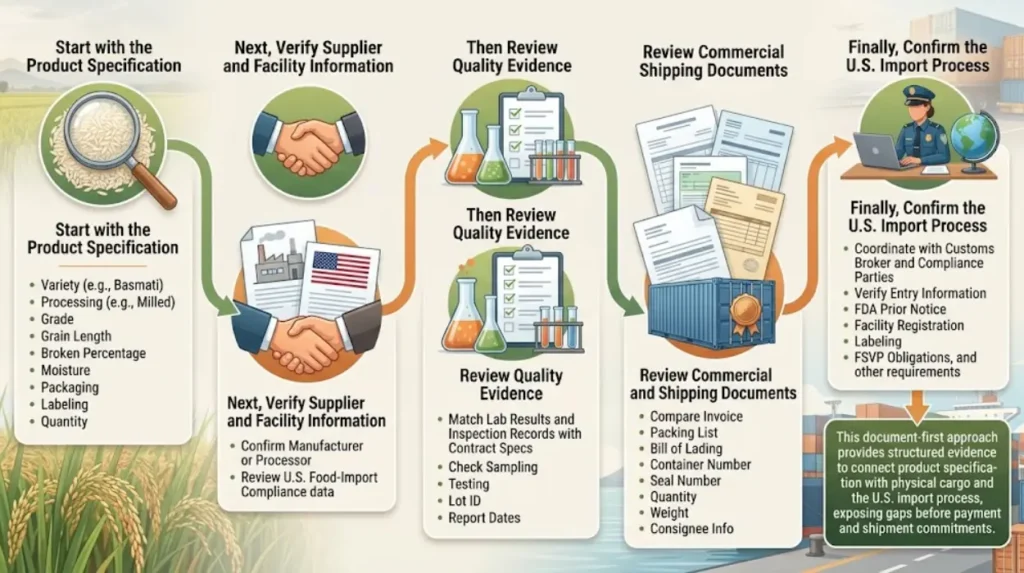
Colorado importers should evaluate documents in the same sequence as the physical supply chain: product specification, supplier identity, processing evidence, quality verification, commercial terms, export records, transportation documents, and U.S. regulatory requirements. This sequence exposes gaps before payment and shipment commitments.
Start with the product specification. Confirm variety, processing type, grade, grain length, broken percentage, moisture, packaging, labeling, and quantity.
Next, verify supplier and facility information. Confirm the actual manufacturer or processor associated with the rice and review the information needed for U.S. food-import compliance.
Then review quality evidence. Match laboratory results and inspection records with the contractual specification. Check that sampling, testing, lot identification, and report dates correspond to the shipment.
After that, review commercial and shipping documents. Compare the invoice, packing list, bill of lading, container number, seal number, quantity, weight, and consignee information.
Finally, confirm the U.S. import process. The importer should coordinate with the customs broker and responsible compliance parties to verify entry information, FDA Prior Notice, facility registration, labeling, FSVP obligations, and any other applicable requirements.
This document-first approach explains why experienced Colorado importers assess paperwork before ordering rice. The documents provide the structured evidence needed to connect the product specification with the physical cargo and the U.S. import process.
For the next consideration stage, readers should examine:
How export documentation supports smooth customs clearance where the focus shifts from document review before ordering to the role each record plays during customs processing.
Frequently Asked Questions
Why do Colorado importers review rice export documentation before ordering?
Colorado importers review export documentation to verify product specifications, supplier information, shipment details, quality records, country of origin, and U.S. food-import requirements before committing to an order.
What documents are required when importing Pakistani Basmati rice into Colorado?
Common documents include a commercial invoice, packing list, bill of lading, certificate of origin, applicable inspection or laboratory reports, quality certificates, and required U.S. food-import records.
What information should a rice commercial invoice contain?
A commercial invoice should identify the exporter and importer, rice variety, product description, quantity, unit price, total value, country of origin, packaging details, and applicable delivery terms.
Why is the packing list important for rice imports?
A packing list records package count, bag size, net weight, gross weight, and shipment details. Colorado importers use it to compare the physical cargo with commercial and shipping documents.
What does a certificate of origin prove for Pakistani rice?
A certificate of origin identifies Pakistan as the country where the rice originated. It supports origin verification for customs, trade documentation, and supply-chain traceability.
Do Pakistani Basmati rice imports require FDA compliance?
Yes. Imported food must meet applicable U.S. food requirements. Depending on the shipment and parties involved, requirements include FDA facility registration, Prior Notice, compliant labeling, and Foreign Supplier Verification Program responsibilities.
Does FDA registration mean a rice shipment is approved?
No. FDA registration does not mean FDA has approved an individual rice product or shipment. Importers must still meet applicable food-safety, labeling, Prior Notice, and other regulatory requirements.