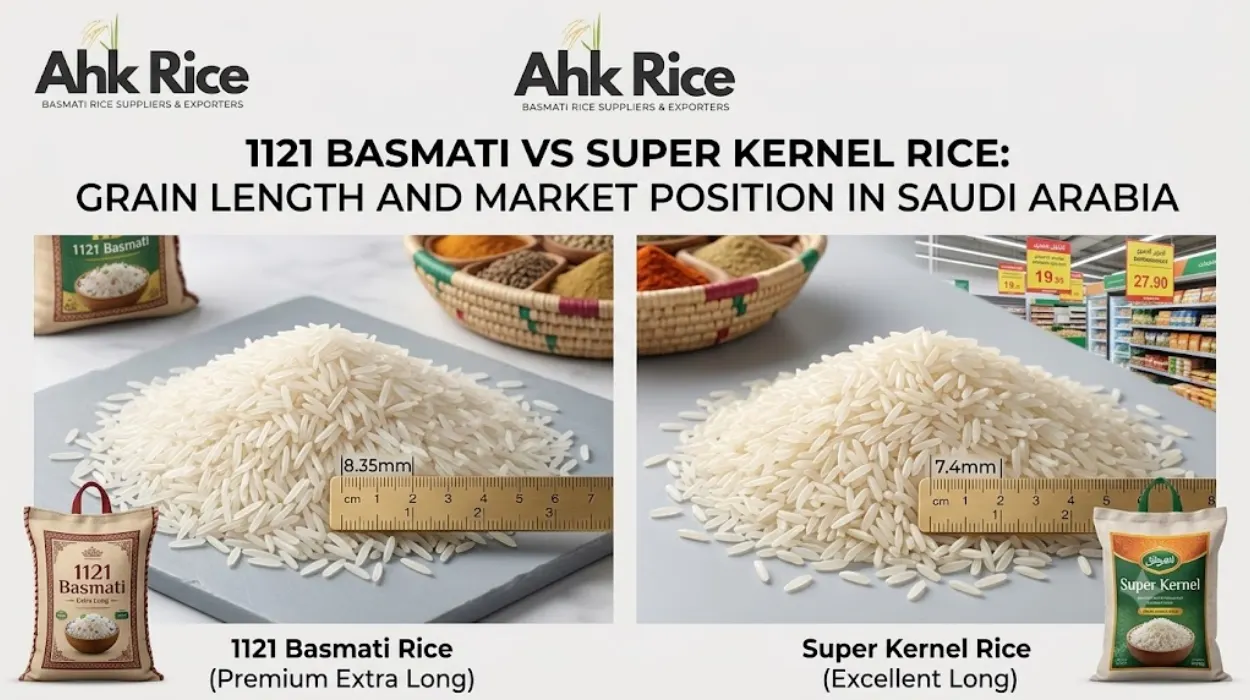
1121 Basmati vs Super Kernel Rice: Grain Length and Market Position in Saudi Arabia
1121 Basmati rice leads premium Saudi Arabian retail and foodservice segments because of its exceptional grain length, while Super Kernel rice maintains a strong position through traditional aroma, cooking performance, and value-focused demand.
Saudi Arabia imports multiple Pakistan Basmati rice varieties because consumer preferences differ across households, restaurants, catering companies, and private-label brands. The main comparison between 1121 Basmati and Super Kernel rice focuses on grain length, appearance, cooking expansion, pricing, and market positioning.
For Saudi Arabian buyers, choosing between these varieties requires understanding how each grain performs after cooking and how customers perceive quality. The decision affects product positioning, packaging strategy, pricing, and repeat purchase behavior.
For a deeper understanding of why Saudi buyers associate extra-long grains with premium quality, read our guide on why extra long grain Pakistan Basmati rice is considered premium in Saudi Arabia.
What are the available solutions for Saudi Arabian rice buyers?
Saudi Arabian buyers can select between 1121 Basmati, Super Kernel, and other Pakistani long grain varieties based on target customers, pricing strategy, and cooking expectations. Each variety serves a different market requirement rather than competing only on grain size or cost.
The available solutions for Saudi Arabian brands include:
- 1121 Basmati rice
1121 Basmati is an extra-long grain variety developed in Pakistan. It is recognized for its very long uncooked grain, high cooking elongation, and premium visual appearance.
AHK Rice supplies 1121 Basmati rice export solutions with processing, quality control, custom packaging, and export support for international markets.
- Super Kernel Basmati rice
Super Kernel is a traditional premium Basmati variety from Pakistan. It is valued for its strong aroma, authentic Basmati identity, and balanced cooking performance.
It has historically maintained strong demand among consumers who prioritize taste and traditional rice characteristics over maximum grain length.
- 1509 Basmati rice
1509 Basmati is another extra-long grain variety used by exporters and brands seeking premium appearance with competitive pricing. It offers strong elongation and is commonly positioned between standard premium and high-end segments.
The choice depends on the market segment. Luxury retail brands often prioritize 1121 Basmati. Traditional Basmati consumers often prefer Super Kernel. Value-premium brands frequently evaluate 1509.
How do 1121 Basmati and Super Kernel rice compare in specifications?
1121 Basmati and Super Kernel differ mainly in grain length, elongation ratio, aroma intensity, pricing, and consumer perception, making them suitable for different Saudi Arabian market segments. A specification comparison helps buyers match the rice variety with brand positioning and customer expectations.
| Attribute | 1121 Basmati Rice | Super Kernel Basmati Rice |
|---|---|---|
| Grain length | Extra-long grain, commonly around 8.3–8.5 mm raw length | Long grain, commonly around 7.5–8.0 mm raw length |
| Cooking elongation | Very high, often reaching 18–24 mm after cooking | High elongation with stronger traditional texture |
| Aroma profile | Mild to medium traditional Basmati aroma | Stronger classic Basmati aroma |
| Saudi market position | Premium retail, gifting packs, luxury restaurants | Premium traditional households and foodservice |
| Price level | Higher price per MT due to premium appearance | Competitive premium pricing |
| Consumer preference | Customers seeking visual luxury and extra-long grains | Customers seeking authentic Basmati taste |
| Best application | Branded retail packs, restaurants, premium catering | Traditional meals, restaurants, household consumption |
The main distinction is not quality superiority. Both varieties are premium Pakistan Basmati rice products. The difference is market purpose.
1121 Basmati creates stronger shelf appeal because the cooked grains appear longer and more separated. Super Kernel creates stronger sensory appeal through aroma and traditional Basmati characteristics.
How do different approaches compare for Saudi Arabia’s rice market?
Saudi Arabian rice brands usually choose between appearance-led positioning, taste-led positioning, or balanced premium positioning. Each approach influences sourcing decisions, packaging design, customer targeting, and acceptable price levels per metric ton.
Market Region Comparison: Saudi Arabia Retail vs Foodservice
| Market Region | Preferred Grade | Buyer Priority | Typical Positioning |
| Premium retail supermarkets | 1121 Basmati | Long grain appearance, packaging quality, premium perception | Luxury household consumption |
| Traditional household segment | Super Kernel Basmati | Aroma, taste, cooking familiarity | Authentic Basmati experience |
| Hotels and restaurants | 1121 and Super Kernel | Consistent cooking results and customer expectations | Menu quality and reliability |
| Catering companies | 1121 or 1509 | Cost efficiency with volume supply | Large-scale meal preparation |
| Private-label brands | Selected according to customer profile | Brand differentiation and margins | Custom market positioning |
Saudi Arabian importers evaluate price per metric ton based on variety, aging period, processing quality, packaging requirements, and export volume.
Approximate Price Comparison Per Metric Ton (2026 Market Position)
| Rice Variety | Market Price Position | Approximate Export Price Range Per MT |
| 1121 Basmati Steam | Premium | USD 1,050–1,450 per MT |
| 1121 Basmati Sella | Premium | USD 1,000–1,350 per MT |
| Super Kernel Basmati | Premium traditional | USD 950–1,300 per MT |
| 1509 Basmati | Value premium | USD 850–1,150 per MT |
Actual export pricing changes according to crop conditions, aging period, processing method, packaging format, order quantity, and international freight conditions.
Shelf Life Comparison
| Variety | Typical Shelf Life | Storage Consideration |
| 1121 Basmati | 18–24 months | Controlled moisture and temperature improve grain stability |
| Super Kernel Basmati | 18–24 months | Proper storage preserves aroma quality |
| Aged Basmati varieties | 24 months or longer | Aging improves cooking performance and premium positioning |
For Saudi Arabia’s climate, exporters and distributors require moisture-controlled storage and proper packaging to maintain quality during transportation and warehouse storage.
Which method works best for different cases?
The best rice selection depends on customer expectations, business model, and price strategy rather than choosing the longest grain available. Different Saudi Arabian buyers require different solutions to achieve commercial success.
Decision Framework for Saudi Arabian Rice Buyers
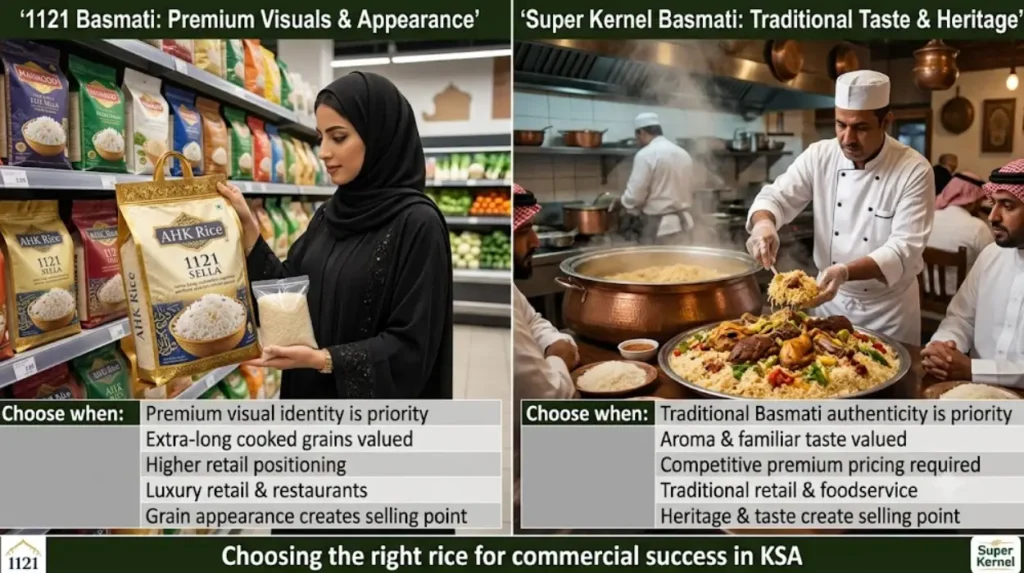
| Decision Factor | Choose 1121 Basmati When | Choose Super Kernel When |
| Brand image | Premium visual identity is the priority | Traditional Basmati authenticity is the priority |
| Customer expectation | Buyers value extra-long cooked grains | Buyers value aroma and familiar taste |
| Pricing strategy | Higher retail positioning is acceptable | Competitive premium pricing is required |
| Business channel | Luxury retail and premium restaurants | Traditional retail and foodservice |
| Product differentiation | Grain appearance creates the selling point | Heritage and taste create the selling point |
A Saudi Arabian private-label brand selling premium supermarket rice may select 1121 Basmati because packaging visuals influence purchasing decisions.
A restaurant group serving traditional rice dishes may prefer Super Kernel because aroma and flavor alignment matter more than grain length.
What are the pros and cons of 1121 Basmati and Super Kernel rice?
Both varieties offer commercial advantages, but their limitations differ. Understanding these strengths and challenges helps importers avoid selecting a rice grade that does not match their target market.
1121 Basmati Rice Pros and Cons
Advantages
- Exceptional grain length creates premium shelf visibility.
- Strong cooking elongation supports restaurant presentation.
- Suitable for luxury packaging and export branding.
- Performs well in Saudi markets where appearance influences purchase decisions.
Limitations
- Higher purchase cost compared with standard premium varieties.
- Some traditional consumers may prefer stronger aroma profiles.
- Requires careful processing to maintain appearance quality.
Super Kernel Basmati Rice Pros and Cons
Advantages
- Strong traditional Basmati identity.
- Recognized by experienced rice consumers.
- Balanced aroma and texture.
- Competitive premium pricing.
Limitations
- Shorter grain length compared with 1121.
- Less visual differentiation in premium retail displays.
- May not target consumers seeking extra-long grain experiences.
What factors should businesses consider before selecting a rice variety?
Saudi Arabian brands should evaluate customer profile, pricing objectives, cooking requirements, packaging strategy, and supply consistency before choosing between 1121 Basmati and Super Kernel rice. A structured evaluation reduces sourcing risks and improves market positioning.
Key decision factors include:
- Customer segment
Luxury consumers often associate longer grains with premium quality. Traditional consumers often recognize aroma and taste as stronger indicators of authenticity.
- Sales channel
Retail shelves require strong visual differentiation. Restaurants require reliable cooking performance and consistent supply.
- Packaging strategy
Extra-long grain varieties create stronger marketing opportunities through transparent windows, premium designs, and product photography.
- Import volume
Large-volume buyers need consistent supply capacity, export documentation, and processing standards.
- Brand positioning
A premium brand should select the variety that supports its market message rather than choosing only based on price.
AHK Rice operates from Punjab, Pakistan, supplying 1121, Super Kernel, and 1509 Basmati rice varieties to international markets with integrated processing, custom packaging options, and export support.
Which rice variety provides the best solution for Saudi Arabian brands?
1121 Basmati works best for premium visual positioning, while Super Kernel works best for traditional Basmati expectations. The right choice depends on whether Saudi buyers prioritize grain length, aroma, pricing, or customer familiarity.
Saudi Arabia’s rice market continues to reward suppliers that understand consumer preferences and deliver consistent quality. Exporters must combine the right variety with proper processing, packaging, and supply management.
Brands evaluating long-term market growth should compare grain specifications, customer expectations, and commercial objectives before finalizing their product range.
For companies seeking a complete sourcing solution, explore our premium Pakistan long grain Basmati rice exporter services for Saudi Arabian brands.
Frequently Asked Questions
What is the main difference between 1121 Basmati and Super Kernel rice?
1121 Basmati rice has a longer grain size and higher cooking elongation, making it popular for premium retail and restaurant segments in Saudi Arabia. Super Kernel Basmati rice has a stronger traditional aroma and is preferred by customers who value classic Basmati taste and texture.
Is 1121 Basmati rice more expensive than Super Kernel rice?
Yes, 1121 Basmati rice generally has a higher price per metric ton because of its extra-long grain appearance, premium market demand, and strong positioning in luxury rice categories. Super Kernel offers premium quality with a comparatively competitive price level.
Which Basmati rice variety is better for Saudi Arabian restaurants?
The best choice depends on the restaurant’s customer profile. 1121 Basmati is suitable for restaurants that focus on premium presentation and long separated grains, while Super Kernel works well for restaurants serving traditional dishes where aroma and authentic Basmati characteristics are important.
How long can 1121 and Super Kernel Basmati rice be stored?
Both 1121 and Super Kernel Basmati rice typically maintain quality for around 18 to 24 months when stored under proper conditions. Controlled moisture, suitable temperature, and quality packaging help preserve grain performance and aroma.
Which Pakistan Basmati rice variety should Saudi Arabian brands import?
Saudi Arabian brands should select rice varieties based on their target customers, pricing strategy, and sales channel. 1121 Basmati is ideal for premium positioning, while Super Kernel is suitable for brands targeting traditional Basmati consumers who prioritize aroma and taste.