Choose AHK Rice as Your Qualified Basmati Rice Supplier
Choosing a Basmati rice supplier for the USA requires more than comparing FOB prices. A qualified supplier needs controlled sourcing, measurable grain specifications, sample approval, export documentation, inspection, packaging control, and predictable shipment execution. For importers reviewing the qualification process:
Why importers qualify rice suppliers before purchasing establishes the foundation for a supplier decision.
The best supplier decision combines verified product specifications, controlled processing, documented quality checks, realistic shipment schedules, transparent costs, and U.S. import readiness. AHK Rice provides this structure for USA importers through Pakistan-origin Basmati sourcing, processing, packaging, inspection coordination, documentation, and container shipment.
The commercial objective is simple: receive the same rice specification that was approved during sampling, in the agreed quantity, with the required documents and within the planned delivery window. A low quotation without these controls creates procurement risk.
AHK Rice operates from Bucheki, Nankana Sahib, Punjab, and manages an integrated export process covering paddy procurement, cleaning, dehusking, polishing, grading, sorting, packaging, documentation, and container loading. Its current export markets include the USA, UK, Germany, UAE, Saudi Arabia, Qatar, China, Malaysia, Indonesia, Vietnam, the Philippines, Turkey, Iraq, Morocco, and Ivory Coast.
What is the best solution for choosing a qualified Basmati rice supplier?
The best solution is a specification-led procurement process that verifies rice quality before purchase, fixes commercial requirements before production, confirms documentation before loading, and connects the approved sample with the exact production batch shipped to the importer.
A professional qualification process starts with a written specification. The specification identifies the Basmati variety, processing grade, grain length, broken percentage, moisture level, foreign matter tolerance, purity, packaging, quantity, destination port, inspection requirement, and Incoterm.
For U.S. buyers, the specification also needs to account for food-import compliance. FDA states that imported foods must meet U.S. legal requirements, including applicable food facility registration and Prior Notice requirements. The importer also carries responsibilities under the Foreign Supplier Verification Program where applicable.
This makes supplier qualification a commercial control rather than a simple vendor search. The exporter needs to provide usable documentation and consistent product information before the container leaves Pakistan.
AHK Rice supplies Pakistani Basmati varieties including 1121, Super Kernel, and 1509. The USA export service identifies 1121 Sella, Super Kernel, traditional white Basmati, and other grades for American importers.
Why choose the USA service from AHK Rice?
The USA service combines Pakistani Basmati sourcing, processing, grading, packaging, quality verification, export documentation, container loading, and shipment coordination, giving U.S. buyers one controlled procurement channel from specification approval through Karachi dispatch.
The USA Basmati rice export service is designed for wholesalers, retailers, distributors, foodservice companies, and other commercial buyers sourcing Pakistani rice for the American market.
The service lists an average grain specification of 8.3 mm or higher for its USA offering, moisture below 12.5%, broken grains below 1%, and customized packaging options. Exact specifications depend on the selected variety and contracted grade, so the commercial specification remains the controlling document.
AHK Rice also provides multiple packaging formats. USA buyers can request PP bags, jute bags, cloth bags, non-woven bags, retail packs, and customized formats. Packaging can be selected around wholesale distribution, foodservice, or private-label requirements.
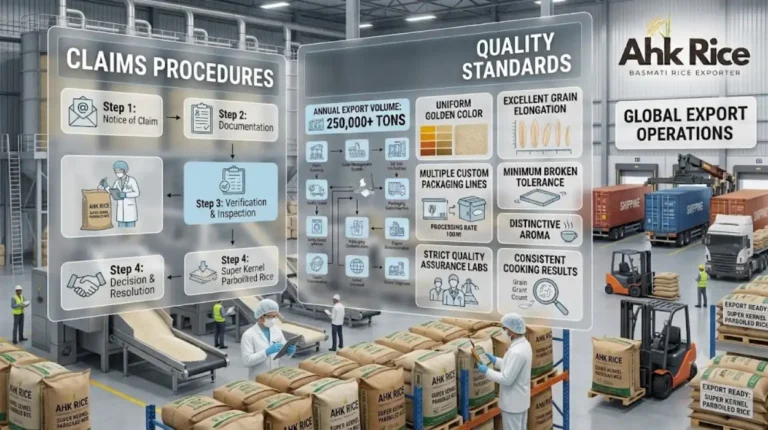
The operational advantage is origin control. AHK Rice manages several production stages before the container reaches Karachi. Paddy procurement is followed by pre-cleaning, dehusking, paddy separation, whitening or polishing, grading, length sorting, packaging, and container loading. Export documentation includes the commercial invoice, packing list, phytosanitary certificate, certificate of origin, fumigation certificate, and bill of lading.
For a U.S. importer, this reduces the number of separate parties involved in the procurement chain. The buyer communicates product requirements once, approves the sample, confirms the order, and receives documentation through the export process.
Which Basmati specification fits a USA buyer?
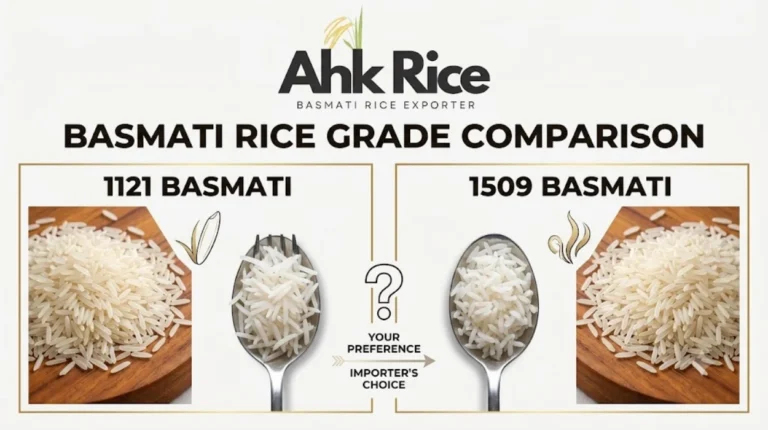
1121 suits premium long-grain positioning, Super Kernel fits aromatic wholesale and foodservice demand, while 1509 provides a competitive long-grain option. The correct choice depends on grain appearance, cooking performance, target customer, packaging strategy, and required procurement price.
| Product | Typical commercial positioning | Key specification focus | Best buyer fit |
|---|---|---|---|
| 1121 Basmati | Premium long grain | 8.3 mm+ grain, low breakage | Premium retail, wholesalers |
| 1121 Sella | Parboiled long grain | Grain elongation, moisture, breakage | Restaurants, foodservice |
| Super Kernel | Aromatic premium Basmati | Long slender grain, aroma | Ethnic retail, distributors |
| 1509 Basmati | Cost-conscious premium | Grain length, aroma, breakage | Wholesale and foodservice |
| Brown Basmati | Whole-grain positioning | Bran retention, moisture | Health-focused retail |
AHK Rice lists 1121 Basmati in white, steam, brown, parboiled, Golden Sella, Creamy Sella, and Sella formats. Super Kernel is available in white, brown, parboiled, and steam formats. Basmati 1509 is also offered across several processing grades.
A buyer seeking visual impact in premium retail can prioritize 1121. A restaurant distributor requiring consistent cooked grain performance can evaluate Sella or parboiled grades. A cost-sensitive wholesale buyer can compare 1509 against 1121 using the same technical specification framework.
This is where a structured comparison of:
How buyers evaluate international rice export vendors becomes important. The procurement decision needs to compare quality, capacity, documentation, logistics, and commercial terms together rather than treating price as the only variable.
What does the AHK Rice sample process cost?
AHK Rice provides up to 20 kg of rice as a product sample without a rice charge; the buyer pays sample shipping and applicable phytosanitary costs. The sample is dispatched after specification confirmation, then tested and approved before bulk production.
The sample process starts with the buyer sending the required variety, grade, packaging preference, destination, and technical specification. AHK Rice then confirms the appropriate sample option.
For USA shipments, the company states that samples can be sent by air courier, with its USA page specifying approximately 5–7 days for 1–5 kg parcels. Its FAQ also states that samples up to 20 kg are free while the client covers shipping costs.
The cost structure is therefore:
| Sample item | Buyer cost |
| Rice sample up to 20 kg | $0 product charge |
| Courier | Buyer pays actual courier cost |
| Phytosanitary certificate | Buyer pays applicable cost |
| Sample testing | Buyer laboratory cost, where independently required |
| Bulk-order sample charge | Waived in the final quotation after qualifying purchase, according to AHK Rice terms |
A buyer can also provide its own courier account. AHK Rice states that clients can use their preferred courier for sample delivery.
The testing stage should cover the agreed commercial parameters. Buyers typically check grain length, broken percentage, moisture, foreign matter, aroma, appearance, cooking performance, packaging condition, and labeling requirements.
Sample approval then becomes the reference point for bulk procurement. A professional buyer records the approved specification and retains the sample or laboratory record for comparison against the commercial shipment.
What does Basmati rice from Pakistan to the USA cost?
USA Basmati pricing depends on variety, grade, crop, quantity, packaging, inspection, Incoterm, destination port, freight, insurance, and payment terms. A public AHK Rice listing shows $1,100 per MT as an indicative starting FOB Karachi price for 1121, not a fixed 2026 quotation.
Price needs to be evaluated on a landed-cost basis. FOB Karachi excludes the buyer’s ocean freight and destination-side charges. CIF or CNF pricing incorporates additional freight elements, while final delivered cost depends on the agreed Incoterm and destination.
AHK Rice’s current 1121 USA product page lists pricing starting at $1,100 per metric ton FOB Karachi and indicates flexible commercial volumes.
Another current market listing published in August 2026 shows indicative Pakistan FOB Karachi prices for 1121 Basmati around $1,135–$1,205 per MT depending on processing grade, while freight remains separately quoted. These figures demonstrate why a live quotation is required instead of using one market number as a permanent price.
The principal cost factors are:
- Rice variety: 1121, Super Kernel, and 1509 carry different commercial values.
- Processing grade: White, Steam, Sella, Golden Sella, Brown, and Parboiled require different processing.
- Order quantity: Container volume affects production planning and freight economics.
- Packaging: Standard PP bags differ from customized retail or private-label packaging.
- Inspection: Independent inspection adds a service cost when requested.
- Freight: Ocean rates change with carrier, route, equipment, fuel, and market conditions.
- Destination: New York, Los Angeles, Houston, and other ports have different freight and inland structures.
- Incoterm: FOB, CFR/CNF, CIF, and other terms allocate freight, insurance, and risk differently.
A buyer comparing two quotations therefore needs to normalize both offers to the same specification, quantity, Incoterm, destination, packaging, inspection scope, and documentation package.
How long does shipping take from Pakistan to USA markets?
AHK Rice states approximately 25–35 days door-to-door for USA shipments, while ocean sailing itself varies by route and port. New York, Los Angeles, and Houston require separate freight confirmation because schedules and inland delivery conditions differ.
AHK Rice’s USA service identifies direct shipment from Karachi to U.S. ports and lists New York, Los Angeles, and Houston among its shipment destinations. The published timeline gives 25–35 days door-to-door.
A practical 2026 planning range is:
| USA market | Planning basis | Approximate timing |
| New York / Northeast | Karachi to U.S. port plus clearance | 25–35 days |
| Houston / Gulf | Karachi to U.S. port plus clearance | 25–35 days |
| Los Angeles / West Coast | Karachi to U.S. port plus clearance | 25–35 days |
Actual transit depends on vessel routing, transshipment, port congestion, customs processing, carrier schedules, and inland transportation. A current market reference gives 24–40 days for Karachi-to-New York/Los Angeles sailing, demonstrating why buyers need a shipment-specific schedule before placing an order.
The export timeline begins with inquiry and quotation, followed by sample approval, contract confirmation, production, inspection, packing, documentation, loading, ocean shipment, customs clearance, and final delivery.
For U.S. food imports, Prior Notice must reach FDA before the food arrives at the first U.S. port. For water shipments, FDA’s stated minimum timing is at least eight hours before arrival, subject to the applicable filing method and requirements.
What results can be expected from a qualified AHK Rice supply program?
A qualified AHK Rice supply program gives buyers specification consistency, controlled origin processing, documented export records, sample-to-shipment alignment, packaging flexibility, shipment visibility, and a repeatable procurement process suitable for wholesale and distribution operations.
The first result is specification control. The buyer defines the rice before production instead of accepting whatever stock happens to be available.
The second result is process visibility. AHK Rice manages sourcing and processing from Punjab and coordinates grading, sorting, packaging, documentation, and container loading.
The third result is inspection flexibility. AHK Rice states that third-party pre-shipment inspection is available through organizations including SGS and Bureau Veritas.
The fourth result is repeat-order planning. A buyer can retain an approved specification and use it as the benchmark for subsequent containers.
The fifth result is packaging control. Retailers and distributors can specify bag sizes and private-label formats rather than purchasing only generic bulk sacks.
These controls matter most when an importer moves from one trial container to recurring monthly or quarterly purchasing. The supplier decision then affects inventory continuity, customer satisfaction, landed cost, and working-capital planning.
How should a buyer make the final supplier decision?
Choose the supplier that satisfies the complete commercial specification, not simply the supplier offering the lowest FOB number. Confirm product quality, sample approval, documentation, inspection, shipment timing, payment terms, packaging, and total landed cost before signing the purchase contract.
Use this final decision framework:
| Decision factor | Buyer verification |
| Product | Approved variety, grade, grain length, moisture and broken limits |
| Quality | Sample approval and inspection procedure |
| Compliance | FDA-related import documentation and importer responsibilities |
| Logistics | Confirmed vessel schedule, destination port and transit window |
| Commercials | FOB/CIF/CNF basis, payment terms and total landed cost |
AHK Rice is positioned for buyers who need a direct Pakistan-origin Basmati supply relationship rather than a purely price-led transaction. Its stated export process covers sourcing through container loading, with documentation and inspection support integrated into the workflow.
The decision becomes stronger when the buyer treats the first order as a qualification benchmark. The approved sample, specification sheet, inspection report, packing record, and shipping documents create a procurement reference for future orders.
For a U.S. importer, this approach also separates exporter responsibilities from importer responsibilities. FDA identifies the U.S. importer as responsible for applicable FSVP activities, while imported food remains subject to U.S. requirements and Prior Notice procedures.
How do you get started with AHK Rice?
Start by submitting the exact variety, grade, quantity, packaging, destination port, Incoterm, and target specification. AHK Rice can then provide a commercial quotation, arrange the applicable sample, confirm production requirements, and structure the shipment around the approved specification.

A buyer should prepare five items before requesting a quotation:
- Required Basmati variety and processing grade.
- Target quantity in metric tons or containers.
- Destination U.S. port.
- Packaging size and private-label requirement.
- Preferred Incoterm and payment structure.
AHK Rice’s USA export process states that inquiries receive a customized quotation covering pricing, MOQ, specifications, and sample options. The company also states that bulk orders can begin from one 20-foot container, with a listed 20 MT starting quantity on its USA service page.
The next step is sample approval. Once the buyer confirms the sample, the commercial specification becomes the basis for production and inspection. The buyer then confirms the contract, production schedule, packaging, documentation, and shipment.
For procurement teams comparing multiple exporters, this process creates a measurable qualification record. The final decision is no longer based on a sales promise. It is based on product evidence, commercial terms, compliance readiness, and logistics execution.
AHK Rice has supplied international markets since 2019 and currently identifies the USA among its export destinations. Its integrated Punjab-based operation gives buyers a direct source for Pakistani Basmati across 1121, Super Kernel, 1509, and multiple processing grades.
For a USA importer seeking a qualified Pakistani Basmati supplier in 2026, the strongest purchasing model is specification-first, sample-approved, inspection-supported, documentation-controlled, and shipment-planned. AHK Rice fits this procurement structure by connecting rice processing in Punjab with export coordination through Karachi and delivery planning for U.S. markets.
To confirm current product availability, specification, freight, Incoterm, sample logistics, and shipment pricing, request a quote from AHK Rice.
Frequently Asked Questions
What Basmati rice varieties does AHK Rice supply to USA importers?
AHK Rice supplies 1121 Basmati, Super Kernel Basmati, 1509 Basmati, traditional White Basmati, Sella, Steam, Golden Sella, Creamy Sella, Parboiled, and Brown Basmati grades. Availability depends on the confirmed specification and order requirements.
What is the minimum order quantity for USA Basmati rice?
AHK Rice lists a starting bulk order of one 20-foot container, with approximately 20 metric tons as the starting quantity for its USA export service. Exact loading quantities depend on packaging and product specification.
How much does Basmati rice from Pakistan cost for USA importers?
Pricing depends on variety, grade, processing, packaging, quantity, freight, inspection, Incoterm, and destination port. AHK Rice lists indicative FOB Karachi pricing, but buyers need a current quotation for the exact specification and shipment.
Can I receive a Basmati rice sample before placing a bulk order?
Yes. AHK Rice offers product samples for qualification. Its USA service states that samples up to 20 kg are available without a rice charge, while the buyer covers applicable courier and phytosanitary costs.
How long does a Basmati rice sample take to reach the USA?
AHK Rice states approximately 5–7 days for 1–5 kg samples sent by air courier to the USA. The exact delivery period depends on courier service, destination, customs processing, and documentation.