Why Does Container Availability Affect International Rice Procurement?
Container availability is the number of suitable shipping containers accessible for loading, booking, and export within a required timeframe. For rice buyers, availability directly affects shipment dates, freight costs, inventory planning, warehouse capacity, and the ability to maintain continuous international supply.
International rice procurement connects agricultural production with overseas demand through processing, packaging, inland transport, port handling, ocean freight, customs clearance, and final delivery. A shipping container is the physical unit that carries the packaged rice between these stages.
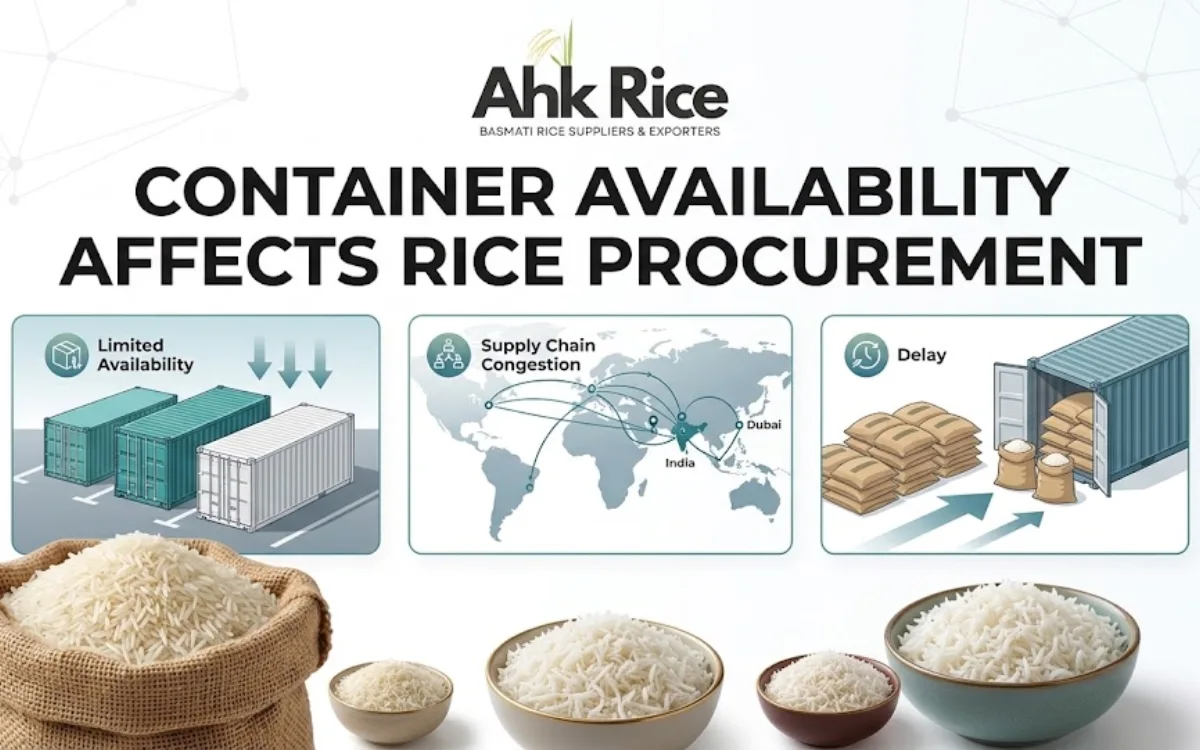
Container availability has two separate dimensions. The first is equipment availability, which concerns whether an empty container is physically available at the required origin location. The second is shipping capacity, which concerns whether a carrier has space for that container on a vessel departing within the required schedule.
A rice exporter in Punjab, Pakistan, for example, can complete milling and packaging on schedule while the export shipment still faces delay because an empty container is unavailable at the required depot. The rice is ready. The logistics chain is not.
This distinction matters because rice is a high-volume commodity. A single procurement programme can involve multiple 20-foot or 40-foot containers, depending on packaging format, payload, carrier requirements, and destination.
In August 2026, global container conditions remain influenced by capacity management, geopolitical risks, blank sailings, and route changes. Drewry reported a World Container Index of US$4,339 per 40-foot container on 13 August 2026, while 49 blank sailings were expected across major East-West trades from 17 August to 20 September, representing a 7% cancellation rate.
These figures show why rice procurement cannot treat freight as a final-stage administrative issue. Container planning forms part of the procurement decision itself.
How does container availability affect the rice supply chain?
Container availability affects rice procurement by connecting production schedules with vessel schedules. When equipment, bookings, port slots, documentation, and inland transport align, rice moves predictably. When one element fails, loading dates, delivery commitments, inventory levels, and procurement costs change.
How does rice move from farm to container?
Rice procurement starts with paddy cultivation. In Pakistan, Basmati rice production is strongly associated with Punjab, where climatic and agricultural conditions support aromatic long-grain varieties.
After harvesting, paddy passes through drying and storage before milling. Milling removes the husk and separates the edible rice kernel from other material. Further processing removes bran layers for white rice production.
A typical export processing sequence includes:
Paddy reception → cleaning → drying → dehusking → paddy separation → whitening → polishing → grading → length separation → colour sorting → quality inspection → metal detection → weighing → packaging → palletisation or container loading.
The exact sequence varies according to the product specification and processing facility.
Why does processing timing matter?
Processing determines when cargo becomes physically available for export. Container procurement works against that production schedule.
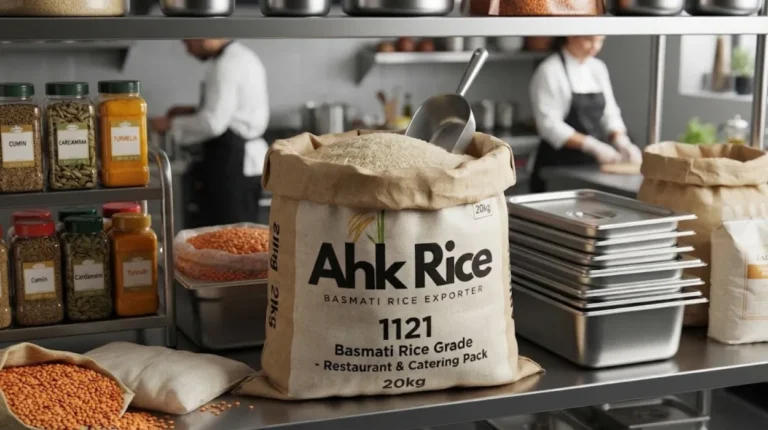
Consider a shipment of 1121 Basmati rice. The buyer requires a specific grain length, moisture specification, packaging format, quantity, and destination. The exporter completes processing according to those specifications. The next requirement is an export container and vessel booking.
If the container arrives after the planned loading date, the completed rice remains in storage. Storage time increases. The original vessel booking becomes unusable. A new booking then becomes necessary.
This creates a direct connection between production readiness and container readiness.
What happens after container loading?
Once the rice is packed and inspected, the cargo enters the export logistics process. The exporter or logistics provider arranges inland movement from the processing facility to the port.
For Pakistani rice exports, Karachi Port and Port Qasim are important maritime gateways. The container reaches the terminal, passes through required procedures, and waits for vessel loading.
The shipping line then transports the container to the destination market. Transit time depends on the route, vessel schedule, transshipment arrangements, port conditions, and geopolitical circumstances.
The procurement process therefore has several linked clocks. Production has one schedule. Container positioning has another. Port operations have another. Vessel departure creates another.
Container availability determines whether those clocks remain synchronised.
Which components determine container availability for rice shipments?
Container availability depends on empty-equipment supply, carrier allocation, depot inventory, vessel capacity, port operations, inland transport, booking windows, cargo specifications, and seasonal demand. Rice procurement succeeds when these components operate within one coordinated shipment schedule.
Empty-container supply
Shipping containers circulate between exporters, importers, terminals, depots, and shipping lines. An exporter needs an empty container at the correct origin location before loading.
A container physically located in another city does not solve an immediate loading requirement. Repositioning takes time and creates additional logistics activity.
Carrier allocation
A shipping line controls vessel capacity and equipment allocation across its network. Allocation depends on trade routes, contractual arrangements, expected cargo volumes, and network capacity.
Container availability therefore does not guarantee vessel space.
A buyer can have an empty container available but still lack a confirmed booking on the preferred sailing.
Port and terminal capacity
Ports handle vessel arrivals, container gates, storage, loading, unloading, and transshipment. Congestion changes the time required to move containers through the system.
Drewry reported that global container port throughput increased 1.5% month-on-month in May 2026 and 2.0% year-on-year, demonstrating continued cargo movement across the global network.
Blank sailings
A blank sailing occurs when a scheduled vessel departure is cancelled or removed from the published schedule. The cargo then requires another sailing.
Drewry reported 49 expected blank sailings across major East-West trades from week 34 through week 38 of 2026, equal to a 7% cancellation rate.
For rice procurement, one cancelled sailing can shift the delivery schedule without changing the rice production date.
Inland transportation
The container also requires a truck or other inland transport connection between the processing facility and port.
A container booking without a suitable trucking appointment does not create a complete export solution. The loading location, container pickup, stuffing date, port gate window, and vessel cutoff must align.
Why does container availability affect rice procurement costs?
Container availability affects procurement costs because delays create additional freight, storage, trucking, handling, demurrage, detention, and inventory expenses. Capacity shortages also increase competition for equipment and vessel space, changing the delivered cost of imported rice.
Rice procurement cost extends beyond the price of the rice itself.
The landed cost includes the product price, packaging, inland transportation, export documentation, port charges, ocean freight, insurance where applicable, import charges, customs costs, and destination logistics.
Container availability affects several of these components.
A delayed container can increase warehouse storage requirements. A missed vessel can require a later booking. A longer terminal stay can create additional charges. A changed sailing can also affect inventory planning at the destination.
Freight rates themselves fluctuate according to market conditions. Drewry’s 13 August 2026 WCI stood at US$4,339 per 40-foot container, while its Intra-Asia Container Index reached US$1,028 per 40-foot container.
The exact freight rate for Pakistani rice depends on the origin port, destination, carrier, equipment type, booking terms, season, contract, and applicable surcharges.
This is why procurement teams compare the total landed cost, rather than evaluating rice only on the quoted commodity price.
Which rice varieties and grades are affected by container planning?
Container planning applies to every export rice category because each variety requires a defined quantity, packaging configuration, quality specification, and destination schedule. Pakistani Basmati procurement commonly includes 1121, Super Kernel, and 1509 varieties with different commercial specifications.
What is 1121 Basmati rice?
1121 Basmati is a long-grain aromatic rice variety widely traded in international markets. Its long grain and characteristic aroma make it a major product category in South Asian rice exports.
Export specifications commonly define grain length, moisture, broken percentage, purity, colour, aroma, and packaging requirements.
What is Super Kernel Basmati?
Super Kernel Basmati is a premium Pakistani Basmati variety recognised for its long grain, aroma, and cooking characteristics.

Procurement specifications distinguish between whole kernels and broken grains and establish quality parameters for the shipment.
What is 1509 Basmati?
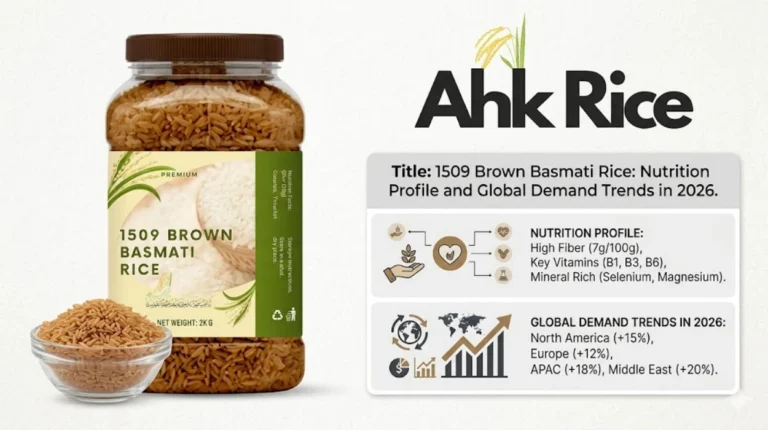
1509 Basmati is an early-maturing Basmati variety used in Pakistani rice production and international trade. It provides another long-grain aromatic option for buyers seeking particular cooking, price, or supply characteristics.
How do rice grades differ from rice varieties?
A variety identifies the rice type, such as 1121, Super Kernel, or 1509. A grade describes the commercial quality specification applied to the shipment.
Grades can distinguish factors such as:
- Whole-grain percentage
- Broken-grain percentage
- Grain length
- Moisture content
- Foreign matter
- Damaged grains
- Discoloured grains
- Milling degree
- Sortex or colour-sorting requirements
The buyer’s specification determines the required grade. Packaging also affects container utilisation because 5 kg, 10 kg, 25 kg, and 50 kg formats distribute weight and volume differently.
Which international markets depend on container availability for rice imports?
Rice importers across the Middle East, Europe, Africa, Asia, and other international markets depend on container availability because ocean freight connects producing regions with destination wholesalers, distributors, retailers, foodservice companies, and industrial buyers. Delivery requirements differ by market.
Pakistani rice has established demand across multiple international regions. Basmati markets include countries in the Middle East and Gulf, European markets, North America, and other destinations where aromatic long-grain rice forms part of consumer demand.
The procurement model differs between destinations.
A Gulf importer often operates with shorter maritime distances from Pakistan than a European buyer. A European shipment also faces specific food safety, customs, packaging, labelling, and documentation requirements.
Container planning therefore begins with the destination rather than ending at the port.
For every shipment, procurement teams need to establish the destination port, estimated transit time, vessel frequency, documentation deadline, import requirements, delivery appointment, and required arrival date.
This information determines the latest acceptable export date.
What benefits does reliable container availability provide?
Reliable container availability improves delivery predictability, inventory control, purchasing accuracy, warehouse planning, customer service, and landed-cost management. It allows rice buyers to connect purchase quantities with realistic shipping schedules instead of treating freight as an isolated transaction.
How does it improve inventory planning?
A rice importer needs enough stock to satisfy forecast demand without creating unnecessary inventory.
When container schedules are reliable, procurement teams can calculate expected arrival dates and coordinate warehouse capacity.
A shipment delay creates a different inventory position. The importer then needs to account for remaining stock, inbound cargo, safety stock, and future purchase orders.
How does it support procurement forecasting?
Container data provides an operational input for purchasing forecasts.
A procurement plan containing 20 containers of rice requires more than a product volume calculation. It requires a shipment calendar showing when those containers become available, when they depart, and when they reach the destination.
How does it improve customer fulfilment?
Importers often supply wholesalers, supermarkets, restaurants, distributors, and food manufacturers.
A missed shipment can affect several downstream orders. Reliable container planning reduces the probability of stock gaps caused by logistics delays.
What are the common misconceptions about container availability?
Container availability does not mean that unlimited shipping capacity exists. An available empty container still requires a valid booking, vessel space, port acceptance, documentation, inland transport, and compliance clearance before rice can move internationally.
Is container availability the same as vessel capacity?
No. These are separate logistics resources.
Equipment availability concerns the physical container. Vessel capacity concerns available space on a ship.
Both need to align with the export schedule.
Does booking early eliminate all shipping problems?
Early booking improves planning visibility, but shipping conditions remain dependent on carrier schedules, port operations, blank sailings, equipment positioning, and geopolitical developments.
Drewry’s 2026 data shows that carriers continue managing capacity through blank sailings while geopolitical developments continue influencing major shipping routes.
Does a lower freight rate always mean lower procurement cost?
No. A lower quoted ocean freight rate does not automatically produce the lowest landed cost.
A procurement team also needs to evaluate transit time, schedule reliability, storage exposure, port charges, inland transportation, surcharges, and inventory requirements.
The correct comparison is the total cost of receiving the specified rice at the required destination within the required timeframe.
How does container availability shape international rice procurement decisions?
Container availability turns international rice procurement into a coordinated supply-chain decision. Buyers need to connect rice specifications, production readiness, packaging, container equipment, vessel schedules, port operations, documentation, freight costs, and destination inventory into one procurement timeline.
The central relationship is simple:
Rice specification → production → packaging → container → booking → port → vessel → destination → warehouse.
A disruption at the container stage affects every stage after it.
For procurement teams, the practical response is to define shipment requirements before confirming purchase quantities. The plan needs a required arrival date, shipment volume, container type, packaging format, origin point, destination port, booking window, documentation deadline, and acceptable delivery variance.
This approach also explains why peak seasons require additional coordination. Harvest cycles increase cargo availability at producing origins. Import demand can increase simultaneously. Carrier capacity then becomes a competitive resource.
For a deeper explanation of the operational methods used during high-demand periods, see:
How exporters manage container allocation during peak seasons
This link belongs at the point where the article moves from explaining the procurement problem to explaining exporter-side capacity management.
In 2026, container markets are not defined by a single global shortage. Drewry’s current data shows significant vessel overcapacity on some major trades, while blank sailings, geopolitical disruptions, port congestion, and regional equipment constraints continue to affect actual shipment availability.
International rice procurement therefore requires a route-specific view of container availability.
A rice buyer does not simply need a container.
The buyer needs the correct container, at the correct origin, connected to the correct vessel, within the correct loading window, carrying the correct rice specification to the correct destination.
That is why container availability directly affects international rice procurement.
Frequently Asked Questions
What is container availability in international rice procurement?
Container availability refers to having the correct shipping container at the required origin location within the planned loading period. It affects rice shipment schedules, freight planning, port movement, inventory levels, and delivery commitments.
Why does container availability affect rice export costs?
Limited container availability can increase freight rates, repositioning costs, storage expenses, trucking charges, and other logistics costs. These expenses influence the final landed cost of imported rice.
Does container availability guarantee vessel space?
No. An available container and vessel capacity are separate resources. A rice exporter needs both suitable equipment and confirmed space on a scheduled vessel.
How does container availability affect rice delivery times?
A container shortage can delay cargo stuffing and cause a shipment to miss its planned vessel. The rice then moves on a later sailing, extending the overall delivery timeline.
Which Pakistani rice varieties require container planning?
Export container planning applies to Pakistani rice varieties including 1121 Basmati, Super Kernel Basmati, and 1509 Basmati. Each shipment requires specific quantity, grade, packaging, and destination planning.
How does packaging affect rice container utilisation?
Packaging determines how rice bags are arranged inside the container and affects weight distribution and available capacity. Common formats include 5 kg, 10 kg, 25 kg, and 50 kg bags.
Which markets import Pakistani Basmati rice?
Pakistani Basmati rice is exported to international markets across the Middle East, Gulf countries, Europe, North America, Africa, and Asia. Each destination has different shipping routes, import requirements, and delivery schedules.
What happens when a rice shipment misses its vessel?
The container is moved to a later sailing when the original vessel is missed. This can increase storage requirements, alter the expected arrival date, and affect downstream inventory planning.
Does peak season affect container availability?
Yes. Peak agricultural export periods can increase cargo volumes and competition for containers, vessel space, trucking capacity, and port services. Exporters therefore coordinate container allocation with production and shipping schedules.
How can rice importers reduce container-related procurement risks?
Importers can establish shipment schedules early, confirm equipment requirements, monitor vessel capacity, coordinate documentation, maintain appropriate inventory levels, and compare total landed costs rather than freight rates alone.
What is the difference between container availability and container allocation?
Container availability means suitable equipment exists at the required location. Container allocation means a shipping line or logistics provider assigns that equipment to a particular shipment, booking, or customer.
Why is container availability important for international rice procurement?
Container availability connects rice production with international transportation. Without suitable equipment and vessel capacity, processed and packaged rice cannot move from the exporting country to the intended international market on schedule.