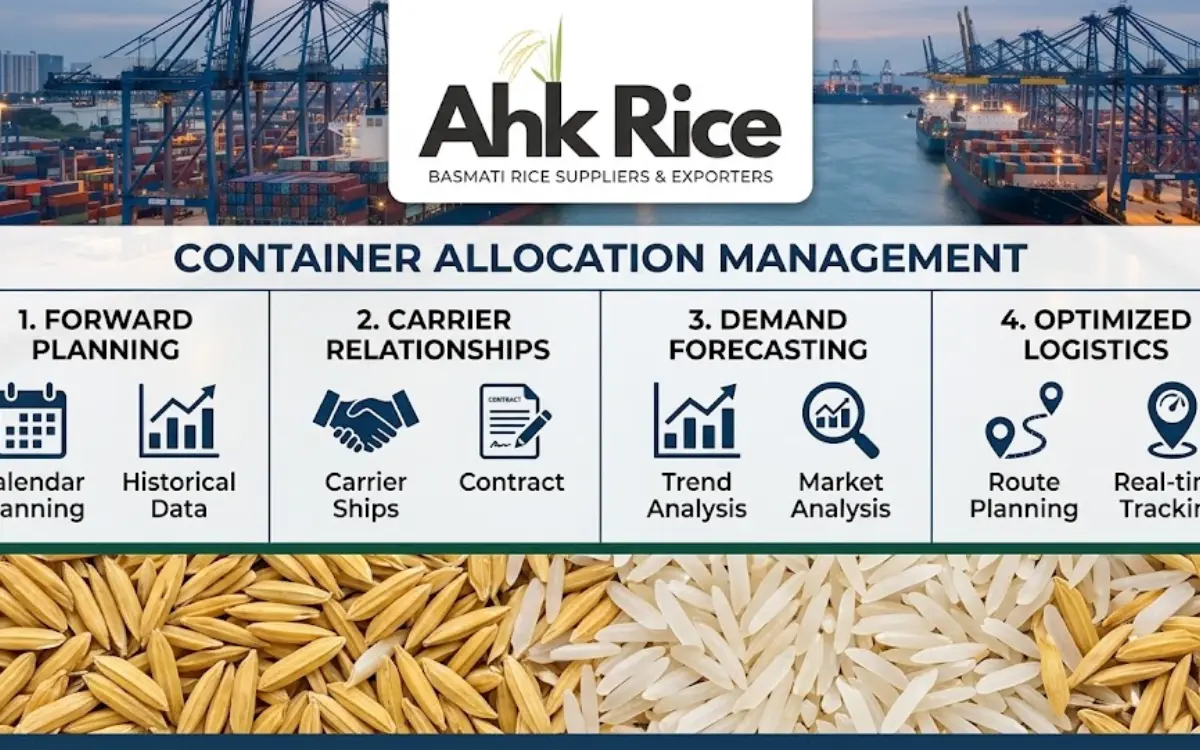
How Do Exporters Manage Container Allocation During Peak Seasons?
Exporters manage peak-season container allocation best through early forecasting, carrier booking commitments, equipment planning, production scheduling, and alternative routing rather than relying on last-minute spot bookings.
Peak season creates a direct connection between product readiness and shipping capacity. For rice exporters, a container is not only a transport unit. It connects milling, packaging, documentation, port handling, vessel space, freight cost, and importer inventory planning. In 2026, this relationship is especially important because global container demand remains strong while effective capacity is constrained by congestion and vessel detours.
For buyers learning why this matters before comparing procurement strategies, the educational guide:
Why Does Container Availability Affect International Rice Procurement?
AHK Rice manages Pakistani Basmati supply from Punjab through processing, grading, packaging, documentation, container loading, and shipment coordination. Its export service covers varieties including 1121, Super Kernel, and 1509, with destination-specific packaging and export requirements.
What happens to container allocation during peak seasons?
Peak-season allocation becomes a controlled capacity-planning process because exporters compete for equipment, vessel space, loading windows, and reliable sailing schedules while importers increase shipment requirements and carriers manage available capacity.
Container allocation refers to the process of securing suitable empty containers and reserving vessel capacity for a shipment. The exporter or freight forwarder coordinates container type, quantity, pickup location, loading date, port, carrier, and sailing schedule.
Peak season changes the normal balance. Importers bring inventory forward, exporters receive more purchase orders, and carriers adjust vessel deployment according to demand. In 2026, Asian export demand remains strong, while effective ocean capacity remains restricted by congestion and alternative vessel routings.
The 2026 peak season also started earlier than the traditional late-summer pattern. Freightos reported strong peak-season demand from late May through early July, while U.S. importers continued to experience uneven capacity across transpacific gateways.
This means a rice exporter cannot treat container booking as the final step after production. The booking decision becomes part of procurement planning from the beginning.
What are the available solutions for peak-season container allocation?
The main solutions are advance carrier booking, forwarder allocation, contract space, multi-carrier planning, equipment positioning, rolling shipment schedules, and alternative-port routing, with each method addressing a different capacity constraint.
Advance carrier booking
Advance booking reserves vessel space before the shipment enters the most congested part of the peak season. Exporters forecast expected monthly tonnage and submit bookings early rather than waiting for confirmed cargo availability.
For example, an exporter planning 100 MT of Basmati for September shipment can divide the volume into several container bookings instead of requesting all equipment immediately before loading.
Freight-forwarder allocation
A freight forwarder consolidates demand across multiple exporters and works with shipping lines to secure space. This model gives smaller exporters access to carrier networks without managing every carrier relationship directly.
The forwarder also monitors rollovers, blank sailings, equipment shortages, port congestion, and alternative vessel schedules.
Contracted or named-account space
Large-volume exporters and importers use annual or seasonal carrier agreements to establish predictable allocation. Named-account space gives the shipper a commercial relationship with the carrier instead of depending entirely on spot-market availability.
This approach becomes valuable for recurring rice programs where shipment volumes are known months in advance.
Multi-carrier allocation
Using several shipping lines reduces dependence on one carrier’s equipment position or sailing schedule. A rice exporter can maintain primary, secondary, and contingency carrier options.
The strategy does not mean booking every carrier simultaneously. It means maintaining operational alternatives when one carrier experiences equipment shortages or blank sailings.
Alternative gateway planning
Exporters also manage allocation through destination flexibility. A buyer targeting the U.S. market can evaluate New York, Los Angeles, Houston, or another suitable gateway according to available capacity and inland transportation.
This is increasingly relevant in 2026 because transpacific capacity differs between U.S. coastal gateways. East Coast capacity remains tighter than some West Coast services, while carrier network decisions and Panama Canal conditions influence the balance.
How do different container allocation approaches compare?
Advance booking provides the strongest planning control, spot booking provides flexibility, contracted allocation supports recurring volume, and multi-carrier planning provides resilience when equipment shortages or vessel disruptions affect individual services.
| Attribute | Advance Booking | Contract Allocation | Multi-Carrier Planning | Spot Booking |
|---|---|---|---|---|
| Capacity control | High | Very high | High | Low |
| Price predictability | Medium-high | High | Medium | Low |
| Flexibility | Medium | Medium | High | Very high |
| Equipment risk | Lower | Lower | Low-medium | High |
| Administrative workload | Medium | High | High | Low |
| Best shipment pattern | Planned seasonal cargo | Recurring large-volume cargo | Multi-market programs | Urgent or irregular cargo |
| Peak-season suitability | High | Very high | Very high | Low |
The comparison shows why no single allocation method fits every rice importer. A company with predictable monthly demand benefits from contracted space. A smaller importer with irregular orders benefits from forwarder-managed allocation.
Multi-carrier planning provides the strongest operational resilience when the buyer serves several markets. Spot booking remains useful when timing changes suddenly, but it exposes the shipment to current capacity and rate conditions.
In August 2026, this distinction remains important. Market reports show that overall demand has softened from earlier peak levels, but capacity remains tight on several services, with some named-account and long-term contract space still controlled by carriers.
How do exporters manage container allocation step by step?
Exporters manage allocation by forecasting demand, confirming rice specifications, scheduling production, requesting equipment, reserving vessel space, monitoring booking status, loading containers, and maintaining backup sailing options until departure.
Step 1: Forecast shipment demand
The exporter first converts purchase forecasts into container requirements. A 120 MT order, for example, requires a defined container plan based on the permitted payload, packaging format, and destination requirements.
The forecast also separates confirmed orders from expected orders. Confirmed cargo receives priority because it has contractual shipment requirements.
Step 2: Match production with loading dates
Production scheduling connects rice availability with container allocation. Milling, grading, sorting, packaging, inspection, and documentation must finish before the container loading window.
AHK Rice operates an integrated process covering paddy sourcing, milling, grading, colour sorting, packaging, export documentation, and container loading.
Step 3: Request equipment early
The exporter provides the carrier or forwarder with the required container quantity and pickup schedule. Equipment planning considers whether the shipment uses standard dry containers or another approved configuration.
Early requests give logistics teams more time to solve empty-container shortages.
Step 4: Confirm vessel space
Equipment availability and vessel space are separate issues. An empty container can exist without confirmed vessel capacity, while vessel space can exist without the required equipment at the loading location.
Exporters therefore confirm both elements before treating the shipment as operationally secure.
Step 5: Monitor booking status
The booking remains under active monitoring until the container is gated into the terminal. Exporters track equipment release, pickup, cut-off time, vessel schedule, port congestion, and possible rollovers.
This control prevents a common mistake: treating a booking confirmation as equivalent to a completed shipment.
Step 6: Maintain a contingency
A contingency plan identifies the next available sailing, alternate carrier, alternate gateway, or revised loading date. The exact backup depends on the destination and the buyer’s inventory tolerance.
Which rice grades and markets require the strongest allocation planning?
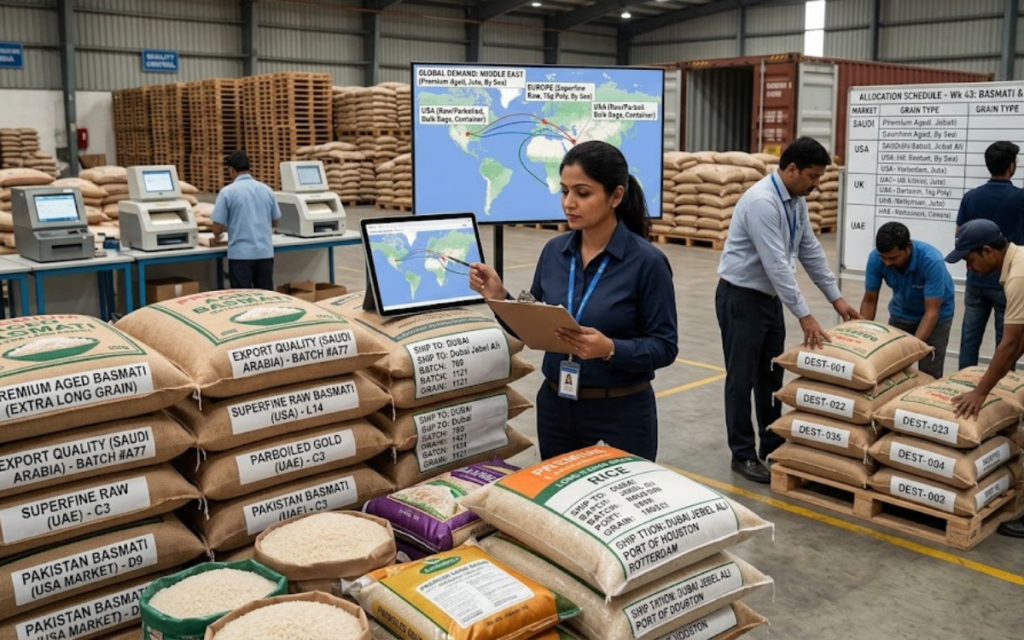
Premium Basmati programs require stronger allocation discipline because buyers purchase specific grain characteristics, processing grades, packaging formats, and shipment schedules, while regional demand determines the preferred combination of product and logistics.
Gulf markets: Saudi Arabia and nearby GCC buyers
Gulf markets strongly favour long-grain Basmati for household, food-service, biryani, mandi, and kabsa applications. Pakistan’s trade statistics identify the UAE and Saudi Arabia among major destinations for Pakistani Basmati exports, with Saudi Arabia accounting for more than 101,000 MT in FY2024.
For this region, 1121 Sella, Golden Sella, and other parboiled formats are strong commercial choices. Saudi-market export data also shows 1121 Sella and related premium Basmati grades as active shipment categories.
Indicative August 2026 pricing provides a useful benchmark. One current market listing places 1121 Sella at approximately $1,135–$1,175 per MT FOB Karachi, with an indicative $178/MT freight component to Jeddah or Dammam, producing approximately $1,313–$1,353/MT CNF. These are market indicators rather than a fixed AHK Rice quotation.
U.S. market: Missouri and wider U.S. distribution
U.S. buyers require a different logistics structure because ocean transit from Karachi is longer and inland distribution adds another planning layer. AHK Rice’s U.S. export specification includes 1121 Sella, Super Kernel, traditional white Basmati, and 1509 options, with customized retail and bulk packaging.
For Missouri importers, the container decision involves the U.S. gateway plus inland transportation to the final warehouse. The importer therefore evaluates total landed cost instead of only the ocean freight quotation.
Current indicative Pakistan FOB pricing places 1121 Basmati around $1,135–$1,205/MT, depending on processing type and specification. U.S. CNF pricing requires a live freight quotation because destination, carrier, gateway, container availability, and inland costs change the landed amount.
| Market region | Common grade preference | Indicative price benchmark | Shelf-life planning | Container priority |
| Saudi Arabia / GCC | 1121 Sella, Golden Sella, Steam | ~$1,135–$1,175/MT FOB; ~$1,313–$1,353/MT CNF Jeddah/Dammam for 1121 Sella | Long storage potential when sealed, dry, and protected | High |
| Missouri / U.S. | 1121 Sella, 1121 Steam, White Basmati, Super Kernel, 1509 | ~$1,135–$1,205/MT FOB Karachi for comparable 1121 grades; U.S. landed price requires live freight | Long storage potential under controlled dry storage | Very high |
Shelf life is primarily a storage and packaging issue rather than a geographic characteristic. Properly stored milled white and parboiled rice has very long storage potential, while moisture, pests, oxygen exposure, temperature, and packaging condition determine quality retention. USA Rice describes properly stored milled rice as having an almost indefinite pantry shelf life.
This makes container allocation especially important for Missouri buyers with longer supply chains. A longer ocean and inland route does not automatically make Basmati unsuitable, but it increases the importance of moisture control, packaging integrity, fumigation, documentation, and warehouse conditions.
For Missouri buyers evaluating a supplier with structured shipment planning:
AHK Rice Supports Missouri Importers with Scheduled Container Availability provides a practical example of how scheduled container coordination supports regular rice procurement.
Which method works best for different importer cases?
The best allocation method depends on order frequency, annual volume, destination flexibility, inventory coverage, price sensitivity, and tolerance for shipment delays rather than simply choosing the cheapest freight option available.
A recurring supermarket importer with predictable monthly demand benefits from contracted or advance allocation. The buyer gains stronger planning control and reduces exposure to last-minute capacity shortages.
A food-service distributor with variable demand benefits from a multi-carrier model. It can reserve a baseline volume while retaining flexibility for additional shipments.
A new importer placing one or two trial containers benefits from forwarder-managed allocation. The forwarder handles carrier selection, equipment coordination, and sailing alternatives while the importer focuses on product specifications and compliance.
A high-volume importer serving several U.S. states benefits from gateway diversification. The buyer evaluates the combined cost of ocean freight, port handling, customs clearance, and inland transportation instead of treating the nearest port as the automatic choice.
What are the pros and cons of each container allocation strategy?
Advance allocation improves reliability but reduces flexibility, contract space improves predictability but requires volume commitment, multi-carrier planning improves resilience but adds management complexity, while spot booking remains flexible but creates greater peak-season capacity and price exposure.
Advance booking
The primary advantage is planning certainty. Production and logistics teams can align loading dates with vessel schedules.
The disadvantage is reduced flexibility when purchase orders change. A buyer that books too early without demand visibility can create unused capacity or costly amendments.
Contract allocation
The main advantage is recurring capacity. A buyer with stable demand receives a defined commercial structure for regular shipments.
The disadvantage is commitment. Contract structures work best when shipment volumes remain reasonably predictable.
Multi-carrier planning
The main advantage is resilience. A problem with one carrier does not automatically stop the entire shipment program.
The disadvantage is operational complexity. Different carriers have different cut-off times, documentation systems, sailing frequencies, and equipment conditions.
Spot booking
The main advantage is flexibility. The importer books according to immediate requirements.
The disadvantage is peak-season exposure. Rates, equipment, and available vessel space change quickly. August 2026 market reports continue to show uneven capacity, equipment shortages, and blank-sailing risks across major services.
What factors should buyers use to evaluate container allocation?
Buyers should evaluate allocation through five factors: capacity reliability, total landed cost, equipment availability, shipment timing, and contingency strength, because a low freight quote has limited value when the container cannot move on schedule.
| Decision factor | What to evaluate | Example |
| Capacity reliability | Confirmed space, equipment access, carrier history | 10 containers scheduled across two sailings |
| Total landed cost | Rice price, freight, insurance, port and inland costs | Compare FOB plus logistics against CNF/CIF |
| Equipment availability | Empty-container release and loading location | Confirm equipment before final production |
| Shipment timing | Cut-off, sailing, transit and delivery windows | Protect two weeks of inventory coverage |
| Contingency strength | Alternative carrier, sailing or gateway | Move from one carrier to another after a rollover |
The first factor is reliability. A low rate does not compensate for a missed sailing when the importer is supplying supermarkets or food-service customers.
The second factor is landed cost. Rice price and freight must be assessed together. The same FOB price can produce different landed costs when destinations, carrier conditions, or inland transport requirements change.
The third factor is equipment. Exporters need the correct empty containers at the correct location and time. Equipment shortages create delays even when vessel capacity exists.
The fourth factor is timing. Buyers need a shipment schedule linked to inventory consumption rather than an isolated vessel departure.
The fifth factor is contingency strength. A resilient export program identifies what happens after a rollover, blank sailing, port delay, or equipment shortage.
What is the most effective peak-season container strategy for rice importers?
The strongest strategy combines early allocation, production readiness, multiple carrier options, destination flexibility, and shipment buffers, creating a controlled supply program instead of relying on individual container bookings during periods of capacity pressure.
For AHK Rice buyers, the practical process starts with product specification. The importer defines the variety, processing grade, grain requirements, packaging, quantity, destination port, and Incoterm before logistics planning begins. AHK Rice provides export options covering 1121, Super Kernel, and 1509 and coordinates processing, packaging, documentation, and shipment preparation.
The second layer is production synchronization. Rice must be ready when the container is available. This avoids both situations that create unnecessary cost: a container waiting for rice and rice waiting for a container.
The third layer is carrier diversification. A primary carrier can handle the standard shipment plan while a secondary option protects against equipment or schedule disruption.
The fourth layer is destination flexibility. U.S. buyers, including Missouri importers, benefit from evaluating the gateway and inland route together. Gulf buyers generally have shorter sailing distances from Karachi, but they still require allocation planning during concentrated demand periods.
The final layer is continuous monitoring. Container allocation does not end when the booking is issued. Equipment release, terminal cut-off, vessel schedule, documentation, and gate-in status all determine whether the shipment actually moves.
This approach becomes more important in 2026 because peak-season conditions remain uneven. U.S. import volumes reached 2.5 million TEUs in July 2026, the fourth-highest July level recorded by Descartes, while early peak-season demand and tariff-related frontloading continued to influence shipping patterns.
Exporters that treat containers as part of the procurement plan rather than as a final transportation task gain better control over delivery schedules, inventory continuity, and landed-cost planning. Importers gain the same advantage by evaluating the exporter according to production capacity, allocation discipline, carrier access, documentation capability, and contingency planning.
For AHK Rice, the relevant service connection is its Pakistan rice export service, which covers export-oriented processing, packaging, documentation, and shipment coordination for international buyers.
Frequently Asked Questions
What is container allocation in rice exports?
Container allocation is the process of securing empty containers and vessel space for scheduled rice shipments. It connects production, loading, documentation, port handling, and ocean transport.
Why does container allocation become difficult during peak seasons?
Peak seasons increase shipping demand, equipment requirements, and competition for vessel space. Congestion, blank sailings, and equipment shortages also create scheduling pressure.
How early should rice exporters arrange containers?
Rice exporters arrange containers before the planned loading period. Early planning gives logistics teams time to secure equipment, confirm vessel space, and prepare alternatives.
Which container allocation method works best for regular rice imports?
Contract allocation or advance booking works best for regular import programmes. These methods provide stronger capacity planning for predictable shipment volumes.
How does multi-carrier planning reduce shipping risk?
Multi-carrier planning prevents dependence on one shipping line. If one carrier faces equipment shortages, schedule changes, or rollovers, another carrier provides an alternative.
Which Pakistani Basmati rice varieties are commonly exported?
Common Pakistani Basmati varieties include 1121, Super Kernel, and 1509. Exporters provide different processing grades, including Sella, Steam, and White Basmati, according to market requirements.
How do Saudi Arabia and U.S. rice markets differ?
Saudi and wider GCC markets commonly purchase premium Basmati grades such as 1121 Sella and Golden Sella. U.S. buyers use 1121, Super Kernel, 1509, and other Basmati specifications based on retail and food-service requirements.
How does shelf life affect container planning?
Rice has long storage potential when properly processed, packaged, and stored in dry, controlled conditions. Importers still need shipment schedules that protect product quality and inventory continuity.
What factors should importers consider before approving container allocation?
Importers should evaluate capacity reliability, total landed cost, equipment availability, shipment timing, and contingency options before selecting an allocation strategy.
How can exporters maintain reliable rice shipments during peak seasons?
Exporters maintain reliability through early forecasting, production scheduling, advance container requests, carrier diversification, continuous booking monitoring, and backup sailing or routing options.