Why Does Moisture Content Matter When Exporting Pakistan Basmati Rice to Saudi Arabia?
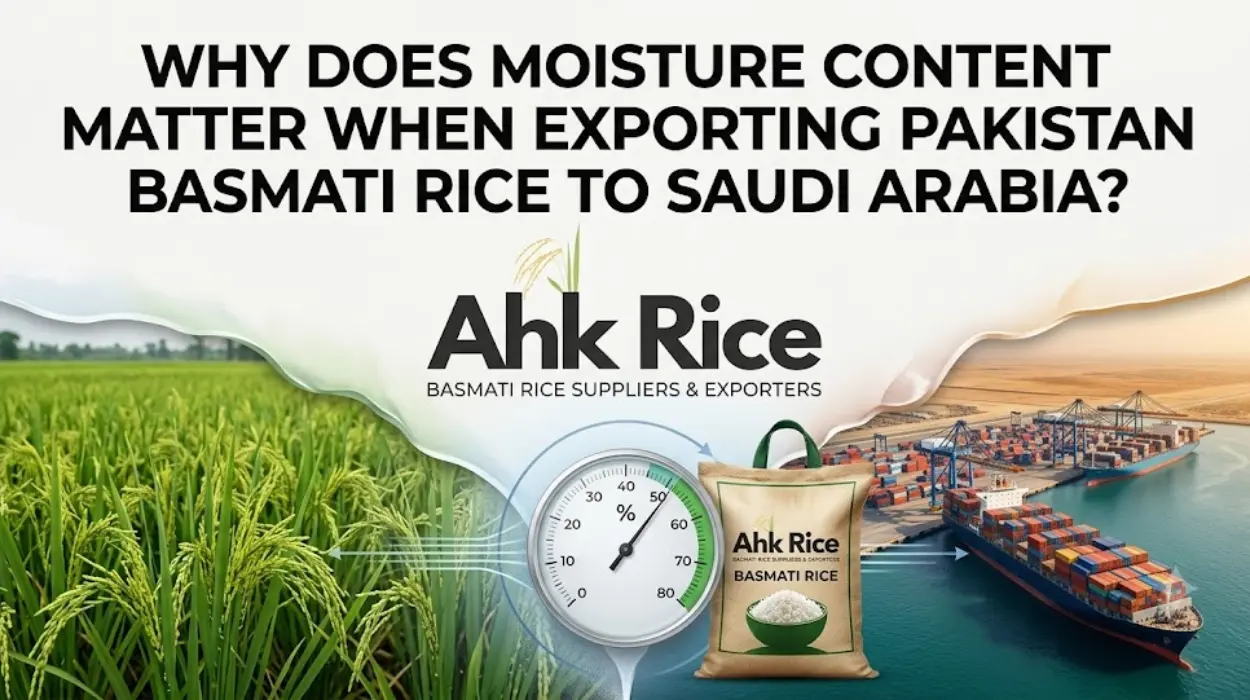
Moisture content is the percentage of water present inside rice grains. It directly affects grain quality, shelf life, milling yield, cooking performance, transport safety, and compliance with Saudi Arabian food import standards for Pakistan Basmati rice.
Moisture content measures the amount of water retained within each rice kernel after harvesting, drying, milling, and packaging. It is expressed as a percentage of the grain’s total weight. In international rice trade, moisture is one of the first quality parameters checked before shipment because it influences almost every stage of the export chain.
Pakistan is one of the world’s leading producers of premium Basmati rice. Punjab remains the primary growing region for export-quality Basmati varieties including 1121 Basmati, Super Kernel Basmati, and 1509 Basmati. Each variety follows controlled post-harvest handling to achieve export-grade moisture levels before international dispatch.
Saudi Arabia is among the largest import markets for Pakistani Basmati rice. Importers evaluate moisture content alongside grain length, purity, broken percentage, aroma, foreign matter, and milling quality before accepting shipments.
Maintaining the correct moisture percentage protects both exporters and importers from financial losses caused by damaged rice.
Why Does Moisture Content Matter During Rice Export?
Correct moisture content preserves grain quality, reduces spoilage, prevents fungal growth, protects aroma, improves transportation safety, increases storage stability, and ensures exported Pakistan Basmati rice reaches Saudi Arabia in market-ready condition.
Rice travels thousands of kilometres from Pakistan to Saudi Arabia through ports, containers, warehouses, and distribution centres. During this journey, the grain experiences changes in temperature and humidity.
Excess moisture creates favourable conditions for biological activity. Higher water content increases respiration inside the grain and supports mould development. This reduces shelf life and weakens grain quality.
Very low moisture creates a different problem. Over-dried rice becomes brittle during milling and transportation. Brittle kernels break more easily, increasing the percentage of broken rice and reducing commercial value.
Exporters therefore aim for balanced moisture that protects grain integrity while meeting importer specifications.
Moisture also influences cooking quality. Consumers in Saudi Arabia expect long, fluffy Basmati rice with distinct grains and natural aroma. Correct moisture helps preserve these characteristics throughout storage and distribution.
How Is Moisture Content Controlled During Pakistan Basmati Rice Processing?

Moisture content is controlled through harvesting, cleaning, drying, storage, milling, laboratory testing, packaging, and container inspection. Every stage protects grain quality before export documentation and international shipping.
Harvesting at the Correct Maturity
Farmers harvest Basmati rice after physiological maturity. Harvesting too early leaves excess moisture inside the grain, while delayed harvesting increases field losses and grain cracking.
Proper harvesting timing creates a stable foundation for the remaining processing stages.
Cleaning Fresh Paddy
Freshly harvested paddy passes through cleaning equipment that removes impurities, including straw, stones, dust, weed seeds, and damaged grains.
Clean paddy dries more uniformly than contaminated batches.
Controlled Drying
Drying is one of the most important processing stages.
Modern rice processing facilities use controlled drying systems to gradually reduce moisture without damaging grain structure.
Rapid drying creates internal stress within kernels. Controlled drying maintains grain strength while preserving natural aroma.
Storage Before Milling
After drying, paddy rests in controlled storage.
This stabilisation period allows moisture to distribute evenly throughout each grain before milling.
Milling Process
The milling stage removes husk and bran layers while protecting kernel length.
Balanced moisture reduces grain breakage during whitening and polishing.
Laboratory Testing
Quality laboratories regularly test moisture using calibrated moisture meters and standard analytical methods.
Each production lot is verified before packaging.
Packaging
Export packaging protects rice from absorbing environmental moisture during transportation.
Common export packaging includes woven polypropylene bags, BOPP laminated bags, paper bags, and customised retail packs.
Container Inspection
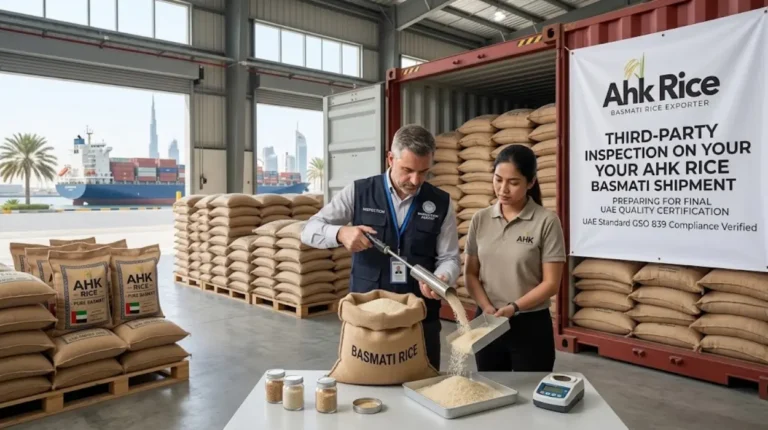
Before loading, containers undergo inspection for cleanliness, odour, structural condition, and moisture presence.
Dry containers reduce condensation risks during sea transport.
What Moisture Level Is Generally Used for Export-Grade Pakistan Basmati Rice?
Export-grade Pakistan Basmati rice is commonly prepared within internationally accepted commercial moisture ranges that support safe transportation, storage stability, milling quality, and importer quality inspections throughout the export supply chain.
International rice trade follows recognised quality practices that keep moisture within controlled commercial limits before shipment.
Export laboratories verify every production batch before loading.
Different buyers specify their own contractual moisture requirements depending on product type, storage duration, destination climate, and retail distribution plans.
Saudi Arabian importers often include moisture specifications in purchase contracts together with limits for broken grains, damaged kernels, foreign matter, chalkiness, and purity.
Understanding:
How Saudi buyers define acceptable moisture specifications for Pakistan 1121 Basmati rice during quality inspection provides a more detailed explanation of importer expectations.
What Quality Components Are Influenced by Moisture Content?
Moisture content affects grain appearance, aroma, milling efficiency, cooking quality, storage performance, transportation safety, insect activity, packaging stability, and overall export acceptance across international rice markets.
Moisture influences numerous quality characteristics simultaneously.
Grain Length
Balanced moisture helps preserve the famous extra-long kernels associated with Pakistan 1121 Basmati rice.
Aroma
Natural Basmati fragrance develops through specific aromatic compounds.
Stable moisture helps retain these compounds throughout storage and transportation.
Milling Yield
Rice processors measure head rice yield after milling.
Proper moisture reduces kernel breakage and improves recovery of whole grains.
Storage Stability
Balanced moisture slows biological deterioration during warehouse storage.
Cooking Performance
Consumers expect rice that cooks evenly, elongates well, and remains separate after cooking.
Correct moisture supports these characteristics.
Packaging Integrity
Dry packaging environments reduce condensation inside bags and shipping containers.
What Grades of Pakistan Basmati Rice Are Commonly Exported?
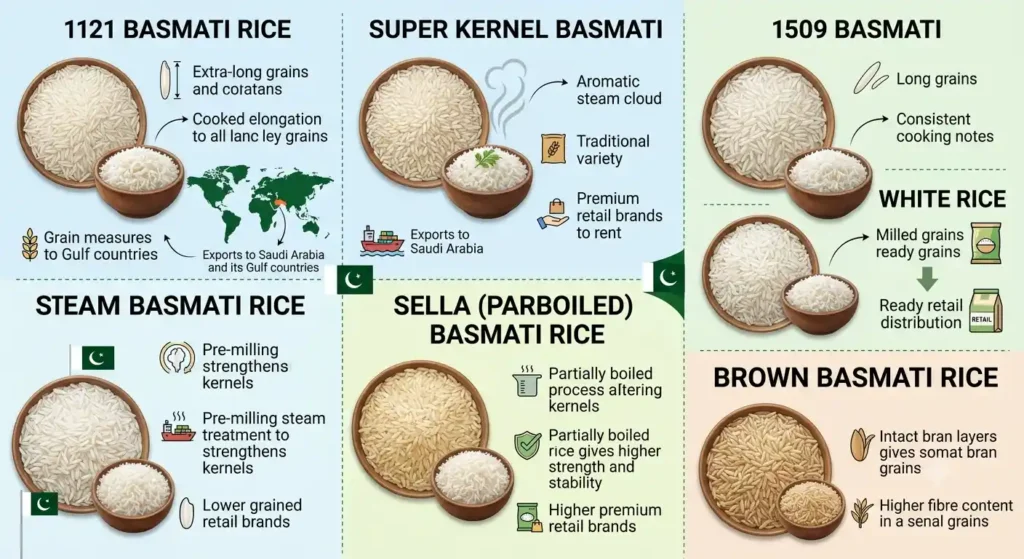
Pakistan exports several commercial Basmati grades including 1121 Basmati, Super Kernel Basmati, 1509 Basmati, Brown Basmati, Steam Basmati, Sella Basmati, White Basmati, and premium sorting grades for international buyers.
Pakistan produces multiple export categories to meet different market requirements.
1121 Basmati Rice
Known for extra-long grains and exceptional cooked grain elongation.
Widely exported to Saudi Arabia and Gulf countries.
Super Kernel Basmati
Traditional aromatic variety with strong global demand.
Popular among premium retail brands.
1509 Basmati
Early-maturing variety offering long grains and consistent cooking performance.
White Basmati Rice
Fully milled rice prepared for immediate retail distribution.
Steam Basmati Rice
Processed using steam treatment before milling to strengthen kernels.
Sella (Parboiled) Basmati Rice
Partially boiled before milling.
Offers higher grain strength and excellent cooking stability.
Brown Basmati Rice
Only the husk is removed.
The bran layer remains intact, providing higher fibre content.
Which Countries Import Pakistan Basmati Rice?
Pakistan exports Basmati rice to Saudi Arabia, the United Arab Emirates, Oman, Qatar, Kuwait, Bahrain, Iraq, the United Kingdom, Canada, Australia, Europe, Africa, and North America through established international trade networks.
Saudi Arabia remains one of Pakistan’s largest Basmati rice destinations because of strong consumer demand for aromatic long-grain rice.
Other Gulf Cooperation Council markets also import significant quantities for retail supermarkets, wholesalers, hotels, restaurants, and catering businesses.
Outside the Middle East, Pakistani Basmati reaches Europe, North America, and Australia, where ethnic food markets and mainstream retailers continue expanding premium rice selections.
Each importing country applies its own food safety requirements, labelling regulations, packaging rules, and quality inspections before customs clearance.
Which Certifications Support Pakistan Basmati Rice Exports?
International rice exports rely on recognised certifications covering food safety, quality management, traceability, hygiene, phytosanitary compliance, laboratory testing, and export documentation required by destination markets including Saudi Arabia.
Export certification demonstrates that rice has been processed under controlled systems.
Common certifications and documentation include:
Food Safety Management
Food safety management systems verify hygienic processing and risk control throughout production.
HACCP
Hazard Analysis and Critical Control Points identifies food safety risks and establishes preventive controls.
ISO-Based Quality Systems
International quality management standards improve process consistency and documentation.
Phytosanitary Certificate
National plant protection authorities issue phytosanitary certificates confirming compliance with plant health regulations.
Certificate of Origin
This document confirms the country where the rice was produced.
Laboratory Quality Reports
Independent laboratory analysis verifies moisture, purity, broken percentage, foreign matter, and other quality specifications requested by buyers.
What Problems Are Caused by Incorrect Moisture Content?
Incorrect moisture reduces export quality through mould growth, insect infestation, grain cracking, reduced milling yield, shorter shelf life, packaging damage, container condensation, and increased commercial disputes between exporters and importers.
High moisture creates favourable conditions for storage fungi.
Fungal activity discolours grains and reduces market value.
Warm, humid environments also encourage insect development during storage.
Low moisture introduces another commercial challenge.
Over-dried kernels become fragile.
This increases broken grain percentages during milling, handling, and transportation.
Container condensation also becomes a concern when moisture differences exist between cargo and external environmental conditions.
Condensation introduces unwanted water inside shipping containers, affecting packaging and product quality.
These risks explain why moisture measurement remains one of the most frequently verified quality parameters before export.
What Are Common Misconceptions About Rice Moisture Content?
Many people assume higher moisture improves freshness or lower moisture guarantees better quality. Professional rice exporting relies on balanced moisture because excessive or insufficient water content both reduce commercial performance.
One misconception is that wetter rice always tastes better.
In reality, excessive moisture shortens storage life and increases spoilage risks.
Another misconception is that drying rice as much as possible improves quality.
Over-drying weakens kernel structure and increases breakage during milling.
Some buyers also believe moisture only affects storage.
Moisture actually influences harvesting, drying, milling, packaging, shipping, cooking quality, retail shelf life, and customer satisfaction.
Professional exporters therefore monitor moisture throughout the complete production chain instead of checking it only before shipment.
Why Does Moisture Management Remain Essential for Pakistan Basmati Rice Exports?
Balanced moisture content protects quality from harvest through delivery, supports international compliance, preserves premium Basmati characteristics, reduces commercial losses, and strengthens confidence between exporters and importers across global rice markets.
Moisture content represents far more than a laboratory measurement.
It reflects the effectiveness of harvesting practices, drying systems, storage management, milling operations, packaging quality, logistics planning, and export inspection.
For Pakistan Basmati rice exported to Saudi Arabia, maintaining balanced moisture helps preserve grain appearance, natural aroma, cooking performance, and storage stability throughout the international supply chain.
As global food safety expectations continue evolving in 2026, moisture management remains one of the most important quality indicators evaluated before rice enters international markets.
Frequently Asked Questions
What is the ideal moisture content for exporting Pakistan Basmati rice?
Export-quality Pakistan Basmati rice is processed within internationally accepted moisture limits to maintain grain quality, storage stability, and compliance with buyer specifications.
Why do Saudi Arabian importers check moisture content in Basmati rice?
Saudi importers check moisture content to ensure the rice remains safe during shipping, maintains its aroma and texture, and meets agreed quality standards.
How is moisture content measured in export-grade rice?
Moisture content is measured using calibrated digital moisture meters and laboratory testing before packaging and shipment to verify compliance with export specifications.
Does moisture content affect the shelf life of Basmati rice?
Yes. Proper moisture content helps extend shelf life by reducing the risk of mould growth, insect infestation, and quality deterioration during storage.
Can high moisture damage a shipment of Basmati rice?
Yes. Excess moisture can cause fungal growth, unpleasant odours, grain discoloration, and container condensation, leading to quality claims and financial losses.
Does low moisture content reduce rice quality?
Very low moisture can make rice kernels brittle, increasing breakage during milling, transportation, and handling while reducing head rice yield.
Which Pakistani Basmati rice varieties are commonly exported to Saudi Arabia?
The most commonly exported varieties include 1121 Basmati, Super Kernel Basmati, 1509 Basmati, Steam Basmati, Sella Basmati, and Brown Basmati Rice.
What certifications support Pakistan Basmati rice exports?
Exporters commonly use certifications and documents such as HACCP, ISO-based quality management systems, phytosanitary certificates, certificates of origin, and laboratory quality reports.
How does moisture content affect the cooking quality of Basmati rice?
Balanced moisture helps preserve grain integrity, allowing Basmati rice to cook evenly, elongate properly, and remain separate after cooking.
Why is moisture management important throughout the rice export process?
Moisture management protects rice quality from harvesting and drying through milling, packaging, shipping, and storage, ensuring the product reaches buyers in excellent condition.