Why Is Moisture Control Critical for Maintaining Pakistan Basmati Rice Quality in Saudi Arabia?
Pakistan Basmati rice maintains its aroma, grain length, cooking performance, and export quality only when moisture levels remain within the correct range from milling to final delivery. Saudi Arabia’s hot climate, varying humidity during transport, and long shipping routes make moisture control one of the most important quality management practices in the rice supply chain.
What Is Moisture Control in Pakistan Basmati Rice Exports?
Moisture control is the process of maintaining rice within a specified moisture range throughout harvesting, drying, milling, storage, packaging, shipping, and distribution to preserve grain quality, reduce breakage, maintain aroma, and comply with international export standards for importing countries such as Saudi Arabia.
Moisture content refers to the percentage of water present inside a rice grain. It directly affects grain strength, milling recovery, cooking quality, storage life, and food safety.
For Pakistani Basmati rice, export-quality moisture generally remains between 12% and 14%, depending on the buyer’s specifications and the type of processing. This range provides enough internal moisture to maintain grain strength without encouraging mould growth or quality deterioration.
Saudi Arabia imports large volumes of Pakistani Basmati because consumers value its extra-long grains, natural fragrance, and cooking expansion. Maintaining these characteristics requires stable moisture from the processing facility until the rice reaches wholesalers and retailers.
Moisture control is not a single activity. It is a continuous quality management system that starts in the rice fields of Punjab and continues until the shipment arrives at Saudi Arabian ports.
How Does Moisture Control Work Throughout the Export Process?
Moisture control works by measuring, adjusting, monitoring, and protecting grain moisture at every stage of production using scientific testing, controlled drying, proper storage conditions, moisture-resistant packaging, and continuous inspection during transportation.
Each processing stage influences the moisture level inside the grain.
Harvesting
Farmers harvest mature rice at the correct physiological stage. Harvesting rice with excessive moisture reduces milling efficiency and increases drying costs.
Drying
Freshly harvested paddy contains high moisture. Controlled drying removes excess water gradually until the desired level is achieved. Uniform drying prevents stress cracks inside the grain.
Cleaning
Dust, straw, immature grains, stones, and foreign materials are removed before milling. Clean rice absorbs moisture more consistently during storage.
Milling
The husk and bran layers are removed using calibrated milling equipment. Proper moisture improves milling efficiency and reduces broken kernels.
Grading
Rice passes through grading machines that separate grains according to length, thickness, colour, and defects.
Examples include:
- Head rice
- Broken rice
- Small broken rice
- Brewer rice
Uniform grading improves export consistency.
Storage
Warehouses maintain controlled ventilation and dry conditions. Moisture migration between grain layers is prevented through proper stacking and inventory rotation.
Packaging
Export packaging acts as a moisture barrier. Multi-layer polypropylene bags, woven bags with liners, vacuum packaging, and retail laminated packs reduce moisture exchange with the surrounding environment.
Shipping
Containers remain clean, dry, and properly ventilated before loading. Moisture monitoring continues during international sea transport.
Which Factors Influence Moisture Levels During Export to Saudi Arabia?
Climate conditions, warehouse management, container preparation, packaging materials, storage duration, grain maturity, processing quality, and shipping practices determine whether Pakistan Basmati rice maintains stable moisture throughout the export journey to Saudi Arabia.
Pakistan and Saudi Arabia have different environmental conditions.
Punjab experiences seasonal harvesting conditions that require proper post-harvest drying.
Saudi Arabia has:
- High daytime temperatures
- Low annual rainfall
- Large temperature differences between day and night
- Air-conditioned storage facilities
- Long inland transportation routes
Temperature changes during shipping create condensation inside containers if moisture management is poor.
Condensation forms water droplets on container ceilings. This phenomenon, often called container rain, allows water to drip onto rice bags, increasing local moisture and creating uneven grain quality.
Proper ventilation and moisture control significantly reduce this risk.
Why Does Correct Moisture Content Protect Basmati Rice Quality?
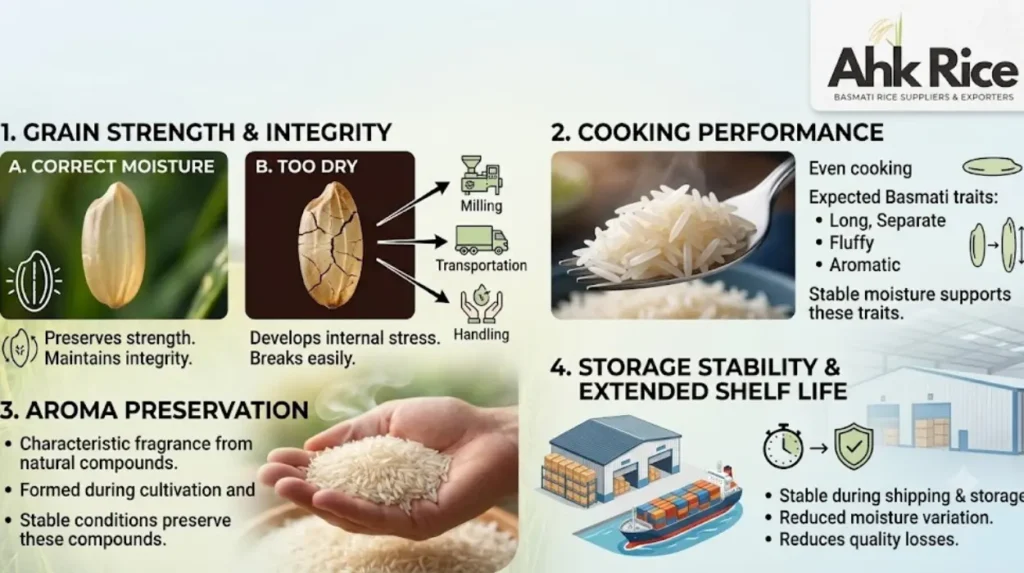
Correct moisture preserves grain strength, maintains natural aroma, supports cooking performance, reduces broken kernels, prevents microbial growth, extends shelf life, and ensures rice meets international commercial quality specifications throughout export distribution.
Moisture affects almost every physical characteristic of rice.
Grain Strength
Rice that becomes too dry develops internal stress.
These grains break more easily during:
- Milling
- Transportation
- Packaging
- Retail handling
Cooking Performance
Proper moisture allows grains to cook evenly.
Consumers expect Pakistani Basmati to remain:
- Long
- Separate
- Fluffy
- Aromatic
Stable moisture supports these cooking characteristics.
Aroma Preservation
The characteristic fragrance of Basmati develops through natural aromatic compounds formed during cultivation and ageing.
Stable storage conditions help preserve these compounds until consumption.
Storage Stability
Rice with controlled moisture remains stable during long shipping periods and warehouse storage.
Lower moisture variation reduces quality losses.
What Are the Main Components of an Effective Moisture Control System?
An effective moisture control system combines moisture measurement equipment, controlled drying technology, calibrated milling machines, warehouse monitoring, suitable packaging materials, container inspection, and documented quality assurance procedures.
Several systems work together to maintain export quality.
Moisture Meters
Digital moisture meters provide accurate readings before milling, packaging, and loading.
Regular testing confirms compliance with buyer specifications.
Drying Equipment
Mechanical dryers remove moisture evenly without overheating the grain.
Uniform drying reduces internal cracking.
Storage Facilities
Modern warehouses include:
- Air circulation
- Dry flooring
- Controlled stacking
- Pest management
- Regular inspections
Packaging Materials
Quality export packaging limits moisture exchange.
Examples include:
- PP woven bags
- Laminated bags
- PE-lined sacks
- Retail vacuum packs
Container Inspection
Containers are inspected for:
- Water leaks
- Rust
- Condensation
- Residual moisture
- Structural damage
Only dry containers should be loaded.
Which Grades of Pakistan Basmati Rice Depend on Proper Moisture Control?
Every export grade requires controlled moisture because grain quality, appearance, milling performance, cooking characteristics, and commercial value depend on maintaining stable moisture throughout processing and shipment.
Pakistan exports several major Basmati varieties.
1121 Basmati Rice
Known for:
- Extra-long grains
- Exceptional elongation
- Premium export quality
Moisture stability protects its cooking expansion.
Super Kernel Basmati
Recognised for:
- Traditional aroma
- Fine texture
- Long grain appearance
Uniform moisture preserves grain integrity.
1509 Basmati
Popular because of:
- Early maturity
- High yield
- Long grains
- Fast cooking
Proper drying prevents unnecessary breakage.
Each variety follows buyer-specific moisture specifications before export.
Which Countries Import Pakistan Basmati Rice Alongside Saudi Arabia?
Pakistan exports Basmati rice to numerous international markets where importers require consistent moisture standards to ensure product safety, storage stability, commercial quality, and consumer satisfaction after long-distance transportation.
Saudi Arabia remains one of the largest destinations for Pakistani Basmati.
Other important importing markets include:
- United Arab Emirates
- Oman
- Qatar
- Kuwait
- Bahrain
- Iraq
- Iran
- United Kingdom
- Germany
- Canada
- Australia
- United States
- Yemen
- Jordan
- South Africa
Each importer establishes quality specifications covering:
- Moisture percentage
- Broken grains
- Purity
- Foreign matter
- Grain length
- Packaging
- Labelling
Meeting these specifications supports smooth international trade.
Which Certifications Support Moisture-Controlled Rice Exports?
International certifications verify food safety, processing quality, traceability, hygiene, and quality management systems that help maintain moisture-controlled rice throughout production, storage, packaging, and export operations.
Leading rice exporters commonly implement recognised certification systems.
Examples include:
- ISO 22000 Food Safety Management System
- HACCP
- GMP (Good Manufacturing Practices)
- Halal Certification
- Phytosanitary Certification
- Fumigation Certification
- Certificate of Origin
- SGS inspection when required by buyers
These certifications demonstrate compliance with international food safety and export requirements.
What Problems Result from Poor Moisture Control?
Poor moisture management reduces grain quality, increases breakage, encourages mould development, shortens shelf life, damages packaging, lowers milling recovery, and creates financial losses throughout the international rice supply chain.
Several quality issues originate from unstable moisture.
Excess Moisture
High moisture encourages:
- Mould growth
- Fungal contamination
- Discolouration
- Quality deterioration
- Reduced storage stability
Low Moisture
Excessively dry grains become brittle.
This increases:
- Broken rice percentage
- Milling losses
- Dust generation
- Reduced commercial value
Uneven Moisture Distribution
Different moisture levels inside one rice lot produce inconsistent cooking performance.
Consumers notice variation in:
- Texture
- Expansion
- Appearance
Uniform moisture prevents these inconsistencies.
What Misconceptions Exist About Rice Moisture Levels?
Many buyers assume lower moisture always improves quality, but export-quality Basmati requires balanced moisture because excessive drying weakens grain structure and reduces overall milling performance.
Several misconceptions appear frequently in international rice trade.
Lower Moisture Means Better Rice
This statement is incorrect.
Rice that becomes excessively dry develops internal fractures and breaks more easily during processing.
Moisture Only Matters During Harvest
Moisture management continues throughout:
- Storage
- Packaging
- Container loading
- Ocean transport
- Import warehousing
- Retail distribution
Packaging Alone Controls Moisture
Packaging provides protection, but grain moisture must already be within the correct specification before sealing.
Proper drying remains essential.
How Does Moisture Control Benefit Saudi Arabian Importers and Consumers?
Stable moisture levels improve storage reliability, preserve cooking quality, reduce commercial losses, maintain grain appearance, protect food safety, and deliver consistent consumer satisfaction across Saudi Arabia’s wholesale and retail markets.
Importers benefit from:
- Lower storage losses
- Better inventory stability
- Reduced customer complaints
- Higher product consistency
Retailers receive rice that maintains its appearance throughout shelf display.
Consumers enjoy:
- Long cooked grains
- Natural aroma
- Uniform texture
- Better cooking performance
- Reliable product quality
Every stage of moisture management contributes to these final consumer expectations.
Readers who want to understand how moisture directly influences milling performance and grain integrity can continue with the companion article on:
How moisture levels influence grain breakage during Pakistan Basmati rice exports to Saudi Arabia, which explores the relationship between moisture percentage and broken kernel rates in greater technical detail.
Frequently Asked Questions
What is the ideal moisture content for Pakistan Basmati rice exported to Saudi Arabia?
The ideal moisture content is generally between 12% and 14%, depending on buyer specifications and export requirements. This range helps preserve grain quality, aroma, and shelf life.
Why is moisture control important during Basmati rice exports?
Moisture control prevents grain breakage, mould growth, quality deterioration, and storage losses while maintaining the rice’s cooking performance and export value.
How is moisture measured before exporting Basmati rice?
Exporters use calibrated digital moisture meters to test rice at different stages, including drying, milling, packaging, and container loading, to ensure compliance with buyer specifications.
Which Pakistani Basmati rice varieties require strict moisture control?
All export varieties require proper moisture management, including 1121 Basmati, Super Kernel Basmati, and 1509 Basmati, because moisture directly affects grain strength and cooking quality.
How does high moisture affect Basmati rice during shipping?
Excess moisture increases the risk of mould, fungal growth, grain discoloration, unpleasant odours, and reduced shelf life during long-distance transportation.
Can low moisture levels damage Basmati rice quality?
Yes. Rice that is too dry becomes brittle, resulting in higher breakage during milling, handling, transportation, and packaging.
Which certifications support quality-controlled Basmati rice exports?
Common certifications include ISO 22000, HACCP, GMP, Halal Certification, Phytosanitary Certificate, Fumigation Certificate, and Certificate of Origin, depending on buyer and destination requirements.
How does moisture control improve cooking quality?
Proper moisture helps Basmati rice cook evenly, maintain its long-grain structure, preserve its natural aroma, and produce fluffy, separate grains after cooking.