What Is the Best Solution for Importing Naturally Aromatic Pakistani Basmati Rice into the UAE?
The best solution is to source Pakistani Basmati rice against a written specification, approve a cooking sample, confirm quality documentation, and release production only after commercial terms are agreed. This process helps UAE premium brands maintain consistent aroma, grain appearance, cooking performance, and packaging quality across repeat orders.
Natural Basmati aroma depends on the rice variety, growing conditions, grain maturity, processing, and storage. Importers cannot establish aroma quality through grain length alone. They need to assess the fragrance of uncooked rice, the aroma released during cooking, cooked grain separation, elongation, and overall taste.
Buyers unfamiliar with the relationship between these characteristics should first understand what gives Basmati rice its natural aroma before selecting an export grade.
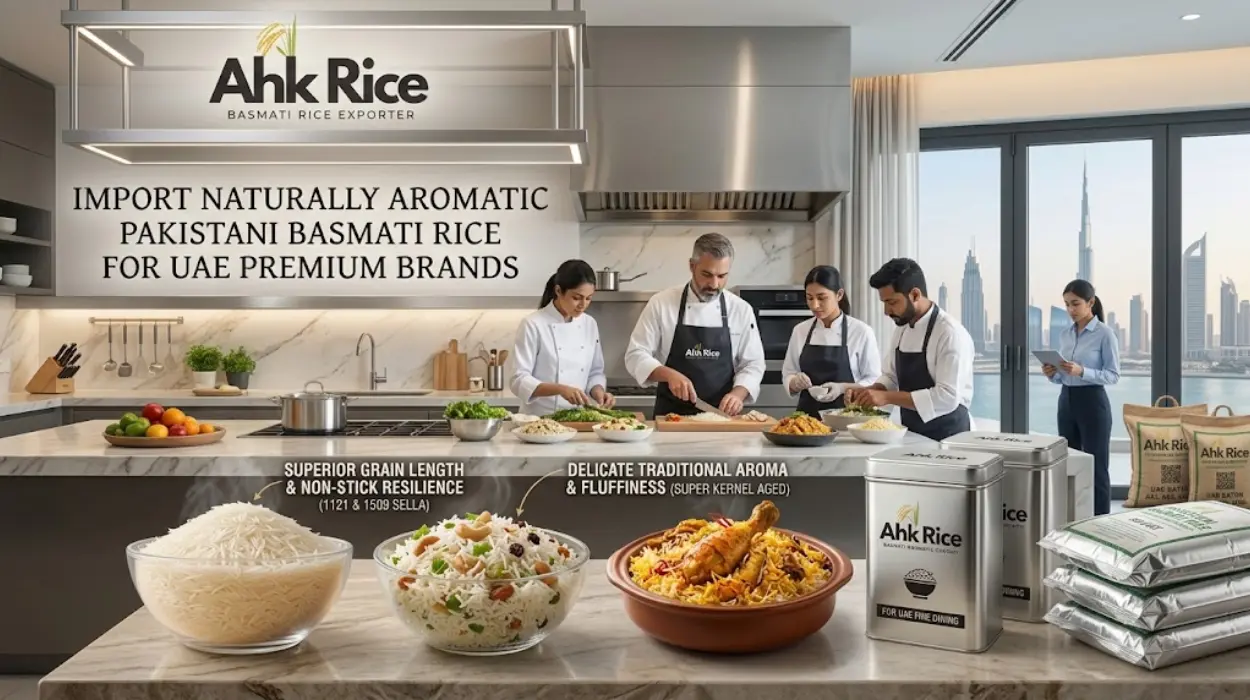
For commercial purchasing, AHK Rice supplies Pakistani Basmati varieties including 1121, Super Kernel, and 1509. Each variety serves different positioning requirements. Premium retail brands may prioritise fragrance and cooked elongation, while wholesalers and foodservice distributors may require a balance between aroma, price, cooking consistency, and supply volume.
The purchasing decision should therefore begin with the intended market segment, target retail price, required grain specifications, and cooking application rather than selecting the longest available grain.
Why Choose AHK Rice for Premium UAE Brands?
AHK Rice supports Pakistani Basmati sourcing through variety selection, processing coordination, grading, inspection, custom packaging, and export arrangements. Buyers can define their required specifications before production, evaluate samples, and establish measurable acceptance criteria for commercial shipments.
AHK Rice operates from Punjab, Pakistan, a major Basmati-producing region, and supplies rice to international markets. Its product range includes 1121, Super Kernel, and 1509 Basmati rice, enabling importers to select a grade aligned with their product positioning and distribution model.
Buyers can review the AHK Rice export and supply service to assess the available product range and discuss export requirements.
For premium UAE retail, 1121 Basmati is relevant when long grains, cooked elongation, and an established premium presentation are central to the product proposition. Super Kernel suits buyers seeking traditional Pakistani Basmati aroma and a recognisable grain profile. The 1509 variety offers another option for importers balancing grain length, price positioning, and volume requirements.
AHK Rice can coordinate product specifications and packaging requirements around the agreed order. However, buyers should approve actual samples and written specifications rather than treating variety names as guarantees of identical performance between lots.
A clear purchase specification should identify the variety, processing type, raw grain length, broken percentage, moisture limit, foreign matter tolerance, crop or ageing requirements where applicable, packing format, and applicable inspection conditions. The final certificate of analysis (COA) should reflect the agreed commercial requirements.
Which Pakistani Basmati Variety Should UAE Premium Brands Import?
Select 1121 for premium grain length and elongation, Super Kernel for traditional aromatic positioning, and 1509 for a value-conscious product proposition. The correct choice depends on the buyer’s target consumer, cooking requirements, retail price, and acceptable landed cost rather than a single quality indicator.
| Variety | Commercial advantage | Suitable UAE applications |
|---|---|---|
| 1121 Basmati | Long grain profile and strong cooked elongation potential | Premium supermarkets, private labels, gifting, and restaurants |
| Super Kernel Basmati | Traditional Pakistani Basmati character and aromatic positioning | Specialist retailers, ethnic grocery chains, and premium wholesale |
| 1509 Basmati | Alternative balance of grain length, supply economics, and cooking performance | Value-premium retail, wholesale distribution, and selected foodservice accounts |
The actual performance of each variety depends on the lot, processing method, storage history, and cooking conditions. Buyers should request representative samples before finalising their specifications.
For example, a Dubai distributor supplying premium South Asian grocery stores may prefer 1121 Steam or Golden Sella if its customers value long cooked grains. A restaurant supplier may prioritise a grade that performs consistently across large cooking batches. A retailer targeting a more price-sensitive segment may evaluate 1509 against its required aroma and appearance standards.
Steam and Golden Sella should also be assessed separately. Steam processing produces a different grain and cooking profile from parboiled Golden Sella. The choice should reflect the intended dish, customer expectations, preparation method, and holding requirements.
AHK Rice can help buyers define the required variety and processing format, but the final decision should follow sample testing against the actual product specification.
How Can Importers Verify Natural Aroma Before Placing an Order?
Importers should approve a representative commercial sample using repeatable sensory and cooking tests before authorising bulk production. A documented sample process helps buyers compare aroma, appearance, elongation, grain separation, and cooking consistency while reducing the risk of receiving rice that differs from their approved product.
The sample-to-order workflow should include five stages.
- Define the requirement. Specify the variety, processing type, intended application, packaging, target quantity, and required quality limits. Include the preferred cooking method and any ageing requirements.
- Request a representative sample. Ask AHK Rice to confirm sample availability, quantity, identification, and whether the sample represents the proposed commercial grade. A small laboratory or cooking sample does not automatically prove that every bulk lot will perform identically.
- Arrange delivery and test the rice. Evaluate uncooked aroma, grain uniformity, cleanliness, and appearance. Cook the sample using a recorded water-to-rice ratio, soaking period, and cooking time.
- Record acceptance criteria. Assess cooked aroma, elongation, texture, grain separation, breakage, and taste. Share the results with the supplier and resolve any differences before confirming production.
- Approve the commercial specification. Confirm the product grade, COA requirements, packing, inspection arrangements, and permitted tolerances in writing before the order proceeds.
For a sample programme, AHK Rice has offered up to 20 kg of Super Kernel Basmati for evaluation, with the buyer covering courier shipping and applicable phytosanitary charges. This offer should be reconfirmed for the requested destination, current availability, and applicable export or import requirements before dispatch.
Sample courier costs are not fixed. They depend on the sample weight, shipping service, destination, customs handling, and any required documentation or inspection charges. The supplier should provide a current cost breakdown before the buyer authorises shipment.
How Do Processing and Storage Affect Aroma During Export?
Aroma preservation requires controlled handling from milling through packaging, transport, and warehouse storage. Buyers should compare processing methods, moisture specifications, packaging barriers, and storage conditions before shipment because exposure to heat, humidity, strong odours, or unsuitable storage can compromise product quality.
The comparison of how processing and storage preserve Basmati aroma from Pakistani mill to UAE shelf helps importers understand why the export specification must cover more than grain length.
Processing affects appearance, texture, and cooking behaviour. Milling and sorting remove unwanted material and help establish the agreed grade. Steam and parboiled processing create different characteristics, so buyers should approve the exact processing type rather than accept a general description such as premium Basmati.
Packaging is equally important for UAE distribution. Importers should select food-grade packaging suitable for the intended shelf life and transport conditions. Moisture protection, sound seals, appropriate bag construction, and clean storage reduce avoidable quality risks.
The UAE’s hot climate makes warehouse management important. Rice should be stored in a clean, dry, ventilated environment away from direct sunlight, water ingress, chemicals, and strong-smelling products. Warehouses should use suitable stock rotation and inspect bags for damage, condensation, pests, and contamination.
AHK Rice buyers should agree on the moisture limit, packaging material, lot identification, and pre-shipment inspection requirements before loading. A documented inspection and COA can support verification of the agreed parameters, but neither replaces appropriate handling after arrival.
How Long Does Shipping Pakistani Basmati Rice to the UAE Take?

Sea freight from Karachi to major UAE ports commonly requires approximately 3–10 days of port-to-port transit, depending on the route and service. Importers must add origin handling, customs clearance, vessel schedules, destination processing, and final delivery when calculating the full replenishment timeline.
Indicative planning ranges are:
| UAE destination | Indicative sea transit from Karachi | Planning considerations |
|---|---|---|
| Jebel Ali, Dubai | Approximately 3–7 days | Sailing frequency, terminal handling, and container availability |
| Khalifa Port, Abu Dhabi | Approximately 4–8 days | Vessel routing, port schedules, and inland delivery |
| Sharjah or other UAE distribution points | Approximately 3–10 days to a relevant port, where applicable | The actual port, onward transport, and carrier routing determine the timeline |
These figures are indicative planning estimates, not guaranteed schedules. The selected carrier, vessel itinerary, transshipment, seasonal congestion, and port operations can change transit times. Buyers should obtain a current sailing schedule and written shipment plan before committing to a launch date.
For initial orders, importers should allow additional time for sample delivery, testing, commercial negotiations, production, packaging, inspection, and export documentation. A sample approval completed late in the purchasing cycle can delay the entire shipment even when sea transit is short.
AHK Rice should confirm the proposed loading date, shipment terms, estimated arrival window, and document requirements for each order. Buyers should also verify current UAE import procedures with their customs broker and relevant authorities.
What Determines the Price of Aromatic Pakistani Basmati Rice?
The final price depends on the variety, processing, grain length, broken percentage, moisture, packaging, order volume, shipment terms, and destination costs. Premium positioning can justify a higher procurement price only when the product specification, quality evidence, and expected selling price support the additional cost.
Importers should request a quotation based on a complete specification rather than comparing generic prices for Pakistani Basmati. A quotation for 1121 Golden Sella is not directly comparable with one for Super Kernel white rice or 1509 Steam.
The principal cost factors include:
- Variety and grade: 1121, Super Kernel, and 1509 have different market positioning and price structures.
- Processing and ageing: Steam, Golden Sella, white rice, and aged rice may involve different processing costs and specifications.
- Quality limits: Grain length, broken percentage, moisture, purity, and inspection requirements affect the commercial grade.
- Packaging: Retail-ready printed bags, private-label artwork, and bulk packaging create different material and production costs.
- Order quantity: Volume, production scheduling, and container utilisation influence the price per metric tonne.
- Shipping terms: FOB, CFR, and CIF quotations allocate freight, insurance, and responsibilities differently.
- Destination expenses: Customs duties, taxes, clearance, port charges, local transport, and applicable inspection fees affect the landed cost.
FOB pricing generally covers the seller’s obligations through delivery on board the nominated vessel under the agreed Incoterms. CIF includes cost, insurance, and freight to the named destination port, while the buyer remains responsible for import clearance and other costs allocated to the buyer under the agreed terms.
Request separate product and freight calculations when comparing quotations. The lowest FOB price does not necessarily produce the lowest landed cost or the best retail margin.
What Documentation Should UAE Importers Confirm Before Shipment?
Buyers should agree on the required commercial, quality, origin, and regulatory documents before production and loading. The precise documents depend on the product, import route, shipment terms, and applicable UAE requirements, so the importer should confirm the final checklist with its customs broker and relevant authorities.
The purchasing file commonly includes a commercial invoice, packing list, bill of lading, certificate of origin where required, and a certificate of analysis against the agreed specification. Phytosanitary documentation and other food-import or conformity documents should be arranged when applicable to the shipment.
The importer should also confirm the product description, country of origin, net weight, packaging details, consignee information, and any required Arabic or bilingual labelling before dispatch. Retail products may have additional labelling and registration requirements compared with bulk shipments intended for further processing or repacking.
AHK Rice and the buyer should identify who arranges each document, who pays the associated charges, and when drafts must be approved. The final COA should match the approved grade and the agreed test parameters. Where independent inspection is required, the contract should state the inspection provider, sampling procedure, acceptance limits, and method for resolving discrepancies.
How Can UAE Buyers Get Started with AHK Rice?
Start with a written buying specification, request a representative sample, complete the cooking test, and approve the final commercial terms before production. This sequence connects product selection with quality verification, landed-cost planning, and delivery scheduling, giving UAE importers a clear basis for approving their first order and managing repeat shipments.
Prepare the following information before requesting a quotation:
- Target variety: 1121, Super Kernel, or 1509.
- Processing type: white, Steam, or Golden Sella, as required.
- Grain length, broken percentage, moisture limit, and other quality tolerances.
- Required packaging size, private-label details, and language requirements.
- Sample quantity, courier destination, and preferred testing procedure.
- Initial order volume, destination port, and preferred FOB or CIF terms.
- Required certificates, inspection conditions, and expected delivery window.
AHK Rice can use these details to assess the requested grade, confirm sample availability, clarify packaging options, and prepare a shipment proposal. Buyers should approve the final specification and applicable documentation before authorising bulk production.
For premium UAE brands, the purchasing decision should be based on verified cooking performance, documented quality parameters, suitable packaging, and a commercially workable landed cost. A clear specification and an approved sample provide a stronger basis for repeat business than aroma claims alone.
To discuss specifications, sample availability, packaging, and current export pricing, request a quotation from AHK Rice.
Frequently Asked Questions
Which Pakistani Basmati rice is best for premium UAE brands?
1121 suits brands prioritising long grains and cooked elongation. Super Kernel fits traditional aromatic positioning. 1509 provides another option for buyers balancing quality and procurement cost. Approve a sample before selecting the commercial grade.
Can UAE importers request Basmati rice samples before ordering?
Yes, subject to supplier availability and destination requirements. AHK Rice has offered up to 20 kg of Super Kernel Basmati for sampling. Buyers cover courier shipping and applicable phytosanitary charges, subject to reconfirmation.
How much does shipping a rice sample to the UAE cost?
The cost depends on sample weight, courier service, destination, customs handling, and documentation requirements. Request a current quote before dispatch. Confirm whether any applicable inspection or phytosanitary charges are additional.
How long does Pakistani Basmati rice take to reach the UAE?
Indicative sea transit from Karachi to major UAE ports is approximately 3–10 days. Vessel schedules, port handling, customs clearance, and final delivery add time. Confirm the current schedule with the supplier and carrier.
How can importers verify Basmati aroma and quality before shipment?
Request a representative sample and perform a documented cooking test. Assess uncooked and cooked aroma, grain elongation, texture, separation, and breakage. Approve written specifications and the required COA before authorising bulk shipment.