Why Pakistani Sella Basmati Rice Is Important in the UAE Rice Market
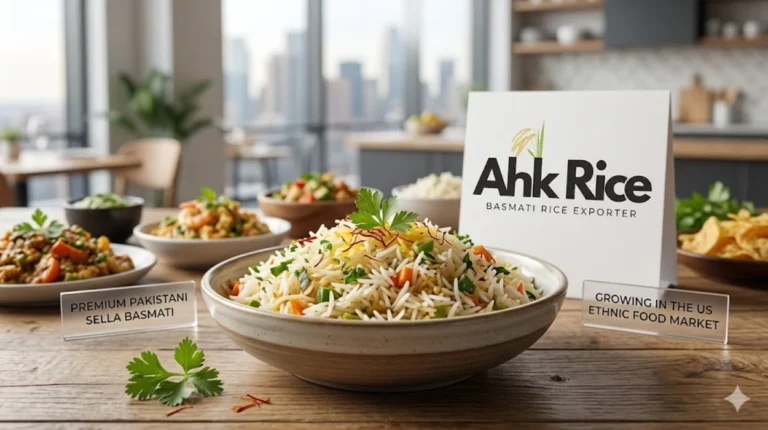
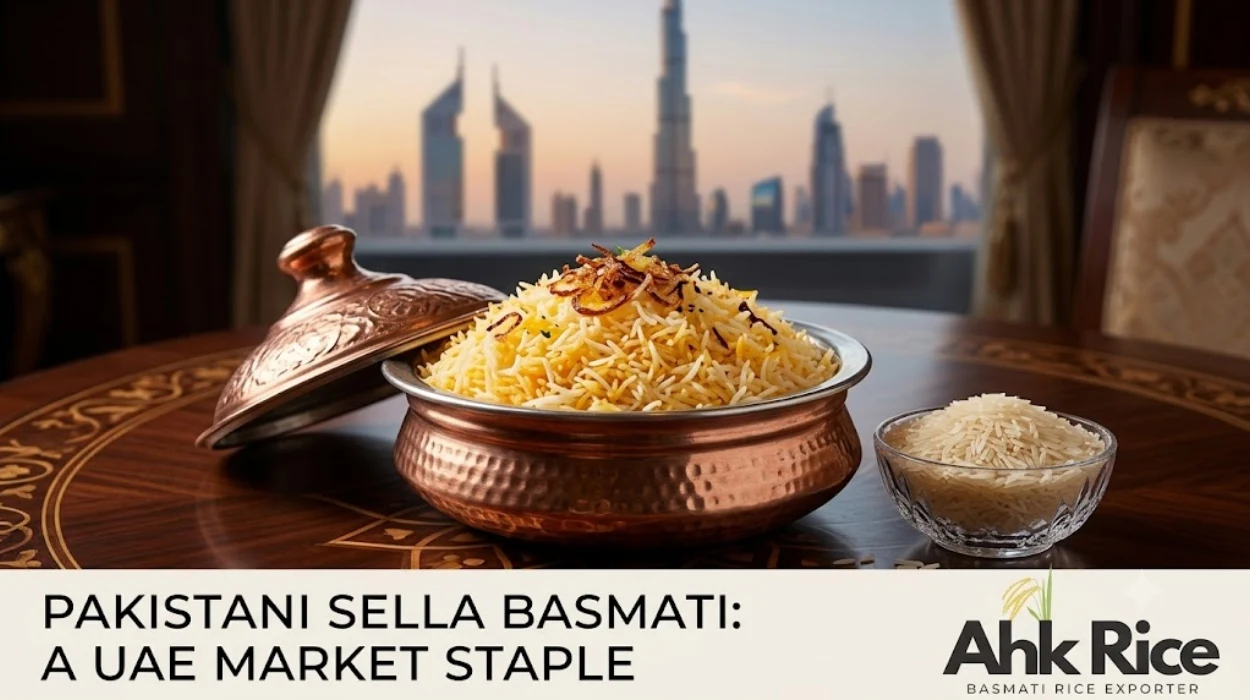
Pakistani Sella Basmati Rice is important in the UAE rice market because it combines long grain length, high cooking yield, storage stability, and suitability for large-scale foodservice operations. UAE importers source Pakistani Sella Basmati Rice to supply restaurants, catering companies, supermarkets, and hospitality businesses that require consistent rice quality throughout the year.
The UAE imports significant volumes of rice because domestic rice cultivation remains limited by climate and water availability. Pakistani Basmati varieties satisfy this demand through established trade routes, competitive specifications, and strong consumer recognition. Pakistan remains one of the leading rice suppliers to Gulf countries, including the UAE.
Rice consumption in the UAE extends beyond households. Hotels, airline caterers, institutional kitchens, and restaurant chains require rice with predictable cooking performance. Pakistani Sella Basmati Rice fulfills these operational requirements through its parboiled processing method and long-grain characteristics.
Understanding its importance begins with understanding what Pakistani Sella Basmati Rice actually is.
What Is Pakistani Sella Basmati Rice?
Pakistani Sella Basmati Rice is a parboiled Basmati rice produced in Punjab, processed through soaking, steaming, drying, milling, and grading to create long grains with improved strength, cooking performance, and shelf stability.
Pakistani Sella Basmati Rice belongs to the Basmati family cultivated primarily in Punjab’s rice-growing belt. Basmati refers to aromatic long-grain rice varieties known for elongation after cooking.
The term “Sella” refers to the parboiling process. Processors treat paddy rice with water and steam before milling. This treatment transfers nutrients from the outer layers into the grain and strengthens the kernel structure.
Pakistani Sella Basmati Rice differs from white rice because the grain undergoes heat treatment before milling. This processing reduces grain breakage and improves storage performance.
Major Sella Basmati varieties include:
1121 Sella Basmati Rice
1121 Sella Basmati Rice features grain lengths of 8.30–8.50 mm before cooking. After cooking, grains can extend beyond 20 mm under proper conditions.
Super Kernel Sella Basmati Rice
Super Kernel Sella Basmati Rice offers a traditional Basmati aroma and grain length of approximately 7.20–7.60 mm.
1509 Sella Basmati Rice
1509 Sella Basmati Rice provides shorter crop cycles and strong cooking performance with grain lengths around 8.00–8.30 mm.
Common Sella processing variations include:
- Golden Sella
- Creamy Sella
- White Sella
Each variation serves different market requirements and consumer preferences.
With the definition established, the next question is how Pakistani Sella Basmati Rice reaches its final form.
How Does Pakistani Sella Basmati Rice Work Through the Processing Chain?
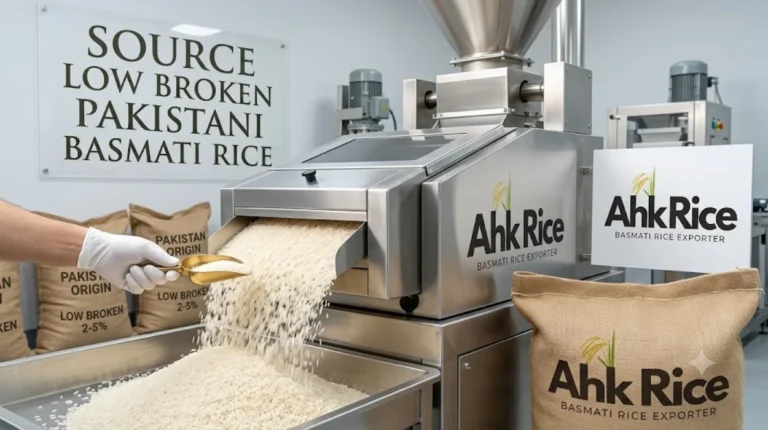
Pakistani Sella Basmati Rice works through a structured parboiling process involving cultivation, harvesting, soaking, steaming, drying, milling, grading, sorting, and packaging before export.
The Sella process changes both the appearance and performance of rice. Processors apply controlled heat and moisture to strengthen each grain.
How Is Sella Basmati Rice Cultivated?
Punjab serves as Pakistan’s primary Basmati cultivation region. Farmers cultivate rice during the Kharif season and harvest mature crops between September and November.
Rice fields receive irrigation through canal systems connected to the Indus Basin irrigation network.
What Are the Processing Steps?
The processing chain follows specific stages:
- Harvest the mature paddy.
- Clean the incoming paddy.
- Soak the grain in water.
- Steam the soaked paddy.
- Dry the treated grain.
- De-husk the paddy.
- Mill the rice kernels.
- Sort by length and quality.
- Grade according to specifications.
- Inspect finished lots.
- Package for export.
- Load containers for shipment.
Each step contributes directly to final grain quality.
Why Does Parboiling Matter?
Parboiling strengthens the grain structure. Stronger kernels resist breakage during milling and transportation.
Parboiling also creates the distinctive golden appearance associated with Golden Sella Rice. UAE buyers often select Golden Sella because visual appearance influences retail purchasing decisions.
Processing explains how the product is created. The next step is understanding the components that define rice quality.
What Key Components Define Pakistani Sella Basmati Rice Quality?
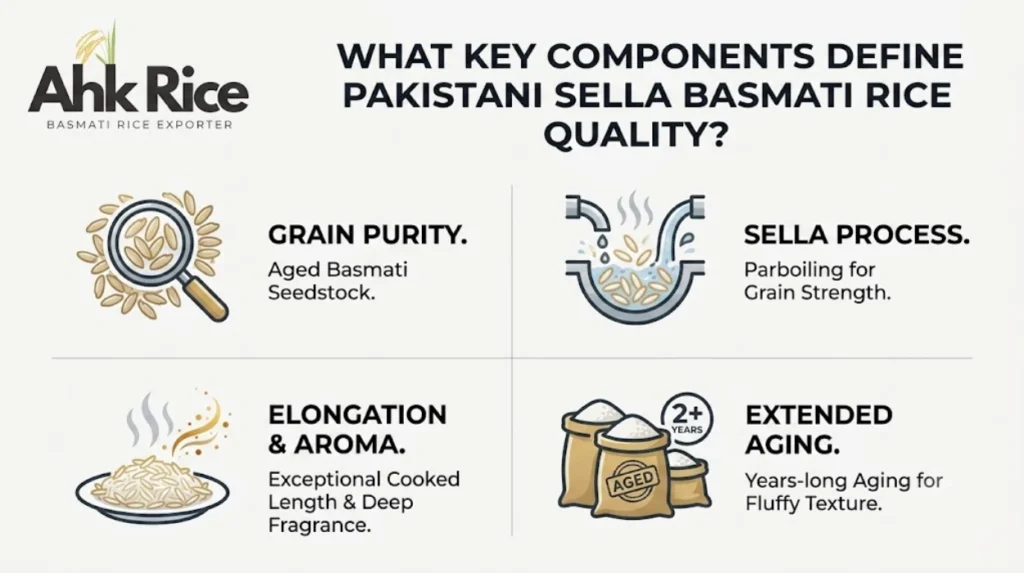
Grain length, moisture level, purity, broken percentage, aroma, color consistency, and cooking elongation determine Pakistani Sella Basmati Rice quality.
Rice buyers evaluate measurable specifications rather than general descriptions.
What Grain Lengths Are Available?
| Variety | Average Grain Length |
|---|---|
| 1121 Sella | 8.30–8.50 mm |
| 1509 Sella | 8.00–8.30 mm |
| Super Kernel Sella | 7.20–7.60 mm |
Longer grains generally command higher market value.
What Quality Specifications Matter Most?
| Specification | Typical Requirement |
|---|---|
| Moisture | 12–14% |
| Purity | Up to 95–99% |
| Broken Grains | 1–5% |
| Damaged Grains | Minimal |
| Foreign Matter | Near zero |
| Grain Length | Variety dependent |
| Color Uniformity | Consistent |
These specifications influence import decisions throughout the UAE distribution chain.
What Grades Are Commonly Exported?
Common export grades include:
- Extra Long Grain Grade
- Premium Grade
- Sortex Grade
- Double Sortex Grade
- Super Sortex Grade
- Retail Grade
- Foodservice Grade
Examples of foodservice buyers include hotels, catering companies, and airline kitchens.
Quality specifications determine performance. Performance creates benefits for importers and consumers.
What Benefits Make Pakistani Sella Basmati Rice Important in the UAE?
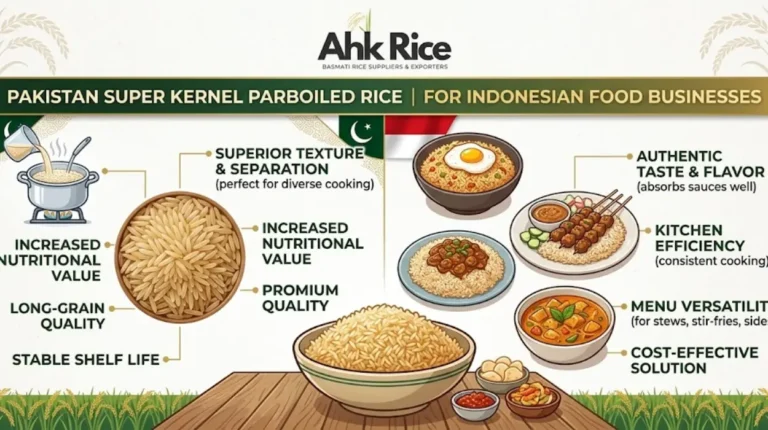
High cooking yield, grain elongation, storage stability, lower breakage, visual appeal, and operational efficiency make Pakistani Sella Basmati Rice valuable across UAE food channels.
The UAE market values practical performance characteristics.
Why Do Restaurants Prefer Sella Rice?
Restaurants require consistency across hundreds of meals daily.
Pakistani Sella Basmati Rice delivers:
- Higher cooked volume
- Strong grain separation
- Reduced stickiness
- Better holding performance
Examples include biryani restaurants, banquet kitchens, and hotel buffets.
Why Does Storage Stability Matter?
UAE temperatures regularly exceed 40°C during summer months.
Golden Sella Rice maintains quality for extended storage periods. White rice generally requires stricter storage controls.
Longer storage stability helps importers manage inventory efficiently.
Why Is Grain Elongation Important?
Consumers often associate elongated grains with premium quality.
1121 Sella Basmati Rice demonstrates exceptional elongation after cooking. This characteristic supports demand in premium hospitality and retail segments.
Benefits explain demand. Demand becomes clearer through actual market applications.
Where Is Pakistani Sella Basmati Rice Used in the UAE?
Pakistani Sella Basmati Rice is used in restaurants, hotels, catering operations, supermarkets, wholesale distribution, airline catering, and household consumption throughout the UAE.
Different sectors purchase different grades.
How Does the Hospitality Industry Use It?
Hotels require rice that maintains appearance during buffet service.
Sella rice retains grain separation for longer periods after cooking. This characteristic improves presentation quality.
Examples include:
- Luxury hotels
- Resort kitchens
- Conference venues
How Does Foodservice Use It?
Foodservice operators focus on consistency and yield.
Examples include:
- Corporate catering
- School catering
- Hospital kitchens
- Airline catering
These operations prepare large volumes daily.
How Does Retail Use It?
Retail buyers focus on packaging, aroma, and grain appearance.
Examples include:
- Supermarkets
- Hypermarkets
- Ethnic food stores
Consumer demand supports year-round imports.
Use cases demonstrate demand patterns. Import demand also depends on international trade relationships.
Which Markets Import Pakistani Sella Basmati Rice?
The UAE, Saudi Arabia, Oman, Qatar, Kuwait, Iraq, the United Kingdom, Canada, and several African countries import Pakistani Sella Basmati Rice.
Pakistan exports rice to more than 100 countries worldwide.
Why Is the UAE a Significant Market?
The UAE functions as both a consumption market and a regional trade hub.
Importers distribute rice within:
- Dubai
- Abu Dhabi
- Sharjah
- Ajman
- Ras Al Khaimah
Regional redistribution also occurs through UAE ports.
What Makes Gulf Markets Different?
Gulf consumers prefer long-grain aromatic rice.
Examples include:
- Biryani preparation
- Kabsa dishes
- Mandi dishes
These cuisines require grain separation and visual appeal.
Import markets create quality expectations. Certifications help verify compliance with those expectations.
What Certifications Apply to Pakistani Sella Basmati Rice?
ISO certification, HACCP systems, food safety compliance programs, phytosanitary certification, and laboratory testing support international rice exports.
Certification verifies product consistency and compliance.
Which Export Documents Are Common?
Required export documents often include:
- Commercial Invoice
- Packing List
- Certificate of Origin
- Phytosanitary Certificate
- Bill of Lading
- Quality Inspection Report
Each document supports customs clearance and import verification.
Which Food Safety Standards Matter?
Common standards include:
- ISO 22000
- HACCP
- GMP
- Halal Certification
Importers use these standards to evaluate supplier capabilities.
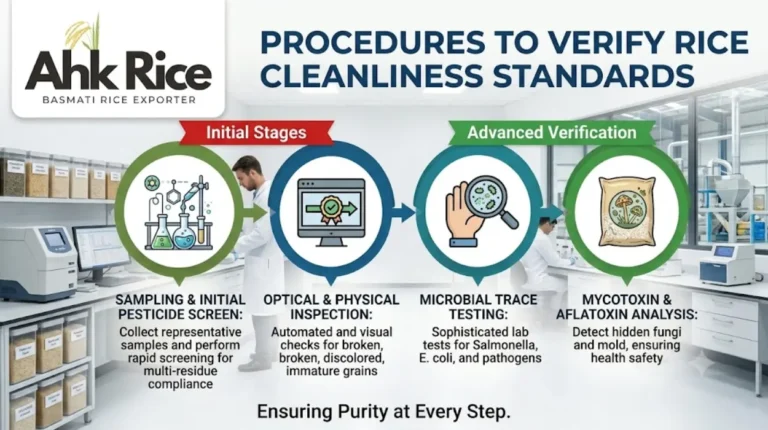
Why Is Laboratory Testing Important?
Laboratories inspect:
- Moisture content
- Grain length
- Purity levels
- Broken percentage
- Foreign matter
Testing creates measurable quality benchmarks.
Certifications establish trust. Trust also requires correcting common misconceptions.
What Common Misconceptions Exist About Pakistani Sella Basmati Rice?
Pakistani Sella Basmati Rice is not artificial rice, not low-quality rice, and not identical across all grades and varieties.
Several misunderstandings affect buyer knowledge.
Is Golden Sella Artificially Colored?
Golden Sella Rice develops its color during parboiling.
Steam treatment and drying create the golden appearance. Processors do not rely on artificial coloring to achieve this result.
Are All Sella Grades Identical?
Different grades contain different specifications.
Examples include:
- Different grain lengths
- Different broken percentages
- Different purity levels
Specification differences influence market positioning.
Is White Rice Always Better Than Sella Rice?
Different applications require different rice types.
Golden Sella lasts longer than many white rice specifications. In high-temperature warehouse environments, storage stability becomes a significant advantage. UAE distributors handling seasonal inventory often prioritize this characteristic.
Pakistani Sella Basmati Rice serves the UAE market because it combines agricultural quality, advanced processing, measurable specifications, and strong cooking performance. These characteristics explain its continued importance across hospitality, retail, and foodservice sectors.
Frequently Asked Questions
What is Sella Basmati Rice?
Sella Basmati Rice is parboiled Basmati rice processed through soaking, steaming, and drying before milling. The process strengthens grains and improves cooking performance.
Which Pakistani variety is most popular in the UAE?
1121 Sella Basmati Rice remains one of the most popular varieties because of its extra-long grain length and cooking elongation.
Why do UAE restaurants use Sella Rice?
UAE restaurants use Sella Rice because it provides grain separation, high cooking yield, and stable holding performance during service.
What is the difference between Golden Sella and White Sella Rice?
Golden Sella undergoes a parboiling process that creates a golden color. White Sella undergoes additional processing that produces a lighter appearance.
Which Pakistani province grows most Basmati rice?
Punjab is the primary Basmati-growing region in Pakistan and produces the majority of export-quality Basmati varieties.
How long can Sella Basmati Rice be stored?
Properly stored Sella Basmati Rice typically maintains quality for extended periods when moisture and temperature remain controlled.