What Is 1121 Golden Sella Basmati Rice? Complete Buyer Guide
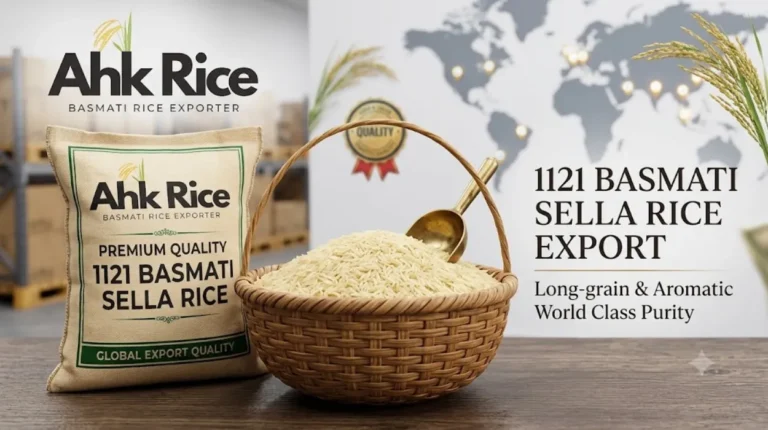
1121 Golden Sella Basmati rice is a long-grain parboiled basmati variety with a golden color, firm texture, and elongation of 2.5–3.0x after cooking. Here is why: it undergoes controlled soaking, steaming, and drying before milling, which hardens the grain and locks nutrients.
1121 Golden Sella Basmati rice defines a specific product category. The grain belongs to the 1121 basmati cultivar. The processing method defines the “Golden Sella” classification. The result is a durable, non-sticky rice suited for bulk cooking and export markets.
What is 1121 Golden Sella Basmati rice?
1121 Golden Sella Basmati rice is a parboiled basmati variety processed through soaking, steaming, drying, milling, and polishing, producing a golden-colored grain of 8.20–8.40 mm raw length with high elongation and low breakage.
1121 Golden Sella Basmati rice originates from Punjab’s basmati-growing belt. Farmers cultivate it in irrigated fields with controlled water cycles. Harvest occurs after 135–145 days of growth.
Golden Sella defines the processing state. The grain absorbs water, then undergoes steaming under pressure. This step gelatinizes starch inside the kernel. The process fixes nutrients and strengthens structure.
Golden color forms during steaming. Heat changes the outer bran layer. This chemical change creates the distinct amber tone.
Export markets classify Golden Sella separately from white or steam rice. Buyers use it for durability and consistent cooking performance.
With the definition established, the next question is how the parboiling process works in detail.
How does golden sella parboiling work step by step?
Golden Sella processing follows 9 exact steps: cleaning, soaking, steaming, drying, husking, polishing, grading, sorting, and packing, each controlling moisture from 28% to 12%.
Step-by-step processing
- Clean the paddy to remove dust, stones, and foreign matter.
- Soak the paddy in water at 60–70°C for 6–8 hours.
- Steam the soaked paddy under pressure for 5–10 minutes.
- Dry the paddy in sunlight or mechanical dryers to 12–14% moisture.
- Dehusk the dried paddy to remove the outer shell.
- Polish the brown rice to achieve smooth grain surface.
- Grade the rice by length and thickness.
- Sort the grains using color sorters to remove defects.
- Pack the final rice in export-grade bags.
Soaking hydrates the grain completely. Hydration ensures uniform steaming. Steaming gelatinizes starch inside the grain. This internal change prevents breakage during milling.
Drying stabilizes the grain. Moisture reduction prevents fungal growth and improves shelf life. Milling removes husk and bran layers without damaging the kernel.
Grading ensures uniformity. Buyers specify exact grain lengths and broken percentages. Sorting removes black, chalky, and immature grains.
Golden Sella processing explains its durability. The next section explains the internal components that define quality.
What are the key components of 1121 Golden Sella Basmati?
1121 Golden Sella quality depends on grain length (8.20–8.40 mm), moisture (12–13%), broken ratio (0–5%), chalkiness (<2%), and purity (95–100%).
Core quality components
- Grain length
- Grain thickness
- Moisture content
- Broken percentage
- Chalky grain ratio
- Foreign matter
- Color uniformity
Grain length defines basmati classification. 1121 has the longest grain among basmati varieties. This characteristic increases plate appeal.
Moisture content controls storage life. Rice above 14% moisture spoils faster. Export-grade rice maintains 12–13%.
Broken percentage affects price. 0–2% broken rice commands premium pricing. 5% broken suits bulk buyers.
Chalkiness indicates immature grains. Low chalk improves cooking quality. Buyers reject shipments with high chalk levels.
Purity defines varietal consistency. Mixed varieties reduce cooking uniformity.
With components defined, the next question is what benefits Golden Sella provides.
What are the benefits of 1121 Golden Sella Basmati rice?
Golden Sella offers 18–24 months shelf life, 2.5–3.0x elongation, non-sticky texture, and high resistance to breakage during transport and cooking.
Golden Sella rice resists breakage due to hardened structure. Steaming strengthens the kernel. This reduces losses during milling and shipping.
Golden Sella rice cooks into long, separate grains. The non-sticky texture suits large-scale cooking. Catering operations depend on this consistency.
Golden Sella rice stores longer than white basmati. In hot climates at 40°C, it maintains quality for 18 months. Steam rice requires consumption within 12 months.
Golden Sella rice retains nutrients inside the grain. Parboiling locks vitamins and minerals into the kernel.
Golden Sella rice performs well in bulk cooking. Restaurants, airlines, and catering services prefer it for reliability.
With benefits established, the next step is understanding where and how it is used globally.
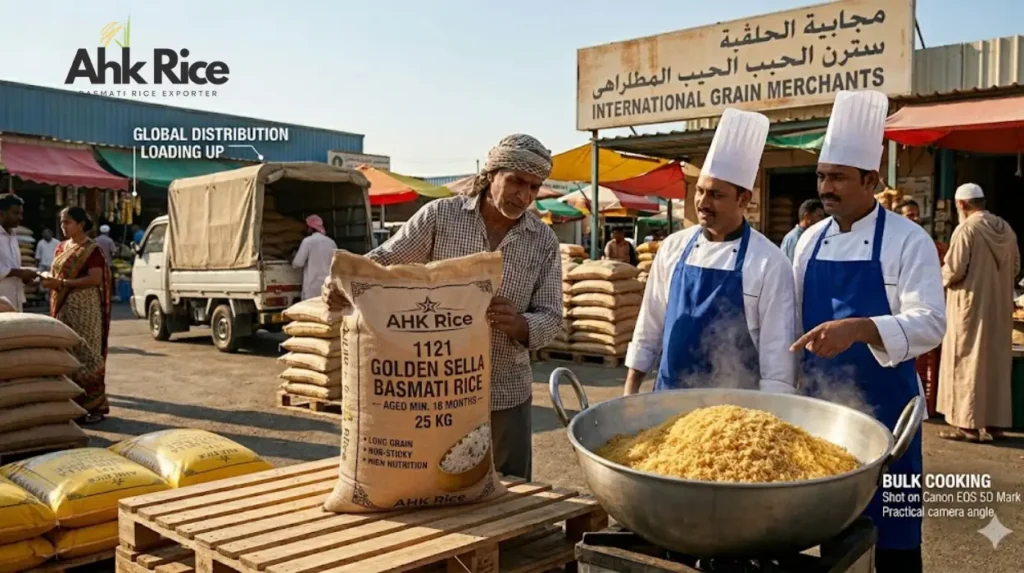
Where is 1121 Golden Sella Basmati rice used?
Golden Sella rice is imported by Middle East, Africa, and Europe, with major demand in Saudi Arabia, UAE, Iraq, and Nigeria, driven by bulk cooking needs (source: REAP export data, December 2025).
Major use cases
Bulk catering
Golden Sella rice suits hotels and restaurants. Large kitchens require rice that holds shape after cooking.
Traditional dishes
Golden Sella rice works in biryani, pulao, and mandi. Long grains enhance presentation.
Food service supply chains
Golden Sella rice fits institutional buyers. Examples include airlines, catering companies, and event planners.
Retail export markets
Golden Sella rice sells in 5 kg and 10 kg packs. Consumers prefer it for home cooking due to ease of preparation.
Middle Eastern markets prefer Golden Sella for mandi dishes. African markets prefer it for jollof rice due to grain strength.
With use cases clear, the next section explains available grades and classifications.
What grades of 1121 Golden Sella Basmati are available?
1121 Golden Sella comes in 7 processing grades: 0% broken, 2% broken, 5% broken, 10% broken, 15% broken, 25% broken, and 100% broken (broken rice).
Grade breakdown
Premium grade
0–2% broken
Used for high-end retail and restaurants
Standard export grade
5–10% broken
Used for bulk export markets
Economy grade
15–25% broken
Used for price-sensitive buyers
Broken rice
100% broken
Used for industrial and processed food applications
Grading determines pricing structure. Lower broken percentages command higher value. Buyers select grades based on target market.
Uniform grading ensures consistent cooking results. Mixing grades reduces product reliability.
With grading explained, the next section addresses common misconceptions.
What are common problems and misconceptions about Golden Sella rice?
Golden Sella rice is often misunderstood as artificial or dyed, but its golden color forms naturally during steaming, not through additives or chemicals.
Misconception 1: Golden color means artificial processing
Golden color results from heat-induced changes in bran. No dyes or chemicals are used.
Misconception 2: Parboiled rice loses quality
Parboiling improves durability and shelf life. It reduces breakage and spoilage.
Misconception 3: Golden Sella tastes inferior
Golden Sella has a firmer texture. Taste depends on cooking method and water ratio.
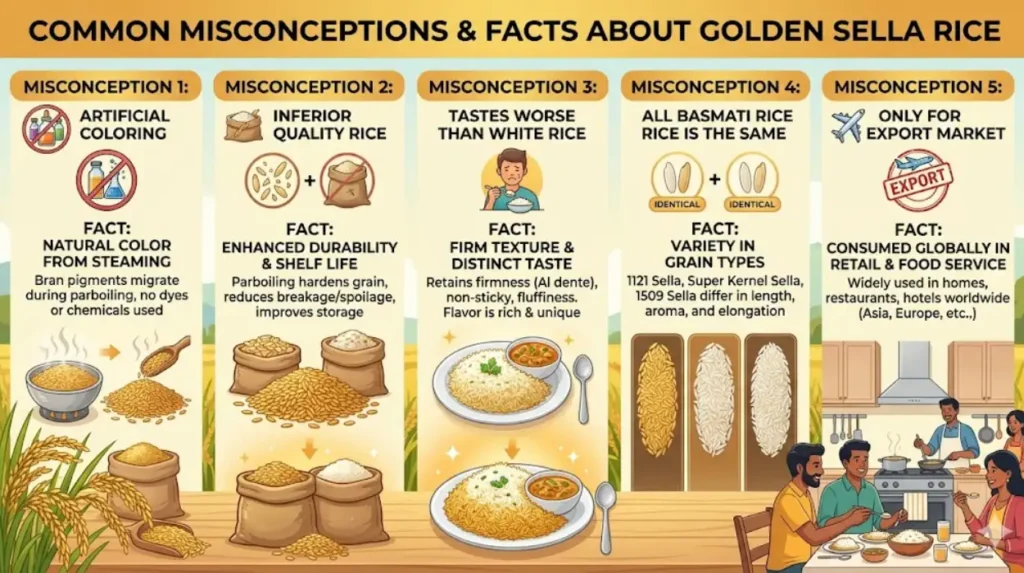
Misconception 4: All basmati rice is the same
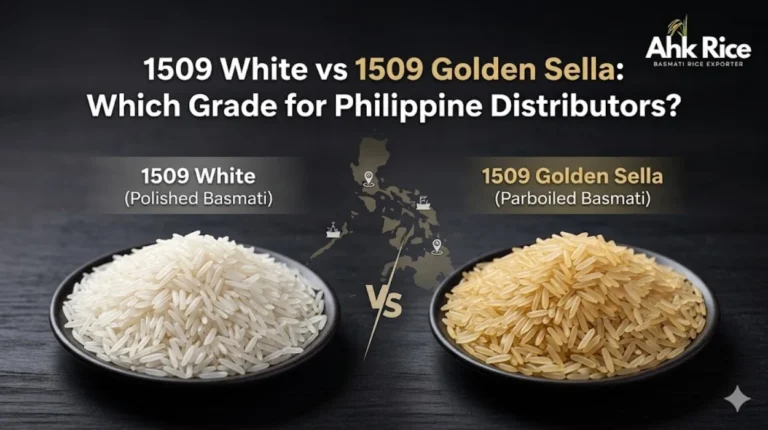
1121 differs from Super Kernel and 1509 in grain length and elongation.
Misconception 5: Golden Sella is only for export
Golden Sella is consumed globally in both retail and food service markets.
Misconceptions clarified, the next section explains how Golden Sella compares to other processing types.
How does Golden Sella compare to other basmati processing types?
Golden Sella differs from Creamy Sella and Steam rice in color, texture, moisture resistance, and shelf life, making it the most durable option among the three.
Golden Sella has a darker golden tone. Creamy Sella has a lighter yellow shade. Steam rice appears white.
Golden Sella has the firmest texture. Creamy Sella is slightly softer. Steam rice is the softest.
Golden Sella lasts up to 24 months in storage. Creamy Sella lasts 18 months. Steam rice lasts 12 months.
Golden Sella resists breakage best. Steam rice breaks more during transport and cooking.
For a detailed comparison, see: golden sella vs creamy sella vs steam 1121 basmati.
With comparisons complete, the final section explains how to identify high-quality Golden Sella rice.
How do buyers identify high-quality 1121 Golden Sella Basmati?
High-quality Golden Sella shows uniform golden color, 8.20–8.40 mm grain length, low broken ratio, and clean, odor-free grains with 12–13% moisture.
Inspection checklist
- Check grain length using calibrated measurement tools
- Verify moisture using a digital moisture meter
- Inspect color consistency visually
- Test aroma after cooking
- Examine broken percentage through sampling
Uniformity defines quality. Mixed grains reduce cooking performance. Clean rice ensures food safety.
Odor-free grains indicate proper drying and storage. Moisture control prevents mold growth.
Inspection ensures the product meets import standards. Buyers rely on lab testing and certification before shipment.
With quality identification explained, the guide completes the full understanding of Golden Sella rice.
Frequently Asked Questions
What makes 1121 Golden Sella different from other basmati rice varieties?
1121 Golden Sella differs due to its parboiling process, golden color, and 2.5–3.0x grain elongation, which create stronger, non-sticky grains compared to white or steam basmati.
1121 Golden Sella undergoes soaking and steaming before milling. This process hardens the grain. It reduces breakage during cooking and transport. Other basmati types lack this structural strength.
Why does 1121 Golden Sella rice have a golden color?
Golden Sella rice gets its color from heat-induced changes during steaming, not from artificial additives or dyes.
Steaming alters the outer bran layer. This chemical reaction produces a natural amber tone. The process also improves grain durability and nutrient retention.
How long can 1121 Golden Sella Basmati rice be stored?
Golden Sella rice maintains quality for 18–24 months when stored at below 25°C with 12–13% moisture content.
Proper storage prevents spoilage and maintains grain structure. High temperatures or excess moisture reduce shelf life and increase the risk of mold formation.
Which countries import 1121 Golden Sella Basmati rice the most?
Major importers include Saudi Arabia, UAE, Iraq, and Nigeria, driven by demand for bulk catering and traditional dishes (source: REAP export data, December 2025).
Middle Eastern markets use it for mandi and biryani. African markets use it for jollof rice due to its firm texture and long grains.
What is the ideal cooking method for 1121 Golden Sella Basmati rice?
The ideal method uses a 1:2 rice-to-water ratio, soaking for 30 minutes, and cooking for 10–12 minutes to achieve full elongation and separate grains.
Soaking hydrates the grain evenly. Controlled cooking preserves structure. Excess water or overcooking reduces grain separation and texture quality.