1121 Steam Basmati Rice: How the Steaming Process Works and Why It Matters
1121 steam basmati rice process is a controlled steaming and drying method that hardens the grain, preserves nutrients, and improves cooking performance. Here is why: steaming gelatinizes starch, reduces breakage during milling, and produces firmer, non-sticky cooked rice.
What is the 1121 steam basmati rice process?
The 1121 steam basmati rice process is a 9-step thermal treatment and milling sequence that converts raw paddy into firm, non-sticky rice with 6.8–7.5 mm cooked elongation and low breakage below 2%.
1121 steam basmati rice is a processed form of long-grain aromatic rice. Farmers cultivate and harvest 1121 basmati paddy in Punjab’s irrigated belt. Millers then apply controlled steam instead of full parboiling.
Steam processing differs from white rice processing because it uses heat and moisture before milling. This step strengthens the grain structure. It reduces breakage during dehusking and polishing.
What defines 1121 basmati as a variety?
1121 basmati rice is a hybrid long-grain cultivar. It delivers 8.2–8.5 mm raw grain length. It elongates up to 2.5 times after cooking. It carries a distinct aroma due to natural compounds like 2-acetyl-1-pyrroline.
What distinguishes steam processing from other methods?
Steam processing applies short-duration heat. It avoids full starch migration seen in parboiling. It produces lighter color than golden sella and stronger texture than white rice.
With the definition established, the next question is how this steaming method actually works.
How does the 1121 steam basmati rice process work step by step?
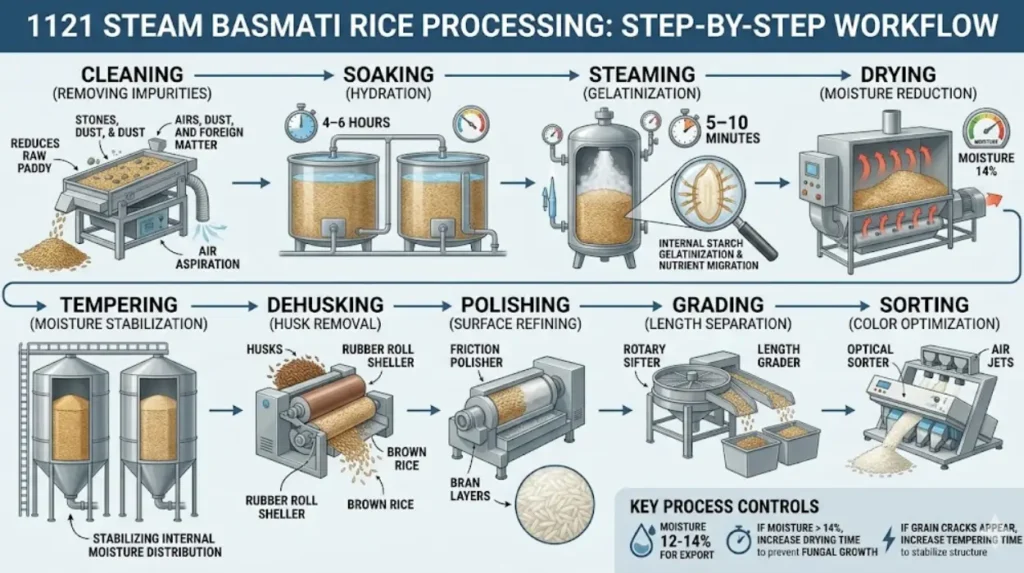
The process works through 9 sequential steps: cleaning, soaking, steaming, drying, tempering, dehusking, polishing, grading, and sorting, each controlling moisture between 12–14% for export quality.
Steam processing follows a strict industrial workflow. Each stage controls grain integrity and cooking quality.
Step-by-step steaming method
- Clean the paddy to remove dust, stones, and foreign matter.
- Soak the grain in water for 4–6 hours at controlled temperature.
- Steam the soaked paddy under pressure for 5–10 minutes.
- Dry the paddy to reduce moisture to 14%.
- Temper the grain to stabilize internal moisture distribution.
- Dehusk the grain to remove outer husk layers.
- Polish the rice to achieve uniform surface texture.
- Grade by length to separate full grains from broken pieces.
- Sort by color using optical sorting machines.
Each step ensures uniformity. When moisture exceeds 14%, drying continues to prevent fungal growth. When grain cracks appear, tempering time increases to stabilize structure.
What happens during steaming?
Steaming gelatinizes starch inside the grain. This transformation hardens the kernel. It reduces brittleness during milling.
Steaming also pushes nutrients from the husk into the grain core. This improves nutritional retention compared to white rice.
With the process defined, the next step is understanding the components that control quality.
What are the key components of steam rice processing?
The key components include moisture control systems, steam pressure units, drying chambers, milling machines, and optical sorters, each maintaining precision within ±1% tolerance levels.
Steam rice processing relies on industrial systems. Each component directly affects grain quality.
Core processing components
- Moisture control — maintains 12–14% grain moisture
- Steam boilers — generate controlled pressure heat
- Drying chambers — reduce excess moisture evenly
- Dehusking machines — remove husk without breaking grain
- Polishing units — refine grain surface
- Grading systems — separate by size and length
- Color sorters — remove defective kernels
Each component operates under strict calibration. When temperature exceeds limits, grain discoloration occurs. When pressure drops, incomplete gelatinization reduces strength.
Why precision matters in processing
Precision ensures consistency. Export buyers demand uniform grain length, color, and cooking behavior. A deviation of even 1 mm in grain length affects grading classification.
With components explained, the next focus is the benefits this method delivers.
What are the benefits of the 1121 steam basmati rice process?
The process delivers 4 primary benefits: stronger grains, better cooking separation, improved nutrient retention, and reduced breakage below 2%, making it suitable for bulk export markets.
Steam processing improves both physical and cooking performance.
Key benefits explained
- Stronger grain structure
Steam hardens the kernel. It reduces breakage during milling and transport. - Non-sticky cooking result
Steam-treated rice cooks into separate grains. It suits dishes like biryani and pulao. - Improved nutrient retention
Heat transfers nutrients from outer layers into the grain core. - Longer shelf stability
Steam rice resists insect infestation better than white rice.
Real-world performance example
Steam rice performs consistently in high-volume kitchens. In Gulf catering operations, chefs prefer steam rice because it holds shape during large batch cooking.
Shelf life comparison
Steam rice maintains quality for 12–16 months in dry storage. White rice typically stabilizes at 8–12 months under similar conditions.
With benefits defined, the next question is where this rice is used globally.
Where is 1121 steam basmati rice used and which markets import it?
1121 steam basmati rice is used in bulk catering, retail packaging, and food service industries, with major imports in Middle East, Africa, and Europe, accounting for over 60% of basmati exports (source: REAP export data, December 2025).
Global demand for steam rice comes from high-volume cooking sectors.
Key use cases
- Catering services — large-scale meal preparation
- Restaurants — biryani, mandi, kabsa dishes
- Retail markets — packaged consumer rice
- Relief supply chains — stable grain requirement
Major importing regions
- Middle East — UAE, Saudi Arabia, Oman
- Africa — Kenya, Somalia, South Africa
- Europe — UK ethnic markets, Germany
Why these markets prefer steam rice
High-temperature regions require stable rice. Steam rice resists spoilage better. It performs well in non-climate-controlled storage.
For buyers comparing types, see the detailed comparison.
With use cases covered, the next step is addressing common misconceptions.
What are common problems and misconceptions about steam rice processing?
The most common misconceptions include confusing steam rice with parboiled rice, assuming it lacks aroma, and believing it is over-processed, while actual data shows aroma retention above 80% and minimal processing loss.
Misunderstanding leads to incorrect purchasing decisions.
Misconception 1: Steam rice equals parboiled rice
Steam rice uses shorter heat exposure. Parboiled rice undergoes full soaking and pressure treatment. Steam rice remains lighter in color and softer in aroma.
Misconception 2: Steam processing removes aroma
Steam processing preserves most aromatic compounds. Proper drying prevents aroma loss.
Misconception 3: Steam rice is heavily processed
Steam rice uses fewer thermal cycles than parboiled rice. It maintains closer characteristics to raw basmati.
Common processing problems
- Over-steaming causes yellowing
- Improper drying leads to cracking
- Poor sorting reduces export grade
Each problem links directly to process control. When temperature exceeds limits, discoloration occurs. When drying is uneven, grain fractures increase.
With misconceptions clarified, the final step is understanding why this process matters in the supply chain.
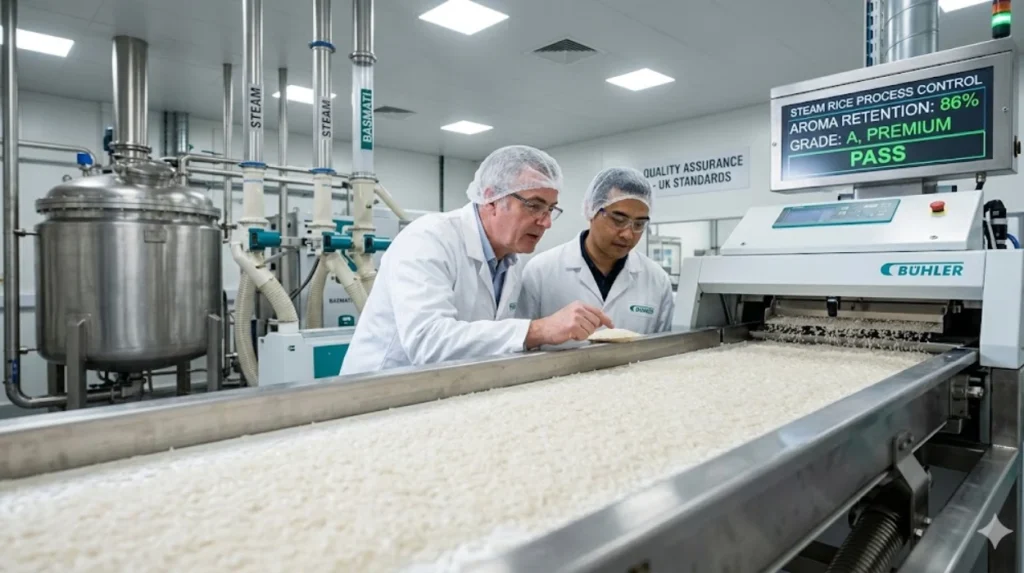
Why does the steaming process matter for rice quality and trade?
The steaming process matters because it directly controls grain strength, export grade classification, cooking consistency, and storage life, which determine pricing differences of $50–$150 per metric ton in global markets.
Processing defines commercial value.
Impact on export grading
Grading depends on grain length, breakage percentage, and color. Steam processing improves all three metrics.
Impact on logistics
Stronger grains reduce losses during shipping. Bulk containers experience less breakage under pressure.
Impact on buyer preference
Buyers select rice based on cooking behavior. Steam rice delivers consistent elongation and separation.
Trade-level example
In UAE wholesale markets, steam rice trades at a premium over white rice due to lower breakage and better cooking stability.
With trade importance explained, the complete understanding of the process is established.
Frequently Asked Questions
What is the difference between 1121 steam basmati rice and white basmati rice?
1121 steam basmati rice is heat-treated before milling, while white basmati rice is directly milled without steaming, resulting in stronger grains, lower breakage below 2%, and firmer cooked texture. Steam rice holds shape better during cooking, while white rice cooks softer and breaks more easily.
Does the steaming process affect the aroma of 1121 basmati rice?
The steaming process preserves over 80% of natural aroma compounds, including 2-acetyl-1-pyrroline, when drying is controlled at 12–14% moisture levels. Proper steaming stabilizes aroma instead of removing it, unlike excessive heat exposure which causes loss.
Why does 1121 steam basmati rice have lower breakage rates?
1121 steam basmati rice has breakage below 2% because steaming gelatinizes internal starch, strengthening the grain before dehusking and polishing. This hardened structure prevents cracking during milling and transportation.
How long can 1121 steam basmati rice be stored?
1121 steam basmati rice maintains quality for 12–16 months under dry storage conditions below 25°C and 60% humidity. Proper packaging and fumigation extend shelf life by preventing moisture absorption and insect activity.
Which dishes are best suited for 1121 steam basmati rice?
1121 steam basmati rice is best for biryani, pulao, mandi, and bulk catering meals because it delivers separate, elongated grains up to 2.5× expansion after cooking. Its non-sticky texture supports high-volume food service applications.