1121 Brown Basmati Rice: What Makes It Different from White and Why Demand Is Rising
1121 brown basmati rice differs from white basmati in bran retention, nutrient density, and processing method, and demand is rising because buyers prioritize wholegrain nutrition, longer digestion cycles, and unpolished export categories. Here is why: brown basmati retains outer bran layers that increase fiber, minerals, and market positioning in health-driven regions.
What is 1121 brown basmati rice?
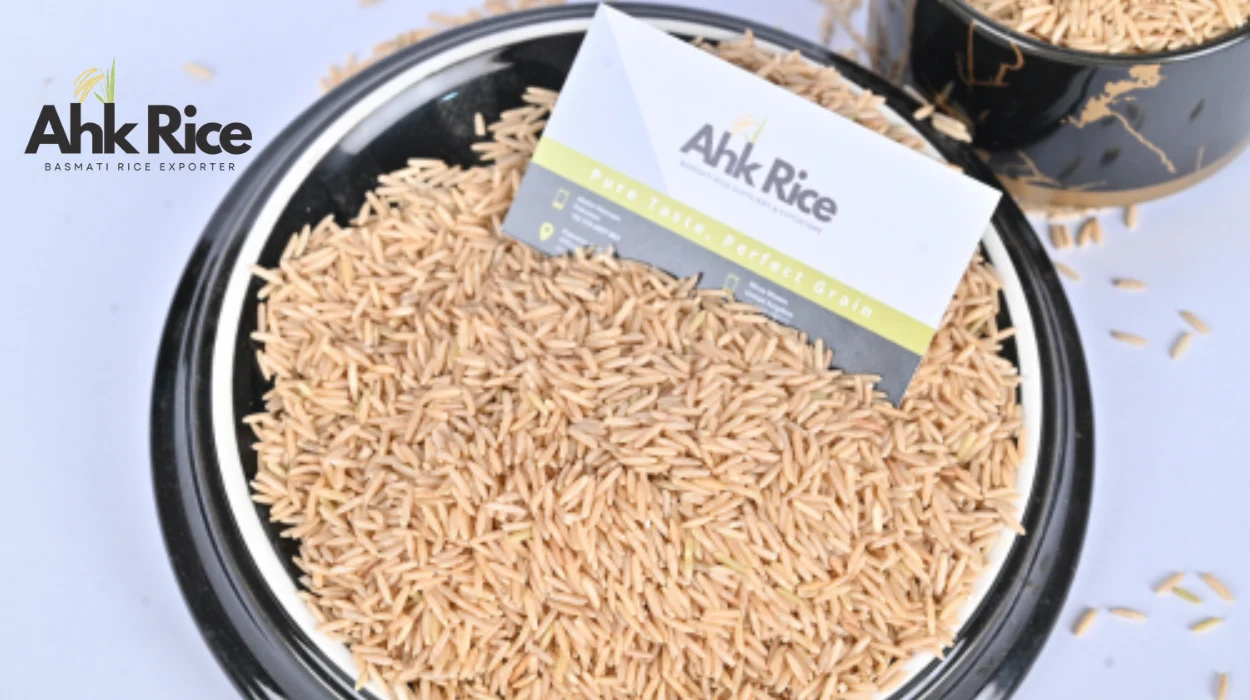
1121 brown basmati rice is an unpolished long-grain aromatic rice with a grain length of 8.0–8.4 mm, where the bran layer remains intact after dehusking, unlike white basmati which undergoes full polishing.
1121 brown basmati rice originates from basmati paddy cultivated in Punjab’s alluvial plains. Farmers cultivate this variety under controlled irrigation cycles. They harvest mature paddy at moisture levels between 20% and 24%. The paddy then enters milling units where processors remove only the outer husk.
Brown basmati rice differs structurally because milling stops after dehusking. White basmati undergoes further polishing that removes bran and germ layers. This structural difference defines its classification as wholegrain basmati.
Wholegrain basmati includes examples such as 1121 brown, super kernel brown, and 1509 brown variants. Each retains bran but differs in grain length and aging behavior. 1121 leads the segment due to its extra-long grain elongation ratio.
Brown basmati rice functions as a nutritional grain and as an export category. Buyers define it as unpolished rice in contracts. Export documentation labels it as “brown basmati” or “cargo rice” depending on the market.
With the definition of 1121 brown basmati established, the next question is how this unpolished grain moves through processing.
How does 1121 brown basmati rice processing work?
1121 brown basmati rice processing involves 9 controlled steps that stop before polishing, preserving the bran layer while ensuring export-grade cleanliness and uniformity.
Step-by-step processing flow
- Clean the paddy
- Dehusk the grain
- Separate husk from brown rice
- Remove immature kernels
- Sort by length
- Grade by thickness
- Polish lightly for dust removal only
- Inspect for defects
- Pack for export
Processing begins with pre-cleaning. Processors remove stones, dust, and straw using vibration and aspiration systems. This step ensures contamination-free milling.
Dehusking removes the outer husk without damaging the grain. Rubber roll shellers apply controlled pressure. The output becomes brown basmati rice with intact bran.
Sorting and grading define export quality. Machines separate grains by length and thickness. Export grades specify broken percentage such as 1%, 2%, or 5%.
Light polishing occurs only to remove surface dust. Brown basmati does not undergo full whitening. This step ensures visual uniformity without removing nutrients.
Inspection involves laboratory testing. Inspectors test moisture, broken ratio, and foreign matter. Typical moisture levels remain between 12% and 13% for safe storage.
Packaging follows strict export standards. Processors pack rice in PP bags, paper bags, or vacuum packs depending on destination requirements.
Processing defines the physical and nutritional identity of brown basmati, which leads directly to understanding its internal components.
What are the key components of brown basmati rice?
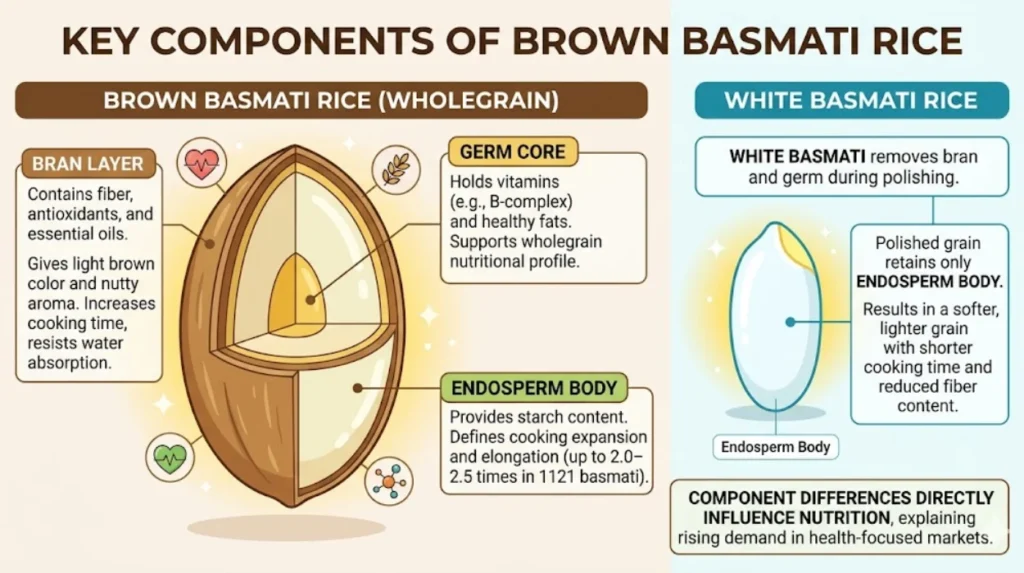
Brown basmati rice consists of 3 core layers—bran, germ, and endosperm, while white basmati retains only the endosperm after polishing.
Structural components
- Bran layer
- Germ core
- Endosperm body
Bran layer contains fiber, antioxidants, and essential oils. This layer gives brown rice its light brown color and nutty aroma. The bran also increases cooking time because it resists water absorption.
Germ core holds vitamins such as B-complex and healthy fats. This component supports the nutritional profile demanded in wholegrain markets.
Endosperm provides starch content. This part defines cooking expansion and elongation. In 1121 basmati, elongation reaches up to 2.0–2.5 times after cooking.
White basmati removes bran and germ during polishing. This removal reduces fiber content and shortens cooking time. The result becomes a softer and lighter grain.
Component differences directly influence nutrition, which explains the rising demand in health-focused markets.
What are the nutritional benefits of 1121 brown basmati rice?
1121 brown basmati rice delivers 2–3 times higher fiber, higher magnesium levels, and a lower glycemic response compared to white basmati.
Brown rice nutrition profile
- Dietary fiber: 3.5–4.5 g per 100 g
- Magnesium: 100–120 mg per 100 g
- Glycemic index: 50–55
- Protein: 7–8%
Fiber improves digestion speed control. Slower digestion supports sustained energy release. This property attracts diabetic-friendly product segments.
Magnesium supports metabolic functions. Wholegrain buyers in Europe and North America prioritize mineral-rich foods in retail packaging.
Glycemic index remains lower than white rice. White basmati ranges between 60 and 70, which results in faster glucose release.
Protein content remains stable across both types. However, brown basmati retains more micronutrients due to minimal processing.
Nutrition defines positioning. Retail brands label brown basmati as a functional food rather than a commodity grain. This positioning explains demand growth in premium markets.
With benefits clarified, the next logical step is understanding where this rice is used globally.
Where is 1121 brown basmati rice used and exported?
1121 brown basmati rice is exported primarily to North America, Europe, and Australia, where wholegrain consumption drives retail and organic market demand.
Key export markets
- United States
- Canada
- United Kingdom
- Germany
- Australia
North American markets import brown basmati for retail packaging. Supermarkets sell it in 1 kg to 5 kg packs under health-focused labels. Demand increased by 18% year-on-year (source: REAP export data, December 2025).
European markets prioritize organic certification. Buyers demand traceability, pesticide compliance, and non-GMO verification. Germany and the UK lead imports due to high wholegrain consumption.
Australian buyers focus on mixed retail and foodservice channels. Brown basmati appears in health cafes and meal prep businesses.
Middle Eastern markets show limited demand. Buyers prefer white basmati due to faster cooking and softer texture. Brown rice remains a niche category in this region.
Export usage patterns explain pricing differences. Brown basmati often commands higher retail margins but lower bulk turnover compared to white basmati.
For a deeper understanding of how pricing and margins differ between these two types, refer to this detailed comparison of export profitability structures.
With use cases established, the next question addresses common misconceptions affecting buyer decisions.
What are common misconceptions about brown vs white basmati rice?
The main misconception is that brown basmati is always superior, while in reality it differs in cooking time, shelf life, and application suitability, not just nutrition.
Misconception 1: Brown rice cooks the same as white rice
Brown basmati requires 30–40 minutes cooking time. White basmati cooks within 12–15 minutes. This difference affects foodservice operations.
Misconception 2: Brown rice stores longer
Brown basmati has a shorter shelf life of 6–9 months. Bran oils oxidize over time. White basmati stores for 12–24 months due to polishing.
Misconception 3: Brown rice suits all cuisines
Brown basmati fits salads, bowls, and health meals. White basmati suits biryani, pulao, and traditional dishes. Texture defines usage.
Misconception 4: Brown rice always commands higher export demand
Brown basmati demand grows in specific regions only. Bulk importers in Gulf countries still prioritize white basmati due to cooking efficiency.
Clarifying misconceptions ensures buyers match the correct product to the correct application, which leads to understanding the overall demand trend.
Why is demand for brown basmati rice rising globally?
Demand for brown basmati rice is rising due to health awareness, wholegrain consumption trends, and premium retail positioning in developed markets.
Demand drivers
- Health-conscious consumers
- Wholegrain labeling regulations
- Organic product growth
- Premium retail pricing
Health awareness increases wholegrain consumption. Consumers shift from refined grains to fiber-rich alternatives. This shift drives supermarket shelf expansion for brown rice.
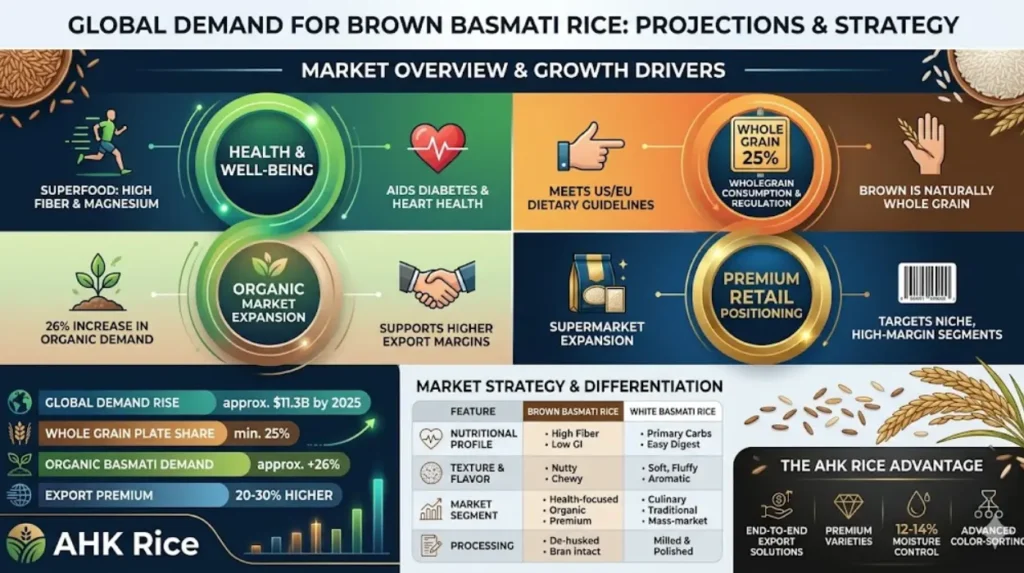
Wholegrain labeling regulations in the EU and US require clear classification. Brown basmati fits these regulations without additional processing.
Organic market growth supports brown rice exports. Organic basmati commands 20–30% higher prices in retail channels (source: Pakistan Bureau of Statistics, FY2024-25).
Premium pricing encourages exporters to diversify product portfolios. Brown basmati provides access to niche segments with higher margins per unit.
Demand growth does not replace white basmati demand. Instead, it creates a parallel category with different buyer profiles and usage patterns.
With demand dynamics clear, the final perspective connects product differences with market strategy.
How does 1121 brown basmati compare structurally and commercially to white basmati?
1121 brown basmati differs from white basmati in processing depth, nutritional composition, cooking performance, and market positioning, creating two distinct export categories.
Structural comparison
- Brown basmati: bran intact
- White basmati: bran removed
Processing comparison
- Brown basmati: dehusked only
- White basmati: dehusked and polished
Cooking comparison
- Brown basmati: longer cooking time
- White basmati: faster cooking time
Market comparison
- Brown basmati: retail and health markets
- White basmati: bulk and foodservice markets
Brown basmati supports value-added exports. White basmati supports volume-based exports. Exporters balance both categories to maintain market coverage across regions.
This comparison completes the macro understanding of the topic and connects directly to profitability analysis in export operations.
Frequently Asked Questions
What is the main difference between 1121 brown and white basmati rice?
The main difference is bran retention in brown basmati versus full polishing in white basmati. Brown basmati keeps the outer bran and germ layers, which increases fiber and nutrients, while white basmati removes these layers for a softer texture and faster cooking.
Why does brown basmati rice take longer to cook?
Brown basmati takes 30–40 minutes because the bran layer blocks water absorption. The intact outer layer slows hydration, while white basmati absorbs water quickly due to polishing, reducing cooking time to 12–15 minutes.
Which markets import 1121 brown basmati rice the most?
North America, Europe, and Australia import the highest volumes of brown basmati. These regions prioritize wholegrain consumption, organic certification, and retail-ready packaging, unlike bulk-focused Middle Eastern markets.
Does brown basmati rice have a shorter shelf life than white rice?
Brown basmati lasts 6–9 months, while white basmati lasts 12–24 months. Natural oils in the bran oxidize over time, reducing storage stability compared to polished rice.
Is 1121 brown basmati rice healthier than white basmati rice?
Brown basmati provides 2–3 times more fiber and a lower glycemic index. This nutritional profile supports controlled digestion and sustained energy release, making it suitable for health-focused diets.