1509 Steam vs 1509 White Basmati: Which Grade Fits Your Buyer Base Better?
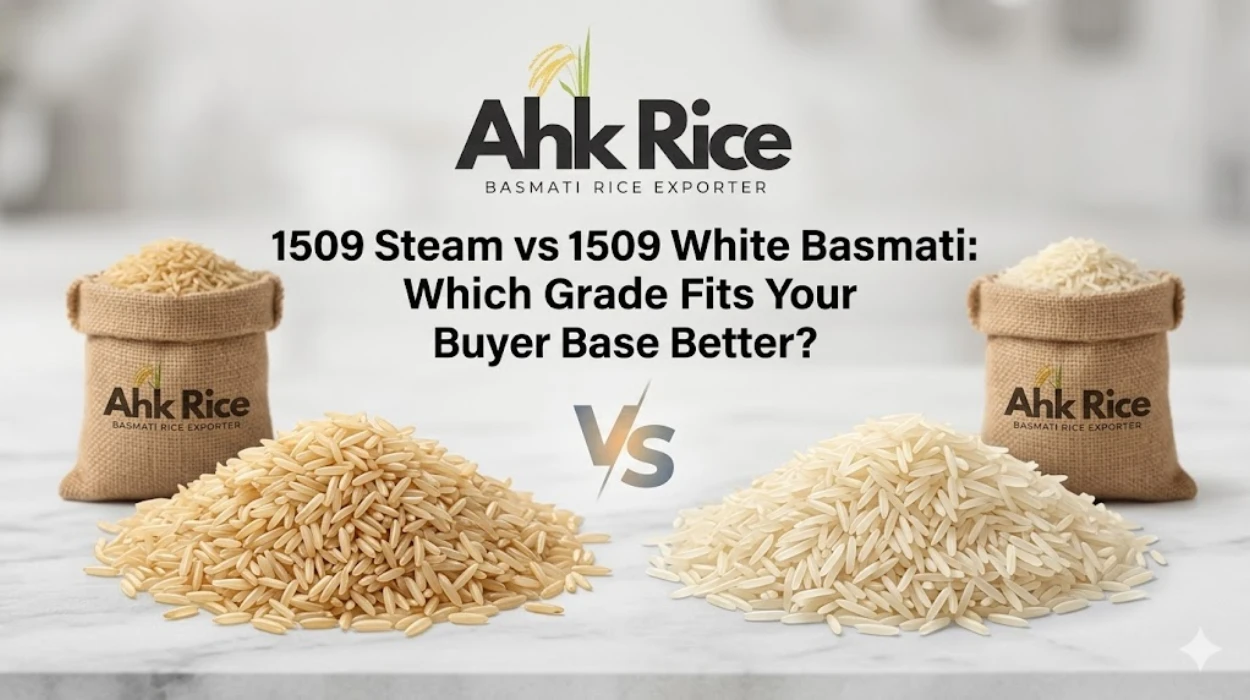
1509 Steam Basmati fits bulk retail and modern trade buyers, while 1509 White Basmati fits price-sensitive and traditional markets. Here is why: Steam processing improves grain strength, shelf stability, and visual consistency, while White (raw) processing preserves natural texture at a lower cost.
1509 Basmati is a short-maturity, high-yield hybrid cultivated in Punjab. 1509 paddy matures faster than 1121, which reduces sourcing volatility. Exporters mill, polish, grade, and sort 1509 into multiple processing types. The two most traded are Steam and White. Buyers choose between them based on cooking behavior, shelf life, and price per metric ton.
Understand the fundamentals first through this detailed guide on how 1509 Basmati rice is cultivated and processed. Then evaluate sourcing decisions based on your market’s demand pattern and storage conditions.
1509 Steam Basmati is the first product most buyers evaluate when working with a full-service exporter. Explore custom packaging and export services for 1509 Basmati shipments to understand how specifications convert into shipped product.
What are the available solutions?
1509 Basmati offers two primary solutions: Steam and White grades, each defined by processing method, grain strength, and market positioning. Both grades originate from the same paddy but diverge during milling and post-processing.
1509 Steam Basmati (Parboiled via steaming)
1509 Steam Basmati is processed by steaming paddy before milling. The exporter hydrates, heats, dries, and then mills the grain. This method gelatinizes starch partially and strengthens the grain structure.
Processing steps (Steam grade):
- Clean the paddy
- Soak under controlled moisture
- Steam at regulated temperature
- Dry the paddy
- Dehusk the grain
- Polish the rice
- Sort by length and color
Steam processing increases head rice recovery. Head rice yield typically exceeds 92%. The grain becomes slightly yellowish and firmer.
1509 White Basmati (Raw milled)
1509 White Basmati is milled directly without parboiling. The exporter dehusks and polishes raw paddy. This preserves natural whiteness and softness.
Processing steps (White grade):
- Clean the paddy
- Dehusk the grain
- Polish the rice
- Sort by length and color
- Grade broken percentage
White processing reduces cost because it skips steaming and drying. However, grain breakage increases during milling.
Specification Comparison Table
| Attribute | 1509 Steam Basmati | 1509 White Basmati |
|---|---|---|
| Grain Length | 8.10–8.30 mm | 8.00–8.20 mm |
| Moisture | 12–13% | 12–14% |
| Broken % | 2–5% | 5–10% |
| Color | Light cream/yellow | Bright white |
| Aroma | Mild | Moderate natural aroma |
| Cooking Expansion | 2.5x | 2.0x |
| Head Rice Yield | 92–95% | 85–90% |
With the available solutions defined, the next step is to compare how these processing approaches perform in real buyer scenarios.
How do different approaches compare?
Steam processing delivers higher durability and consistency, while White processing delivers lower cost and traditional texture. The correct choice depends on storage conditions, cooking style, and buyer expectations.
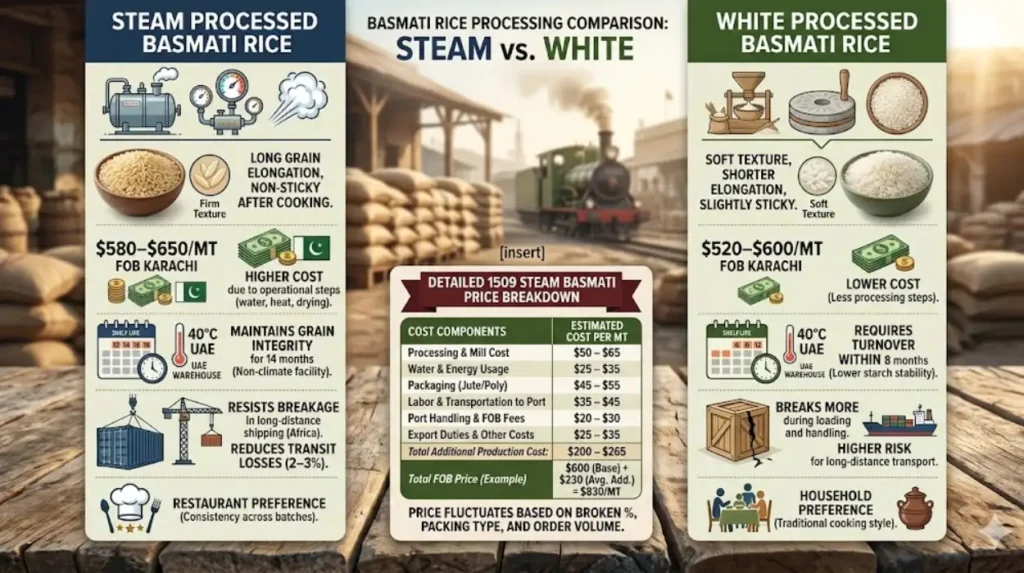
Cost comparison (per metric ton)
Steam processing adds operational steps. Exporters use water, heat, and drying systems. This increases cost.
- Steam: $580–$650/MT FOB Karachi
- White: $520–$600/MT FOB Karachi
Price fluctuates based on broken percentage, packing type, and order volume. Discover detailed 1509 steam basmati price breakdown for bulk buyers.
Shelf life comparison
Steam Basmati lasts longer because starch stabilizes during steaming.
- Steam: 12–18 months
- White: 6–12 months
In a 40°C warehouse in the UAE, Steam maintains grain integrity for 14 months. White requires turnover within 8 months. For importers storing in non-climate facilities, Steam is the correct specification.
Cooking performance comparison
Steam rice remains separate and non-sticky after cooking. White rice cooks softer and slightly sticky.
- Steam: firm texture, long grain elongation
- White: soft texture, shorter elongation
Restaurants prefer Steam because consistency matters across batches. Households prefer White because softness aligns with traditional cooking styles.
Breakage and handling
Steam rice resists breakage during transport. White rice breaks more during loading and handling.
- Steam reduces transit losses by 2–3%
- White increases risk in long-distance shipping
This difference becomes critical for Africa-bound shipments where transit time exceeds 30 days.
With these comparisons established, the next question is which method works best for specific markets and buyer types.
Which method works best for different cases?
Steam fits bulk buyers, modern retail chains, and export markets with long storage cycles, while White fits price-driven retail, traditional consumption markets, and short turnover supply chains.
Middle East (UAE, Saudi Arabia)
Middle Eastern importers prioritize grain length and shelf stability.
- Preferred grade: 1509 Steam
- Reason: high-temperature storage and bulk consumption
- Example: catering companies store rice in warehouses for months
Africa (West and East Africa)
African markets focus on affordability and availability.
- Preferred grade: 1509 White
- Reason: lower price per MT
- Example: distributors sell in open markets with fast turnover
Europe (ethnic retail)
European ethnic stores require visual quality and branding.
- Preferred grade: 1509 Steam (premium packs)
- Reason: consistent grain and better shelf appeal
Pakistan domestic and nearby regions
Local markets value softness and aroma.
- Preferred grade: 1509 White
- Reason: matches traditional cooking style
Buyer type segmentation
| Buyer Type | Recommended Grade | Reason |
|---|---|---|
| Importer (bulk) | Steam | Storage stability |
| Distributor | White | Lower cost |
| Retail chain | Steam | Visual consistency |
| Restaurant | Steam | Cooking reliability |
| Household market | White | Soft texture |
With market alignment clear, the next step is to evaluate advantages and limitations of each option.
What are the pros and cons of each grade?
Steam offers durability and consistency but costs more, while White offers affordability and natural texture but reduces shelf life and increases breakage risk.
1509 Steam Basmati
Pros:
- Longer shelf life
- Lower breakage during shipping
- Higher head rice yield
- Consistent cooking performance
Cons:
- Higher cost
- Slight color variation (cream tone)
- Mild aroma compared to raw
1509 White Basmati
Pros:
- Lower price per MT
- Bright white appearance
- Softer cooking texture
- Traditional consumer acceptance
Cons:
- Higher breakage risk
- Shorter shelf life
- Less suitable for long storage
Real-world example comparison
Steam performs better in bulk shipments. A 500 MT shipment to Saudi Arabia arrives with minimal breakage. White rice in the same route loses up to 2% additional volume due to handling.
White performs better in fast-moving markets. A distributor in Nigeria sells White stock within 45 days. Shelf life becomes irrelevant in this scenario.
With advantages and trade-offs defined, the next step is building a structured decision framework.
What decision factors should guide your choice?
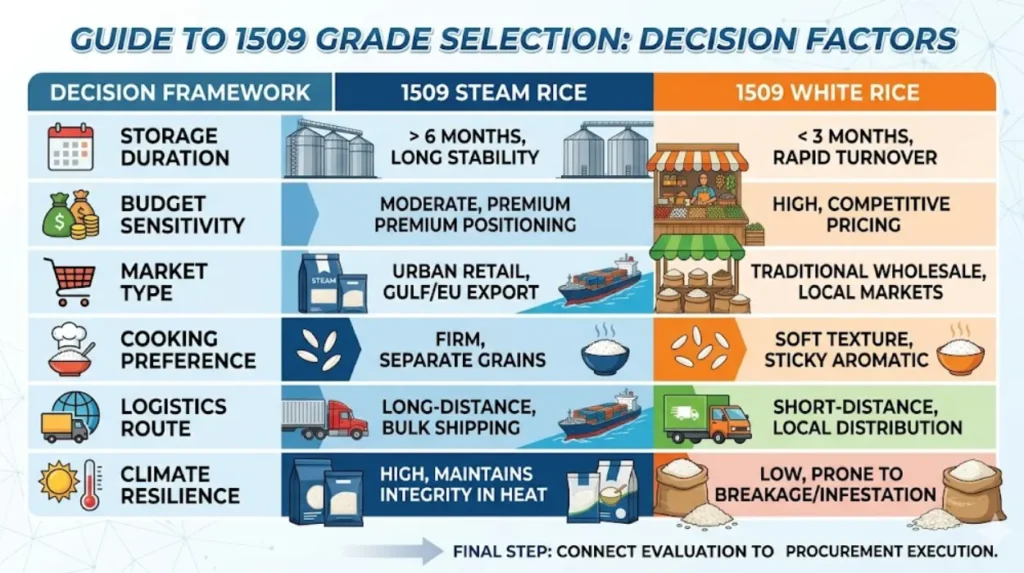
Buyer base, storage duration, pricing strategy, and distribution model determine the correct 1509 grade. A structured framework reduces procurement risk and aligns supply with demand.
Decision Framework Table
| Factor | Choose Steam | Choose White |
|---|---|---|
| Storage duration | Over 6 months | Under 3 months |
| Budget sensitivity | Moderate | High |
| Market type | Urban retail | Traditional markets |
| Cooking preference | Non-sticky | Soft texture |
| Logistics route | Long-distance | Short-distance |
Key decision variables explained
Storage duration determines grade selection. Use Steam when stock cycles exceed 90 days. Use White when turnover is rapid.
Pricing strategy defines margin structure. White supports competitive pricing. Steam supports premium positioning.
Distribution model impacts handling losses. Bulk shipping favors Steam. Local distribution tolerates White.
Consumer preference drives repeat demand. Soft rice sells better in South Asia. Separate grains sell better in Gulf markets.
Climate conditions affect shelf life. High heat environments require Steam because it maintains grain stability.
With decision factors structured, the final step is connecting this evaluation to procurement execution.
Final recommendation: Align grade with buyer behavior
1509 Steam suits structured supply chains and long storage cycles, while 1509 White suits fast-moving, price-sensitive markets. The correct decision aligns processing type with buyer behavior, not just price.
Procurement teams must define their buyer segment first. Then match grade specifications to demand patterns. This approach reduces waste, improves customer satisfaction, and stabilizes margins.
Frequently Asked Questions
What is the main difference between 1509 Steam and 1509 White Basmati?
1509 Steam Basmati undergoes a steaming process before milling, which strengthens the grain and improves shelf life. 1509 White Basmati is milled directly without steaming, which preserves its natural color and softer texture but reduces durability and storage time.
Which grade is better for long-distance export shipments?
1509 Steam Basmati is better for long-distance exports because it resists breakage and maintains quality during extended transit. Its stronger grain structure ensures lower losses during loading, shipping, and unloading.
Why is 1509 White Basmati cheaper than Steam?
1509 White Basmati costs less because it skips the steaming and drying stages during processing. This reduces energy, labor, and handling costs, making it more suitable for price-sensitive markets.
Which grade has a longer shelf life?
1509 Steam Basmati has a longer shelf life, typically lasting up to 12–18 months under proper storage. 1509 White Basmati usually lasts 6–12 months and requires faster stock turnover to maintain quality.
How do I choose the right grade for my market?
Choose 1509 Steam Basmati for markets with long storage cycles, high temperatures, or bulk distribution. Choose 1509 White Basmati for fast-moving markets where lower cost and softer cooking texture are more important.