Why Creamy Sella Basmati Rice Has a Longer Shelf Life Than White Rice
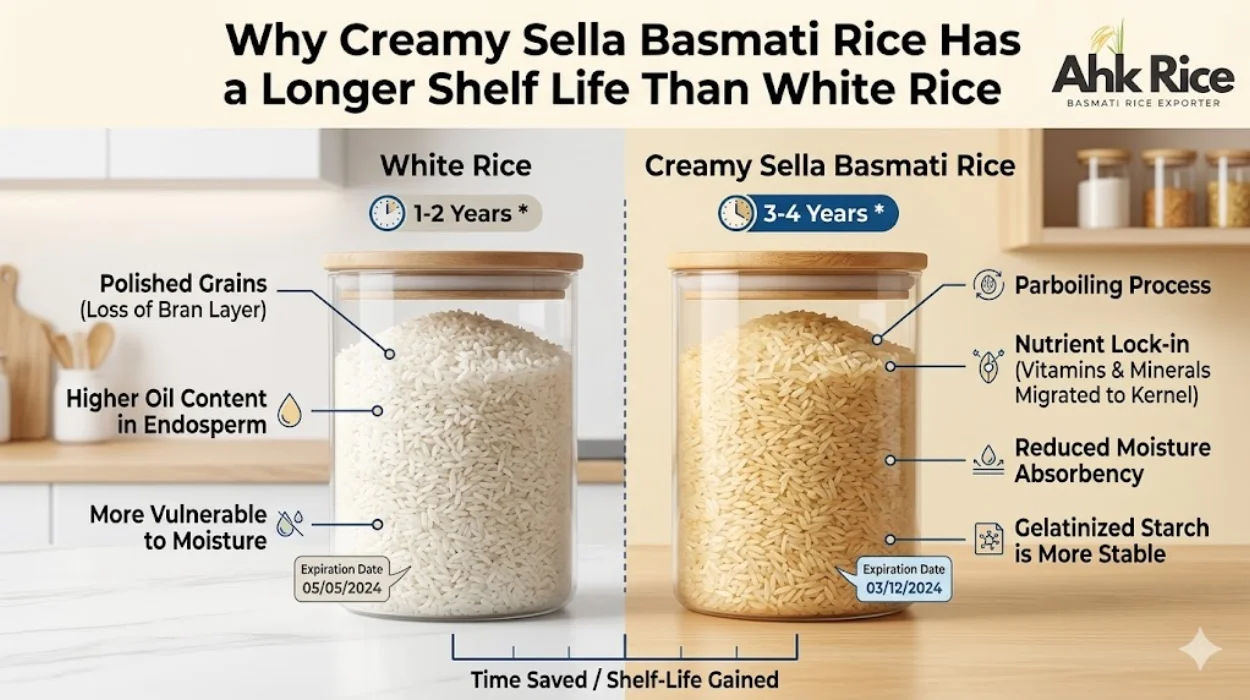
Creamy Sella Basmati rice lasts 18–24 months in controlled storage while white rice lasts 6–12 months because parboiling locks nutrients, strengthens grain structure, and reduces moisture absorption after milling. Here is why: parboiling gelatinizes starch inside the kernel, creating a dense grain that resists spoilage, oxidation, and insect infestation during long storage and export cycles.
Creamy Sella Basmati rice is a parboiled rice type produced by partially boiling paddy before milling. The process moves nutrients from the husk into the grain. This creates a firmer structure compared to raw milled white rice. The grain becomes less porous and more stable under humidity changes.
White rice loses protective layers during milling without parboiling. This exposes starch and increases susceptibility to rancidity and insect damage. Creamy Sella maintains integrity because the starch is pre-gelatinized during controlled steaming.
Creamy Sella rice is widely cultivated in Punjab, where controlled irrigation and seasonal harvesting support uniform paddy quality. Export processors mill, dehusk, steam, dry, and grade the rice under strict moisture targets. This ensures long storage performance for international shipments.
With the definition of creamy sella basmati established, the next focus is how parboiling structurally changes the grain to extend shelf stability.
How does parboiling increase shelf life in creamy sella rice?
Parboiling increases shelf life by gelatinizing starch inside the grain, sealing micro-pores, reducing free moisture, and stabilizing the kernel structure against microbial and insect activity during storage and shipping cycles.
Parboiling starts with soaking paddy in water to raise internal moisture levels. Millers then steam the soaked paddy under controlled temperature. This process drives nutrients into the endosperm and partially cooks the grain while still in husk form.
Gelatinization of starch occurs during steaming. This step converts fragile starch molecules into a compact structure. Once dried, the grain becomes harder and less absorbent compared to raw milled rice.
Drying stabilizes moisture content between 12% and 14%. This controlled reduction prevents fungal growth and slows enzymatic activity. Lower moisture directly increases storage life in hot climates like the Middle East and Africa.
Dehusking and polishing complete the process without removing structural strength. The grain remains intact even during long-distance shipping in variable humidity environments.
With parboiling mechanisms understood, the next section explains the processing components that directly influence durability and export performance.
What are the key processing components that improve durability?
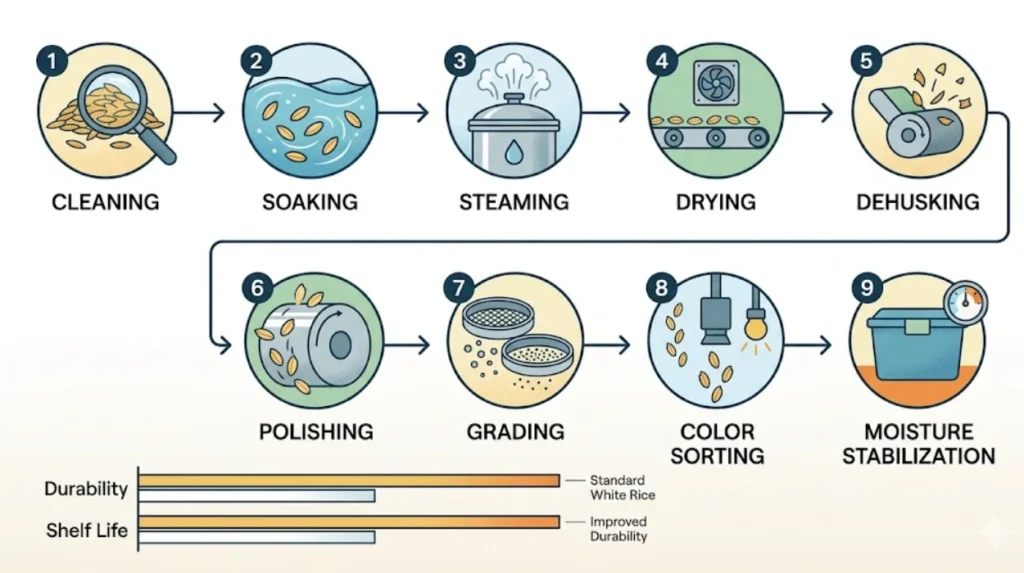
Durability improves through nine controlled processing steps: cleaning paddy, soaking, steaming, drying, dehusking, polishing, grading, color sorting, and moisture stabilization that collectively extend shelf life beyond white rice standards.
Cleaning removes dust, stones, and immature grains before processing. This step ensures uniform parboiling and prevents contamination during steaming.
Soaking hydrates the paddy uniformly. Hydration ensures consistent heat penetration during steaming, which determines final grain strength.
Steaming applies controlled heat that triggers starch gelatinization. Temperature consistency ensures no grain overcooks or cracks during processing.
Drying reduces moisture content to export-safe levels. Controlled airflow prevents surface stress fractures and maintains kernel integrity.
Dehusking removes the outer hull without damaging the grain. Mechanical calibration ensures minimal breakage during milling.
Polishing refines surface texture without reducing structural density. This step improves appearance for premium export markets.
Grading separates long grains from broken segments. Uniform grading improves packaging efficiency and market classification.
Color sorting removes discolored or damaged grains. Optical systems ensure purity in export lots.
Moisture stabilization locks final grain condition for shipment. This prevents microbial growth during container transport.
With processing components defined, the next section explains the benefits for exporters and global buyers relying on long storage cycles.
What are the main benefits of longer shelf life for exporters and buyers?
Longer shelf life enables 18–24 month storage stability, reduces shipment losses, improves inventory planning, and ensures consistent grain quality across global supply chains with variable climate conditions.
Exporters benefit from reduced rejection rates during customs inspections. Stable grain structure prevents quality degradation during long transit routes from South Asia to Africa, Europe, and the Gulf.
Buyers gain flexibility in procurement cycles. Bulk importers can store rice for extended distribution without rapid turnover pressure. This improves cost efficiency and reduces emergency restocking.
Long shelf life reduces fumigation frequency. Insect-resistant structure lowers chemical treatment requirements during warehouse storage.
Retailers maintain consistent cooking quality. Stable starch structure ensures uniform texture after extended storage periods.
Industrial kitchens benefit from predictable expansion ratios. Parboiled grains absorb water evenly during cooking even after long storage periods.
Importers in hot climates rely on sella rice because temperature fluctuations do not degrade grain integrity quickly.
With benefits established, the next section connects these properties to real-world global consumption patterns and use cases. Read Mofu Article: Creamy sella 1121 basmati top import markets
What are the use cases of creamy sella basmati in global markets?
Creamy Sella Basmati is used in catering, institutional food service, retail packaging, and humanitarian food supply because it maintains structure, resists spoilage, and performs consistently under bulk storage conditions.
Catering operations use creamy sella for large-scale meal preparation. The rice retains firmness during holding periods and reheating cycles.
Institutional kitchens prefer it for hospitals, schools, and military kitchens. Controlled expansion ensures predictable serving portions.
Retail packaging companies use it for long shelf-life supermarket distribution. Stable grain prevents quality variation on shelves.
Humanitarian programs use parboiled rice for food aid distribution. Long storage stability supports logistical delays in transport and warehousing.
Export markets in the Middle East and Africa demand creamy sella for bulk imports due to non-refrigerated storage conditions.
Industrial food processors use it in ready-to-eat meals because structure remains stable after thermal processing.
With use cases defined, the next section addresses common misconceptions about shelf life and storage performance.
What common misconceptions exist about sella rice storage advantage?
Common misconceptions include the belief that creamy sella is artificially preserved, that it contains additives for shelf life, and that longer storage reduces cooking quality, all of which are incorrect due to natural parboiling and structural transformation.
Misconception assumes chemical preservation. Creamy Sella rice uses only heat, water, and steam during processing. No preservatives are added.
Misconception assumes flavor loss over time. Properly stored sella rice retains aroma because bran nutrients are stabilized inside the grain.
Misconception assumes cooking performance declines. Parboiled structure maintains absorption capacity even after long storage cycles.
Misconception assumes higher breakage rates. Controlled milling reduces fissures and strengthens kernel integrity.
Misconception assumes white rice is more natural. White rice undergoes deeper polishing, removing protective layers entirely.
Misconception assumes shelf life depends on packaging alone. Shelf life depends on moisture control and parboiling, not packaging material only.
With misconceptions clarified, the next section explains how storage conditions directly influence performance outcomes.
How do storage conditions affect parboiled rice shelf life?
Storage conditions directly control shelf life by regulating temperature, humidity, oxygen exposure, and infestation risk, with optimal conditions extending creamy sella stability up to 24 months without quality loss.
Temperature control maintains grain stability. Ideal storage remains below 25°C to prevent enzymatic degradation.
Humidity control maintains moisture balance. Relative humidity below 60% prevents fungal growth and grain swelling.
Ventilation control reduces condensation inside storage warehouses. Air circulation prevents localized spoilage zones.
Pest control prevents insect infestation. Controlled fumigation schedules ensure grain safety during long storage cycles.
Packaging control preserves structural integrity. Multi-layer PP or jute bags reduce external moisture absorption.
Warehouse stacking controls airflow distribution. Proper pallet spacing prevents heat accumulation inside bulk storage piles.
With storage conditions defined, the full mechanism behind creamy sella’s extended shelf life becomes clear through processing, structure, and environment interaction.
Frequently Asked Questions
Why does creamy sella basmati rice last longer than white rice?
Creamy Sella Basmati rice lasts longer because it is parboiled before milling. The steaming process gelatinizes starch inside the grain and reduces moisture absorption. This creates a dense structure that resists spoilage, insect attack, and oxidation during long storage.
How long can creamy sella rice be stored safely?
Creamy Sella rice can be stored for 18 to 24 months under proper warehouse conditions. Controlled temperature below 25°C and humidity below 60% maintain grain quality. White rice typically lasts only 6 to 12 months under the same conditions.
Does parboiling change the nutrition of basmati rice?
Parboiling improves nutrient retention by transferring vitamins and minerals from the husk into the grain. This process increases stability and preserves nutrients better during storage and cooking compared to fully milled white rice.
What storage conditions are best for creamy sella basmati rice?
Dry, cool, and ventilated storage conditions preserve creamy sella rice quality. Airtight packaging, pest control, and stable humidity prevent moisture absorption and fungal growth. These conditions ensure consistent quality during long export cycles.
Which markets prefer creamy sella basmati rice the most?
Middle Eastern, African, and institutional catering markets prefer creamy sella basmati rice. These regions require long shelf life, stable cooking performance, and bulk storage efficiency for hotels, food service, and large-scale import distribution.