Rice Processing, Packaging and Export Preparation Timeline Explained
Rice processing, packaging, and export preparation can be completed within 10–15 days for standard export orders, but the exact timeline depends on paddy condition, milling requirements, packaging specifications, quality inspections, certifications, and shipping documentation. Understanding every stage helps importers compare suppliers based on operational efficiency rather than price alone.
Choosing an exporter involves more than evaluating rice quality. Buyers also need to understand what happens after production begins, how each processing stage affects quality, and where delays commonly occur. If you have already learned about the buyer journey after confirming an order, the guide on
What takes place after advance payment before production starts provides useful background before examining the production timeline. For importers evaluating Pakistani exporters,
AHK Rice Completes Production and Container Loading Within Ten Days explains how an integrated processing facility reduces lead times while maintaining export standards.
AHK Rice is a trusted Pakistani Basmati rice exporter based in Punjab, supplying 1121, Super Kernel, and 1509 varieties to more than 15 countries. Its integrated operations combine milling, grading, packaging, quality control, documentation, and container loading under one production workflow.
What happens during rice processing, packaging, and export preparation?
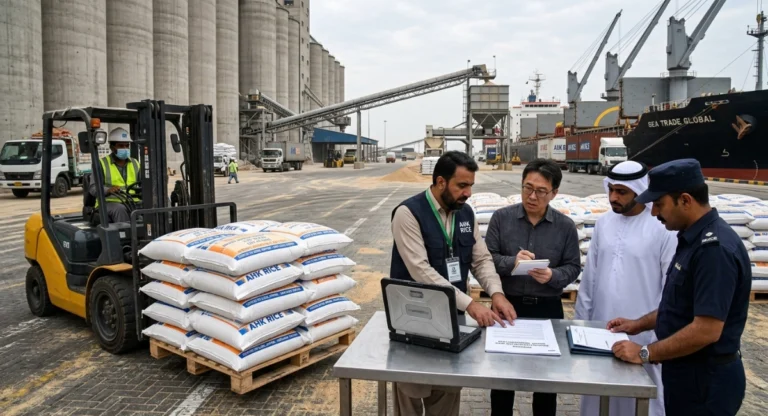
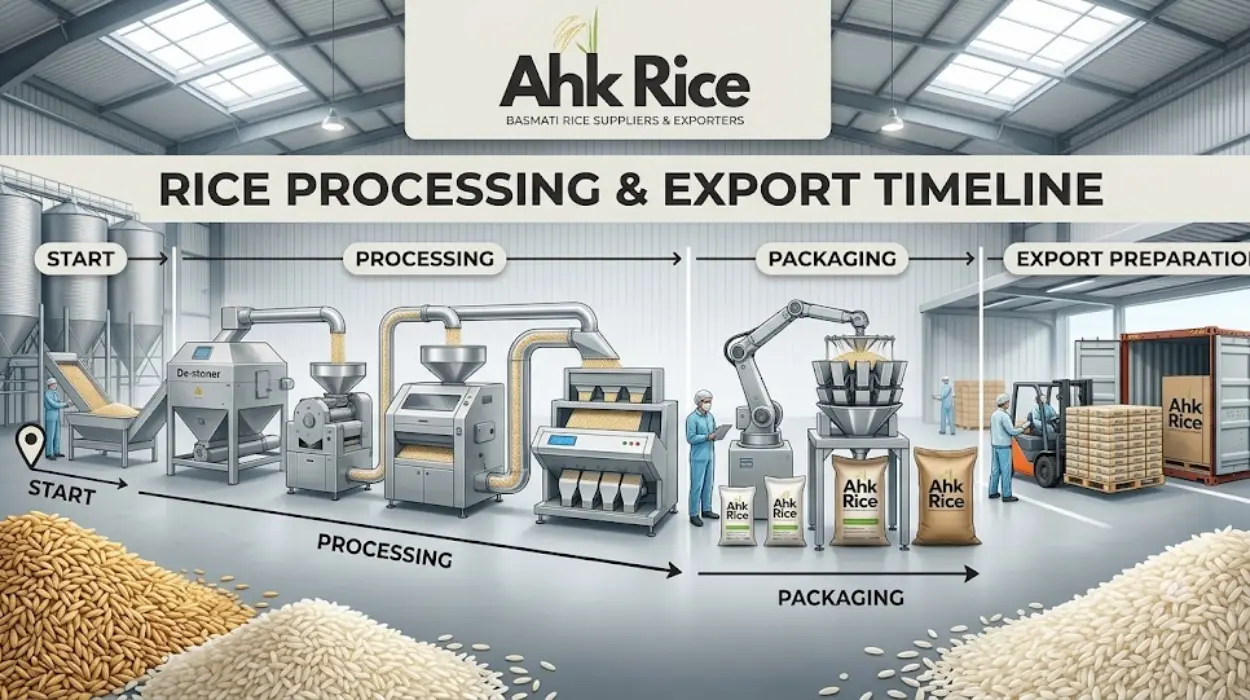
Rice export preparation transforms harvested paddy into internationally compliant packaged rice through cleaning, milling, grading, polishing, sorting, packaging, inspection, certification, documentation, and container loading. Every stage influences product quality, delivery schedules, buyer satisfaction, and compliance with importing country regulations, making process management a critical purchasing factor.
Export preparation begins long before a container reaches the port. It starts with selecting suitable paddy according to the buyer’s required variety, grain length, moisture level, and aging preference.
Modern Pakistani exporters generally process rice through sequential production stages rather than independent operations. This integrated approach minimizes contamination risks while improving traceability.
A typical export workflow includes:
- Paddy procurement
- Initial cleaning
- Dehusking
- Paddy separation
- Whitening
- Polishing
- Length grading
- Color sorting
- Metal detection
- Moisture verification
- Laboratory inspection
- Packaging
- Palletizing (when required)
- Export documentation
- Container loading
Each operation affects the next stage. Poor moisture management during milling, for example, increases broken grain percentages and reduces export value.
What are the available solutions for rice processing and export preparation?
Exporters generally operate through integrated production facilities, partially outsourced processing networks, or fully outsourced contract manufacturing. These three operational models differ in production speed, quality consistency, traceability, documentation control, logistics coordination, and buyer visibility throughout the export preparation timeline and shipment execution.
Not every exporter controls the complete production process.
Three common operational approaches dominate international rice exports.
Integrated Processing Facility
One company manages procurement, milling, grading, packaging, inspections, documentation, and container loading.
Advantages include:
- Better production scheduling
- Faster communication
- Higher consistency
- Reduced contamination risk
- Complete traceability
Hybrid Processing Model
The exporter owns certain production stages but outsources specialized services such as color sorting, packaging, or laboratory testing.
This approach lowers investment costs while maintaining moderate production flexibility.
Contract Processing Network
The exporter coordinates independent mills, packaging facilities, inspection companies, and logistics providers.
Although suitable for commodity trading, coordination complexity often increases production lead times.
Specification Comparison
| Attribute | Integrated Facility | Hybrid Processing | Contract Processing |
|---|---|---|---|
| Production control | Excellent | Good | Moderate |
| Average processing speed | Fast | Medium | Slow |
| Traceability | Complete | Partial | Limited |
| Quality consistency | Very High | High | Variable |
| Documentation management | Centralized | Mixed | Distributed |
| Packaging flexibility | Excellent | Good | Moderate |
| Delay risk | Low | Medium | Higher |
The operational model often determines delivery reliability more than factory size.
How do different processing approaches compare?
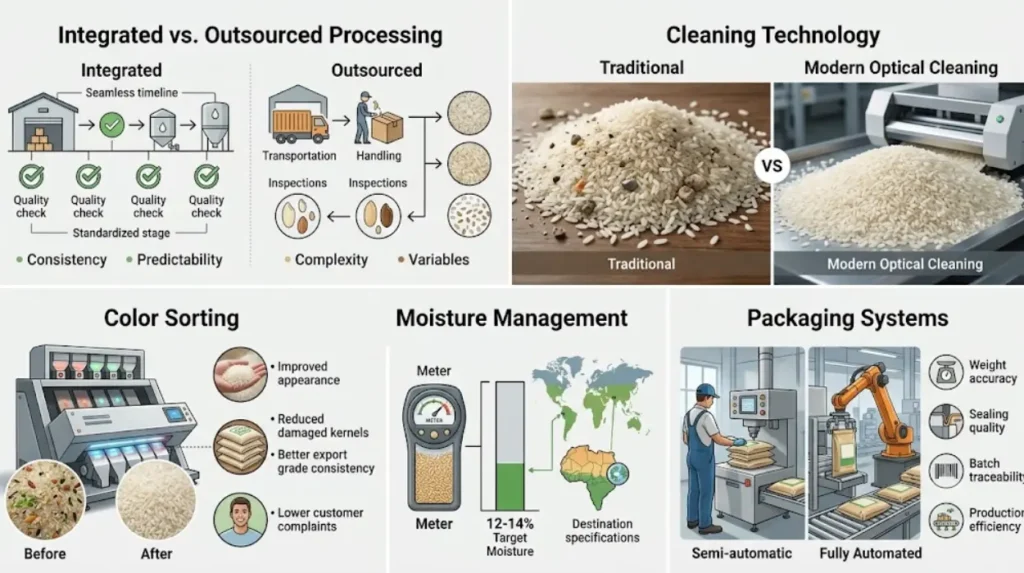
Integrated processing consistently produces better quality stability because every production stage follows standardized quality parameters. Outsourced workflows introduce additional handling, transportation, scheduling, and inspection variables that increase production complexity and reduce operational predictability for international buyers requiring consistent specifications across repeated shipments.
Rice processing involves multiple technical decisions.
Each affects export quality differently.
Cleaning Technology
Traditional cleaning removes basic impurities.
Modern optical cleaning systems remove dust, stones, immature grains, and foreign materials more efficiently.
Color Sorting
Optical color sorters identify defective grains using high-speed cameras and artificial intelligence.
Benefits include:
- Improved appearance
- Reduced damaged kernels
- Better export grade consistency
- Lower customer complaints
Moisture Management
Modern moisture monitoring systems continuously measure grain moisture during production.
Target moisture generally ranges between 12% and 14%, depending on buyer specifications and destination climate.
Packaging Systems
Semi-automatic packaging suits smaller production runs.
Fully automated packaging improves:
- Weight accuracy
- Sealing quality
- Batch traceability
- Production efficiency
Which method works best for different buyer requirements?
The best export preparation method depends on shipment volume, destination regulations, packaging complexity, certification requirements, delivery urgency, and consistency expectations. Large importers benefit from integrated facilities, while specialized or smaller orders may efficiently use hybrid production systems with certified external partners.
Different buyers prioritize different outcomes.
Retail Importers
Retail brands require:
- Premium appearance
- Attractive packaging
- Barcode integration
- Batch coding
- Strong traceability
Integrated facilities usually meet these requirements most efficiently.
Food Service Distributors
Hotels and restaurants prioritize:
- Cooking consistency
- Uniform grain length
- Competitive pricing
- Reliable deliveries
Hybrid production often satisfies these commercial requirements.
Government Procurement
Public tenders emphasize:
- Documentation
- Laboratory compliance
- Shipment reliability
- Quantity accuracy
Centralized production reduces administrative risks.
Industrial Food Manufacturers
Food processors focus on:
- Moisture consistency
- Stable cooking performance
- Uniform particle size
- Long-term supply continuity
Integrated production provides the greatest consistency across repeated contracts.
Which grades do different export markets prefer?
Buyer preferences differ significantly across international markets because consumer cooking habits, purchasing power, retail positioning, and regulatory standards influence preferred grain length, polishing level, packaging size, and acceptable broken percentages for imported Pakistani Basmati rice shipments.
Different regions purchase different specifications.
Middle East
Preferred grades include:
- 1121 Steam
- 1121 Sella
- Super Kernel Basmati
Common packaging:
- 5 kg
- 10 kg
- 20 kg
- 40 kg
Priority factors:
- Aroma
- Extra-long grain
- Premium presentation
European Union
Preferred grades include:
- 1121 White
- Premium Super Kernel
Priority factors:
- Lower broken percentage
- Food safety compliance
- Traceability
- Sustainable packaging
Regional Comparison
| Comparison Factor | Middle East | European Union |
|---|---|---|
| Preferred grades | 1121 Steam, 1121 Sella, Super Kernel | 1121 White, Premium Super Kernel |
| Typical quality preference | Premium aroma and appearance | Food safety and uniform quality |
| Average export price (2026) | US$1,050–1,250/MT | US$1,150–1,350/MT |
| Preferred broken level | 2–5% | 1–2% |
| Common package sizes | 5–40 kg | 1–10 kg retail and 20–25 kg wholesale |
| Expected shelf life | Up to 24 months | Up to 24 months with compliant packaging |
The European market generally demands stricter documentation and lower defect tolerances, while Middle Eastern buyers place greater emphasis on grain appearance and cooking characteristics.
What are the advantages and disadvantages of each export preparation strategy?
Every processing strategy balances speed, operational control, production flexibility, investment costs, and supply chain complexity. Buyers should compare advantages and disadvantages according to shipment frequency, specification consistency, certification requirements, and long-term sourcing objectives rather than focusing solely on purchase price.
Integrated Processing
Advantages:
- Faster production
- Better consistency
- Complete documentation control
- Lower delay risk
- Easier communication
Disadvantages:
- Higher operating costs
- Greater capital investment
Example:
A retailer requiring identical packaging across twelve annual shipments benefits from centralized production.
Hybrid Processing
Advantages:
- Operational flexibility
- Lower investment
- Good scalability
Disadvantages:
- Moderate scheduling complexity
- More coordination requirements
Example:
Seasonal importers can combine in-house milling with outsourced retail packaging.
Contract Processing
Advantages:
- Lower fixed costs
- Wide sourcing network
Disadvantages:
- Higher scheduling risk
- Variable consistency
- Increased quality verification
Example:
Commodity traders purchasing bulk rice for re-export often use contract production networks.
What factors should buyers evaluate before selecting an exporter?
Importer decisions should prioritize operational capability, production transparency, inspection standards, export documentation, packaging flexibility, logistics performance, certifications, and historical delivery consistency because these factors determine long-term supply reliability more accurately than product price alone.
Selecting an exporter requires evaluating measurable operational capabilities.
The following framework simplifies supplier comparison.
| Decision Factor | Why It Matters | Buyer Priority |
|---|---|---|
| Integrated production | Reduces delays | Very High |
| Quality inspection system | Maintains consistency | Very High |
| Packaging flexibility | Supports branding | High |
| Documentation capability | Enables customs clearance | Very High |
| Export logistics coordination | Improves delivery reliability | High |
Importers should also review:
- Production capacity
- Annual export volume
- Laboratory testing capability
- Traceability systems
- Packaging options
- Country-specific certifications
- Historical shipment performance
These indicators provide a stronger measure of supplier reliability than price comparisons alone.
Why does the production timeline matter in international rice trade?
Production timelines directly affect inventory planning, seasonal demand fulfillment, shipping schedules, retail launches, and working capital management. Efficient production reduces uncertainty, improves forecasting accuracy, and helps importers maintain continuous product availability across competitive international food markets.
Importers often plan inventory months before seasonal demand.
Delayed production creates additional warehousing costs, shipping disruptions, and stock shortages.
Efficient exporters coordinate:
- Raw material procurement
- Production scheduling
- Quality inspections
- Packaging procurement
- Documentation
- Freight booking
- Container loading
Synchronizing these operations minimizes idle time while improving shipment predictability.
For repeat buyers, production consistency often becomes more valuable than minor price differences because dependable deliveries reduce overall supply chain costs.
Rice processing, packaging, and export preparation represent a coordinated production system rather than isolated manufacturing steps. Integrated facilities generally outperform outsourced production models in quality consistency, documentation accuracy, and delivery reliability. Buyers comparing exporters should evaluate production workflows, inspection systems, packaging capabilities, certifications, and logistics coordination alongside product specifications. A structured assessment of these operational factors helps importers select suppliers capable of maintaining consistent quality across long-term international trade relationships.
Frequently Asked Questions
Why is integrated rice processing better than outsourced processing?
Integrated processing provides better quality control, faster production, complete traceability, and fewer delays because milling, grading, packaging, inspection, and loading are managed within one coordinated facility.
Which packaging options are available for Basmati rice exports?
Pakistani exporters commonly offer 1 kg, 2 kg, 5 kg, 10 kg, 20 kg, 25 kg, and 50 kg packaging in PP woven bags, BOPP laminated bags, non-woven bags, paper bags, and customized private-label packaging.
What quality checks are performed before rice is exported?
Export-quality rice undergoes moisture testing, broken grain analysis, color sorting, foreign matter inspection, grain length measurement, laboratory testing, metal detection, and final packaging inspections before shipment.
Which certifications are commonly required for rice exports in 2026?
Most international buyers request certifications such as ISO 22000, HACCP, GMP, Halal Certification, Phytosanitary Certificate, Certificate of Origin, and Fumigation Certificate, depending on the destination market.
How does packaging affect the shelf life of exported rice?
Proper moisture-resistant packaging protects rice from humidity and contamination, allowing Basmati rice to maintain quality for up to 24 months when stored under recommended conditions.
What factors can delay rice export preparation?
Delays may occur due to customized packaging production, laboratory testing, certification approvals, container shortages, shipping line schedules, or additional buyer-requested quality inspections.
Which Pakistani Basmati rice varieties are most commonly exported?
The most exported varieties include 1121 Basmati, Super Kernel Basmati, and 1509 Basmati, each serving different international markets based on grain length, aroma, cooking performance, and price.
How should importers evaluate a rice exporter?
Importers should compare production capacity, integrated processing facilities, quality control systems, certifications, packaging capabilities, export documentation, logistics management, and on-time shipment performance.
Why is understanding the export preparation timeline important for buyers?
Knowing the complete processing and export timeline helps importers plan inventory, coordinate shipping schedules, avoid supply chain disruptions, and select exporters capable of delivering consistent product quality and reliable lead times.