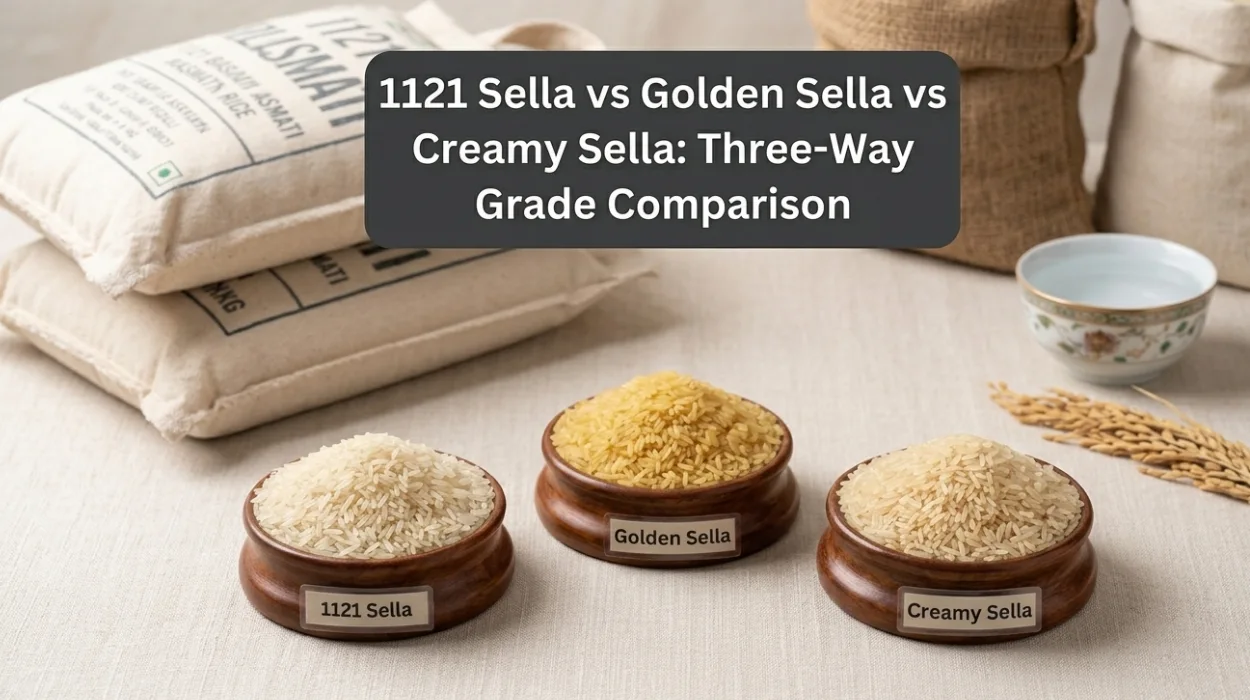
1121 Sella vs Golden Sella vs Creamy Sella: Three-Way Grade Comparison
1121 Sella, Golden Sella, and Creamy Sella all stem from the same 1121 basmati base, but the processing intensity and finish drive the real‑world difference in price, shelf impact, and end‑market fit. For bulk buyers, understanding these three grade options is critical because they sit in overlapping but distinct bands inside the parboiled 1121 landscape. The right choice depends on target market, visual expectation, and how much the buyer can charge for a “premium‑looking” parboiled grain.
For commercial buyers near the decision stage, a 1121 Sella basmati wholesale price covers volume‑level pricing and packaging formats in more depth.
What are the available solutions?
For 1121 parboiled basmati, 1121 Sella, Golden Sella, and Creamy Sella are the three main export‑grade solutions, each with its own colour depth, texture profile, and market positioning. These are not different varieties. They are the same 1121 basmati processed under slightly different parboiling, steam‑treatment, and grading protocols. Each grade supports a distinct buyer profile and pricing strategy.
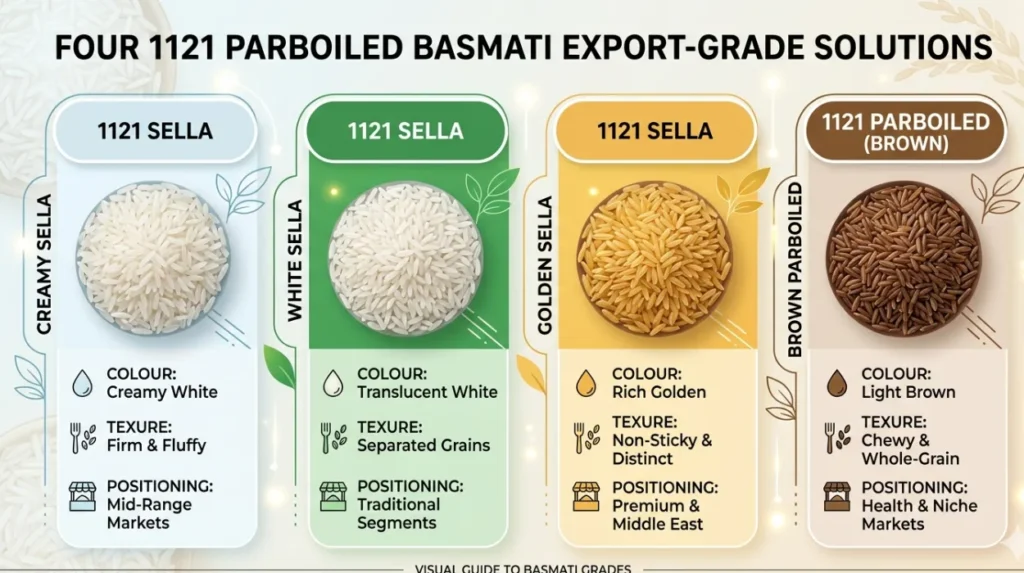
1121 Sella sits in the middle of the spectrum, with a clear golden‑amber finish, strong grain separation, and moderate visual premium. Golden Sella emphasises a deeper, more uniform golden tone, which is marketed as a higher‑premium parboiled option. Creamy Sella typically has a paler, more neutral‑cream colour, which appeals to buyers who want a softer‑looking parboiled grain without the intense golden finish.
All three formats share the same origin concept: 1121 paddy soaked, steamed, and dried, then milled, polished, and graded for export. The main divergence comes from the steam‑intensity, colour‑sorting strictness, and packaging strategy. AHK Rice controls this process end‑to‑end for 1121, Super Kernel, and 1509 basmati, which allows consistent grading across these three Sella types.
How do different approaches compare?
The 1121 Sella, Golden Sella, and Creamy Sella approaches compare on grain colour, visual premium, price per MT, and the target market’s expectation of what “premium parboiled” looks like. Each grade positions the rice differently in the buyer’s portfolio, and the trade‑off is usually between price, appearance, and channel‑fit. The following table summarises the core attributes.
| Attribute | 1121 Sella | Golden Sella | Creamy Sella |
|---|---|---|---|
| Variety base | 1121 basmati | 1121 basmati | 1121 basmati |
| Parboiling level | Standard | High‑intensity | Medium‑low |
| Colour intensity | Golden‑amber | Deep golden | Light cream |
| Head‑rice recovery | High | High | High |
| Grain separation after cooking | Strong | Strong | Strong |
| Typical price per MT | Medium | High | Medium‑low |
| Best‑fit channel | Value‑premium, mixed | High‑premium retail | Value‑oriented, foodservice |
This table shows that the fundamental difference is not grain length or cooking quality. The key differentiators are colour intensity and perceived premium status. Golden Sella usually commands the highest price because its strong golden finish reads as more premium on the shelf. Creamy Sella is often the most price‑efficient option for buyers who still want parboiled benefits but not a bold‑coloured grain. 1121 Sella fits the middle ground, where buyers want a clear golden‑finish signal without the Golden Sella price tag.
For example, a European supermarket chain may prefer Golden Sella for its premium‑rice aisle because the colour supports higher unit pricing. A large‑volume foodservice distributor in the Middle East may choose 1121 Sella because it offers a balance between price and appearance. A budget‑oriented wholesaler may pick Creamy Sella for markets where the visual premium is not a strong selling point.
Which method works best for different cases?
1121 Sella generally works best for mixed‑channel buyers, Golden Sella for premium‑retail environments, and Creamy Sella for price‑sensitive or foodservice‑focused channels. The deciding factor is not only the grain itself. It is how the rice will be presented on the shelf or how it will perform in repeated cooking cycles. The same 1121 parboiled batch can be graded into these three formats, so the buyer’s choice also shapes the supplier’s production plan.
For retail‑focused buyers, Golden Sella is the strongest choice when the target is premium packaging, strong visual contrast, and the expectation that consumers will pay more for “golden” rice. The deep golden finish supports higher brand positioning, especially in private‑label or branded basmati lines. The grain separation and stability match this expectation, so the product delivers both appearance and texture.
For mixed‑channel buyers who sell into both retail and foodservice, 1121 Sella offers the best compromise. The golden‑amber colour is clearly parboiled and export‑grade, but the price is usually lower than Golden Sella. The grain still performs well in high‑volume kitchens, which gives the buyer flexibility if part of the shipment moves through foodservice channels. This is why many importers that handle 1121 parboiled elect to split volumes between 1121 Sella and Golden Sella, depending on the mix of retail and wholesale customers.
For buyers in price‑sensitive or value‑driven segments, Creamy Sella is the most efficient option. The paler colour reduces the visual premium, which allows the buyer to keep the landed price lower while still benefiting from the parboiled texture and grain separation. This format works well in catering institutions, budget‑cafeterias, and wholesale channels where the rice is served in bulk and the consumer does not see the bag.
What are the pros and cons of each grade?
The pros and cons of 1121 Sella, Golden Sella, and Creamy Sella depend on how the buyer balances visual premium, price efficiency, and channel expectations. Each grade creates a different outcome in terms of traded value, perceived quality, and margin structure. The right choice does not exist in isolation. It depends on the importer’s route‑to‑market.
1121 Sella pros and cons
- Gain a clear golden‑amber finish that signals parboiled rice without the highest Golden Sella price premium.
- Keep price per MT under Golden Sella levels, which supports margin in mixed‑channel portfolios.
- Support both retail and foodservice customers because the grain separation and firm texture suit multiple use cases.
- Accept a weaker visual premium than Golden Sella in markets that strongly associate “golden” with higher status.
- Face tighter colour‑sorting pressure if the buyer expects Golden Sella‑level uniformity from a mid‑grade product.
Golden Sella pros and cons
- Strengthen shelf impact with a deeper, more uniform golden colour that appeals in premium retail environments.
- Align with higher‑end labelling and pricing because the product naturally supports a “premium‑golden” positioning.
- Gain stronger brand‑differentiation in markets where Golden Sella is already recognised as a top‑tier parboiled format.
- Pay a higher price per MT because the processing intensity and colour standards create an export‑grade premium.
- Limit value‑efficiency when the buyer serves price‑sensitive channels that do not reward the visual shift.
Creamy Sella pros and cons
- Lower per‑MT acquisition cost by selecting a less colour‑intense finish that still delivers parboiled texture.
- Maintain grain separation and firmness suitable for foodservice use and bulk serving environments.
- Fit value‑conscious buyers who prioritise function over strong visual premium.
- Reduce shelf‑differentiation compared with Golden Sella, which may limit resale value in premium retail.
- Weaken brand‑premium perception if the buyer enters markets that expect a clearly golden‑finish parboiled rice.
These pros and cons show that the three‑way choice is less about technical superiority and more about channel‑fit. Golden Sella is not “better rice” in every context. It is better positioned for specific channels. Creamy Sella is not “worse rice.” It is better suited to price‑driven environments. 1121 Sella fills the gap between them, giving importers a widely‑usable export‑grade specification.
What are the decision factors for importers?
The five main decision factors are target market segment, landed price per MT, shelf‑life expectation, packaging and labelling strategy, and container‑level consistency. These factors determine whether 1121 Sella, Golden Sella, or Creamy Sella generates the strongest value for the buyer. The wrong choice can lock the importer into misaligned margins or weak shelf impact.
Decision framework table
| Decision factor | 1121 Sella | Golden Sella | Creamy Sella |
|---|---|---|---|
| Target market | Mixed retail and foodservice | Premium retail | Value‑oriented and foodservice |
| Landed price per MT | Medium | High | Medium‑low |
| Shelf‑life and stability | Strong, similar to all parboiled | Strong, same process family | Strong, same process family |
| Visual branding | Golden‑amber, export‑grade | Deep golden, high‑premium look | Pale‑cream, functional look |
| Margin‑and‑segment fit | Balanced for mixed channels | Best for premium‑retail markup | Best for volume‑based margin |
Target market is the primary filter. Buyers in premium‑retail‑heavy markets usually choose Golden Sella because the colour and perception align with higher‑end pricing. Those in mixed‑retail and foodservice environments usually choose 1121 Sella because it fits both channels without over‑investing in visual premium. Budget‑focused or foodservice‑dominated buyers usually choose Creamy Sella because it keeps the landed cost lower while still delivering parboiled benefits.
Landed price per MT is the second filter. AHK Rice prices these three grades in relation to each other, with Golden Sella at the top, Creamy Sella at the bottom, and 1121 Sella in the middle. The exact spread varies with season, freight, and demand, but the relative band usually stays consistent. Importers who must keep per‑MT cost low favour Creamy Sella or 1121 Sella, depending on colour expectation.
Shelf‑life and stability are the third factor. All three grades benefit from the same parboiled advantages, including improved grain strength and moisture control. Proper storage preserves each format equally, so the choice is driven more by appearance and price than by shelf‑life risk. Packaging and labelling strategy are the fourth factor. The chosen grade must match the brand story, whether that is “golden‑premium,” “golden‑export‑value,” or “functional‑parboiled.” Consistency across containers is the fifth factor. AHK Rice controls this by standardising sorting, packing, and documentation, so the buyer gets the same grade profile from one shipment to the next.
How do shelf life and storage compare?
All three grades—1121 Sella, Golden Sella, and Creamy Sella—have similar shelf life when stored under controlled moisture and temperature, because the parboiled treatment is the same. The grain structure, moisture level, and milling‑quality follow the same processing line. The visible difference is mainly colour and grain‑sorting, not durability.
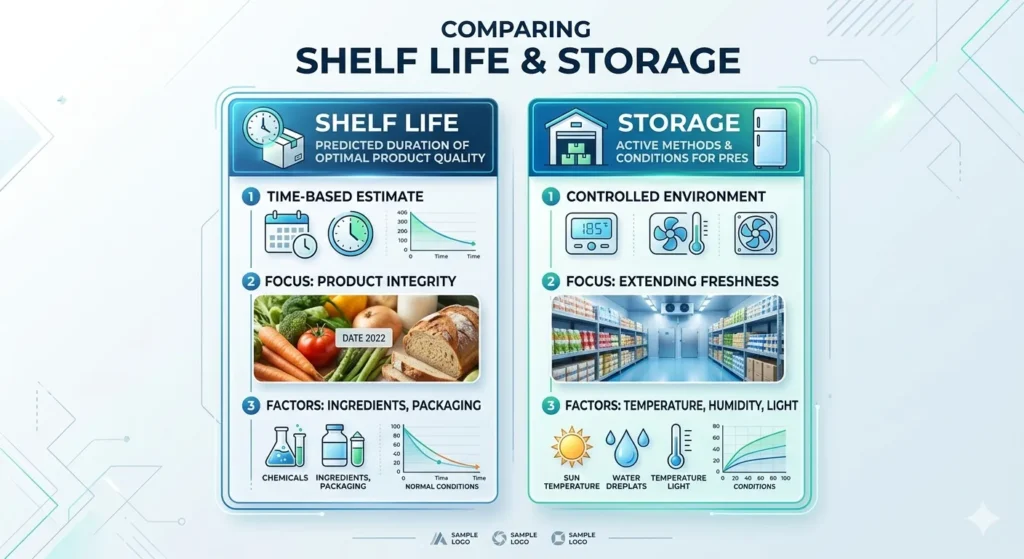
Export‑grade parboiled 1121 from AHK Rice is typically packed below 13% moisture, which suppresses mould and insect activity in dry warehouses. The firm grain structure resists breakage during handling and container transport. The colour difference does not change the underlying stability; a Creamy Sella grain stored correctly lasts as long as a Golden Sella grain under the same conditions.
The main risk comes from poor storage, not the grade. High humidity, temperature swings, or direct sunlight can degrade any parboiled rice, regardless of whether it looks golden or creamy. That is why buyers must align the grade choice with their storage and warehousing standards rather than assuming one Sella type is more “durable” than another.
How do price per MT and market preferences differ?
Golden Sella usually trades at a higher price per MT than 1121 Sella, and Creamy Sella usually sits at or below 1121 Sella, with the gap shaped by market demand, packaging, and perceived premium status. These differences are visible in both origin‑price and landed‑cost analysis. The exact spread changes with season, but the hierarchy is consistent.
For example, in a Middle East retail‑driven market, Golden Sella can command a 10–15% premium over 1121 Sella on a per‑MT basis. The extra value comes from the colour‑intensity and the expectation that consumers associate golden rice with higher quality. Creamy Sella, by contrast, may sit 5–10% below 1121 Sella if the buyer selects a less colour‑intense finish and accepts a more functional presentation.
In Europe, premium‑retail chains may prefer Golden Sella because the deep colour supports higher‑priced private‑label lines. Mid‑range supermarkets and value‑oriented distributors may prefer 1121 Sella because it delivers a clear golden‑finish at a lower price point. Budget‑focused wholesalers that supply cafeterias or institutional catering may choose Creamy Sella because it reduces the per‑MT cost without sacrificing core cooking performance.
These patterns create a clear three‑way landscape. Golden Sella serves the visual‑premium end of the market. 1121 Sella serves the value‑plus premium middle. Creamy Sella serves the price‑led, function‑first end. The buyer’s job is to match the grade to the channel and the margin structure.