Malaysia Basmati Rice Import Market: Which Pakistani Grade Sells Best?
Malaysia imports Pakistani Basmati rice because 1121 Steam, 1121 Golden Sella, and 1509 Steam grades match Malaysian retail, restaurant, and catering demand. Here is why: Malaysian buyers prioritize extra-long grain length, soft cooked texture, stable aroma, and competitive CIF pricing. Pakistani exporters supply these specifications consistently through Punjab-based cultivation and modern milling systems.
Malaysia imports rice to support domestic consumption because local production does not fully cover national demand. Malaysia consumed approximately 2.7 million metric tons of rice in 2025, while domestic production covered around 70% of demand (source: Malaysian Ministry of Agriculture, 2025). Pakistani Basmati rice fills the premium aromatic segment in supermarkets, restaurants, and hotel chains.
Pakistani Basmati rice dominates the premium imported category because Punjab’s climate supports long-grain aromatic cultivation. Punjab’s irrigation system uses glacier-fed rivers from the Indus Basin. Farmers cultivate Basmati rice in districts including Hafizabad, Gujranwala, Sheikhupura, Narowal, and Sialkot. These districts produce grains with strong elongation ratios and stable aroma after cooking.
Malaysia’s import market also values processing consistency. Pakistani exporters mill, polish, grade, inspect, and pack rice according to buyer specifications before shipment. Malaysian distributors require moisture control, broken percentage verification, and phytosanitary certification for customs clearance.
With Malaysia’s import demand defined, the next question is which Pakistani Basmati grades dominate the market.
Which Pakistani Basmati Rice Grades Sell Best in Malaysia?
1121 Steam Basmati, 1121 Golden Sella, and 1509 Steam Basmati account for the highest Malaysian demand because they combine long grain length, soft texture, and competitive pricing.
Malaysian importers comparing cooking texture, pricing, and wholesale demand between leading Pakistani grades often review detailed breakdowns of how 1509 and 1121 varieties perform across retail and catering sectors.
1121 Steam Basmati Rice
1121 Steam Basmati rice sells strongly in Malaysia’s supermarket and restaurant sectors because the grain cooks soft and remains separate after cooking. Pakistani mills process Steam rice through controlled steaming instead of heavy parboiling. This method preserves the white appearance and natural aroma.
1121 Steam Basmati usually measures 8.30 mm to 8.40 mm before cooking. The grain elongates up to 18 mm after cooking. Malaysian restaurants prefer this specification for biryani and mandi dishes because the rice absorbs spices evenly.
Malaysia imports this grade from Pakistan because consumers associate white extra-long grains with premium dining. Supermarkets package this rice in 5 kg, 10 kg, and 25 kg bags for household buyers.
1121 Golden Sella Basmati Rice
1121 Golden Sella Basmati rice sells strongly in Malaysia’s catering sector because parboiling increases shelf stability and grain strength. Pakistani mills parboil the rice before milling. This process hardens the grain structure and reduces breakage during transport.
1121 Golden Sella usually measures 8.20 mm to 8.35 mm before cooking. The rice remains firm after cooking and performs well in bulk preparation.
Golden Sella lasts longer than Steam rice. In a humid Malaysian warehouse, Golden Sella maintains storage stability for approximately 18 months. Steam rice performs best within 12 months under the same storage conditions. Catering companies prefer Golden Sella because cooked rice remains separate during buffet service.
1509 Steam Basmati Rice
1509 Steam Basmati rice grows rapidly in Malaysia’s import market because the variety offers lower pricing than 1121 while maintaining long grain appearance. Pakistani farmers cultivate 1509 Basmati as an early-maturing variety. The crop requires fewer cultivation days than traditional Basmati.
1509 Steam usually measures 8.00 mm to 8.20 mm before cooking. The rice cooks soft and suits mid-range restaurant chains.
Malaysia imports increasing quantities of 1509 because distributors target price-sensitive retail buyers. The grade also supports blended rice products for commercial food service.
Readers comparing pricing and demand patterns between these varieties should review the detailed breakdown in the article about how Malaysian buyers compare different Pakistani grades across wholesale segments.
With the leading grades established, the next question is how Pakistan cultivates and processes Basmati rice for export to Malaysia.
How Does Pakistan Process Basmati Rice for Malaysia Export?
Pakistani exporters process Basmati rice through cleaning, dehusking, polishing, grading, sorting, testing, packing, and container loading before dispatching shipments to Malaysia.
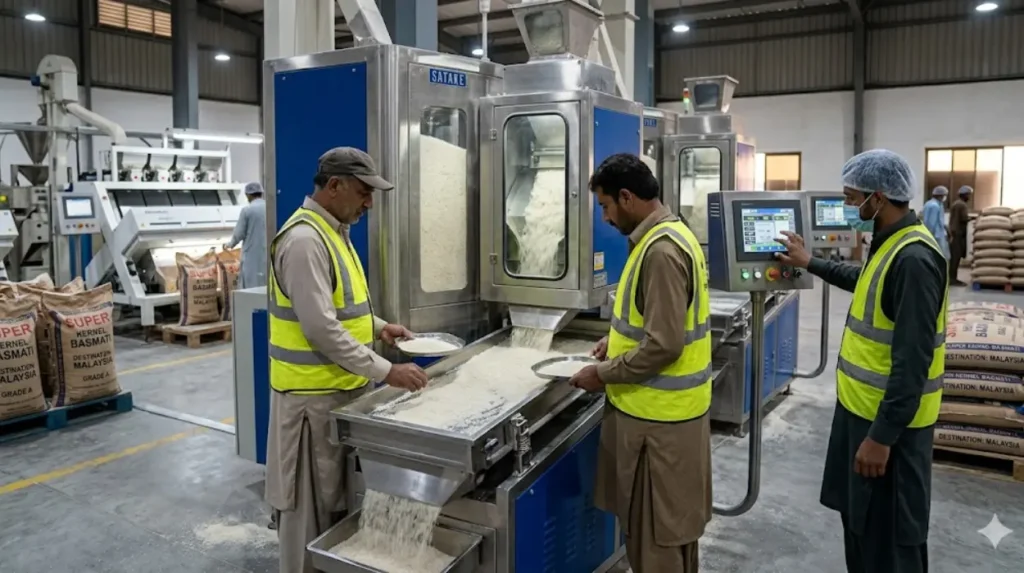
Pakistani rice mills follow structured export processing because Malaysian importers require consistency in grain appearance, moisture level, and purity. Modern mills in Punjab use automated equipment to maintain export specifications.
How Farmers Cultivate Basmati Rice
Punjab farmers cultivate Basmati rice during the Kharif season. Farmers transplant seedlings between June and July. Harvesting starts from October and continues into November.
Punjab’s clay-loam soil supports long-grain development because the soil retains controlled moisture during cultivation. Irrigation canals distribute water across major Basmati districts. Farmers inspect crop maturity before harvesting because immature grains reduce export quality.
How Rice Mills Process Export Rice
Pakistani exporters process Basmati rice through nine major steps:
- Clean the harvested paddy
- Dry the moisture evenly
- Dehusk the outer layer
- Polish the grain surface
- Grade the grain length
- Sort defective kernels
- Inspect moisture percentage
- Pack export specifications
- Load containers for dispatch
Rice mills inspect grain moisture carefully because Malaysian customs and distributors require stable shelf life. Export mills usually maintain 12% to 14% moisture content.
Colour sorting improves export quality. Optical sorters remove damaged kernels, chalky grains, and foreign particles before packing. Malaysian buyers prioritize uniform grain appearance because retail packaging highlights visual quality.
Which Packaging Formats Malaysia Imports
Malaysian importers purchase multiple packaging formats because retail and catering sectors require different bag sizes.
Common packaging specifications include:
- 1 kg retail bags
- 5 kg consumer packs
- 10 kg supermarket packs
- 25 kg catering bags
- 40 kg PP woven sacks
Pakistani exporters also supply private-label packaging for Malaysian supermarket chains.
With the processing system explained, the next question is why Malaysian buyers prefer Pakistani Basmati over competing origins.
Why Does Malaysia Prefer Pakistani Basmati Rice?
Pakistani Basmati rice attracts Malaysian buyers because it offers stronger aroma, longer grain length, and lower pricing than many competing origins.
Malaysia imports rice from several countries including Thailand, Vietnam, India, and Pakistan. Each origin supplies different market segments. Pakistan dominates the premium aromatic category because traditional Basmati cultivation produces distinct fragrance and elongation.
Aroma and Grain Elongation
Pakistani Basmati rice contains naturally occurring aromatic compounds developed during cultivation in Punjab’s climate. The cooked grain releases a nutty aroma that Malaysian consumers associate with biryani and festive dishes.
1121 Basmati elongates significantly after cooking. Malaysian restaurants prefer this feature because plate presentation improves. Longer grains create visual distinction in premium meals.
Competitive Pricing
Pakistan rice exports remain competitive because Punjab’s large cultivation area supports high production volume. Pakistan exported over 5 million metric tons of rice during FY2024-25 (source: Pakistan Bureau of Statistics, FY2024-25).
1509 Basmati costs less than 1121 Basmati because the variety matures earlier and produces higher yield per acre. Malaysian distributors use 1509 to target value-focused buyers.
Halal Compatibility
Malaysia’s food sector prioritizes halal compliance. Pakistani rice exporters supply halal-certified processing systems because Malaysian retailers and food chains require verified documentation.
Pakistani mills also maintain traceability records. Exporters inspect batches before shipment because Malaysian authorities require phytosanitary verification and contamination control.
With buyer preference explained, the next question is which certifications Malaysia requires for imported Basmati rice.
Which Certifications Apply to Pakistan Rice Malaysia Exports?
Malaysia requires phytosanitary certification, fumigation records, quality inspection documents, and halal-related compliance verification for imported Pakistani Basmati rice.
Rice exporters prepare export documentation before shipment because Malaysian customs clearance depends on inspection records and health certification.
Which Export Documents Matter Most
Pakistani rice exporters commonly prepare:
- Phytosanitary certificate
- Certificate of origin
- Fumigation certificate
- Commercial invoice
- Packing list
- Bill of lading
- Quality inspection report
Phytosanitary inspection confirms the rice remains free from pests and contamination. Malaysian import authorities inspect these records before cargo release.
Which Quality Standards Buyers Request
Malaysian importers evaluate several technical specifications before procurement:
- Grain length
- Broken percentage
- Moisture percentage
- Chalky grain percentage
- Foreign matter percentage
- Crop year
- Aroma retention
Restaurant buyers prioritize grain elongation because presentation affects customer perception. Catering companies prioritize storage stability because bulk inventory remains in warehouses longer.
Which Food Safety Systems Support Exports
Modern Pakistani rice mills implement international food safety systems to support export trade.
Common systems include:
- HACCP compliance
- ISO certification
- SGS inspection
- Halal verification
Food safety systems improve buyer confidence because importers require traceable supply chains for retail distribution.
With certification requirements covered, the next question is how Malaysian buyers choose the correct grade for different business models.
How Do Malaysian Buyers Select the Right Pakistani Rice Grade?
Malaysian buyers select 1121 Steam for premium retail, 1121 Golden Sella for catering, and 1509 Steam for value-focused distribution.
Different Malaysian industries purchase rice based on cooking method, customer expectation, and budget structure.
Which Grade Works Best for Restaurants
Restaurants prefer 1121 Steam because the rice cooks soft and aromatic. Premium biryani restaurants prioritize extra-long grains because visual presentation supports higher menu pricing.
Fine dining restaurants usually avoid broken percentages above 2% because grain separation matters during serving.
Which Grade Works Best for Catering
Catering companies prefer Golden Sella because parboiled grains resist overcooking during large-scale preparation. Buffet operations store cooked rice for extended periods. Golden Sella maintains structure during reheating.
Large catering kitchens also prefer Golden Sella because transport breakage remains lower during shipping.
Which Grade Works Best for Retail Distribution
Retail distributors import 1509 Steam because pricing remains accessible for supermarket consumers. Malaysian households purchase mid-range rice for regular consumption.
Distributors also blend 1509 with other long-grain rice types for commercial packaging programs.
Readers comparing wholesale demand trends between 1121 and 1509 can place a contextual article link here discussing how importers evaluate grain length, price stability, and cooking performance in the Malaysian market.
With buyer selection patterns explained, the final question concerns common misconceptions about Malaysian Basmati imports.
What Misconceptions Exist About Malaysia Basmati Rice Imports?
Many buyers incorrectly assume all Basmati rice grades perform equally, but processing method, grain length, and moisture control directly affect Malaysian market suitability.
Import buyers often focus only on pricing. Malaysian distribution performance depends on multiple technical specifications.
Steam and Sella Rice Are Not the Same
Steam rice cooks softer because processing uses controlled steaming. Golden Sella cooks firmer because parboiling hardens the grain structure.
Steam rice suits restaurant plating. Golden Sella suits catering operations.
Longer Grain Does Not Guarantee Better Performance
Grain length alone does not determine quality. Moisture stability, sorting accuracy, and milling quality also affect cooking performance.
Poor sorting increases broken percentage during transport. Malaysian retail buyers reject inconsistent grain appearance because packaging transparency exposes defects.
All Pakistani Rice Does Not Qualify as Basmati
Basmati refers to aromatic long-grain varieties cultivated in recognized regions. IRRI-6 and IRRI-9 are non-Basmati long-grain varieties. Malaysian buyers purchase these grades separately for economy segments.
Basmati commands higher pricing because cultivation conditions and aroma profile differ significantly from standard long-grain rice.
With common misconceptions clarified, Malaysia’s import market structure becomes easier to understand for wholesalers, distributors, and food service buyers.
Frequently Asked Questions
Which Pakistani Basmati rice grade sells best in Malaysia?
1121 Steam Basmati sells best in Malaysia’s premium retail and restaurant sectors because the grain cooks soft and elongates significantly after cooking. Malaysian catering companies also import 1121 Golden Sella because the parboiled grain remains firm during bulk preparation and storage.
Why does Malaysia import Basmati rice from Pakistan?
Malaysia imports Pakistani Basmati rice because Punjab-grown varieties provide strong aroma, long grain length, and competitive pricing. Pakistani exporters also supply multiple processing grades including Steam, Golden Sella, and White Rice for different Malaysian market segments.
What is the difference between 1121 and 1509 Basmati rice?
1121 Basmati rice offers longer grain length and stronger aroma than 1509 Basmati rice. 1509 Basmati costs less because the variety matures earlier and produces higher agricultural yield. Malaysian distributors often use 1509 for value-focused retail supply.
Which packaging sizes does Malaysia import for Pakistani rice?
Malaysia imports Pakistani rice in 1 kg, 5 kg, 10 kg, 25 kg, and 40 kg packaging formats. Retail supermarkets prefer smaller consumer packs, while catering companies and wholesalers purchase larger PP woven sacks for bulk distribution.
Which certifications are required for Pakistan rice exports to Malaysia?
Malaysia requires phytosanitary certificates, fumigation documents, commercial invoices, packing lists, and quality inspection records for rice imports. Malaysian importers also request halal-related compliance verification and food safety documentation before shipment approval.