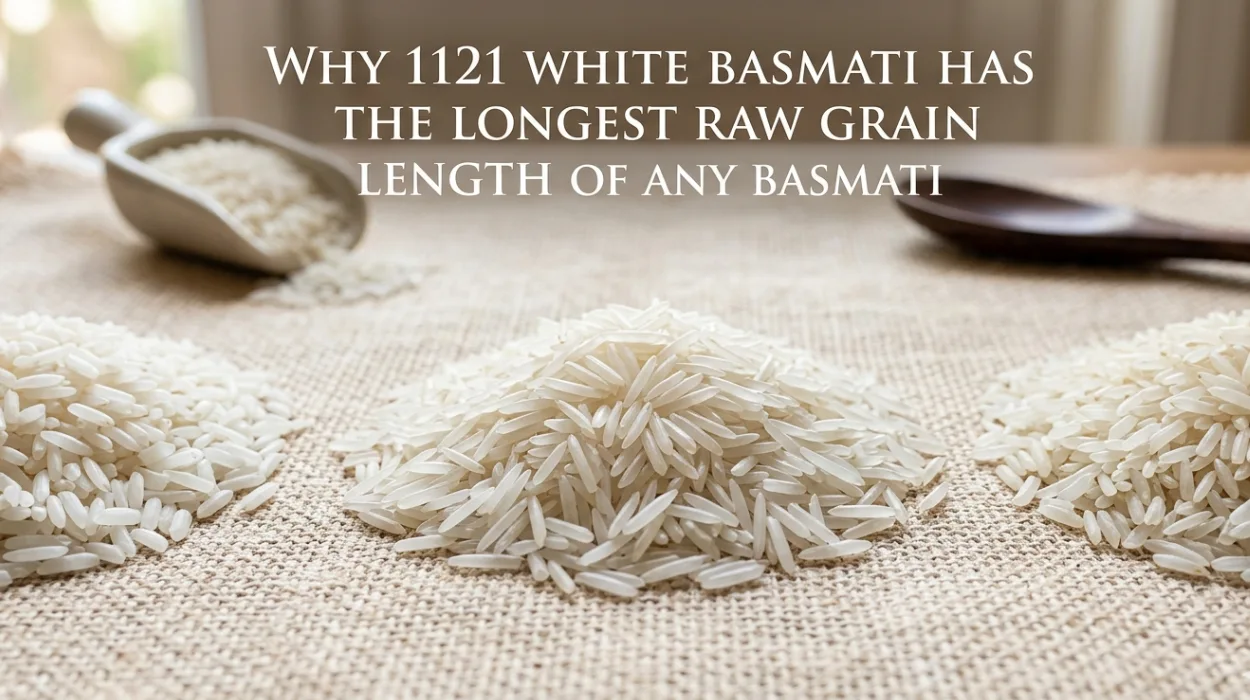
Why 1121 White Basmati Has the Longest Raw Grain Length of Any Basmati
1121 white basmati is an extra long grain basmati rice variety from the Punjab rice belt, known for its 8.3 mm raw grain length, strong elongation after cooking, and polished white appearance that suits export grade white rice markets.
1121 white basmati is a specific basmati cultivar, not a generic rice type. The number 1121 identifies the variety, and the white form identifies the milling stage after hulling, whitening, and polishing. The raw grain length of 8.3 mm places it among the longest commercially traded basmati grains. That length matters because buyers use it as a quality marker in export contracts and retail comparisons.
The grain grows in the irrigated rice systems of Punjab. Fertile alluvial soils, warm temperatures, and controlled water supply support the grain structure that makes basmati distinct. The long raw kernel appears before cooking, but the final long shape is only part of the story. Aroma, grain integrity, and elongation also define its export value.
Where is 1121 white basmati grown?
1121 white basmati is grown mainly in the Punjab rice belt of Pakistan and India, where fertile soil, canal irrigation, and warm seasonal conditions support long grain development and basmati aroma formation before milling.
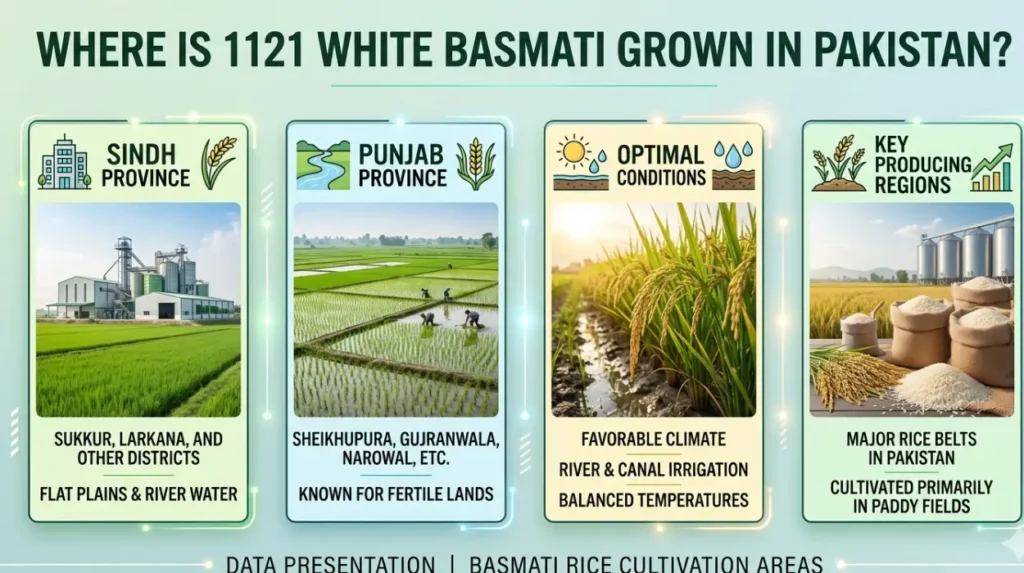
Punjab is the core origin region because the environment supports the genetic expression of basmati traits. The crop develops under irrigated conditions and matures during the main rice season. The paddy is harvested as rough rice, then moved into the milling chain that creates the final white form. The white grain is therefore the processed end result of a field grown variety.
The geographic origin matters because basmati quality depends on both genetics and growing conditions. Long grain length does not come from polishing alone. It begins in the field, where the grain fills under controlled water and temperature patterns. AHK Rice sources basmati from Punjab and then processes it into export forms such as 1121, Super Kernel, and 1509 for multiple markets.
How does the grain reach 8.3 mm raw length?
The 8.3 mm raw grain length comes from the 1121 variety’s genetic structure, which produces an unusually long kernel before cooking, while whitening and polishing preserve the raw length rather than creating it.
The length is a varietal trait. The paddy already carries the long kernel before milling begins. Whitening and polishing remove the husk and outer bran layers, but they do not shorten the true grain identity. The raw white grain still measures about 8.3 mm because the kernel structure remains intact through the milling process.
That is why the 1121 grain length record is treated as a varietal feature rather than a milling byproduct. Many rice types appear long after cooking, but fewer begin at such a high raw length. This makes 1121 white basmati stand out in export classification. The raw size also supports elongated cooked appearance, which is one of the main quality cues in basmati buying.
How is 1121 white basmati processed step by step?
1121 white basmati is processed by cleaning, dehusking, whitening, polishing, grading, and packing, with each stage removing outer layers while preserving the long raw kernel and creating export grade white rice.
The first step is cleaning. The paddy is screened to remove stones, dust, straw, and other foreign matter. The second step is dehusking. This removes the outer husk and reveals brown rice. The third step is whitening. Milling machines remove the bran layers that surround the kernel. The fourth step is polishing. This creates a smooth, bright surface that improves visual consistency.
The fifth step is grading. The rice is sorted by length, breakage, and purity. The final step is packing. Export packs can be bulk sacks or custom retail packs depending on the buyer. The raw grain length remains long because the process focuses on surface removal rather than kernel reshaping. This is why white basmati can look visually refined while still preserving its long-grain identity.
Stage sequence
- Clean the paddy, for example by removing stones and dust.
- Remove the husk, for example by separating rough rice from the outer shell.
- Whiten the grain, for example by milling away the bran layer.
- Polish the grain, for example by smoothing the surface for a bright finish.
- Grade and pack the rice, for example by separating whole grains from broken grains.
Why does 1121 have such a long raw grain?
1121 has such a long raw grain because its genetic structure is built for extra long kernel development, and the Punjab growing environment supports that trait through controlled irrigation and seasonal maturity.
The genetic structure is the first reason. The 1121 cultivar was selected for long kernel development, strong cooking elongation, and commercial export appeal. That makes the grain naturally longer at harvest than many other basmati types. The environmental factor is the second reason. Punjab’s soil and irrigation conditions help the grain fill evenly and mature without losing structural integrity.
The long grain is valuable because it signals premium quality in trade. Buyers often compare raw length before any other physical trait. The 8.3 mm basmati raw grain creates a strong visual advantage in sample testing and destination market grading. The combination of variety and origin therefore creates a grain profile that stands out from shorter basmati lines.
What are the key components of 1121 white basmati quality?
The key components are raw grain length, elongation after cooking, whiteness, breakage ratio, moisture control, purity, and aroma, each of which affects export grade white rice performance in different markets.
Raw grain length is the first marker because it shapes the visible identity of the rice. Elongation after cooking is the second marker because basmati buyers expect the grain to stretch rather than collapse. Whiteness matters because export buyers often require a clean, polished appearance. Breakage ratio also matters because whole grains carry higher commercial value than fragmented grain.
Moisture control protects storage and shipping quality. Purity determines whether the lot meets export expectations. Aroma remains important because basmati is not only a visual product. AHK Rice processes 1121 and other varieties through end-to-end export handling, so each component can be managed from the mill to the buyer’s pack specification.
What benefits does 1121 white basmati offer?
1121 white basmati offers extra long raw grain length, strong cooked elongation, bright appearance, broad export acceptance, and a commercial profile that suits premium retail and foodservice channels.
The first benefit is visual premium value. The 8.3 mm raw grain length gives the rice a strong presence in sample trays and retail packs. The second benefit is cooked presentation. The grain elongates and separates well when prepared correctly. That makes it suitable for dishes where appearance matters. The third benefit is market recognition. Buyers across the Middle East, Europe, the UK, and other regions recognise basmati as a premium long-grain product.
The fourth benefit is packing flexibility. White basmati can be sold in small retail packs, larger foodservice bags, or bulk export containers. The fifth benefit is commercial consistency. Because the variety is widely understood, buyers can spec it clearly across repeated orders. This is one reason AHK Rice supplies 1121 in export channels alongside Super Kernel and 1509.
Which markets import 1121 white basmati?
1121 white basmati is imported by the UK, EU, Middle East, North America, and parts of Africa, where buyers value long grain appearance, cooking performance, and export grade white rice consistency.
The UK and EU often use white basmati in retail, grocery, and foodservice supply. Buyers in those markets often compare grain length, whiteness, aroma, and certification documents before placing orders. The Middle East also imports large volumes because basmati fits regional food patterns and catering systems. North American buyers often purchase through ethnic retail and wholesale channels.
These markets expect more than long grain length. They also expect documentation, packing discipline, and stable supply. AHK Rice exports to 15 plus countries and supports end-to-end processing and custom packing, which makes the product usable across multiple market types. The same variety can therefore move through different routes while keeping its premium grain identity.
What certifications apply to export-grade white rice?
Export-grade white rice typically requires phytosanitary documents, certificate of origin, food safety certification, residue compliance records, and destination specific packing and labelling papers.
These documents matter because import markets want proof that the shipment is safe and traceable. A phytosanitary document confirms plant health status. A certificate of origin supports customs treatment and origin verification. Food safety systems such as HACCP or ISO 22000 strengthen confidence in the mill’s production controls. Some buyers also ask for residue and moisture test reports before shipment approval.
The exact paper set changes by destination market. Some regions need strict residue documentation. Others need halal or packaging declarations. In every case, export grade white rice performs best when the grain quality and the paper trail match the buyer’s import standard. AHK Rice uses export processing and packing systems that support that chain.
What are common misconceptions about 1121 white basmati?
The most common misconception is that whitening creates the long grain, when the long grain already exists in the 1121 variety before milling begins.
Whitening and polishing change the surface, not the kernel identity. The raw grain length is already built into the varietal structure. Another misconception is that all basmati types have the same raw length. They do not. Some are shorter and some are longer, and 1121 is known for being among the longest commercially traded raw basmati grains.
A third misconception is that appearance alone defines quality. It does not. White basmati must also meet breakage, moisture, purity, and aroma expectations. The visible length is important, but export success depends on the full specification. That is why a buyer should compare the grain’s physical and commercial profile before deciding on a shipment.
How does 1121 compare with other basmati grades?
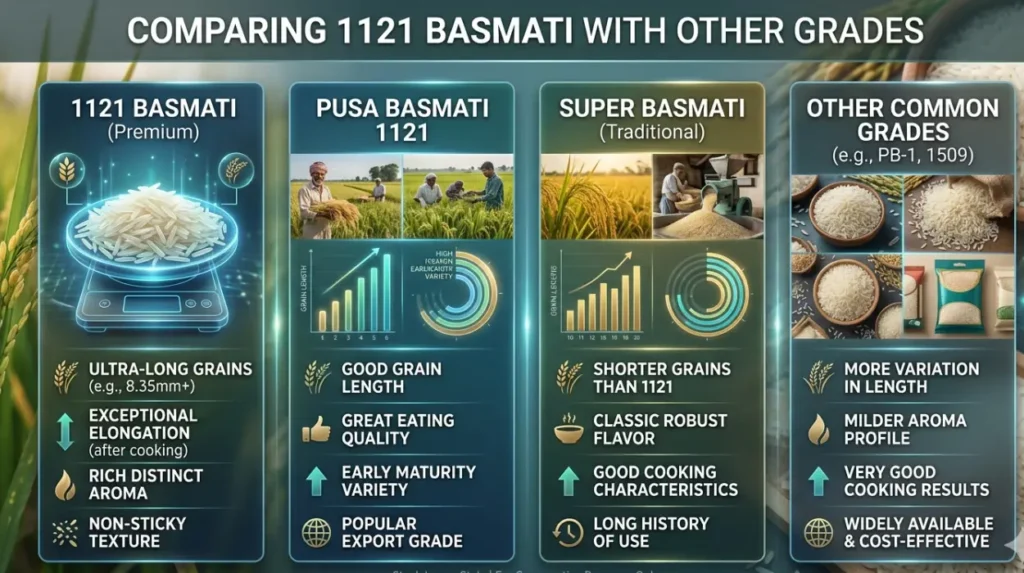
1121 white basmati compares favourably with other basmati grades because it combines extra long raw grain length with strong cooked elongation, while other grades such as Super Kernel and 1509 serve different market and cooking preferences.
Super Kernel is often selected for its own grain profile and market positioning. 1509 is frequently chosen for different yield, cooking, or trade considerations. 1121 remains the standout when buyers want the longest raw grain appearance and premium export recognition. That is why 1121 is often treated as a flagship basmati line in trade discussions.
What should a buyer understand before ordering?
A EU retail buyer should understand that the 8.3 mm raw grain length is a varietal feature, the export grade is a processing outcome, and the final buyer value depends on how the rice fits the destination market specification.
The raw grain length creates the first impression. The processing steps create the final market form. The destination market decides how that form will be judged. A buyer who needs bright export grade white rice will focus on polishing, purity, and presentation. A buyer who needs a retail or private label program will also focus on packing and documentation.
AHK Rice works within this logic because it exports 1121, Super Kernel, and 1509 from Punjab with full processing and packing control. That structure allows the same base variety to serve different trade uses without confusing the buyer about origin or grade. The key point is simple. The long raw grain length is not the result of whitening. It is the result of the 1121 variety itself, supported by Punjab growing conditions and preserved through export processing.