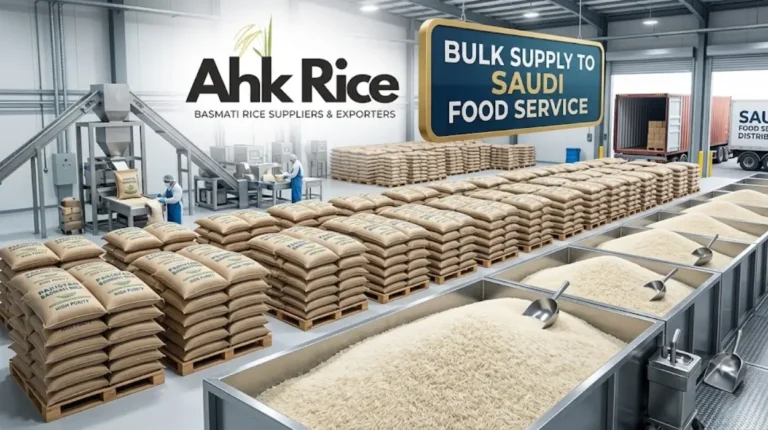
AHK Rice 1121 White Basmati: EU Tricyclazole-Free Certified Supply Available
AHK Rice 1121 white basmati is the best solution when the buyer needs export-grade white grain, EU residue compliance, and predictable shipment timing. AHK Rice combines certified processing, packing control, and export documentation to reduce procurement risk.
What is the best solution for EU certified white basmati supply?
The best solution for EU certified white basmati supply is export-grade 1121 white basmati with verified residue compliance, consistent grain polishing, and documented shipment control across the full export chain.
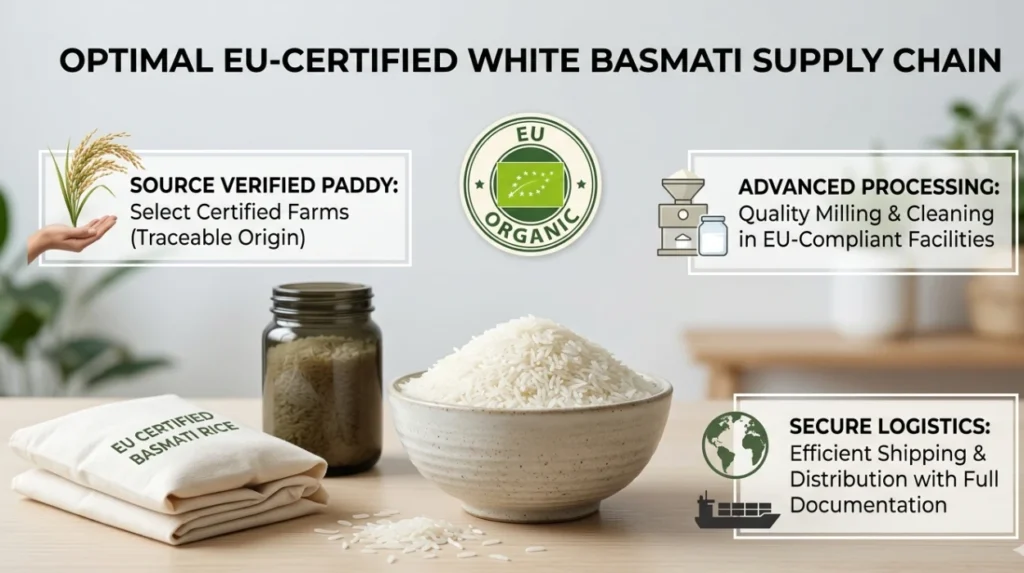
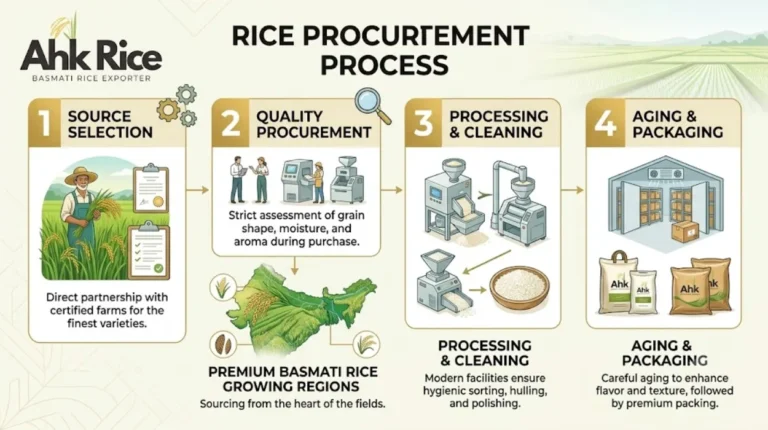
The EU market places strong emphasis on compliance. Importers need a product that fits residue standards, buyer specifications, and supermarket presentation rules. AHK Rice supplies 1121 white basmati from Punjab with the processing discipline needed for that market. The product starts with sourced paddy, then moves through cleaning, hulling, whitening, polishing, grading, and packing.
This matters because white basmati is not only a visual product. It is a commercial specification. EU buyers assess grain length, whiteness, breakage, moisture, and compliance papers together. AHK Rice is structured around those requirements, which makes the supply model suitable for importers that need reliable white basmati rather than generic rice.
For background on the grain form itself, the whitening polishing explains how whitening and polishing create the export appearance.
Why choose 1121 White Basmati Rice?
1121 White Basmati Rice is the right choice when the buyer needs a polished long grain, a clean export appearance, and a supply chain that supports EU tricyclazole-free compliance from source to shipment.
The first reason is visual consistency. White basmati has the bright finish many EU retail and foodservice buyers expect. The second reason is cooking performance. Polished white basmati cooks faster than less milled formats and fits widely used consumer and catering applications. The third reason is export flexibility. AHK Rice supplies it in a format that can move into retail bags, wholesale sacks, and market-specific pack styles.
AHK Rice is relevant here because buyers need more than a product name. They need a verified supply route. The supplier must manage paddy sourcing, mill control, residue testing, packing, and document preparation. That full chain defines whether the rice can enter EU channels without avoidable delays.
A first-order procurement decision also depends on market fit. White basmati works well in EU retail because the grain looks premium on shelf and performs predictably in home kitchens. That is why AHK Rice continues to see demand for this format from buyers that prioritise visual and regulatory certainty at the same time.
What results can be expected from this supply?
The expected results are consistent grain appearance, EU-compliant residue control, stable cooking behaviour, and predictable shipment handling that supports retail and wholesale planning.
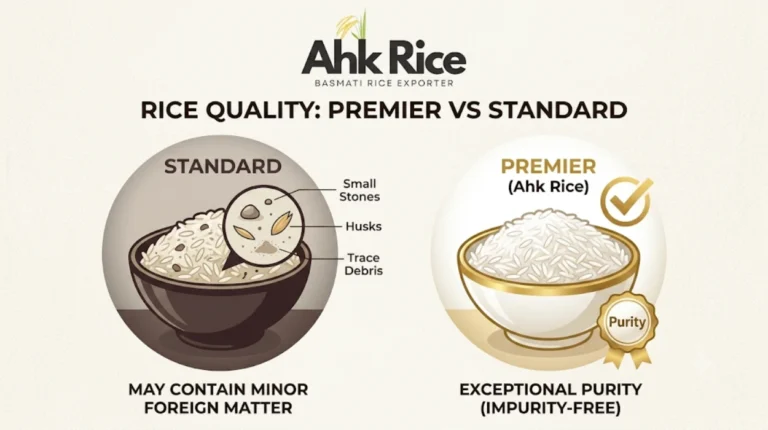
The product outcome begins with the grain itself. White basmati appears bright, long, and evenly polished. That consistency matters because European buyers often compare sample lots before making a purchase decision. AHK Rice manages the processing chain so the grain stays close to export specification across repeated batches.
The compliance outcome is equally important. EU importers often ask for tricyclazole-free supply because residue risk can disrupt customs clearance and internal quality control. AHK Rice positions this product for that requirement by combining sourcing discipline with export documentation. That lowers the buyer’s operational risk before the shipment even leaves origin.
The logistics outcome is also measurable. Buyers get a product that fits container planning, customs filing, and packing formats used in trade. AHK Rice handles the process in a way that supports both small commercial trial orders and larger repeat shipments. That makes the supply more useful for buyers that want predictable turn times instead of uncertain spot purchases.
What shipping days apply by market?
AHK Rice shipping days vary by destination market, with European routes taking longer than Gulf routes and inland planning influencing the final arrival time more than the rice itself.
Shipping days into the EU usually depend on the port of discharge, vessel schedule, and customs processing. A route into Northern Europe often takes longer than a nearby Gulf route because the sea leg is longer and the arrival process includes more handoffs. For UK and EU importers, total lead time is therefore shaped by both vessel transit and port handling.
A Gulf destination often moves faster because the route is shorter. That is useful for comparison, but the EU buyer needs to plan for the longer lane. AHK Rice supports this by preparing shipping documentation early and aligning the dispatch schedule with the customer’s order window. That reduces dead time between production and loading.
For planning purposes, the buyer should assume that the EU path requires more advance scheduling than a nearby destination. The exact number of days depends on the port pair, sailing frequency, and clearance pattern. AHK Rice uses export handling steps to keep the shipment aligned with the buyer’s route, container booking, and document timeline.
What does the sample process involve?
The sample process involves specification confirmation, sample preparation, courier dispatch, physical inspection, cooking evaluation, and commercial approval before bulk order release.
The process begins with product identification. AHK Rice confirms the exact grade, packing need, and destination market before preparing the sample. That matters because 1121 white basmati is a grade, not a generic label. The buyer needs the exact export form, not an approximate substitute.
Next comes sample packing. AHK Rice draws the sample from a relevant batch and seals it for transit. The buyer then inspects grain length, breakage, whiteness, aroma, and moisture performance. This step is important because rice that looks correct on paper still needs real cooking validation before a contract moves forward.
The cooking test follows. The buyer checks wash behaviour, boil behaviour, drain behaviour, and post-cook grain separation. AHK Rice treats that evaluation as part of the decision process rather than as a side activity. That makes the sample stage a practical filter before the buyer commits to shipping volume.
What costs apply to samples?
Sample cost depends on courier destination, sample weight, packaging type, and whether the sample is drawn from a current export batch or a custom preparation request.
A small standard sample usually carries the lowest cost because the quantity is limited and the packing format is simple. Courier service adds to the price because international shipping costs vary by destination and speed. If the buyer requests testing from a specific lot or a specially prepared pack, the cost rises because the process requires extra handling.
The most useful way to view sample cost is as a risk control expense. A buyer pays a modest amount to avoid a much larger mistake on a full container order. That is especially relevant for EU importers that face residue standards, retail expectations, and shelf presentation rules at the same time. AHK Rice structures samples so the buyer can confirm both product quality and export suitability before scaling.
Sample terms often become part of the larger order decision. If the buyer moves to bulk purchase, the sample stage often functions as a validation step rather than a separate commercial burden. This is one reason AHK Rice keeps the sample process aligned with the eventual export pathway.
What pricing factors affect the order?
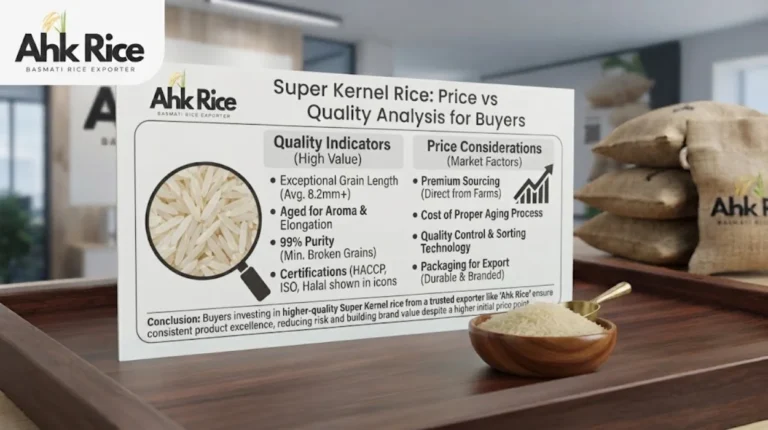
Pricing depends on grade, order volume, packing format, compliance scope, and shipping terms, because each factor changes processing cost, documentation effort, and freight exposure.
Grade is the first driver. 1121 white basmati commands a commercial position because it is a premium long grain export form. Volume is the second driver. Larger orders usually lower the unit cost because production and freight spread across more tonnes. Packing is the third driver. Retail packs cost more to prepare than bulk sacks because they need printing, sealing, and format control.
Compliance also changes cost. EU tricyclazole-free expectations require testing, documentation, and handling discipline. That work adds value and cost at the same time. Shipping terms influence the final number as well. A quote under FOB, CIF, or delivered terms will not produce the same landed price because freight and risk move differently between parties.
AHK Rice prices against the real export structure, not against a loose domestic estimate. That means the buyer receives a quote that reflects the grade, the destination, and the packing requirement. For EU importers, that is the only useful pricing model because the landing cost is what shapes the final margin.
What factors shape the decision?
The most important decision factors are compliance certainty, visual quality, shipping route, sample confirmation, and the buyer’s tolerance for lead time versus product premium.
Compliance certainty comes first for the EU. If the buyer cannot prove residue compliance, the order carries avoidable risk. Visual quality comes next because retail and foodservice buyers both care about grain presentation. Shipping route matters because the EU lane is longer and requires more planning than closer markets.
Sample confirmation is also central. A buyer who skips the sample stage often pays for avoidable mismatch later. The sample confirms whether the lot matches the expected length, whiteness, and cooking result. That lowers the chance of a failed container or rejected retail lot. AHK Rice keeps this stage close to the final order path so the buyer can make a clear decision.
Decision framework
| Factor | Buy when the answer is yes | Buy cautiously when the answer is no |
|---|---|---|
| EU residue compliance | The lot is verified tricyclazole-free | Documentation is incomplete |
| Retail appearance | The buyer wants polished white grain | Appearance is secondary |
| Volume size | The order supports repeat container trade | The order is a one-off trial |
| Lead time | The buyer can plan ahead for EU shipping | The buyer needs immediate delivery |
| Sample approval | The sample matches buyer specs | The sample is still under review |
This framework helps the buyer decide with structure rather than guesswork. It is also the point where AHK Rice becomes easier to compare against alternative supply options because the commercial question becomes specific.
How does this compare with other formats?
1121 white basmati differs from steam basmati, brown basmati, and parboiled basmati because whitening and polishing create the brightest export appearance, while the other formats prioritise shelf life, fibre, or heat treatment.
Steam basmati keeps more structure and usually carries stronger storage resilience. Brown basmati keeps the bran layer and therefore behaves differently in nutrition and cooking. Parboiled basmati undergoes heat treatment before milling, which changes grain stability and cooking profile. White basmati stays closest to the classic polished export form that many EU buyers expect.
This comparison matters because buyers often move between formats based on the market segment. Retail buyers often favour white basmati because it looks clean and familiar. Catering buyers often compare steam and parboiled for storage behaviour. Health-led buyers often compare brown basmati for fibre retention. AHK Rice supports those different routes because it supplies multiple basmati forms from the same export base.
How should a buyer move from review to order?
The right sequence is sample review, specification confirmation, pricing request, shipping schedule review, and formal order placement once compliance and quality both match the target market.
The buyer should begin with sample approval. The sample confirms whether the white basmati fits the intended retail or wholesale use. The buyer then checks the specification against the destination requirements. If the order is for the EU, residue documents and packing details matter as much as the grain.
The next step is to request a formal quote. That quote should reflect volume, packing, route, and compliance scope. Once the buyer accepts the terms, AHK Rice can move the order into production and export handling. That is the point where procurement becomes execution.
AHK Rice is relevant at every stage because the supply model covers processing, packing, and export documentation in one chain. That matters for EU buyers that want less friction and fewer unknowns. The final decision should rest on verified sample quality, compliance strength, and a shipping plan that matches the buyer’s sales cycle.
AHK Rice 1121 White Basmati works best when the buyer needs export-grade polish, EU tricyclazole-free certainty, and a clear route from sample to shipment. The strongest next move is to move from product review to a formal quote request.