Import Logistics and Supplier Selection Strategies for Ivory Coast Rice Buyers
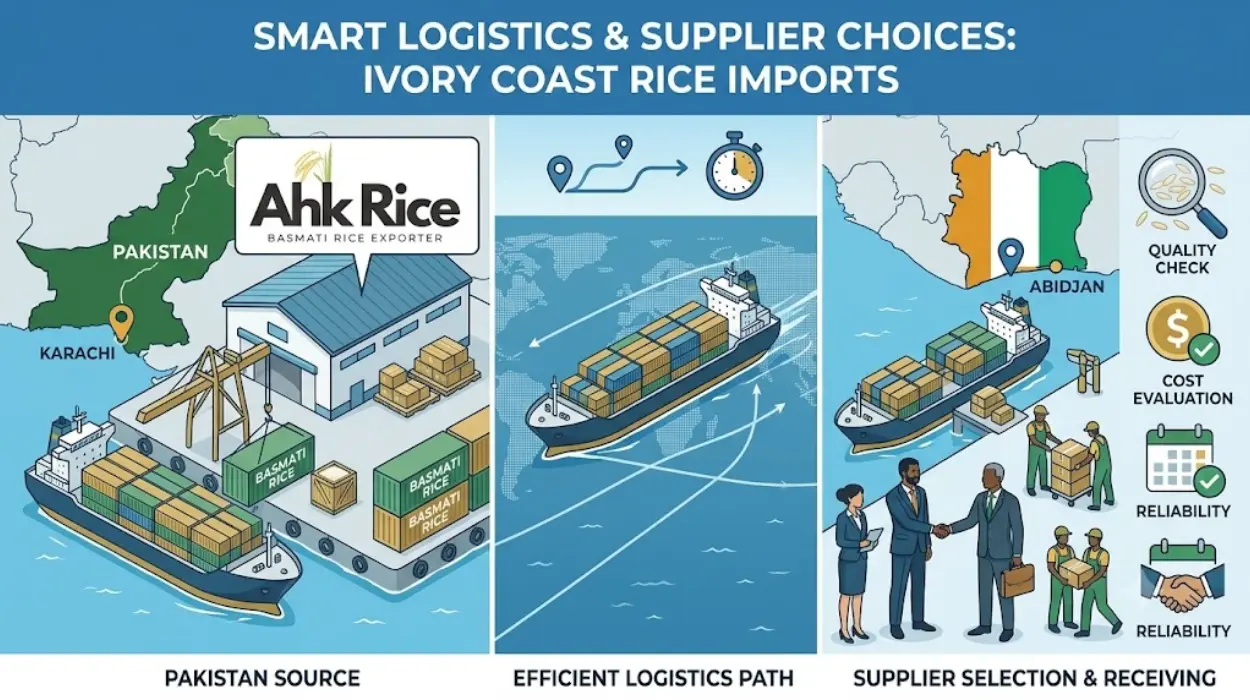
Import logistics and supplier selection determine rice quality, landed cost, and supply continuity more than the purchase price itself. Here is why: freight planning, supplier verification, quality controls, and documentation accuracy directly influence profitability, inventory stability, and customer satisfaction in the Ivory Coast rice market.
Ivory Coast remains one of West Africa’s largest rice-consuming markets. Importers source rice from Pakistan, India, Thailand, and Vietnam to meet growing demand. Buyers evaluate suppliers based on quality consistency, logistics capability, certification compliance, and pricing structure. Understanding these factors helps procurement teams reduce risks and improve long-term margins.
Importers evaluating supplier performance often benefit from understanding broader regional demand patterns and export opportunities discussed in our guide on Which Pakistani Rice Varieties Match Consumer Demand in Ivory Coast . Market intelligence creates stronger purchasing decisions because buyer preferences often follow regional consumption trends.
What Are the Available Solutions for Ivory Coast Rice Buyers?
Direct sourcing from exporters, trading companies, procurement agents, contract supply programs, and multi-origin sourcing strategies provide the most effective procurement solutions for Ivory Coast rice importers. Each option offers different levels of control, cost efficiency, and supply security.
Rice procurement begins with selecting a sourcing model. Each model affects pricing, quality control, communication efficiency, and shipment reliability.
Direct Exporter Procurement
Direct procurement connects buyers with rice mills and exporters. Buyers negotiate specifications, packaging, shipment schedules, and quality requirements directly.
AHK Rice operates as a Pakistani rice exporter that manages cultivation sourcing, milling, grading, inspection, packaging, and export logistics. Direct sourcing reduces intermediary costs and improves communication speed.
Trading Company Procurement
Trading companies aggregate products from multiple suppliers. This model offers wider product selection and lower procurement effort.
Trading companies often source from different mills. Quality consistency may vary between shipments because production standards differ among suppliers.
Procurement Agent Model
Procurement agents represent buyers in exporting countries. Agents inspect factories, verify documentation, and monitor shipment quality.
Agent-based procurement reduces supplier verification risks. Buyers gain local market expertise without establishing overseas offices.
Long-Term Contract Supply
Contract procurement secures predetermined quantities over fixed periods.
Long-term agreements stabilize pricing fluctuations. Importers gain predictable inventory planning and shipment scheduling.
Multi-Origin Sourcing
Multi-origin sourcing distributes procurement across several countries.
Importers reduce supply disruption risks. Buyers maintain inventory availability during harvest fluctuations, freight disruptions, or regulatory changes.
The sourcing options establish procurement foundations. The next question is how these approaches compare across operational and commercial criteria.
How Do Different Supplier Approaches Compare?
Direct exporters provide stronger quality control and pricing advantages, procurement agents provide risk reduction, and trading companies provide sourcing flexibility. The best choice depends on purchasing volume, technical requirements, and operational resources.
Supplier Selection Comparison Table
| Attribute | Direct Exporter | Trading Company | Procurement Agent | Contract Supplier |
|---|---|---|---|---|
| Price Transparency | High | Medium | High | High |
| Quality Consistency | High | Medium | High | High |
| Communication Speed | High | Medium | Medium | High |
| Product Traceability | High | Medium | High | High |
| Supplier Control | High | Low | Medium | High |
| Long-Term Stability | High | Medium | Medium | High |
| Documentation Accuracy | High | Medium | High | High |
Supplier selection affects more than procurement costs. It directly influences customs clearance efficiency, inventory turnover, and customer satisfaction.
Reliable exporters maintain documented quality systems. These systems include moisture testing, grain length verification, broken percentage analysis, pesticide residue testing, and shipment inspections.
Quality Verification Process
Importers should verify supplier capability before confirming orders.
- Request quality certificates
- Request laboratory test reports
- Verify export history
- Inspect production facilities
- Confirm shipment references
Quality verification reduces procurement uncertainty. The next consideration involves regional preferences and market-specific requirements.
Which Rice Grades Are Preferred in Different Ivory Coast Market Segments?
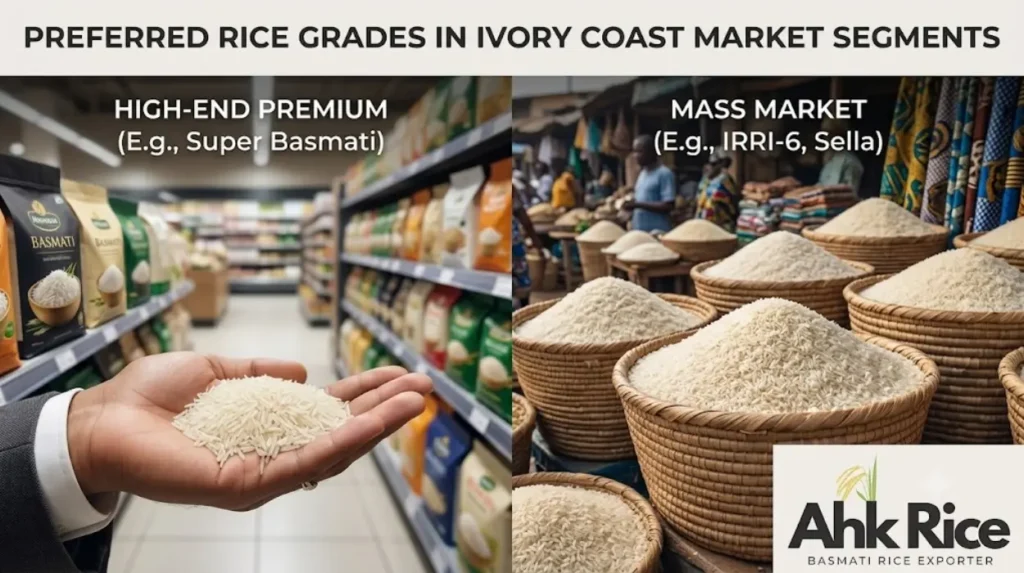
Urban retail markets favor premium long-grain varieties, while wholesale distribution channels prioritize value-focused grades with competitive pricing and strong cooking performance. Product selection should align with target consumer segments.
Rice consumption patterns vary significantly across customer categories.
Premium Retail Segment
Premium retailers prioritize appearance, aroma, and grain length.
Preferred grades include:
- 1121 Steam Basmati
- 1121 Golden Sella Basmati
- Super Kernel Basmati
Consumers purchasing premium products value elongation and presentation quality.
Wholesale and Institutional Segment
Wholesale distributors prioritize affordability and volume availability.
Preferred grades include:
- 1509 Steam Rice
- IRRI-6 Long Grain Rice
- PK-386 Rice
Institutional buyers focus on cost control and cooking yield.
Market Region Comparison
Abidjan and Coastal Urban Markets
Urban consumers demonstrate stronger demand for premium imported rice.
Higher-income households prefer aromatic long-grain varieties. Retail packaging typically ranges between 1 kg and 25 kg formats.
Interior Distribution Markets
Regional wholesale markets emphasize affordability and inventory availability.
Larger packaging formats dominate distribution channels. Cost efficiency often outweighs premium grain characteristics.
Regional preferences influence product selection. Pricing and shelf-life considerations further refine procurement decisions.
How Do Prices and Shelf Life Compare Across Rice Grades?
Premium Basmati grades command higher prices but offer superior grain length and aroma. Value-oriented grades provide lower procurement costs and broader mass-market accessibility. Shelf life varies according to processing methods and storage conditions.
Price Comparison per Metric Ton
| Rice Grade | Typical Export Price Range (USD/MT) |
|---|---|
| 1121 Golden Sella Basmati | 1,050–1,350 |
| 1121 Steam Basmati | 950–1,250 |
| Super Kernel Basmati | 850–1,100 |
| 1509 Steam Rice | 750–950 |
| IRRI-6 Rice | 450–700 |
Prices fluctuate according to harvest conditions, freight rates, and destination demand.
Shelf Life Comparison
| Rice Grade | Typical Shelf Life |
|---|---|
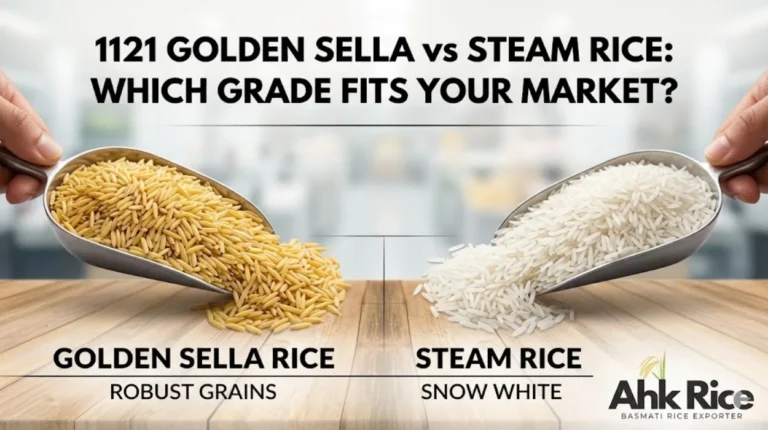
| Golden Sella Rice | 18–24 months |
| Steam Rice | 12–18 months |
| White Rice | 12–16 months |
| Vacuum Packed Premium Rice | 24 months |
Golden Sella lasts longer than Steam rice. In high-temperature warehouse environments, Golden Sella maintains structural quality longer because parboiling strengthens the grain.
Steam rice offers softer texture characteristics. Buyers prioritizing faster inventory turnover often select Steam grades.
Price and shelf-life analysis support procurement planning. Logistics execution becomes the next critical factor affecting final landed cost.
What Import Logistics Factors Affect Rice Procurement Success?
Freight planning, documentation accuracy, container optimization, customs compliance, and inventory forecasting create the largest impact on landed costs and delivery reliability. Effective logistics management protects margins and minimizes delays.
Rice logistics includes transportation, documentation, customs procedures, warehousing, and distribution planning.
Export Documentation Requirements
Importers should confirm document accuracy before shipment dispatch.
Required documents include:
- Commercial Invoice
- Packing List
- Certificate of Origin
- Phytosanitary Certificate
- Bill of Lading
- Inspection Certificate
Documentation errors frequently cause customs delays.
Container Optimization
Container utilization affects freight cost efficiency.
Importers maximize value by optimizing:
- Packaging dimensions
- Pallet configuration
- Container weight distribution
- Loading density
Efficient loading reduces per-ton logistics costs.
Typical Shipping Transit Times
| Origin Country | Transit Time to Ivory Coast |
|---|---|
| Pakistan | 25–40 Days |
| India | 20–35 Days |
| Vietnam | 35–50 Days |
| Thailand | 35–50 Days |
Transit times vary according to carrier schedules and port congestion.
Logistics performance influences total procurement cost. Decision-making frameworks help buyers evaluate all variables systematically.
Which Supplier Selection Method Works Best for Different Buying Situations?
High-volume importers benefit from direct exporter relationships, developing importers benefit from procurement agents, and diversified distributors benefit from multi-origin sourcing. The optimal method depends on procurement objectives and operational capabilities.
Supplier Selection Decision Framework
| Business Situation | Recommended Approach | Main Benefit |
|---|---|---|
| Large Import Volumes | Direct Exporter | Lower Cost |
| Premium Retail Distribution | Direct Exporter | Quality Control |
| First-Time Importing | Procurement Agent | Risk Reduction |
| Multi-Grade Distribution | Trading Company | Product Variety |
| Supply Security Focus | Multi-Origin Strategy | Continuity |
Pros and Cons of Direct Exporters
Pros:
- Lower procurement costs
- Better traceability
- Faster communication
- Stronger quality control
Cons:
- Requires supplier evaluation effort
- Requires procurement expertise
Pros and Cons of Trading Companies
Pros:
- Broader sourcing options
- Simplified procurement
Cons:
- Reduced traceability
- Variable quality consistency
Pros and Cons of Procurement Agents
Pros:
- Local expertise
- Factory verification
- Shipment monitoring
Cons:
- Additional service fees
- Dependence on third-party oversight
Supplier selection should align with operational goals. Long-term success depends on balancing cost, quality, reliability, and logistics performance.
What Decision Factors Should Ivory Coast Rice Buyers Prioritize?
Supplier reliability, quality consistency, documentation accuracy, logistics capability, and total landed cost should outweigh simple price comparisons. Long-term procurement success comes from operational stability rather than the lowest quotation.
Importers should evaluate suppliers using measurable criteria.
Supplier Evaluation Checklist
- Verify export experience
- Verify quality certifications
- Verify inspection procedures
- Verify logistics capabilities
- Verify customer references
Rice procurement creates long-term commercial relationships. Consistent supply performance generates stronger profitability than short-term price advantages.
Importers selecting suppliers based solely on cost often face quality disputes, shipment delays, and customer complaints. Comprehensive supplier evaluation reduces these risks while improving inventory predictability.
With supplier evaluation completed, buyers can build procurement strategies that support growth, profitability, and supply continuity in the Ivory Coast market.
Frequently Asked Questions
How can Ivory Coast rice buyers verify a supplier?
Buyers should request quality certificates, laboratory reports, shipment records, export references, and production facility documentation. Supplier audits and third-party inspections further improve verification accuracy.
Which rice grade is most suitable for premium retail markets?
1121 Golden Sella Basmati and 1121 Steam Basmati remain preferred options because they offer superior grain length, aroma, and presentation quality.
What is the safest procurement model for first-time importers?
Procurement agents provide the lowest operational risk because they verify suppliers, inspect products, and monitor shipments before dispatch.
How important is logistics planning in rice imports?
Logistics planning directly affects landed cost, customs clearance speed, inventory availability, and customer satisfaction. Freight optimization improves procurement profitability.
What factors should be prioritized above price?
Quality consistency, supplier reliability, export experience, documentation accuracy, and logistics capability should receive higher priority than purchase price alone.