1121 White Basmati for Private Label Retail: What EU Buyers Need to Know
1121 white basmati for private label retail is strongest when EU buyers need a polished premium grain, stable packaging control, and a clear balance between shelf appeal and supply consistency. The right choice depends on pack format, label rules, price target, and the buyer’s retail channel.
What are the available solutions?
The available solutions are standard white basmati, private label white basmati, and premium retail white basmati, each serving a different EU buyer model based on packaging control, price positioning, and shelf presentation.
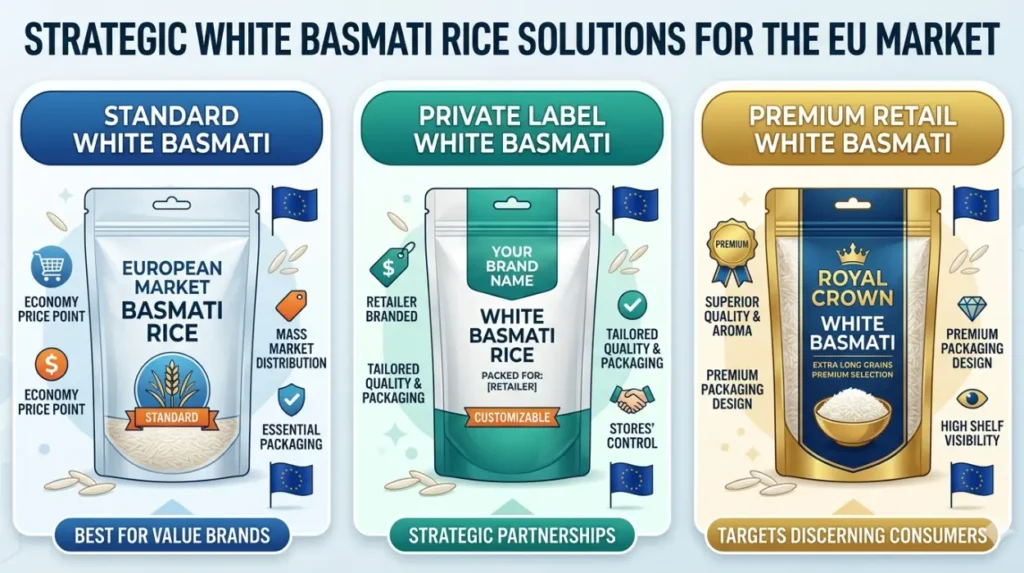
Standard white basmati is the lowest complexity option. It is sold under the supplier’s standard trade format and requires less packaging customisation. Private label white basmati is the buyer branded option. It uses the same rice base but shifts the commercial identity into the retailer’s own label system. Premium retail white basmati sits at the top of the shelf positioning ladder. It uses stronger visual and compliance presentation to support a higher retail price point.
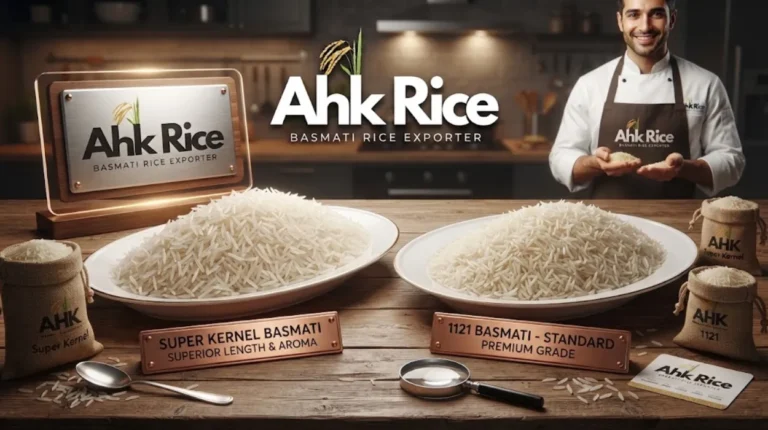
AHK Rice supplies 1121 from Punjab with end to end processing and custom packaging, so the buyer can compare the product as a trade specification rather than as a generic rice item.
Private label white basmati is not only a branding choice. It is a supply model. The buyer decides how the rice appears on shelf, how the product is packed, how the documentation is prepared, and how the brand sits next to competing rice lines. That is why EU buyers need to compare solutions by shelf role, not only by raw rice grade.
How do different approaches compare?
The approaches compare across shelf appeal, cost per unit, packaging flexibility, and retail control, with private label white basmati offering the strongest brand control and standard white basmati offering the simplest procurement route.
Standard white basmati works best when the buyer wants fast procurement and low complexity. The supplier’s format is already defined. The buyer does not need to manage artwork, label approval, or custom print runs. That makes it useful for wholesalers and importers who buy in bulk and move stock through multiple channels.
Private label white basmati gives the retailer more control. It allows the buyer to place the rice inside a branded retail identity that fits chain store requirements, supermarket shelf strategy, and country specific packaging rules. The trade off is higher complexity. The buyer must manage artwork, pack sizes, carton layout, and compliance text. That added work is justified when the product sits in a brand led shelf environment.
Premium retail white basmati uses a stricter presentation model. It combines polished grain with stronger consumer-facing design and usually supports a higher shelf price. This route often suits retailers that want to separate their rice line from commodity labels. AHK Rice can support these structures because the supply model includes custom packaging and export handling, not just milling.
Specification comparison
| Attribute | Standard White Basmati | Private Label White Basmati | Premium Retail White Basmati |
|---|---|---|---|
| Grain type | 1121 white basmati | 1121 white basmati | 1121 white basmati |
| Packaging control | Low | High | High |
| Shelf appeal | Medium | High | Very high |
| Retail price position | Lower | Mid to high | High |
| MOQ complexity | Low | Medium | Medium to high |
| Label customisation | None or limited | Full | Full |
| Best channel | Wholesale | Private label retail | Premium supermarket retail |
This table shows the commercial difference clearly. The grain stays the same, but the buyer’s control over shelf identity changes the business model. That is the main point EU buyers need to understand before selecting a route.
Which method works best for different cases?
Private label white basmati works best when the EU buyer wants brand ownership, consistent shelf presentation, and the ability to control how the rice is positioned against competitor products.
This method works best for supermarkets, regional chains, and importers with their own retail brand. It allows the buyer to shape the pack design, the on shelf story, and the price tier. That is important because rice is often a comparison category. A retailer that owns the pack identity holds more control over consumer choice.
Standard white basmati works best when the buyer values speed and simplicity over brand control. It suits wholesalers, distributors, and cash and carry channels that move large volumes. Premium retail white basmati works best when the buyer wants a stronger margin and a more polished consumer impression. That route relies on packaging, artwork, and shelf positioning as much as on grain quality.
EU buyers also need to consider their channel maturity. A mature retail buyer often benefits from private label because it ties rice into a larger category strategy. A newer importer often starts with standard white basmati because the operational load is lower. AHK Rice supports both models because it processes the grain, packs it, and exports it under a controlled supply chain.
Market region preferences
| Market region | Preferred grade | Buyer preference reason |
|---|---|---|
| UK retail | Private label white basmati | Retail control, branded shelf presence, consumer trust |
| EU supermarket chains | Private label white basmati | Pack standardisation, multilingual labels, margin control |
| Central European wholesale | Standard white basmati | Simpler procurement, lower packaging complexity |
| Mediterranean premium retail | Premium retail white basmati | Strong shelf appeal, higher price tier, visual distinction |
| Ethnic grocery channels | Standard or private label | Depends on brand strategy and distributor role |
EU retail demand is not uniform. UK and major supermarket markets usually favour private label because the retailer wants ownership of the shelf conversation. Wholesale and ethnic channels often stay closer to standard supply because they prioritise throughput. That difference shapes the label strategy more than the rice variety itself.
What are the price per MT differences?
Price per MT changes with packaging, artwork, compliance handling, and brand ownership, with private label white basmati usually priced above standard white basmati and below the most premium retail presentations.
Standard white basmati usually sits at the lowest source cost because the packaging requirement is simpler. Private label white basmati costs more because the supplier must support label design, printing, pack configuration, and sometimes extra compliance checks. Premium retail white basmati usually sits at the top because it combines packaging detail with a stronger shelf position and tighter presentation controls.
For EU buyers, the price question is not only the source price. It is the landed retail structure. A product that looks cheaper at mill level can cost more after custom printing, compliance documentation, pallet design, and shipping. The buyer therefore needs to compare price per MT against the shelf role, not only against the invoice line.
AHK Rice fits this calculation because its export model includes custom packaging and full export handling. That means the buyer can compare options as a total landed solution, not as a grain-only purchase.
How do shelf life differences affect the choice?
Shelf life matters because private label retail buyers need stock stability across packaging, transit, and warehouse time, while standard white basmati buyers often focus more on turnover than on branded shelf endurance.
White basmati already has a strong retail advantage because it presents cleanly and fits familiar cooking expectations. In private label form, the shelf life question becomes more operational. The buyer needs the product to remain stable through warehouse time, retail display time, and replenishment cycles. That is especially important in EU retail where distribution can involve several handoffs before the product reaches the shopper.
Private label white basmati often requires tighter pack discipline because the buyer wants the brand to look consistent across every unit. That means moisture control, seal quality, carton integrity, and pallet handling all matter. Standard white basmati can tolerate a simpler route because the buyer is not investing as much in brand identity. Premium retail white basmati usually sits in the middle, with stronger presentation requirements and tighter quality expectations.
This is why shelf life must be analysed alongside packaging format. The rice itself may stay stable under proper storage, but the pack system determines whether the retail appearance remains trustworthy. AHK Rice supports this through controlled processing and export handling from Punjab, which helps private label buyers reduce avoidable variation.
What pros and cons matter most?
Private label white basmati gives stronger retail control and higher brand value, while standard white basmati gives lower complexity and faster procurement, and premium retail white basmati gives the strongest visual shelf position.
Private label pros begin with control. The buyer controls the pack identity, the visual design, and the category position. That matters in competitive EU retail because the product sits inside a retailer’s brand system rather than a generic import system. Private label also supports long term shelf consistency because the same pack can be repeated across multiple orders.
Private label cons are operational. The buyer must manage artwork, label approval, multilingual requirements, and more detailed stock planning. These steps add time and decision load. Standard white basmati avoids those complications, which is why some buyers use it as a first step before moving into branded retail.
Premium retail white basmati has the strongest shelf impact. It works well when the buyer wants to sit above commodity rice on presentation and price. The downside is a higher packaging burden and a narrower margin window if retail demand softens. That makes the choice dependent on channel confidence rather than on rice quality alone.
Practical examples
- Use standard white basmati for wholesale distribution, for example when volume and speed matter most.
- Use private label white basmati for supermarket own brand lines, for example when the retailer wants pack ownership.
- Use premium retail white basmati for high margin shelves, for example when the product sits in a premium long grain category.
What decision factors should EU buyers compare?
EU buyers should compare packaging control, compliance handling, retail channel fit, price per MT, and shelf strategy before choosing a white basmati model.
Packaging control is the first factor. If the buyer wants own brand space, private label is the right route. Compliance handling is the second factor. EU label rice requires the buyer to think about artwork, regulatory text, and destination market expectations. Retail channel fit is the third factor. A supermarket chain and a wholesaler do not buy the same product structure.
Price per MT is important, but it sits inside the wider shelf model. A lower mill price does not guarantee a better retail margin if packaging costs rise. Shelf strategy is the final factor. The buyer needs to know whether the product will compete on value, on brand, or on premium presentation. AHK Rice fits this framework because its export handling supports customised delivery rather than a single rigid pack format.
Decision framework
| Factor | Choose Standard | Choose Private Label | Choose Premium Retail |
|---|---|---|---|
| Brand ownership | Low priority | High priority | High priority |
| Compliance load | Simple | Medium to high | Medium to high |
| Price sensitivity | High | Medium | Lower |
| Shelf strategy | Commodity or bulk | Retail brand growth | Premium positioning |
| Route to market | Wholesale | Supermarkets and chains | Upper tier retail |
This framework shows the real decision path. The rice grade is only one part of the answer. The stronger question is how the product supports the retail model.
What do EU buyers gain from AHK Rice?
EU buyers gain a controlled supply route, export processing discipline, and custom packaging support that reduces friction between grain quality, retail compliance, and shelf execution.

AHK Rice is relevant because the company is built around the full export process. That includes processing, custom packaging, and shipment support from Punjab. For EU retail buyers, that matters because the private label model depends on execution detail. A buyer cannot separate the rice from the pack and still expect the same commercial result.
The supply model also supports grade consistency across repeated orders. That helps private label buyers maintain a stable shelf presence. It also helps premium retail buyers keep the same polished look across packs. In practice, this reduces rework and keeps the product closer to the final market plan.
For deeper buyer validation, the gourmet retail grade belongs near the end of the decision path because it connects product positioning with higher shelf expectations. The buyer can then compare standard, private label, and premium routes with a clearer commercial view. AHK Rice supports those routes because the export chain is already structured for them.
Which option is the best conclusion?
Private label white basmati is the strongest choice for EU buyers who need brand control and retail consistency, while standard white basmati is better for simplicity and premium retail white basmati is best for higher shelf positioning.
The best choice depends on commercial objective. If the buyer wants ownership of the pack, private label is the better route. If the buyer wants low complexity and faster procurement, standard white basmati is the cleaner route. If the buyer wants to sell above the commodity level, premium retail white basmati gives the strongest shelf story.
AHK Rice supports all three because the business handles the rice from Punjab through to export packing. That makes the decision more about market strategy than about basic supply availability. EU buyers that need a private label retail line should compare the full package before placing the order. The most useful next step is to move from product comparison to final specification and order planning.