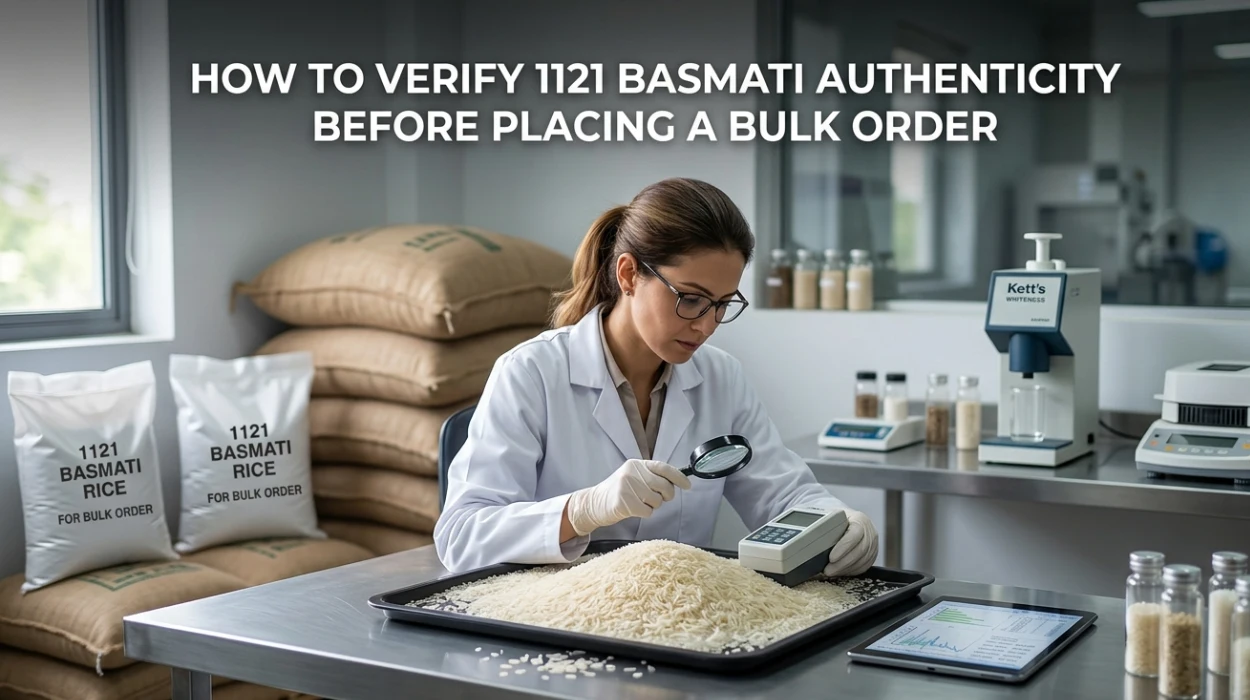
How to Verify 1121 Basmati Authenticity Before Placing a Bulk Order
1121 basmati authenticity verification is the process of confirming that a rice lot is genuinely 1121 variety, correctly grown, properly processed, and accurately documented before bulk purchase.
It combines identity checks, physical inspection, document review, and third-party testing. The goal is to verify rice origin and reduce the risk of substitution, mislabelling, or mixed lots. In bulk trade, that matters because 1121 is sold on premium grain length, aroma, and cooking performance.
Which verification methods are available?
The available methods are visual inspection, sample cooking, laboratory testing, origin-document review, and third-party inspection, each checking a different part of the 1121 quality chain.
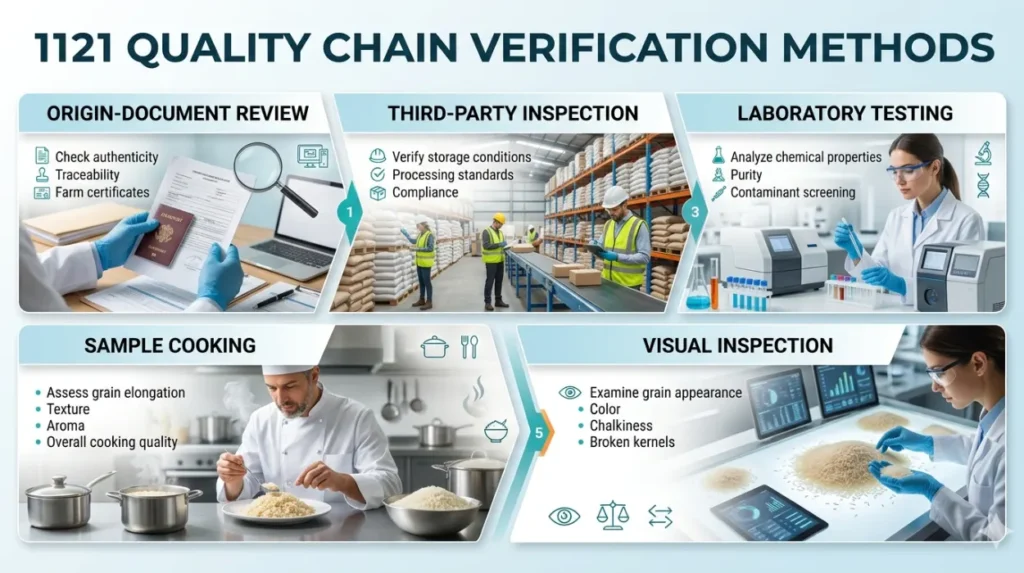
Visual inspection checks grain length, colour, breakage, and uniformity. Genuine 1121 typically shows extra-long kernels and consistent size across the lot. Sample cooking checks elongation, aroma release, and separation after boiling. Laboratory testing checks moisture, purity, foreign matter, and in some cases starch profile or varietal markers.
Document review checks invoice details, certificate of origin, phytosanitary papers, and packing records. Third-party inspection checks whether the lot matches the supplier’s claim before shipment. Together, these methods create basmati authenticity verification that is stronger than relying on product photos or verbal assurances.
How do these methods compare?
The methods differ in speed, cost, and certainty, with visual checks being fastest, laboratory and inspection methods being most reliable, and document review sitting between them.
| Method | What it checks | Strength | Limitation |
|---|---|---|---|
| Visual inspection | Grain length, breakage, uniformity | Fast and low cost | Does not prove varietal identity |
| Sample cooking | Aroma, elongation, texture | Good for buyer experience | Subjective without lab data |
| Laboratory testing | Moisture, purity, contaminants | High certainty | Requires time and fee |
| Document review | Origin, packing, traceability | Useful for compliance | Depends on document integrity |
| Third-party inspection | Lot matching, shipment condition | Strong for bulk orders | Adds coordination time |
Visual inspection works best at the first screening stage. It filters out obvious mismatches, such as short grain or poor grading. Cooking tests work best when the buyer wants to judge aroma and elongation before committing to volume. Laboratory testing works best when the buyer needs a stronger claim around purity, moisture, or contamination control. Document review and third-party inspection work best when the buyer needs traceability and shipment assurance.
Which method works best for bulk orders?
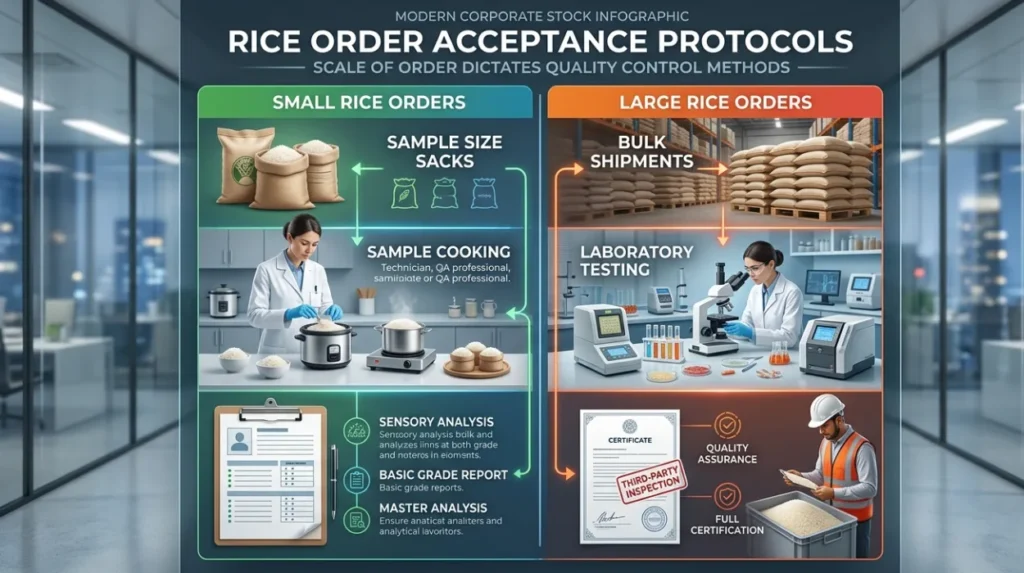
The best method for bulk orders is a layered approach that combines sample cooking, document verification, lab testing, and third-party inspection before final commitment.
Bulk orders carry higher risk because the buyer absorbs more value if the lot is mixed, mislabelled, or lower grade than promised. A single method does not cover every risk. Sample cooking confirms the user experience. Lab testing confirms physical quality. Document review confirms origin and trade legitimacy. Third-party inspection confirms lot consistency before loading.
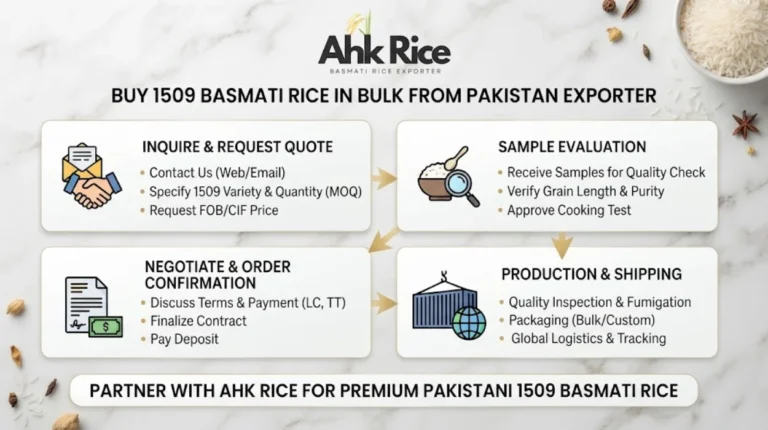
A practical 1121 quality check bulk process usually starts with a sample. The buyer tests the sample for grain length, smell, and cooked performance. The buyer then checks whether the certificate of origin, packing list, and export papers match the claim. Next, the buyer compares the sample with a lab report. The final step is pre-shipment verification by an independent inspector.
This approach works best because it reduces blind spots. If the rice looks correct but the documents fail, the buyer stops the order. If the papers look correct but the cooking result is weak, the buyer stops the order. If both are correct and the inspection matches, the buyer has a stronger basis for bulk purchase.
What are the pros and cons of each approach?
Each approach has a different strength profile, and the best choice depends on whether the buyer prioritises speed, certainty, or trade compliance.
Visual inspection:
- Identify obvious grain defects, such as short kernels or broken lots.
- Example: A lot that contains mixed short grain fails the first screen quickly.
- Strength: Fast and inexpensive.
- Limitation: Cannot prove variety identity.
Sample cooking:
- Measure elongation, aroma, and separation in a kitchen test.
- Example: A genuine 1121 sample stretches well after cooking.
- Strength: Strong for buyer experience.
- Limitation: Subjective without supporting data.
Laboratory testing:
- Check moisture, foreign matter, and purity with measurable results.
- Example: A moisture reading outside the expected range raises storage risk.
- Strength: High confidence.
- Limitation: Costs more and takes longer.
Document review:
- Confirm origin, exporter details, and packing claims.
- Example: A certificate of origin should match the invoice and container records.
- Strength: Strong for traceability.
- Limitation: Only as reliable as the paperwork.
Third-party inspection:
- Verify the lot before dispatch or loading.
- Example: The inspector confirms that the shipper’s sample matches the bulk stock.
- Strength: Good for bulk risk control.
- Limitation: Adds process time.
How does rice origin affect authenticity?
Rice origin affects authenticity because 1121 is sold not only as a variety but also as a regional product tied to recognised growing and milling systems.
A buyer who wants to verify rice origin checks whether the lot comes from the claimed producing area. In Pakistan, the Punjab rice belt is a recognised source for premium basmati. In trade, that origin supports the identity claim because 1121’s reputation depends partly on where it is grown and how it is handled.
Origin matters for two reasons. First, it supports product story and market trust. Second, it affects traceability across the export chain. If a seller claims Pakistan origin, the buyer checks whether the shipment papers, milling records, and export certificates support that claim. If the origin is vague, the buyer sees higher substitution risk.
Origin verification does not replace quality testing. A genuine origin can still produce weak quality if the grain is stored badly or processed poorly. A strong lot needs both origin proof and grade proof. That is why the best verification process always checks identity and condition together.
What role do documents play in authenticity checks?
Documents play a central role because they link the physical rice lot to the export trail, the mill, and the claimed origin.
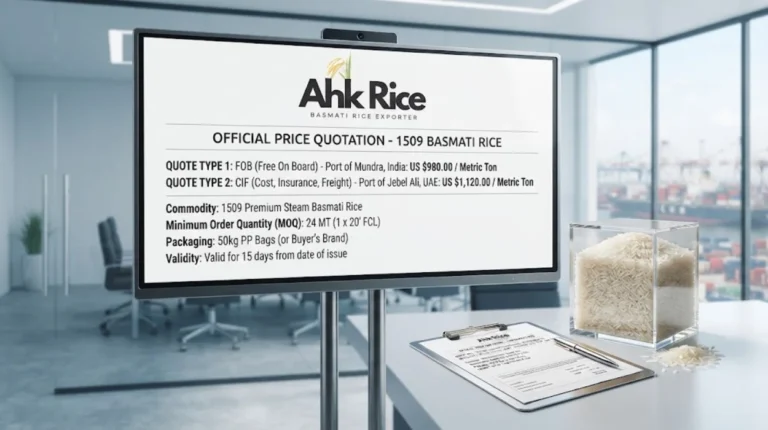
The key documents are the commercial invoice, packing list, certificate of origin, phytosanitary certificate, and any third-party inspection report. Each document adds one layer of traceability. The invoice should match the exporter name and product description. The packing list should match the number of bags, weight, and container details. The certificate of origin should match the producing country. The phytosanitary certificate should match the shipment and confirm compliance with plant-health rules.
Document inconsistencies are a warning sign. If the product name changes between papers, the buyer checks carefully. If the packing weight changes without explanation, the buyer pauses. If the origin paper does not match the exporter record, the buyer stops. Documents do not prove taste, but they prove the chain of custody and help verify rice origin.
How do third-party inspections improve certainty?
Third-party inspections improve certainty by giving the buyer an independent view of the lot before shipment or loading.
An inspector checks whether the stock matches the agreed specification. This includes grain size, moisture, broken percentage, packaging accuracy, and quantity. The buyer gets a neutral report that reduces dependence on the seller’s internal claims. In bulk trade, that report is valuable because the financial exposure is high.
The inspection is strongest when it happens at the right stage. Pre-shipment inspection checks the stock before it leaves the facility. Loading inspection checks the stock as it enters the container or truck. Both stages help catch mismatch risk early. If the buyer needs stronger assurance, the inspection can be paired with a lab report and sample comparison.
This method is especially useful when the buyer is ordering from a new supplier or a new market. It gives an external control point. It also creates a record that can support any future dispute about lot quality or packing compliance.
What decision factors matter most?
The most important decision factors are lot size, seller history, destination rules, budget, and the level of risk the buyer accepts on authenticity.
| Decision factor | What to check | Best method |
|---|---|---|
| Lot size | Number of MT and container count | Inspection plus documents |
| Seller history | Past delivery and consistency | Document review plus sample |
| Destination rules | Import, residue, and plant-health rules | Laboratory testing |
| Budget | Cost allocated for verification | Visual check plus sample |
| Risk tolerance | How much uncertainty is acceptable | Full layered verification |
Small orders often rely on sample cooking and basic documents. Large orders justify lab testing and third-party inspection. Buyers with strict import rules use stronger verification because compliance risk is higher. Buyers with tight margins still need a minimum check, because a cheap lot that fails authenticity is more expensive in the end.
How does this connect to the next step?
The next step after authenticity checks is to review whether the supplier can support inspection, documentation, and traceability at bulk-order scale.
Once the buyer confirms the rice is genuine, the focus shifts to execution. That includes consistency across bags, container handling, and export documentation. For buyers evaluating suppliers with third-party oversight, the SGS Bureau Veritas inspection fits best after the section on third-party inspections, because it connects the verification process to an order-ready supply chain.
What is the main takeaway?
The main takeaway is that 1121 basmati authenticity verification works best as a layered process that checks grain, documents, cooking performance, and independent inspection together.
No single method proves everything. Visual inspection catches obvious defects. Cooking tests show the sensory result. Lab testing confirms measurable quality. Documents confirm origin and traceability. Third-party inspection confirms the lot before dispatch. When these methods align, the buyer has a far stronger basis to place a bulk order in Pakistan with lower risk and clearer evidence.