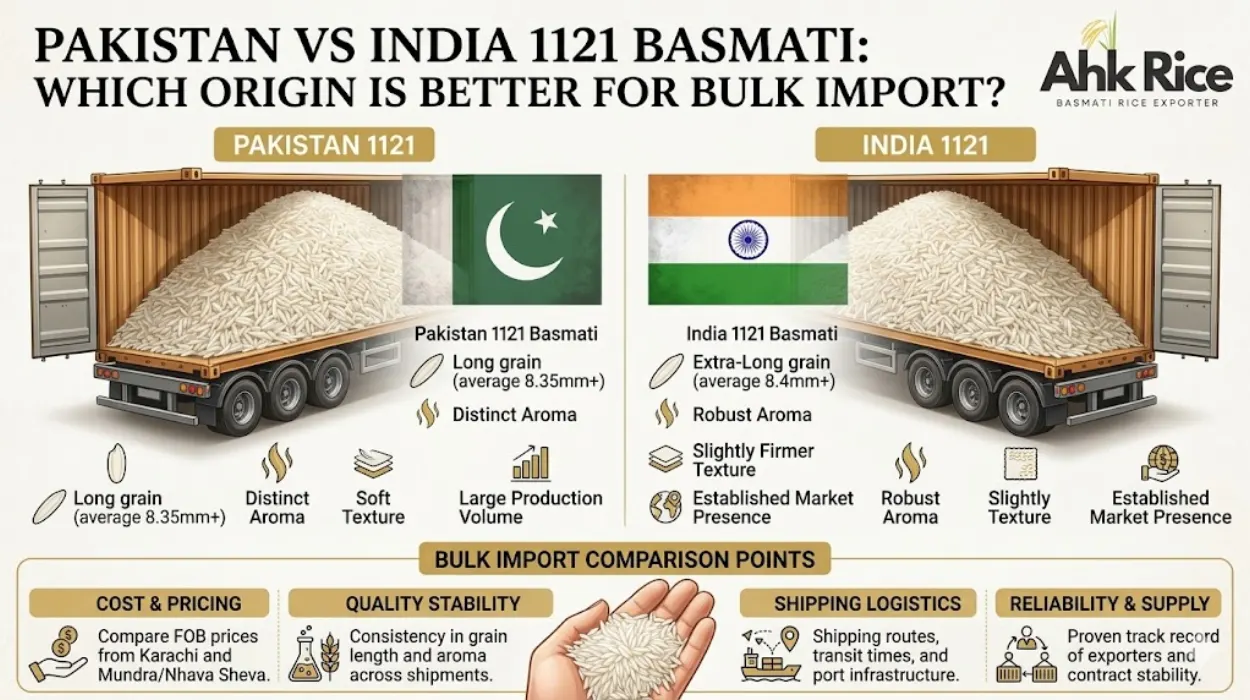
Pakistan vs India 1121 Basmati: Which Origin Is Better for Bulk Import?
Pakistan vs India 1121 basmati bulk import origin compares two geographically distinct production systems that supply long-grain aromatic rice, focusing on differences in soil composition, grain characteristics, processing standards, export infrastructure, and compliance requirements that directly impact large-scale international procurement decisions.
1121 Basmati is a specific extra-long grain rice variety known for elongation, aroma, and slender shape. The term “origin” defines the country where the crop is cultivated, harvested, milled, and exported. Pakistan and India dominate global basmati exports, contributing more than 85% of total supply.
Pakistan grows basmati primarily in Punjab regions such as Gujranwala, Hafizabad, and Sheikhupura. India produces basmati across Punjab, Haryana, and western Uttar Pradesh. Both regions share the Indo-Gangetic plains, but differences in irrigation water, soil minerals, and post-harvest handling create measurable variations.
Bulk import refers to procurement volumes exceeding 20 metric tons, typically shipped in containers or bulk vessels. Importers evaluate origin to ensure consistency across thousands of kilograms. A single origin mismatch affects cooking performance, aroma retention, and customer satisfaction in markets such as UAE, Saudi Arabia, UK, and Africa.
Origin comparison is not subjective. It depends on measurable attributes such as grain length, chalkiness percentage, broken ratio, moisture level, and elongation index after cooking.
How does 1121 basmati production differ between Pakistan and India?
1121 basmati production differs between Pakistan and India in cultivation practices, irrigation sources, harvesting timelines, and post-harvest processing methods, which influence grain uniformity, aroma strength, and export-grade consistency required for international bulk buyers.
Cultivation and Soil Differences
Pakistan’s Punjab uses canal irrigation from glacier-fed rivers such as the Chenab and Ravi. This water carries mineral-rich sediments that enhance grain aroma. Soil composition contains higher potassium levels, which supports grain elongation during cooking.
India uses a mix of canal and tube well irrigation. Tube wells introduce groundwater with higher salinity in some regions. This affects grain texture and consistency. Indian basmati farms often rely on mechanized farming systems with larger landholdings.
Harvesting and Aging Practices
Pakistan typically harvests 1121 basmati between October and November. After harvesting, rice is stored for 12 to 24 months for natural aging. Aging reduces moisture content and strengthens aroma compounds.
India follows similar harvesting timelines but often accelerates export cycles. Some exporters supply rice aged for 6 to 12 months. Shorter aging reduces elongation ratio and fragrance intensity.
Milling and Processing
Pakistan’s rice mills focus on low-breakage polishing techniques. Processing includes:
- Pre-cleaning (removal of dust and stones)
- Dehusking (removing husk layer)
- Whitening (bran removal)
- Polishing (surface smoothness)
- Length grading (separating long grains)
- Color sorting (removing discolored grains)
India uses advanced automated mills with high throughput capacity. However, high-speed processing increases broken grain percentages if not controlled precisely.
What are the key quality components in origin comparison?
Key quality components in Pakistan vs India basmati comparison include grain length, elongation ratio, aroma intensity, chalkiness level, broken percentage, moisture content, and purity standards, all measured using defined laboratory and export inspection protocols.
Grain Length and Elongation
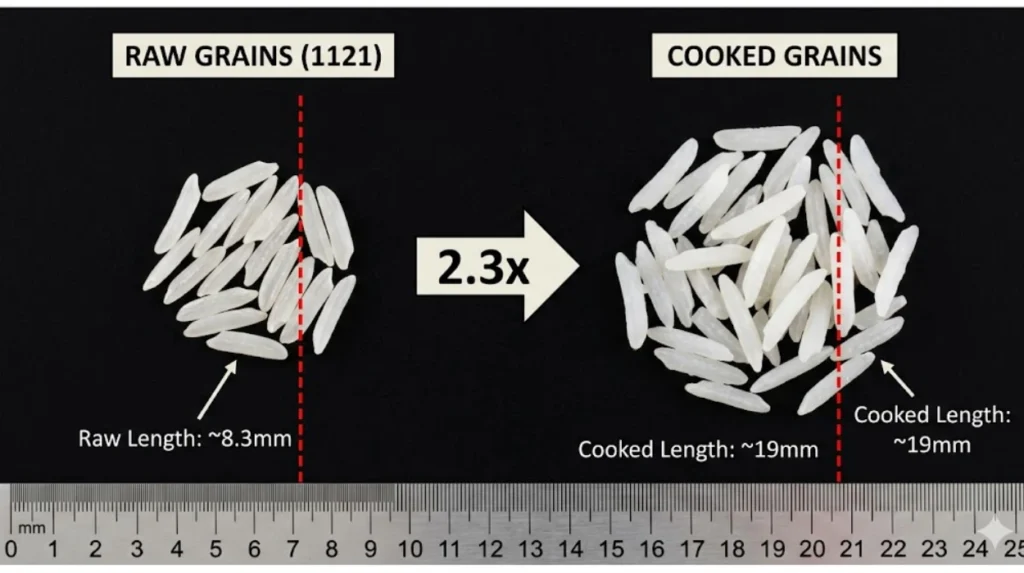
1121 basmati is defined by raw grain length exceeding 8.30 mm. After cooking, elongation reaches 18 to 22 mm. Pakistani 1121 often records higher elongation ratios due to extended aging.
Indian 1121 maintains strong length but shows slightly lower elongation when aging periods are shorter.
Aroma Profile
Basmati aroma comes from 2-acetyl-1-pyrroline (2-AP), a natural compound. Pakistani basmati typically contains higher 2-AP concentration due to soil conditions and aging practices.
Indian basmati also contains this compound but varies based on region and storage duration.
Broken and Chalky Grains
Broken percentage defines how many grains are fractured during milling. Export-grade standards:
- Premium grade: 0%–2% broken
- Standard grade: 5%–10% broken
Chalkiness refers to opaque white patches inside grains. Lower chalkiness improves appearance and cooking uniformity. Pakistan often delivers lower chalkiness due to controlled drying.
Moisture Content
Export moisture must remain between 12% and 14%. Higher moisture leads to fungal growth during shipping. Pakistan exporters typically maintain 12.5%–13% moisture after aging. Indian shipments sometimes vary due to faster export cycles.
What are the benefits of choosing Pakistan or India origin for bulk import?
Benefits of choosing Pakistan or India origin for bulk import depend on buyer priorities such as price efficiency, grain elongation, aroma strength, supply stability, and processing customization capabilities for different international market requirements.
Pakistan Origin Benefits
Pakistan offers strong aroma intensity and higher elongation ratios. This suits premium retail markets such as UAE supermarkets and UK ethnic stores.
Cost structure is generally competitive due to lower labor costs. This benefits importers targeting price-sensitive markets such as Africa and Central Asia.
Processing customization is flexible. Exporters provide private labeling, packaging sizes from 1 kg to 50 kg, and tailored grading.
India Origin Benefits
India provides large-scale production capacity. Annual basmati output exceeds 7 million metric tons, ensuring consistent supply for large contracts.
India has strong export infrastructure with multiple ports such as Mundra and Kandla. This reduces shipping delays.
Indian exporters often provide diverse grade segmentation, allowing buyers to choose specific quality-price combinations.
Where is 1121 basmati used in global markets?
1121 basmati is used in global markets for premium food service, retail packaging, catering industries, and ethnic cuisine segments where long-grain appearance, aroma, and elongation are essential for dishes such as biryani, pulao, and rice platters.
Middle East Markets
Countries such as UAE, Saudi Arabia, and Qatar import large volumes of 1121 basmati. Restaurants use it for biryani and mandi dishes. Pakistani origin dominates premium segments due to aroma strength.
European Markets
The UK and EU import basmati under strict quality standards. Retail chains demand low broken percentages and certified origin labeling. Indian basmati has strong presence due to established trade agreements.
African Markets
Countries such as Kenya, South Africa, and Nigeria import both origins. Buyers prioritize affordability and acceptable quality. Indian basmati often competes on price, while Pakistani rice targets mid-premium segments.
Asian Markets
Markets such as Malaysia and Indonesia import basmati for niche segments. Demand focuses on consistency and packaging flexibility.
What problems or misconceptions exist in origin comparison?
Common problems and misconceptions in Pakistan vs India basmati comparison include confusion between varieties, inconsistent quality within the same origin, misunderstanding of aging impact, and reliance on price instead of measurable quality indicators during bulk purchasing decisions.
Misconception 1: All 1121 rice is identical
1121 is a variety, not a uniform product. Differences exist within the same origin based on farm practices, milling quality, and storage duration.
Misconception 2: Lower price means better deal
Lower price often reflects higher broken percentage or shorter aging. This reduces cooking performance. Bulk buyers must calculate value based on yield after cooking, not only purchase cost.
Misconception 3: Origin guarantees quality
Origin indicates potential quality, not guaranteed output. Exporters within the same country produce different grades. Buyers must verify specifications through lab reports and inspection certificates.
Misconception 4: Aging is optional
Aging directly affects aroma and elongation. Non-aged rice cooks shorter and lacks fragrance. Bulk importers must specify aging duration in contracts.
How does the bulk import process work for 1121 basmati?
The bulk import process for 1121 basmati includes supplier selection, sample verification, contract agreement, quality inspection, packaging, container loading, shipping, customs clearance, and final delivery, each step requiring defined documentation and compliance checks for international trade.
Step 1: Supplier Selection
Importers identify exporters based on certifications, capacity, and export history. They request product specifications and samples.
Step 2: Sample Testing
Samples undergo lab testing for:
- Grain length
- Broken percentage
- Moisture level
- Aroma strength
Step 3: Contract Agreement
Contracts define quantity, grade, packaging type, and delivery terms such as FOB or CIF.
Step 4: Quality Inspection
Third-party inspection agencies verify shipment quality before loading.
Step 5: Packaging and Loading
Rice is packed in bags such as polypropylene or jute. Containers typically hold 24 to 26 metric tons.
Step 6: Shipping and Clearance
Shipping documents include:
- Bill of lading
- Certificate of origin
- Phytosanitary certificate
- Fumigation certificate
Customs clearance occurs at destination port before final delivery.
For a deeper understanding of how importers confirm grain specifications before shipment, refer to this guide on selecting and validating export-quality rice.
What certifications apply to Pakistan and India basmati exports?
Certifications for Pakistan and India basmati exports include food safety, quality assurance, and origin verification standards such as ISO, HACCP, phytosanitary certification, and geographical indication tagging, which ensure compliance with international import regulations.
Food Safety Certifications
- ISO 22000: Food safety management system
- HACCP: Hazard analysis and critical control points
These certifications ensure safe processing and handling.
Export Compliance Documents
- Phytosanitary certificate confirms pest-free shipment
- Fumigation certificate ensures pest treatment
- Certificate of origin verifies production country
Geographical Indication (GI)
India holds GI status for basmati in specific regions. This protects branding but does not automatically guarantee quality.
Pakistan exports basmati under national quality standards regulated by authorities such as the Rice Exporters Association.
Conclusion: Which origin is better for bulk import?
Pakistan or India 1121 basmati origin is better for bulk import depending on priority factors, where Pakistan offers stronger aroma and elongation for premium markets, while India provides larger supply capacity and diversified pricing options for high-volume procurement strategies.
The decision requires matching product characteristics with market expectations. Premium retail and food service buyers prioritize aroma and elongation, favoring Pakistan. Large-scale distributors focusing on cost efficiency and steady supply often select India.
Bulk import success depends on measurable quality parameters, verified samples, and clearly defined contracts rather than origin alone.
Frequently Asked Questions
How do importers verify the quality of 1121 basmati before bulk purchase?
Importers verify quality by testing representative samples in certified laboratories. Key parameters include grain length above 8.30 mm, moisture between 12% and 14%, broken percentage below agreed limits, and aroma strength. Third-party inspection agencies also validate shipment consistency before export.
Is there a price difference between Pakistan and India 1121 basmati?
Yes, price differences exist due to production costs, aging duration, and supply volume. Pakistan-origin 1121 basmati often commands higher prices for premium grades due to stronger aroma and elongation. India offers wider price ranges because of larger production and multiple grade variations.
Which origin has better cooking performance for restaurants?
Pakistan-origin 1121 basmati delivers better cooking performance in terms of elongation and aroma retention, making it suitable for dishes such as biryani and pulao. Indian-origin rice performs consistently but may show slightly lower elongation if aging duration is shorter.
Does packaging differ between Pakistan and India exporters?
Packaging options are similar in both countries and include 1 kg, 5 kg, 10 kg, 25 kg, and 50 kg bags. Materials include polypropylene, jute, and non-woven fabric. Bulk importers can request private labeling, moisture-proof lining, and custom branding based on market requirements.
Are certifications mandatory for importing 1121 basmati rice?
Yes, certifications are mandatory for international trade compliance. Importers require documents such as phytosanitary certificates, fumigation certificates, and certificates of origin. Food safety certifications like ISO 22000 and HACCP ensure proper processing and handling standards are followed.