EU Pesticide MRL Rules for Basmati Rice Imports: What Germany Requires
EU pesticide MRL rules for basmati rice imports in Germany define the maximum legally permitted pesticide residue levels in rice placed on the EU market. These limits protect consumer health by enforcing strict residue thresholds, standardized testing, and rejection of shipments that exceed EU-wide safety limits.
EU pesticide MRL rules basmati rice imports Germany operate under Regulation (EC) No 396/2005. The system applies uniform limits across all EU member states, including Germany. Every imported basmati rice shipment undergoes laboratory testing before release into the market.
MRLs stand for Maximum Residue Levels. These values define how much pesticide residue remains in rice after cultivation, milling, and processing. The EU sets default MRLs at 0.01 mg/kg when no specific pesticide tolerance exists.
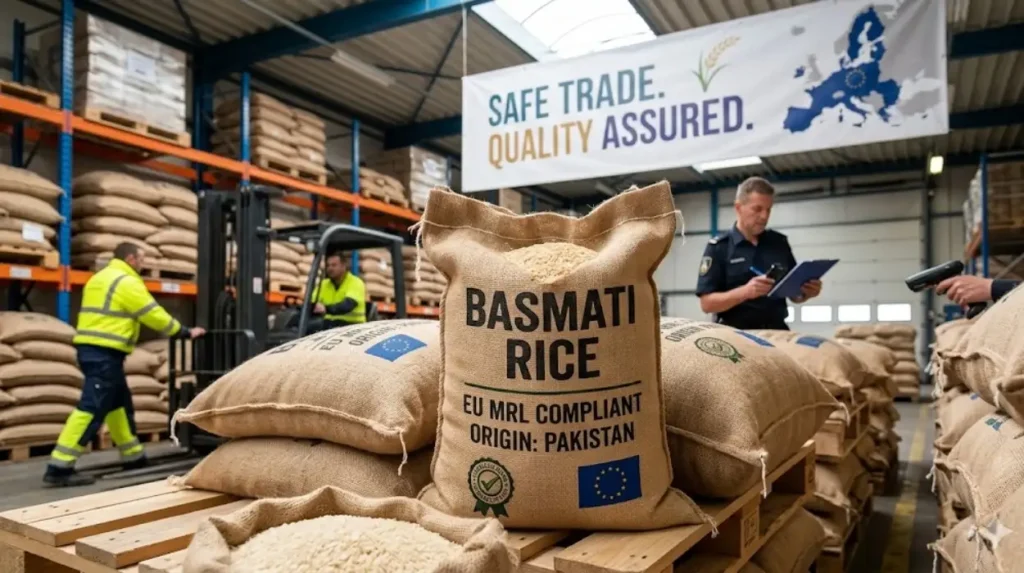
Germany enforces these rules through border inspection points. Authorities inspect consignments, test samples, and verify compliance certificates. Non-compliant rice gets rejected, destroyed, or returned to origin.
Basmati rice exporters from Pakistan and India must ensure pesticide use during cultivation remains within approved EU substance lists. This includes controlled application during irrigation, pest control, and pre-harvest intervals.
With the definition of EU pesticide MRL rules established, the next section explains how the system operates during import control and testing.
How does the EU MRL system work for rice imports?
The EU MRL system works through predefined pesticide limits, border sampling, laboratory analysis, and regulatory enforcement. Germany applies these checks at entry points before basmati rice is cleared for distribution into retail and wholesale channels.
EU authorities apply a structured inspection workflow. The system evaluates pesticide residues in imported basmati rice before it enters the supply chain. Each shipment follows standardized risk assessment protocols.
Customs authorities first collect representative samples from rice consignments. These samples reflect the entire shipment batch, not individual bags.
Laboratories then analyze pesticide residues using chromatography and mass spectrometry methods. These tests detect active pesticide molecules at trace levels.
Regulators then compare results with EU MRL thresholds defined under Regulation 396/2005. Any exceedance triggers automatic rejection procedures.
Importers must also provide phytosanitary certificates issued by the exporting country. These documents confirm pest control compliance and cultivation standards.
Germany integrates EU Rapid Alert System for Food and Feed (RASFF). This system flags non-compliant rice shipments across all member states instantly.
With inspection mechanisms defined, the next section explains the core components that shape compliance requirements for basmati rice exporters.
What are key components of pesticide MRL compliance?
Key components of pesticide MRL compliance include residue limits, pesticide registration, laboratory testing, traceability systems, and certification documents that verify rice safety from cultivation to export dispatch.
Pesticide MRL compliance depends on multiple interconnected controls. Each stage ensures basmati rice meets EU food safety law.
Residue limit frameworks define maximum acceptable pesticide levels. These limits apply to active substances used during rice cultivation in Punjab fields where basmati varieties are grown.
Approved pesticide lists restrict which chemicals farmers can use. EU-approved substances must be followed during irrigation and pest management cycles.
Laboratory testing protocols measure residues after milling and polishing. Mills remove husk and bran layers while maintaining compliance integrity.
Traceability systems track rice from farm to export warehouse. Each batch records cultivation date, pesticide application logs, and processing steps.
Certification documents include phytosanitary certificates, laboratory reports, and export clearance papers. These documents accompany every shipment to Germany.
Rice processors mill, dehusk, polish, grade, and sort grains before export inspection. Each step reduces contamination risk and stabilizes compliance outcomes.
EU importers rely on verified supply chains. Without documented compliance, basmati rice shipments fail entry clearance.
With compliance components defined, the next section explains why these rules matter for trade, safety, and market access.
What benefits do EU MRL rules provide for basmati rice trade?
EU MRL rules provide consumer safety, standardized trade conditions, predictable import approval, and stronger market access for compliant basmati rice exporters supplying Germany and wider European markets.
EU pesticide MRL systems create uniform food safety standards across all member states. Germany applies the same thresholds as France, Italy, and Netherlands.
Consumer protection remains the primary benefit. Controlled pesticide exposure reduces long-term health risks linked to chemical residues in staple foods like rice.
Trade predictability improves for exporters. When basmati rice meets EU MRL requirements, customs clearance becomes faster and more consistent.
Market access expands for compliant suppliers. Exporters from Pakistan and other basmati-producing regions gain entry into premium European retail channels.
Retailers benefit from reduced regulatory risk. Consistent compliance reduces product recalls and strengthens supply chain trust.
Quality assurance increases through mandatory testing. Every shipment undergoes identical verification regardless of origin.
Tricyclazole-free basmati Pakistan EU compliant grades supports deeper understanding of pesticide-free cultivation strategies and compliant grade selection.
With trade benefits explained, the next section highlights operational problems and misconceptions that affect exporters and importers.
What are common problems and misconceptions in Germany rice imports?
Common problems include pesticide overuse, weak traceability, misunderstanding of EU default MRLs, and incorrect assumption that processing removes all pesticide residues from basmati rice.
Exporters often face rejection due to excessive pesticide residues. Over-application during cultivation in rice fields leads to non-compliance at EU borders.
Many suppliers misunderstand EU default MRL rules. When no pesticide is listed, the system applies 0.01 mg/kg limit automatically, which is extremely strict.
Processing does not eliminate all pesticide residues. Milling removes husk layers, but chemical residues can remain in endosperm if overuse occurs during farming.
Traceability gaps create compliance failures. When batch-level records are missing, regulators reject entire consignments regardless of sample results.
Another misconception assumes EU testing only targets finished rice. In reality, authorities evaluate both raw grain and processed basmati rice under import protocols.
Misaligned documentation also causes delays. Missing certificates or inconsistent pesticide logs lead to extended inspection holds at German entry ports.
With compliance challenges clarified, the next section defines basmati rice grades that align with EU pesticide MRL expectations.
Which basmati rice grades meet EU MRL compliance requirements?
EU MRL compliant basmati rice grades include 1121 Steam, 1121 Golden Sella, Super Kernel Basmati, and 1509 White Rice when cultivated under controlled pesticide regimes and verified through laboratory testing.
Basmati rice grades differ in processing, grain structure, and export suitability. Compliance depends on cultivation control rather than grade alone.
1121 Steam Basmati Rice maintains long grain structure with controlled parboiling. It supports stable residue distribution after processing.
1121 Golden Sella Basmati Rice undergoes full parboiling, followed by milling and polishing. This grade offers strong export stability under long storage conditions.
Super Kernel Basmati Rice provides premium aroma and elongated grains. It requires strict pesticide control during irrigation cycles.
1509 White Basmati Rice offers faster cooking properties. It requires precise pesticide management due to shorter aging cycles.
Processing steps include cleaning paddy, de-husking grain, parboiling kernels, milling rice, polishing surfaces, grading lengths, and sorting impurities. Each step improves physical consistency but does not replace field-level pesticide control.
Exporters supplying Germany must align cultivation practices with EU-approved pesticide lists. Certification ensures compliance during customs inspection.
With grade classification completed, the next step is understanding where MOFU content integration strengthens topical authority.
Frequently Asked Questions
What are EU pesticide MRL rules for basmati rice?
EU pesticide MRL rules set strict maximum residue limits for pesticides in basmati rice imported into Germany and the EU. These limits ensure food safety and regulate chemical usage in rice cultivation.
EU MRL rules define the legal threshold for pesticide residues measured in milligrams per kilogram. Import shipments must comply with Regulation (EC) No 396/2005. Germany enforces these limits through border testing and laboratory analysis before market release.
What is the maximum pesticide limit allowed in EU rice imports?
The default EU pesticide MRL limit is 0.01 mg/kg when no specific pesticide tolerance is set for basmati rice imports.
EU food safety law applies this strict default threshold to protect consumers from unregulated pesticide exposure. If a pesticide is not explicitly approved, the residue level must remain at or below this limit for clearance in Germany.
How is basmati rice tested for pesticide residues in Germany?
Basmati rice is tested through border sampling, laboratory chemical analysis, and compliance verification against EU MRL thresholds.
German authorities collect representative samples from imported shipments. Laboratories then use chromatography and mass spectrometry to detect pesticide residues. Results are compared with EU legal limits before customs clearance is granted.
Does rice processing remove pesticide residues completely?
Rice processing does not fully remove pesticide residues, although milling and polishing reduce surface contamination levels significantly.
De-husking, milling, and polishing remove outer layers of the grain where some residues accumulate. However, pesticides applied during cultivation can remain in the endosperm, making field-level control essential for compliance.
Which basmati rice grades are suitable for EU import compliance?
1121 Steam, 1121 Golden Sella, Super Kernel, and 1509 basmati rice grades are suitable for EU import when cultivated under controlled pesticide use.
These grades comply when farmers follow EU-approved pesticide lists and exporters verify residue levels through laboratory testing. Certification and traceability ensure these rice varieties meet Germany’s import standards.