Packaging Sizes and Quality Specifications Preferred by Qatari Rice Buyers
Qatari rice buyers prefer 5 kg, 10 kg, 20 kg, 35 kg, and 40 kg packaging formats combined with premium 1121 Golden Sella and 1121 Steam Basmati specifications. These formats match retail, wholesale, catering, and foodservice demand patterns across Qatar. Here is why: consumers prioritize convenience, while distributors and hospitality operators prioritize shelf life, grain consistency, and freight efficiency.
Qatar remains one of the most important Gulf markets for Pakistani Sella Basmati rice. Rising foodservice demand, a large expatriate population, and strong preference for long-grain aromatic rice continue to influence purchasing decisions. Buyers evaluating packaging options often begin by understanding consumption patterns and market demand. The analysis in our guide on Pakistani consumer preferences in Qatar provides useful market context before selecting specifications and packaging formats.
Pakistani Basmati rice suppliers must align product specifications with market segments. AHK Rice’s Pakistani Basmati rice export services support importers seeking customized packaging, private labeling, and specification-based sourcing for Gulf markets. Packaging selection directly affects freight costs, warehouse management, shelf presentation, and product freshness.
What packaging sizes do Qatari rice buyers prefer?
Retail buyers prefer 5–10 kg packs, wholesalers prefer 20 kg packs, and catering operators prefer 35–40 kg bags because these formats optimize storage, handling, and consumption patterns across different distribution channels in Qatar.
Packaging size selection depends on the final customer segment. Retail supermarkets focus on household consumption. Foodservice distributors focus on cost efficiency. Hospitality buyers focus on inventory management.
Retail Packaging Preferences
Retail channels in Qatar primarily stock smaller consumer packs. Families purchase rice frequently and prefer manageable pack sizes.
Common Retail Formats
| Packaging Size | Primary Buyer | Market Use | Demand Level |
|---|---|---|---|
| 5 kg | Households | Weekly consumption | High |
| 10 kg | Families | Monthly consumption | Very High |
| 20 kg | Large households | Bulk household use | Medium |
Five-kilogram packs work well in premium supermarket chains. Ten-kilogram packs dominate mainstream retail shelves because they balance convenience and value.
Wholesale Packaging Preferences
Wholesale distributors focus on logistics efficiency. Larger packs reduce handling costs and improve container utilization.
Common Wholesale Formats
| Packaging Size | Buyer Type | Distribution Channel |
| 20 kg | Traders | Retail redistribution |
| 25 kg | Regional wholesalers | Mixed distribution |
| 35 kg | Institutional suppliers | Catering supply |
Twenty-kilogram packaging remains popular because distributors can break shipments into multiple retail channels.
Foodservice Packaging Preferences
Hotels, restaurants, and catering companies consume significant rice volumes every month.
Common Catering Formats
| Packaging Size | Use Case |
| 35 kg | Hotels |
| 40 kg | Catering companies |
| 50 kg | Institutional kitchens |
Forty-kilogram bags reduce packaging waste and lower procurement costs per kilogram.
Packaging decisions influence quality requirements. The next question examines which specifications Qatari buyers prioritize when selecting rice.
What quality specifications do Qatari buyers require?
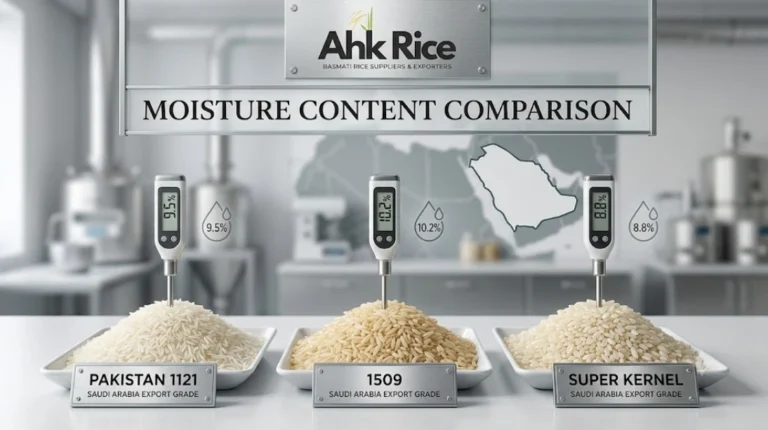
Grain length above 8.0 mm, moisture below 13%, purity above 95%, low broken percentage, and strong cooking elongation represent the most requested specifications among Qatari importers purchasing Pakistani Sella Basmati rice.
Quality specifications determine customer satisfaction and repeat purchases. Importers evaluate measurable characteristics before confirming contracts.
1121 Golden Sella Basmati Specifications
1121 Golden Sella Basmati remains the leading imported rice category in Qatar. The product undergoes parboiling before milling. This process improves grain strength and shelf stability.
Typical Import Specifications
| Attribute | Preferred Specification |
| Grain Length | 8.20–8.40 mm |
| Moisture | 12–13% |
| Broken Grains | 2–5% |
| Purity | 95–98% |
| Foreign Matter | 0.1% maximum |
| Cooking Elongation | 2.5–3 times |
| Shelf Life | 18–24 months |
Qatari buyers favor Golden Sella because the grains remain separate after cooking. Restaurants serving biryani and mandi particularly value this characteristic.
1121 Steam Basmati Specifications
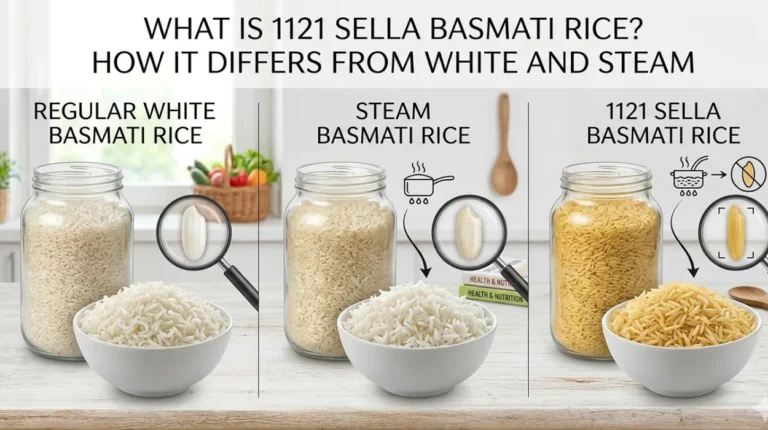
Steam Basmati provides a lighter appearance and softer texture. Premium retail brands often select this grade.
Typical Import Specifications
| Attribute | Preferred Specification |
| Grain Length | 8.10–8.35 mm |
| Moisture | 12–13% |
| Broken Grains | 2–5% |
| Purity | 95–98% |
| Cooking Elongation | 2.2–2.8 times |
Steam Basmati appeals to consumers seeking a brighter grain color and softer mouthfeel.
Quality specifications influence product selection. The next step is comparing the major options available to Qatari importers.
How do the main rice specifications compare?
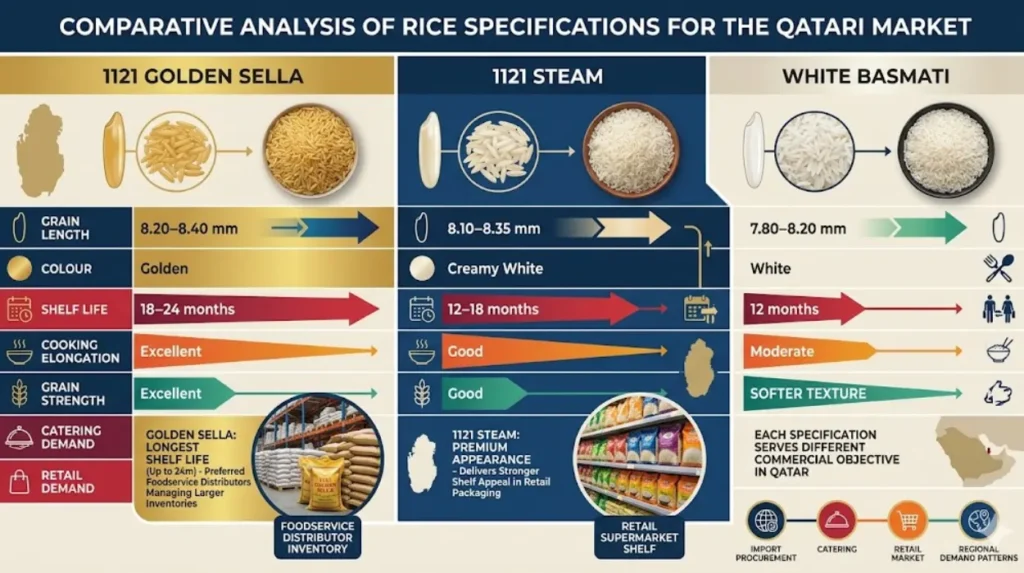
1121 Golden Sella offers the longest shelf life, 1121 Steam offers premium appearance, and White Basmati offers softer texture. Each specification serves a different commercial objective within the Qatari market.
Importers evaluate several product categories before making procurement decisions.
Specification Comparison Table
| Attribute | 1121 Golden Sella | 1121 Steam | White Basmati |
| Grain Length | 8.20–8.40 mm | 8.10–8.35 mm | 7.80–8.20 mm |
| Colour | Golden | Creamy White | White |
| Shelf Life | 18–24 months | 12–18 months | 12 months |
| Cooking Elongation | High | Medium-High | Medium |
| Grain Strength | Excellent | Good | Moderate |
| Catering Demand | Very High | Medium | Low |
| Retail Demand | High | Very High | Medium |
Golden Sella lasts longer than Steam rice. In Gulf warehouse environments, Golden Sella maintains quality for up to 24 months. Steam rice performs best within 18 months. Foodservice distributors managing larger inventories often prefer Golden Sella.
Steam rice delivers stronger shelf appeal in retail packaging. Premium supermarket brands frequently position Steam Basmati as a premium consumer product.
Specification comparison naturally leads to regional buying patterns. Understanding regional demand helps importers choose suitable grades.
Which specifications are preferred in different Qatari market segments?
Hospitality buyers prefer 1121 Golden Sella, premium retailers prefer 1121 Steam, and wholesale traders often purchase multiple grades to serve diverse customer groups throughout Qatar.
Different buyer groups prioritize different performance characteristics.
Hospitality Sector
Hotels and catering operators prioritize consistency. Large-scale food preparation requires uniform cooking performance.
1121 Golden Sella dominates this segment because grains remain separate after extended holding periods. Mandi restaurants, banquet operators, and catering businesses commonly select this specification.
Premium Retail Sector
Premium supermarkets emphasize consumer perception. Attractive grain appearance influences purchasing decisions.
1121 Steam Basmati performs strongly because of its bright appearance and soft texture.
Ethnic Food Distribution
Ethnic grocery chains serve consumers from South Asia, the Middle East, and Africa.
Mixed grade sourcing helps distributors satisfy varied customer preferences. Product portfolios often include Golden Sella, Steam Basmati, and White Basmati.
Regional preferences explain product selection. The next consideration involves pricing differences between grades and packaging formats.
How do packaging sizes and rice grades affect import pricing?
Larger packaging lowers per-kilogram costs, while premium grades command higher prices because of stricter quality specifications, longer grains, and stronger cooking performance.
Rice pricing reflects processing costs, packaging materials, freight efficiency, and market demand.
Price Comparison by Grade
| Grade | Typical Relative Price |
| White Basmati | Lowest |
| Steam Basmati | Medium |
| Golden Sella Basmati | Premium |
Golden Sella commands higher prices because parboiling increases processing complexity. The product also delivers greater storage stability.
Price Comparison by Packaging Size
| Packaging | Cost Efficiency |
| 5 kg | Lowest efficiency |
| 10 kg | Moderate efficiency |
| 20 kg | Good efficiency |
| 35–40 kg | Highest efficiency |
Large-format packaging reduces material costs and increases container loading efficiency.
Price alone does not determine sourcing decisions. Buyers also evaluate operational advantages and disadvantages.
What are the advantages and disadvantages of different packaging approaches?
Small packs improve retail sales, while large packs improve logistics efficiency. The correct choice depends on the target customer and distribution model.
Retail Packaging Advantages
Advantages
- Better shelf presentation
- Stronger consumer convenience
- Easier brand positioning
- Higher retail margins
Disadvantages
- Higher packaging costs
- Lower container efficiency
- More warehouse handling
Bulk Packaging Advantages
Advantages
- Lower packaging costs
- Higher freight efficiency
- Faster warehouse operations
- Better catering suitability
Disadvantages
- Limited retail appeal
- Reduced brand visibility
- Higher handling weight
Five-kilogram packs perform well in supermarkets. Forty-kilogram bags perform better for catering companies managing large-scale food preparation.
Understanding advantages and disadvantages supports better procurement decisions. The final step is selecting the most suitable option.
Which packaging and specification combination works best?
The best combination depends on buyer objectives: 10 kg Steam Basmati suits retail brands, while 35–40 kg Golden Sella suits hospitality and catering operations.
Importers should match specifications to commercial goals rather than selecting products based solely on price. Supplier reliability, quality consistency, export documentation, and inspection procedures also influence procurement success.
Decision Framework
| Buyer Objective | Recommended Grade | Recommended Packaging | Reason |
| Premium Retail | 1121 Steam | 5–10 kg | Consumer appeal |
| Mainstream Retail | 1121 Golden Sella | 10 kg | Value and quality |
| Wholesale Trade | Golden Sella | 20 kg | Distribution flexibility |
| Hotels | Golden Sella | 35 kg | Cooking consistency |
| Catering Companies | Golden Sella | 40 kg | Cost efficiency |
Retail-focused importers benefit from smaller consumer packs. Hospitality-focused importers benefit from larger formats that reduce operational costs.
Qatari buyers increasingly prioritize specification-driven sourcing. Grain length, purity, cooking performance, and packaging suitability now influence procurement decisions as much as price.
Importers evaluating suppliers should combine packaging requirements with verified quality specifications. The next stage of the buying journey involves supplier assessment, quality verification, export documentation, and procurement risk management. Those considerations are covered in our detailed guide on choosing reliable Pakistani rice exporters for the Qatari market.
Frequently Asked Questions
What packaging size is most popular among Qatari rice buyers?
The most popular packaging sizes in Qatar are 10 kg for retail consumers and 35–40 kg for hotels, restaurants, and catering companies. Retail buyers prefer manageable pack sizes, while foodservice operators focus on cost efficiency and bulk purchasing.
Which Pakistani Basmati rice grade is preferred in Qatar?
1121 Golden Sella Basmati Rice is the most preferred grade in Qatar. Buyers value its extra-long grain length, strong cooking elongation, separate grain texture, and long shelf life. The grade is widely used by catering businesses, restaurants, and hospitality operators.
What quality specifications do Qatari importers look for in Basmati rice?
Qatari importers typically require grain length above 8.0 mm, moisture below 13%, purity above 95%, low broken grain percentages, and strong cooking performance. These specifications ensure consistency, customer satisfaction, and product stability during storage.
How long can Sella Basmati rice be stored in Qatar?
1121 Golden Sella Basmati Rice can maintain quality for 18–24 months when stored in dry and well-ventilated warehouses. Its parboiling process improves grain strength and shelf stability, making it suitable for Gulf climate conditions.
Should importers choose retail or bulk packaging for the Qatari market?
The choice depends on the target customer. Retail brands generally achieve better results with 5 kg and 10 kg packs. Hotels, catering companies, and wholesalers usually prefer 20 kg, 35 kg, or 40 kg packaging because these formats reduce handling and packaging costs.