How Does Export Packaging Protect Rice During Ocean Transport?
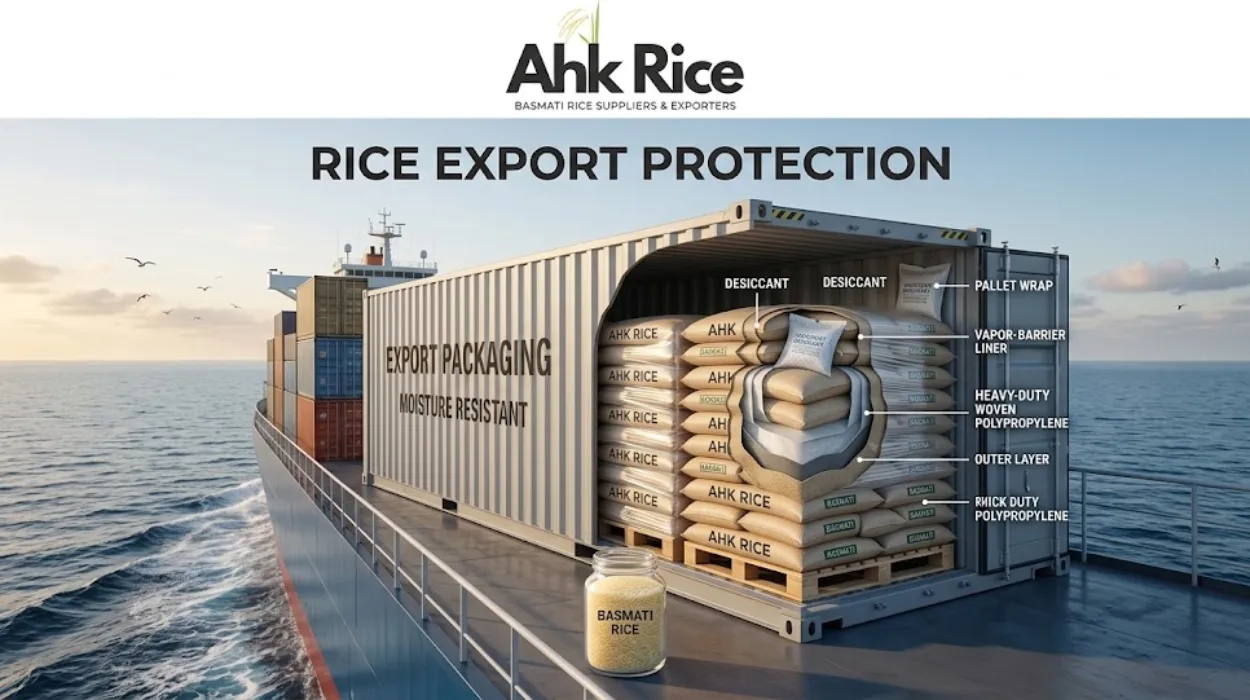
Export packaging protects Basmati rice most effectively when it combines a moisture barrier, strong outer structure, secure sealing, correct pallet or container loading, and destination-specific labeling. The best configuration depends on voyage length, humidity, handling conditions, packaging size, market requirements, and the rice grade being shipped.
Ocean transport exposes rice to several risks that do not exist at the mill. Containers can experience humidity changes, temperature fluctuations, condensation, compression, abrasion, rough handling, and long storage periods. Packaging therefore acts as a physical and environmental control between the rice and the transport system.
Codex food-hygiene principles require food packaging and transport arrangements to protect products from contamination and damage while maintaining conditions that preserve food suitability. Packaging materials must also be suitable for their intended use and must not create a food-safety hazard.
For importers evaluating packaging specifications, the relationship between packaging standards, product protection, and compliance is explained in:
Why packaging standards matter for imported Basmati rice.
What risks does rice packaging need to control during ocean transport?
Ocean packaging must control moisture, condensation, physical impact, contamination, insects, compression, tearing, and labeling damage while preserving grain quality throughout loading, vessel transport, port handling, customs inspection, warehouse storage, and final distribution without creating additional food-safety risks.
Moisture and condensation
Moisture is one of the most important packaging risks for rice during ocean transport. A container can move between hot and cooler environments while remaining closed for weeks. Temperature differences can produce condensation inside the container.
A moisture barrier reduces the opportunity for external humidity or condensed water to reach the rice. Polyethylene liners are commonly used inside woven sacks because they create an additional barrier between the grain and surrounding moisture.
Physical damage
Rice bags experience lifting, stacking, shifting, loading, unloading, and warehouse handling. Weak stitching or unsuitable material can result in torn bags and grain leakage.
A strong woven polypropylene outer bag provides mechanical protection. The outer structure also helps maintain the shape of stacked bags inside a container.
Contamination
Packaging separates food from dust, foreign material, chemicals, dirty surfaces, and other cargo-related contaminants. Codex specifically identifies protection against contamination and damage as core transport requirements.
Insect and storage risks
Rice can remain in the logistics chain after vessel arrival. Packaging therefore needs to work with the exporter’s pest-control and fumigation procedures. Packaging does not replace proper grain inspection, sanitation, or fumigation. It supports those controls.
What are the available export packaging solutions for Basmati rice?
The main export solutions are woven polypropylene sacks, polypropylene bags with polyethylene liners, BOPP-laminated bags, vacuum packs, and smaller laminated retail formats, with each option balancing moisture resistance, mechanical strength, presentation, storage performance, cost, and container efficiency.
Woven polypropylene bags
Polypropylene, commonly abbreviated as PP, is a synthetic polymer used to manufacture strong woven bags. PP woven sacks are widely suited to bulk rice because they provide mechanical strength at relatively low packaging weight.
Typical bulk configurations include 25 kg and 50 kg sacks. A liner can be added when stronger moisture protection is required.
PP bags with polyethylene liners
A polyethylene, or PE, liner creates a separate internal barrier. The PP outer bag provides strength while the PE layer provides additional moisture protection.
This combination is useful for ocean shipments where humidity and condensation are significant considerations. It is particularly relevant when the buyer prioritizes protection over the lowest possible packaging cost.
BOPP-laminated bags
Biaxially oriented polypropylene, or BOPP, is a stronger printed film used as a laminated outer layer. BOPP bags provide both packaging protection and retail presentation.
They are particularly useful for private-label rice sold through supermarkets and distributors. The printed surface can carry product information, brand elements, weight, origin, cooking information, lot identification, and other market-specific details.
Vacuum packaging
Vacuum packaging removes much of the air from a sealed package before closing it. This creates a compact pack and reduces the amount of oxygen remaining around the rice.
Vacuum packaging is more relevant to premium retail formats than standard bulk distribution. It can also improve protection where extended storage and premium presentation justify the additional packaging cost.
How do different export packaging approaches compare?
Packaging approaches differ mainly in moisture resistance, physical durability, retail presentation, storage performance, and cost; bulk PP favors efficient wholesale movement, lined PP adds moisture protection, BOPP improves presentation, while vacuum packaging prioritizes compact premium protection.
| Attribute | PP Woven | PP + PE Liner | BOPP Laminated | Vacuum Pack |
|---|---|---|---|---|
| Primary purpose | Bulk protection | Bulk moisture protection | Retail and private label | Premium retail protection |
| Moisture barrier | Moderate | High | High | Very high |
| Mechanical strength | High | High | High | Moderate |
| Retail presentation | Basic | Basic | Excellent | Excellent |
| Typical pack sizes | 25–50 kg | 25–50 kg | 1–25 kg | 1–5 kg |
| Relative packaging cost | Low | Low–medium | Medium | Medium–high |
| Best distribution channel | Wholesale | Wholesale/importers | Retail | Premium retail |
The comparison shows why one packaging type should not be treated as universally superior. A 50 kg wholesaler sack and a 2 kg supermarket pack solve different commercial problems.
Packaging should therefore be specified alongside rice grade, shipment quantity, destination, storage conditions, and distribution channel.
Which packaging works best for Saudi Arabia and the UAE?
Saudi Arabia and the UAE generally favor strong bulk and retail packaging, with premium long-grain Basmati grades commonly positioned in lined PP or laminated formats; packaging selection should prioritize heat, humidity, handling, private labeling, and extended warehouse storage.
Saudi Arabia
Saudi Arabian buyers commonly require long-grain aromatic Basmati grades such as 1121, Super Kernel, and 1509. Foodservice and wholesale channels can favor 25 kg or 50 kg formats, while retail programs require smaller branded packs.
AHK Rice currently identifies Saudi Arabia among its export markets and lists 1121, Super Kernel, and 1509 for the market. Its Saudi-facing specifications include moisture below 14% and bulk container options.
For bulk distribution, PP woven bags with an internal PE liner provide a practical combination of strength and moisture protection. For supermarkets, BOPP-laminated retail bags provide stronger branding and presentation.
UAE
The UAE has a highly developed wholesale, foodservice, hospitality, and retail distribution structure. This creates demand for multiple packaging formats rather than one universal specification.
Premium 1121 and Super Kernel can be positioned in retail-ready laminated packaging, while larger foodservice quantities can use stronger bulk sacks. Packaging should also account for warehouse storage and repeated handling after port clearance.
The UAE is one of AHK Rice’s established international markets, alongside Saudi Arabia and other destinations.
Indicative price and shelf-life comparison
Packaging should not be compared using bag cost alone. The commercial comparison should include rice grade, packaging material, quantity, printing, liner, freight terms, and destination costs.
| Market region | Common grade preference | Indicative rice value* | Practical packaging choice | Typical shelf-life planning** |
|---|---|---|---|---|
| Saudi Arabia | 1121, Super Kernel, 1509 | From about $1,100/MT | Lined PP or BOPP | 12–24 months |
| UAE | 1121, Super Kernel, 1509 | About $1,100–$1,250/MT | Lined PP or BOPP | 12–24 months |
| USA / Southeast | 1121 and premium Basmati grades | Buyer-specific FOB/CIF | Lined PP, BOPP, or vacuum | 12–24+ months |
These are procurement reference ranges rather than fixed August 2026 quotations. Actual pricing changes with grade, crop, quantity, packaging, Incoterm, freight, inspection, and destination charges. AHK Rice itself states that export pricing depends on variety, quantity, market conditions, packaging, destination, and shipping terms.
Shelf life is specification-dependent. Buyers should use the manufacturer’s declared shelf life and storage conditions rather than assuming a universal period. Packaging can protect quality, but it cannot correct excessive moisture, poor milling, contamination, or improper storage.
Which packaging works best for the United States and South Carolina?
For United States shipments, packaging should combine food-contact suitability, moisture protection, durable handling performance, accurate labeling, traceability, and retail requirements; South Carolina buyers should select the pack according to wholesale, foodservice, distributor, or supermarket distribution.
South Carolina adds an important logistics consideration because rice entering the United States can pass through a longer supply chain before reaching the final customer.
A commercial shipment can involve milling, export packing, container loading, ocean transport, port handling, customs clearance, inland transportation, warehousing, and distributor delivery. Packaging must remain intact across each stage.
For wholesale Basmati, lined PP sacks provide a strong balance between cost and protection. For private-label supermarket programs, BOPP packaging provides better presentation. For premium smaller-format products, vacuum packaging provides another option.
U.S. importers should also evaluate the complete compliance package rather than treating packaging as a visual specification. Product labeling, lot identification, documentation, food-contact suitability, and importer requirements must align with the destination market.
Codex provides international principles for packaging, transport, labeling, and food hygiene, while destination-country requirements remain legally controlling.
What are the advantages and disadvantages of each packaging method?
PP bags provide low-cost mechanical protection, lined bags improve moisture control, BOPP improves retail presentation, and vacuum packs provide premium protection; however, every option adds different costs, handling requirements, material considerations, and limitations to the export program.
PP woven bags
The main advantage is strength at a comparatively low packaging cost. They are practical for 25 kg and 50 kg wholesale shipments.
The limitation is that standard PP fabric alone does not provide the same moisture barrier as a sealed internal liner. Buyers shipping through humid conditions should therefore specify the required barrier rather than assuming the outer sack is sufficient.
PP with PE liner
The principal advantage is the combination of structural strength and improved moisture protection. The limitation is additional material and packing complexity.
For example, a 50 kg Basmati shipment destined for a humid distribution environment can justify a liner because preventing moisture-related deterioration has greater commercial value than minimizing the packaging cost by a small amount.
BOPP laminated packaging
BOPP provides strong branding, graphics, and retail appearance. It is effective for private-label programs where packaging influences shelf presentation.
The disadvantage is greater packaging complexity and cost compared with basic bulk sacks. It also becomes less efficient when a buyer only needs bulk foodservice packaging.
Vacuum packaging
Vacuum packaging creates a compact, premium format and reduces air inside the sealed package.
Its disadvantage is higher packaging cost and lower suitability for large bulk shipments. A buyer importing hundreds of metric tons for foodservice does not normally need every kilogram packed in small vacuum bricks.
How should importers decide between packaging methods?
Importers should select packaging by evaluating moisture exposure, voyage duration, rice grade, distribution channel, bag size, warehouse conditions, labeling requirements, handling intensity, and total delivered cost rather than selecting packaging from material price alone.
A useful five-factor decision framework is:
| Decision factor | Key buyer question | Preferred direction |
|---|---|---|
| Moisture exposure | Will the shipment face high humidity or condensation risk? | Add PE liner or stronger barrier |
| Distribution channel | Is the rice sold wholesale or retail? | Bulk PP for wholesale; BOPP for retail |
| Handling intensity | How often will bags be moved? | Strong woven outer construction |
| Storage period | Will inventory remain in storage for extended periods? | Higher-barrier or vacuum formats |
| Commercial positioning | Is presentation part of the product value? | BOPP or premium retail packaging |
This framework prevents buyers from choosing packaging based only on the initial bag price.
The correct specification also needs to define bag material, weight tolerance, dimensions, liner requirement, stitching or sealing method, print requirements, lot identification, palletization requirements where applicable, and container loading instructions.
How does the exporter integrate packaging with rice processing?
Effective export protection begins before packaging because rice moisture, grain purity, grading, sorting, inspection, packaging, documentation, and container loading must remain aligned; packaging protects a compliant product but cannot compensate for poor processing or unsuitable pre-shipment specifications.
For Pakistani Basmati, the process starts with paddy procurement in Punjab. The rice is cleaned, de-husked, separated, whitened or processed according to grade, sorted by length and quality, inspected, and then packed according to the buyer’s specification.
AHK Rice describes an integrated process covering paddy procurement, pre-cleaning, de-husking, paddy separation, whitening, grading, custom packaging, export documentation, and container loading.
For example, AHK Rice’s Pakistan rice export service includes packaging and labeling, quality inspection, export documentation, fumigation, container loading, and shipment coordination as connected stages of the export workflow.
This integration matters because packaging specifications should match the rice specification. A buyer purchasing premium 1121 Basmati should not evaluate packaging independently from grain length, moisture, broken-grain percentage, purity, processing grade, and intended distribution channel.
What should buyers check before approving export packaging?
Buyers should approve packaging only after confirming material construction, liner requirements, bag size, weight tolerance, sealing method, labeling, lot identification, food-contact suitability, storage conditions, container loading method, and compatibility with destination-country import requirements.
A practical packaging approval document should state the exact material and construction instead of using a broad description such as “export quality bag.”
It should identify whether the bag is PP woven, laminated BOPP, lined PP, vacuum laminate, or another agreed format. It should also identify the nominal net weight, artwork, language requirements, product name, origin statement, lot or batch reference, and required handling information.
Packaging samples should be checked before mass production. The buyer can verify dimensions, stitching, sealing, printing quality, liner placement, net weight, and physical durability.
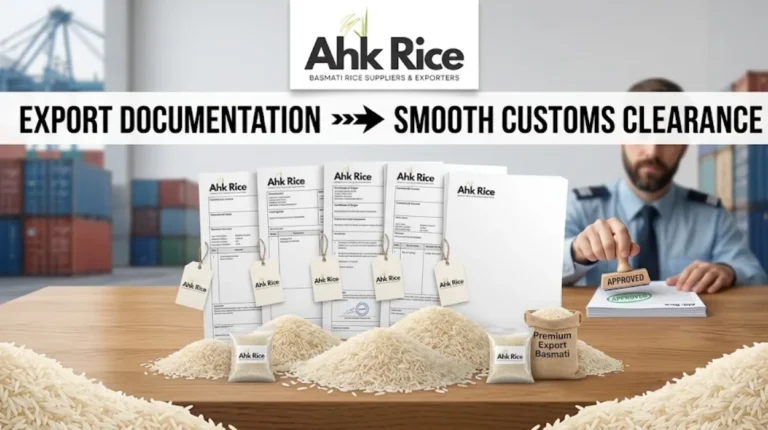
The same approved specification should then be connected to the commercial invoice, packing list, inspection records, and shipment instructions. This creates consistency between what the buyer ordered and what the container actually carries.
What is the most practical packaging strategy for international Basmati imports?
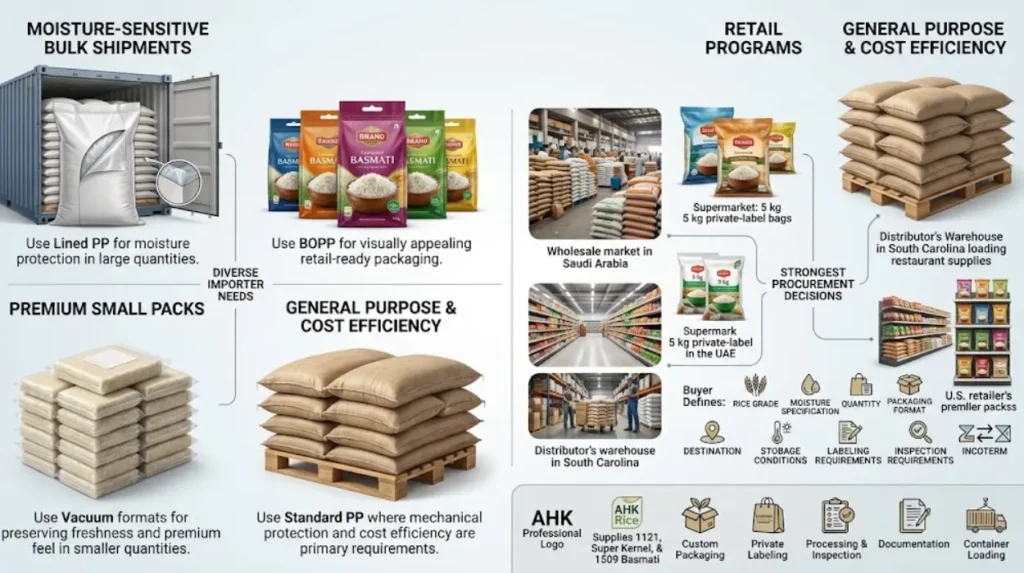
The most practical strategy is a specification-based packaging system: use lined PP for moisture-sensitive bulk shipments, BOPP for retail programs, vacuum formats for premium small packs, and standard PP where mechanical protection and cost efficiency are the primary requirements.
There is no single packaging format that provides the best result for every rice importer.
A Saudi wholesaler purchasing 50 kg bags has a different requirement from a UAE supermarket importing 5 kg private-label packs. A South Carolina distributor serving restaurants has a different requirement from a U.S. retailer selling premium Basmati directly to consumers.
The strongest procurement decision connects packaging to the entire supply chain. The buyer defines the rice grade, moisture specification, quantity, packaging format, destination, storage conditions, labeling requirements, inspection requirements, and Incoterm before approving the final specification.
AHK Rice supplies 1121, Super Kernel, and 1509 Basmati rice and provides custom packaging, private labeling, processing, inspection coordination, documentation, and container loading as part of its export workflow.
For buyers moving from evaluation to supplier selection, the decision-stage explore:
AHK Rice supplies export-ready Basmati rice for South Carolina, USA
Frequently Asked Questions
How does export packaging protect rice during ocean transport?
Export packaging protects rice from moisture, condensation, physical damage, contamination, tearing, and handling pressure during ocean transportation. The packaging specification should match the rice grade, shipment duration, destination, and storage conditions.
What is the best packaging for Basmati rice exports?
PE-lined woven polypropylene bags provide a strong combination of mechanical strength and moisture protection for bulk Basmati rice. BOPP-laminated bags are better suited to retail and private-label products where presentation is important.
Why is a polyethylene liner used inside rice bags?
A polyethylene liner creates an additional moisture barrier inside the outer woven bag. It helps reduce exposure to humidity and condensation during ocean transport and subsequent warehouse storage.
Are PP woven bags suitable for ocean shipping?
Yes. PP woven bags provide strong mechanical protection and are suitable for bulk rice shipments. For shipments exposed to high humidity or extended storage, a PE liner can provide additional moisture protection.
What is BOPP packaging for rice?
BOPP stands for biaxially oriented polypropylene. BOPP rice bags combine a durable outer structure with high-quality printing, making them suitable for branded, private-label, supermarket, and retail Basmati rice products.
Is vacuum packaging better for premium Basmati rice?
Vacuum packaging can be advantageous for premium small-format retail rice because it reduces air inside the sealed package and provides compact presentation. It is less practical for large-volume foodservice and wholesale shipments because of its higher packaging cost.
What packaging size is commonly used for bulk Basmati rice?
Bulk Basmati rice is commonly packed in 25 kg and 50 kg bags, although the final size depends on the buyer’s distribution channel, warehouse handling system, retail requirements, and destination-market specifications.
Which packaging is suitable for rice exports to Saudi Arabia?
For Saudi Arabian bulk Basmati imports, PE-lined PP bags provide a practical combination of strength and moisture protection. BOPP packaging is suitable for retail and private-label programs requiring stronger visual presentation.
Which packaging is suitable for rice exports to the UAE?
UAE importers can use PE-lined PP bags for bulk and foodservice distribution and BOPP-laminated bags for retail programs. The appropriate format depends on the rice grade, pack size, storage period, and sales channel.