Super Kernel vs 1121 Basmati Rice: Aroma, Price and Market Comparison
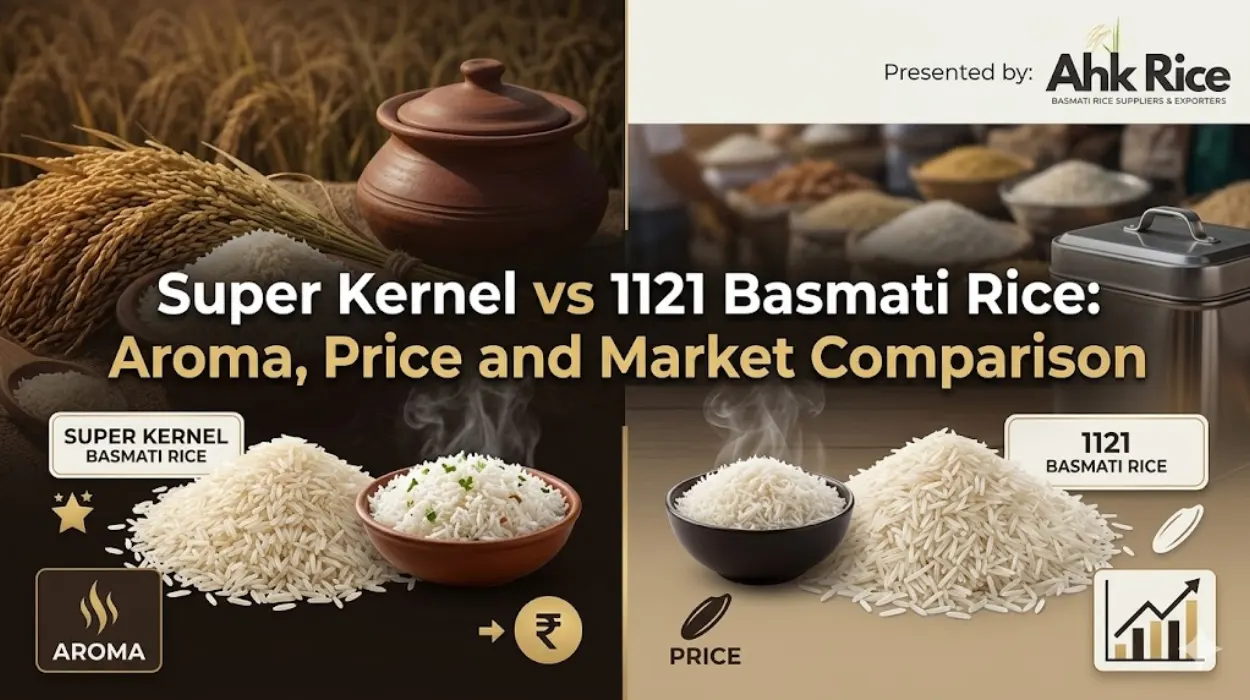
Super Kernel and 1121 Basmati rice serve different commercial needs. 1121 Basmati delivers longer grain length and higher yield after cooking, while Super Kernel offers stronger traditional aroma and premium positioning in many export markets. Here is why: grain characteristics, processing grades, regional demand, pricing, and shelf-life requirements differ significantly between both varieties.
Rice importers often compare these two Pakistani Basmati varieties before placing bulk orders. Buyers need to balance aroma, grain appearance, cooking performance, market preference, and landed cost. Understanding these differences helps distributors, wholesalers, retailers, and food service companies select the correct specification.
For buyers learning about traditional Pakistani aromatic rice varieties, understanding the heritage and characteristics of Pakistan’s most recognized premium aromatic rice category provides useful background before comparing commercial specifications.
AHK Rice exports both Super Kernel and 1121 Basmati varieties from Punjab, Pakistan. The company cultivates, mills, grades, sorts, inspects, certifies, loads, and ships rice to buyers across Asia, the Middle East, Africa, Europe, and North America.
What is the difference between Super Kernel and 1121 Basmati Rice?
1121 Basmati reaches grain lengths above 8.30 mm, while Super Kernel typically measures 7.20–7.60 mm. Super Kernel offers stronger traditional fragrance. 1121 provides higher cooked grain elongation, larger visual appeal, and broader international demand.
Both varieties belong to the Basmati rice family cultivated in Pakistan’s fertile Punjab region. Basmati rice is a long-grain aromatic rice known for its fragrance, slender appearance, and elongation during cooking.
What is Super Kernel Basmati Rice?
Super Kernel Basmati is a traditional aromatic variety developed from classic Basmati genetics. The variety produces slender grains, rich fragrance, and soft cooking texture.
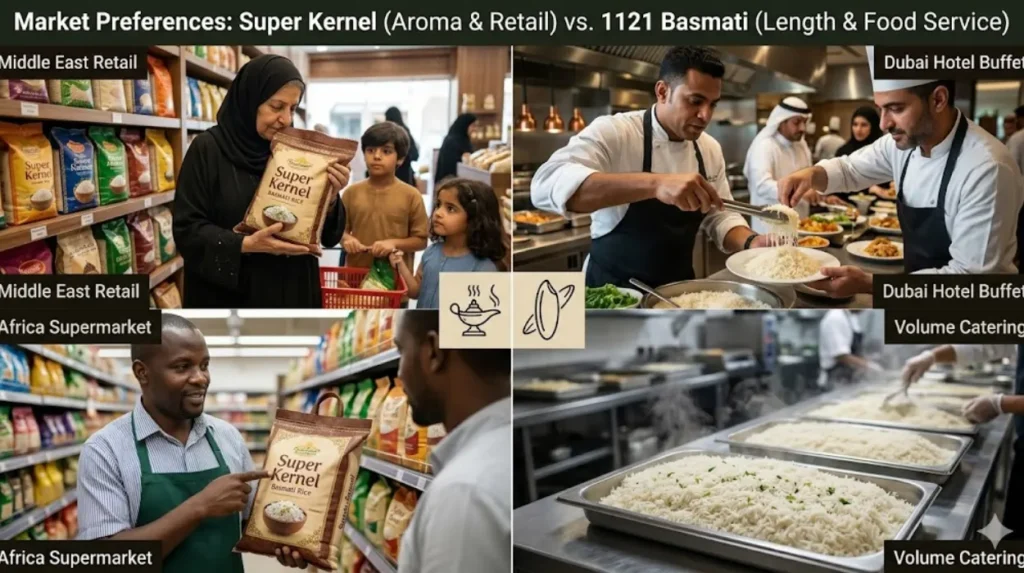
Super Kernel dominates premium retail segments in many Middle Eastern and African markets because consumers associate its aroma with authentic Basmati rice. Importers frequently source this variety for branded retail packaging and premium supermarket shelves.
What is 1121 Basmati Rice?
1121 Basmati is a newer extra-long grain variety. The rice delivers exceptional grain length before and after cooking.
1121 became popular because it creates attractive plate presentation. Restaurants, catering companies, and large food service operators prefer the variety due to its visual appearance and cooking yield.
Specification Comparison Table
| Attribute | Super Kernel Basmati | 1121 Basmati |
|---|---|---|
| Average Grain Length | 7.20–7.60 mm | 8.20–8.50 mm |
| Aroma Strength | High | Medium to High |
| Cooked Elongation | Moderate | Very High |
| Texture | Soft | Fluffy |
| Export Demand | Premium Retail | Retail and Food Service |
| Typical Shelf Life | 18–24 Months | 18–24 Months |
| Average Export Price | Premium Positioning | Volume-Based Positioning |
Super Kernel focuses on fragrance and heritage value. 1121 focuses on grain length and cooking performance. Understanding these core differences helps buyers evaluate price and market suitability more effectively.
With the primary differences established, the next question is how both varieties perform across international markets.
Which export markets prefer Super Kernel and which prefer 1121 Basmati?
Middle Eastern premium retail markets frequently prefer Super Kernel, while food service buyers in Gulf countries, Africa, and Asia increasingly choose 1121 Basmati because of its longer grain and higher cooked yield.
Market preference directly affects procurement decisions. Buyers who understand local consumer expectations reduce inventory risk and improve product turnover.
Middle East Market Preferences
Countries such as the UAE, Saudi Arabia, Qatar, Kuwait, and Oman maintain strong demand for aromatic rice.
Super Kernel performs well in premium retail channels because consumers recognize its traditional fragrance. Pakistani exporters continue supplying substantial volumes to Gulf markets due to long-standing consumer familiarity (source: REAP export data, December 2025).
1121 Basmati also performs strongly across the Gulf region. Restaurants and catering companies prefer the variety because longer grains create a premium visual appearance.
For hotel buffets in Dubai, 1121 creates better plate presentation. For premium household consumers in Saudi Arabia, Super Kernel often delivers the preferred aromatic experience.
African Market Preferences
African importers increasingly source 1121 Basmati because the variety offers attractive grain appearance at competitive pricing.
Super Kernel remains relevant in premium retail segments. However, 1121 generally captures larger institutional and wholesale volumes.
For distributors supplying supermarkets in East Africa, Super Kernel supports premium positioning. For wholesalers serving restaurants and caterers, 1121 often provides better commercial value.
European and North American Markets
European and North American buyers prioritize consistent quality, food safety compliance, and packaging standards.
1121 performs strongly because consumers appreciate extra-long grains. Super Kernel remains attractive among specialty ethnic food retailers serving South Asian and Middle Eastern communities.
Market preference influences demand patterns. The next consideration is how pricing differs between both varieties.
How does the price of Super Kernel compare with 1121 Basmati?
Super Kernel generally commands a premium for aroma, while 1121 pricing depends heavily on crop availability, export demand, and processing grade. Price differences typically range from $20–$80 per metric ton depending on season and specification.
Rice pricing depends on multiple variables.
Key Factors Affecting Price
- Crop availability
- Milling recovery
- Broken percentage
- Processing grade
- Packaging format
- Freight destination
Typical Export Price Comparison
| Specification | Estimated Price Range (USD/MT) |
|---|---|
| Super Kernel White Rice | $850–$1,050 |
| 1121 White Rice | $820–$1,020 |
| 1121 Steam Rice | $900–$1,100 |
| 1121 Golden Sella Rice | $950–$1,150 |
Prices fluctuate throughout the year based on harvest volume and export demand (source: REAP export data, December 2025).
Processing Grade Impact
Processing grade affects final pricing more than variety alone.
AHK Rice commonly processes export rice through:
- Clean the paddy
- De-husk the grain
- Separate impurities
- Dry the rice
- Polish the kernels
- Grade by size
- Sort by color
- Inspect quality
- Pack for export
Higher-grade processing increases uniformity and export value.
Price explains part of the buying decision. Shelf life and storage performance are equally important for importers.
Which variety offers better shelf life and storage performance?
Both varieties typically maintain commercial quality for 18–24 months, but storage conditions, processing method, and packaging determine actual shelf-life performance more than rice variety alone.
Shelf life matters because importers often store inventory for several months before distribution.
White Rice Storage Performance
White rice offers excellent shelf stability when exporters maintain proper moisture levels.
Super Kernel White Rice maintains aroma effectively in controlled storage. 1121 White Rice maintains appearance and cooking quality over similar periods.
For distributors storing inventory in climate-controlled warehouses, both varieties perform well for up to 24 months.
Steam Rice Storage Performance
Steam rice undergoes controlled heat treatment during processing.
Steam processing improves grain strength and handling durability. The method reduces breakage during transportation.
For importers handling multiple warehouse transfers, steam rice provides operational advantages.
Golden Sella Storage Performance
Golden Sella rice undergoes parboiling before milling.
Golden Sella lasts longer than Steam Rice. In warehouses reaching 40°C temperatures, Golden Sella frequently maintains quality for up to 24 months. Steam rice performs best within shorter storage cycles.
For catering distributors in Iraq and Gulf countries using non-climate-controlled storage facilities, Golden Sella often represents the safer specification.
Storage performance influences product suitability. The next question is which variety works best for specific business models.
Which rice variety works best for different buyers?
Super Kernel suits premium retail brands, while 1121 suits food service operators, distributors, wholesalers, and businesses prioritizing grain appearance, cooking yield, and scalability.
Different buyers require different outcomes.
Retail Brands
Retail brands focus on aroma, repeat purchases, and premium perception.
Super Kernel supports strong brand storytelling because consumers associate the variety with traditional Pakistani Basmati heritage.
Restaurants
Restaurants focus on plate presentation and portion yield.
1121 performs exceptionally because grains elongate significantly after cooking.
Catering Companies
Catering companies prioritize consistency and profitability.
1121 helps reduce food cost pressure through strong cooked volume performance.
Ethnic Food Distributors
Ethnic food distributors often carry both varieties.
Super Kernel serves fragrance-focused consumers. 1121 serves appearance-focused consumers.
Decision Framework Table
| Buyer Type | Preferred Variety | Main Reason |
|---|---|---|
| Premium Retail Brand | Super Kernel | Strong aroma |
| Restaurant Chain | 1121 | Long cooked grain |
| Catering Company | 1121 | Better yield |
| Ethnic Grocery Distributor | Both | Broader customer coverage |
| Premium Gift Packaging | Super Kernel | Heritage positioning |
Buyer objectives determine specification selection. Understanding the advantages and limitations of both varieties helps finalize procurement decisions.
What are the pros and cons of Super Kernel and 1121 Basmati Rice?
Super Kernel excels in aroma and heritage value, while 1121 excels in grain length, presentation, and cooking yield. Neither variety is universally superior because each serves different commercial objectives.
Super Kernel Advantages
- Strong aroma
- Traditional Basmati profile
- Premium retail appeal
- Established Gulf market demand
Super Kernel Limitations
- Shorter grain length
- Lower visual impact after cooking
- Smaller food service demand
1121 Advantages
- Extra-long grain
- High elongation ratio
- Strong food service demand
- Attractive presentation
1121 Limitations
- Aroma may appear less intense
- Premium fragrance-focused consumers may prefer Super Kernel
For premium supermarket brands in Saudi Arabia, Super Kernel often creates stronger differentiation. For restaurant groups serving large banquet volumes, 1121 frequently delivers better operational value.
Pros and cons become clearer when aligned with buyer goals. The final step is selecting the right specification based on business requirements.
How should importers choose between Super Kernel and 1121 Basmati Rice?
Choose Super Kernel for premium aroma-focused retail markets. Choose 1121 for food service, catering, and customers prioritizing grain length. Choose multiple grades when serving diverse customer segments.
Importers should evaluate five decision factors.
Key Decision Factors
- Define target consumer preference.
- Compare required grain length.
- Calculate cooked yield requirements.
- Review storage conditions.
- Analyze market pricing.
Successful rice sourcing begins with market demand rather than product preference.
Super Kernel satisfies buyers seeking traditional Basmati fragrance. 1121 satisfies buyers seeking maximum visual impact and cooking performance.
Businesses serving multiple channels often import both varieties because each addresses different customer expectations.
Buyers evaluating wholesale sourcing options can introduce the decision-stage article about AHK Rice’s export-grade Super Kernel supply capabilities immediately after the section discussing processing grades, export specifications, or supplier selection criteria, where commercial procurement decisions naturally occur.
Frequently Asked Questions
What is the main difference between Super Kernel and 1121 Basmati Rice?
Super Kernel is known for its stronger traditional aroma and slightly shorter grain, while 1121 Basmati is an extra-long grain variety that expands more after cooking. Both are premium Pakistani basmati types but serve different market needs.
Which rice has better aroma, Super Kernel or 1121?
Super Kernel generally has a stronger and more traditional basmati fragrance. 1121 also has a pleasant aroma, but it is usually considered milder compared to Super Kernel.
Which rice is better for restaurants and catering?
1121 Basmati is preferred by restaurants and catering businesses because it produces longer, fluffier grains and higher cooked yield, which improves plate presentation and portion efficiency.
Which variety has higher grain length after cooking?
1121 Basmati has a higher grain length and elongation after cooking compared to Super Kernel. This makes it visually more appealing for large-scale food service and banquet use.
How long can Super Kernel and 1121 be stored?
Both Super Kernel and 1121 Basmati rice can typically be stored for 18–24 months if kept in proper dry, cool, and sealed conditions. Storage quality depends more on packaging and environment than variety.