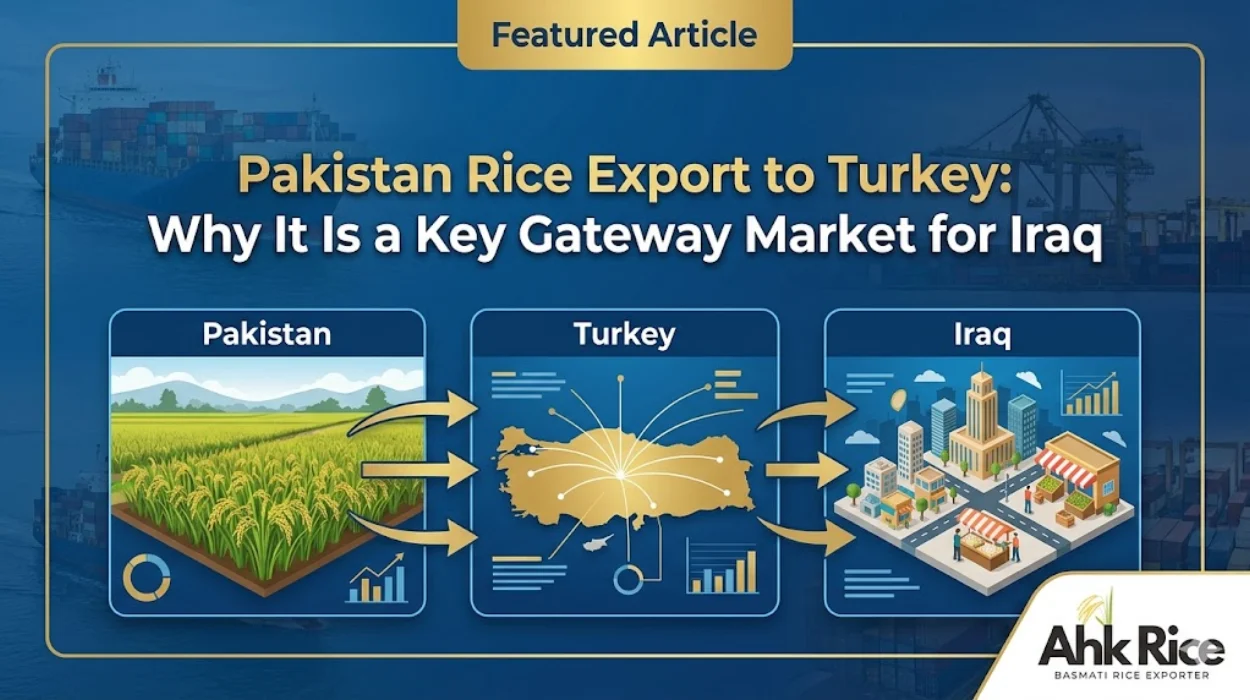
Pakistan Rice Export to Turkey: Why It Is a Key Gateway Market for Iraq
Pakistan rice export to Turkey supports Iraqi rice supply through shorter transit routes, Turkish redistribution networks, and established food import infrastructure. Turkey imports Pakistani Basmati rice, processes bulk shipments, and dispatches rice cargo into Iraq through road corridors and regional wholesale markets. Here is why: Turkish ports handle large food cargo volumes, Turkish distributors maintain Iraqi trade relationships, and Pakistani exporters supply rice grades that match Iraqi consumption patterns.
Pakistan cultivates Basmati rice in Punjab regions including Gujranwala, Hafizabad, Sheikhupura, and Sialkot. Turkish importers procure 1121 Basmati, Super Kernel Basmati, and 1509 Basmati because Iraqi consumers prefer long-grain aromatic rice for households, restaurants, and catering supply chains.
Turkey operates as a transit rice hub between South Asia and the Middle East. Turkish logistics companies clear cargo through customs, warehouse rice near border routes, and dispatch shipments toward Iraqi cities including Baghdad, Basra, Erbil, and Mosul. This trade structure connects Pakistani rice mills with Iraqi wholesale markets.
Why does Turkey operate as a gateway market for Iraqi rice imports?
Turkey connects Pakistani rice exporters with Iraqi wholesale buyers through Mersin Port, Istanbul logistics corridors, bonded warehousing systems, and overland trucking routes into Northern and Central Iraq.
Turkey imports agricultural commodities from Asia and redistributes food products across neighboring regions. Turkish import companies purchase Pakistani rice in container loads and store cargo near industrial logistics zones. Iraqi distributors source rice from Turkish suppliers because Turkish ports process shipments faster than several regional alternatives.
Pakistan rice export Turkey gateway market Iraq trade increased because Iraq consumes high rice volumes annually. Iraqi households use rice in dishes including biryani, qabuli, and lamb rice platters. Turkish distributors maintain inventory closer to Iraqi buyers, which reduces procurement delays.
Turkish customs infrastructure supports agricultural trade movement. Mersin Port handles containerized cargo from Karachi and Port Qasim. Trucking companies then dispatch rice into Iraq through Habur border crossings. This route supports continuous supply cycles for wholesalers and foodservice companies.
Turkey also provides commercial advantages for regional buyers. Turkish importers consolidate multiple food products into shared shipments. Iraqi distributors therefore reduce freight fragmentation costs. Bulk rice storage facilities near Turkish logistics zones improve inventory management during seasonal demand spikes.
Pakistan Basmati Turkey trade also benefits from cultural food preferences. Iraqi consumers prefer extra-long grain rice with aroma retention and elongation after cooking. Pakistani 1121 Basmati matches these requirements because grains elongate significantly during cooking and maintain separate texture.
With Turkey’s gateway role established, the next question is how Pakistani rice physically moves through this regional trade system.
How does Pakistan rice export to Turkey and Iraq work step by step?
Pakistani exporters cultivate paddy, mill rice, grade grains, inspect quality, load containers, ship cargo to Turkish ports, clear customs, warehouse inventory, and dispatch trucks into Iraqi markets.
Rice export begins in Punjab agricultural zones. Farmers cultivate Basmati varieties under irrigated conditions during the Kharif season. Harvesting normally starts between September and November. Rice mills procure paddy from local mandis and transport raw material to processing facilities.
How do rice mills process export-grade Basmati rice?
Rice mills clean, dehusk, polish, sort, grade, test, fumigate, pack, and seal export rice before shipment.
Processing facilities follow sequential production stages to maintain export specifications:
- Clean the harvested paddy to remove dust and stones
- Dehusk the grain to separate husk layers
- Polish the rice to improve surface finish
- Sort broken grains through grading systems
- Separate discolored kernels with colour sorters
- Test moisture levels and grain dimensions
- Fumigate cargo for phytosanitary compliance
- Pack rice into PP, jute, or non-woven bags
- Load containers for export dispatch
Pakistani exporters ship rice through Karachi Port and Port Qasim. Shipping lines transport containers toward Turkish ports including Mersin and Istanbul. Turkish importers clear customs documentation before warehousing cargo for redistribution.
Which export documents support rice trade into Turkey?
Commercial invoices, phytosanitary certificates, fumigation certificates, packing lists, certificates of origin, and quality inspection reports support Turkish rice imports.
Turkish customs authorities inspect agricultural cargo before market clearance. Importers verify grain length, moisture percentage, broken ratio, and contamination levels. Laboratories test pesticide residues because food safety regulations require compliance documentation.
Turkey transit rice hub operations continue after customs clearance. Turkish logistics providers store inventory near industrial zones before dispatching trucks toward Iraq. Iraqi wholesalers then distribute rice into retail and catering channels.
The export process explains movement efficiency, while the next section defines the rice grades Turkish importers prefer for Iraqi distribution.
Which Pakistani rice grades do Turkish importers prefer for Iraqi markets?
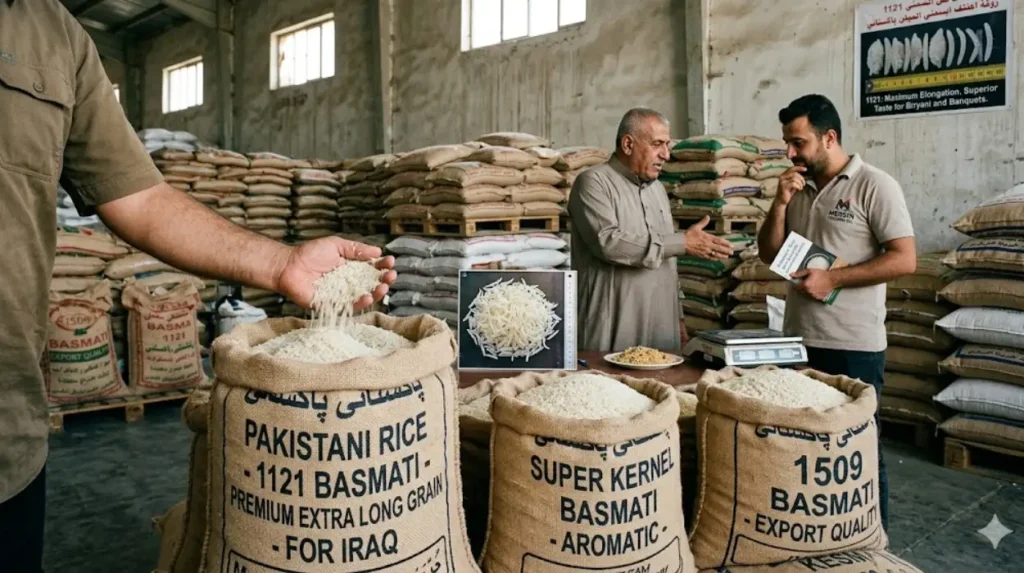
1121 Basmati, Super Kernel Basmati, and 1509 Basmati dominate Turkish imports because Iraqi buyers prioritize grain length, aroma, elongation, and bulk foodservice performance.
Turkish importers procure multiple rice grades because Iraqi demand differs between retail consumers, restaurants, and institutional catering buyers. Long-grain aromatic rice performs strongly in premium segments, while medium-priced varieties support high-volume distribution.
What makes 1121 Basmati important for Turkey and Iraq?
1121 Basmati delivers grain lengths above 8.30 mm, strong aroma retention, and elongation ratios near 2.5 times after cooking.
1121 Basmati remains one of Pakistan’s largest export varieties. Iraqi restaurants use this rice for premium biryani and banquet meals because cooked grains remain separate. Turkish importers prefer this specification for upscale retail packaging and foodservice supply.
1121 Golden Sella Basmati withstands long storage cycles effectively. In 40°C warehouse conditions, Golden Sella maintains quality for approximately 18 months. Steam rice performs best within shorter storage periods. Iraqi catering distributors therefore source Golden Sella for non-climate-controlled storage systems.
Why does Super Kernel Basmati maintain demand in Turkey?
Super Kernel Basmati combines traditional aroma, medium-long grain structure, and competitive pricing for household retail channels.
Super Kernel Basmati remains popular across Middle Eastern communities because consumers recognize its fragrance profile. Turkish wholesalers distribute this grade into ethnic food stores and regional supermarkets serving Iraqi populations.
Super Kernel also supports blended retail packaging. Turkish distributors combine packaging flexibility with regional branding strategies. Iraqi retailers then sell rice in 5 kg, 10 kg, and 40 kg formats depending on customer segments.
How does 1509 Basmati support volume trade?
1509 Basmati offers shorter crop duration, high yield output, and competitive export pricing for bulk commercial distribution.
1509 Basmati supports institutional procurement because pricing remains lower than premium 1121 grades. Iraqi catering contractors use this rice for large-scale meal preparation in hotels, labor camps, and event catering operations.
Turkish importers also prefer 1509 because supply availability remains stable during high-demand seasons. Pakistani mills cultivate large production volumes across Punjab farming regions.
Readers comparing buyer demand patterns can explore how Turkish distributors select rice categories through this contextual guide on Pakistani rice specifications preferred by regional wholesale buyers.
With grade preferences defined, the next question concerns why Turkish infrastructure supports this trade route efficiently.
What infrastructure makes Turkey a transit rice hub?
Turkish ports, bonded warehouses, trucking corridors, customs systems, and regional wholesale markets position Turkey as a major food redistribution center.
Turkey connects Europe, the Middle East, and Asia through maritime and road logistics networks. This geographic position supports agricultural redistribution into neighboring countries including Iraq, Syria, and regional Gulf markets.
Mersin Port processes high agricultural cargo volumes annually. Turkish logistics operators move containerized rice shipments from ports into inland warehouses quickly. Iraq-bound cargo then travels through overland trucking routes.
Bonded warehousing strengthens Turkey transit rice hub operations. Importers store rice before re-export procedures. This structure reduces repeated customs costs and improves inventory flexibility for regional buyers.
Turkish food wholesale markets also support redistribution efficiency. Large distributors maintain long-term procurement contracts with Pakistani exporters. Iraqi buyers therefore source rice through existing commercial relationships instead of arranging direct overseas imports independently.
Turkey’s infrastructure role supports trade efficiency, while the next section explains the certifications required for rice movement.
Which certifications apply to Pakistani rice exports into Turkey and Iraq?
Phytosanitary certification, fumigation compliance, ISO standards, HACCP systems, and halal documentation support rice imports into Turkish and Iraqi markets.
Agricultural exports require compliance verification before customs clearance. Turkish authorities inspect rice cargo for contamination, pest exposure, and food safety standards. Iraqi distributors also request certification records before procurement approval.
Why is phytosanitary certification mandatory?
Phytosanitary certificates confirm that rice shipments remain free from regulated pests and agricultural contamination.
Government inspection departments examine export cargo before dispatch. Inspectors verify grain condition, storage hygiene, and fumigation treatment. Turkish customs authorities review this documentation during import clearance procedures.
How do food safety certifications support rice trade?
ISO and HACCP systems document controlled processing environments, traceability procedures, and food safety monitoring standards.
Rice mills implement controlled processing systems because export buyers require predictable quality specifications. Processing facilities inspect moisture percentages, broken ratios, and grain purity during production cycles.
Halal certification also supports Middle Eastern trade channels. Iraqi wholesalers prioritize halal-compliant food supply chains for retail and hospitality distribution networks.
According to Pakistan Bureau of Statistics export records, rice remains one of Pakistan’s leading agricultural export sectors (source: Pakistan Bureau of Statistics, FY2024-25). REAP trade reporting also identifies the Middle East as a major destination region for Pakistani Basmati exports (source: REAP export data, December 2025).
Certification structures explain compliance requirements, while the next section addresses commercial benefits for both Turkey and Iraq.
What benefits does Turkey provide for Pakistani rice exports into Iraq?
Turkey reduces regional transit time, improves cargo redistribution, supports inventory storage, and connects Pakistani exporters with Iraqi wholesale distribution systems.
Turkey improves supply continuity for Iraqi importers. Turkish distributors maintain rice inventory closer to Iraqi consumption centers. Iraqi wholesalers therefore reduce overseas lead-time dependence during seasonal demand increases.
Turkish logistics networks also simplify mixed-food procurement. Iraqi buyers source rice alongside edible oils, pulses, and packaged food products through consolidated Turkish supply chains. This structure lowers operational complexity.
Pakistan Basmati Turkey trade also supports packaging adaptation. Turkish distributors repackage imported rice into Arabic-labeled retail formats. Iraqi supermarkets therefore receive market-ready inventory aligned with local consumer preferences.
Turkish transit systems strengthen emergency procurement flexibility as well. Iraqi distributors increase rice purchases rapidly during Ramadan and wedding seasons because Turkish warehouses already maintain regional stock availability.
Trade benefits are established, while the final section addresses misconceptions surrounding Turkey’s role in the rice market.
What misconceptions exist about Turkey rice import and redistribution?
Turkey does not replace Pakistani rice origin, Turkish traders do not cultivate Basmati locally, and Iraq does not rely exclusively on direct imports from Pakistan.
One misconception claims Turkish rice exports originate from Turkish agriculture. Pakistani Basmati remains the primary origin product in this supply chain. Turkey functions mainly as an import, storage, redistribution, and packaging center.
Another misconception assumes Iraqi buyers only import directly from Pakistan. Iraqi distributors also procure rice through Turkish intermediaries because warehousing proximity improves supply responsiveness.
Some buyers incorrectly treat all Basmati grades as identical. 1121 Basmati, Super Kernel Basmati, and 1509 Basmati differ significantly in grain length, aroma intensity, and price positioning. Iraqi catering businesses therefore select grades according to operational requirements.
Steam rice and Golden Sella rice also serve different storage conditions. Golden Sella tolerates longer warehouse cycles. Steam rice provides softer texture and faster cooking performance. Turkish importers distribute both grades depending on market demand segments.
Turkey’s redistribution role completes the broader understanding of how Pakistani rice reaches Iraqi consumers through regional infrastructure and commercial networks.
Frequently Asked Questions
Why do Iraqi buyers source Pakistani rice through Turkey?
Iraqi buyers source Pakistani rice through Turkey because Turkish distributors maintain regional warehouses and faster trucking access into Iraq. Turkish ports process container cargo efficiently. Iraqi wholesalers also reduce delivery delays by purchasing rice inventory already stored inside Turkey.
Which Pakistani rice varieties enter Turkish markets most frequently?
1121 Basmati, Super Kernel Basmati, and 1509 Basmati enter Turkish markets most frequently. Turkish importers select these grades because Iraqi consumers prefer long-grain aromatic rice with strong elongation and separate cooked texture for household and catering use.
Which Turkish ports handle Pakistani rice shipments?
Mersin Port and Istanbul logistics terminals handle large Pakistani rice shipments. Shipping companies transport containers from Karachi and Port Qasim into these Turkish trade corridors. Turkish importers then clear customs and dispatch cargo toward Iraqi wholesale markets.
What certifications support Pakistan rice export into Turkey?
Phytosanitary certificates, fumigation certificates, halal certification, ISO compliance, and HACCP documentation support rice imports into Turkey. Turkish authorities inspect agricultural cargo before customs clearance. Iraqi distributors also verify food safety documents before procurement approval.
Why does Turkey operate as a rice transit hub for Iraq?
Turkey operates as a rice transit hub because it connects South Asia with Middle Eastern trucking and wholesale networks. Turkish warehouses store imported rice close to Iraqi border routes. This logistics structure improves supply continuity for Iraqi retailers, restaurants, and catering companies.