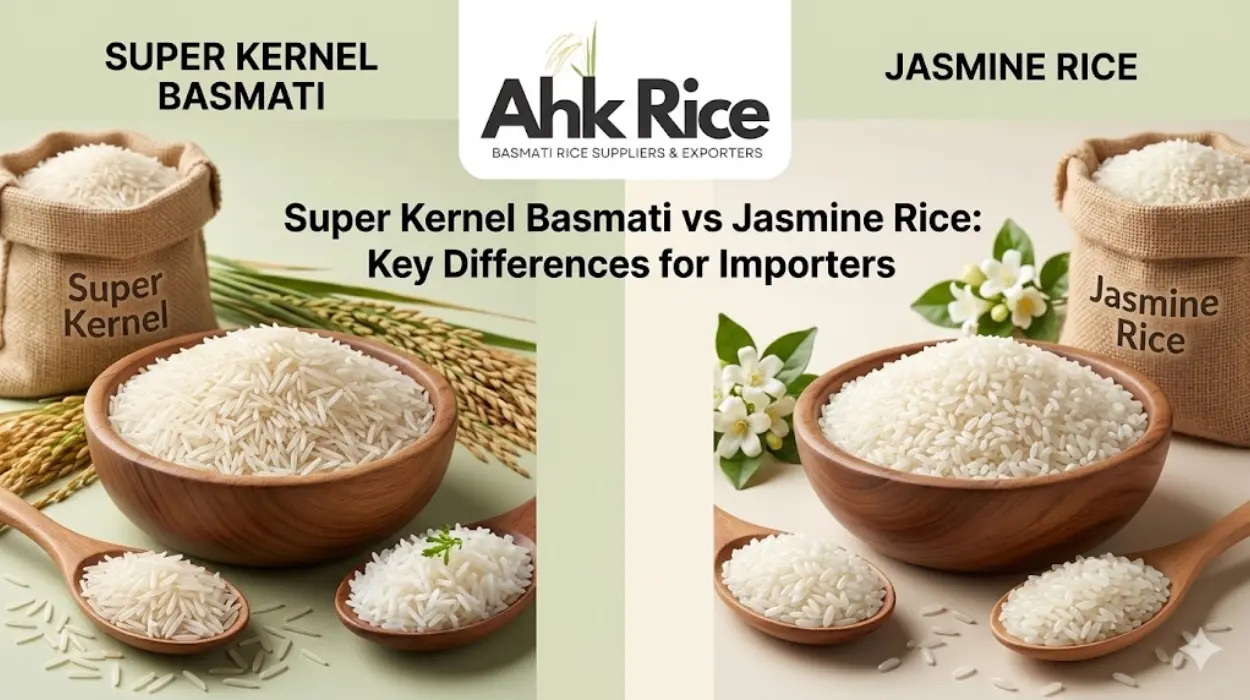
Super Kernel Basmati vs Jasmine Rice: Key Differences for Importers
Super Kernel Basmati rice delivers superior grain elongation, aroma retention, and export stability compared to Jasmine rice in long-distance trade. Here is why: Super Kernel Basmati maintains structural integrity during milling, polishing, and shipping, while Jasmine rice loses aroma faster under humid logistics conditions common in Gulf and African import routes. AHK Rice supplies both varieties to global buyers requiring consistent grading and certified export batches.
Importers evaluating long-grain rice performance often compare aroma intensity, shelf life, and cooking expansion. Super Kernel Basmati consistently performs better in controlled storage and re-export hubs due to its lower moisture variability and higher grain resilience.
For a deeper breakdown of export destinations and demand patterns, importers can also review how trade flows align with Super Kernel supply chains in this detailed market overview: Top Countries Importing Super Kernel Basmati Rice.
What are the available solutions for importers choosing between Super Kernel Basmati and Jasmine Rice?
Importers choose between Super Kernel Basmati, Jasmine Rice, blended long-grain alternatives, and origin-specific aromatic rice categories. Super Kernel Basmati dominates export-grade long-grain supply due to higher elongation ratio, while Jasmine Rice dominates Southeast Asian fragrance-driven consumption markets with softer texture and shorter export durability.
Super Kernel Basmati functions as a long-grain export rice cultivated in Pakistan and Northern India. It is processed through milling, dehusking, polishing, grading, and moisture stabilization. AHK Rice cultivates and processes Super Kernel batches for export consistency across 15+ countries.
Jasmine Rice functions as a fragrant short-to-medium grain rice cultivated primarily in Thailand and Vietnam. It is milled and polished for soft texture retention, but it loses aroma faster during long shipping cycles.
Blended rice solutions combine aromatic basmati with cost-optimized grains. These are used in institutional catering where price stability matters more than aroma intensity.
Origin-specific aromatic rice categories include Thai Hom Mali, Indian 1121 variants, and Pakistani Super Kernel. Each category serves different logistics and consumer expectations.
With solution categories defined, the next step is to evaluate how each rice type performs under measurable export and culinary conditions.
How do different approaches compare in grain performance, export durability, and pricing?
Super Kernel Basmati outperforms Jasmine Rice in elongation ratio, export shelf life, and high-temperature storage stability, while Jasmine Rice leads in immediate aroma strength and softer texture preference in Southeast Asian food systems across domestic consumption channels.
Super Kernel Basmati and Jasmine Rice differ significantly in physical structure, export behavior, and market pricing. AHK Rice grades Super Kernel into export-specific lots designed for Gulf, African, and European buyers requiring long shelf stability.
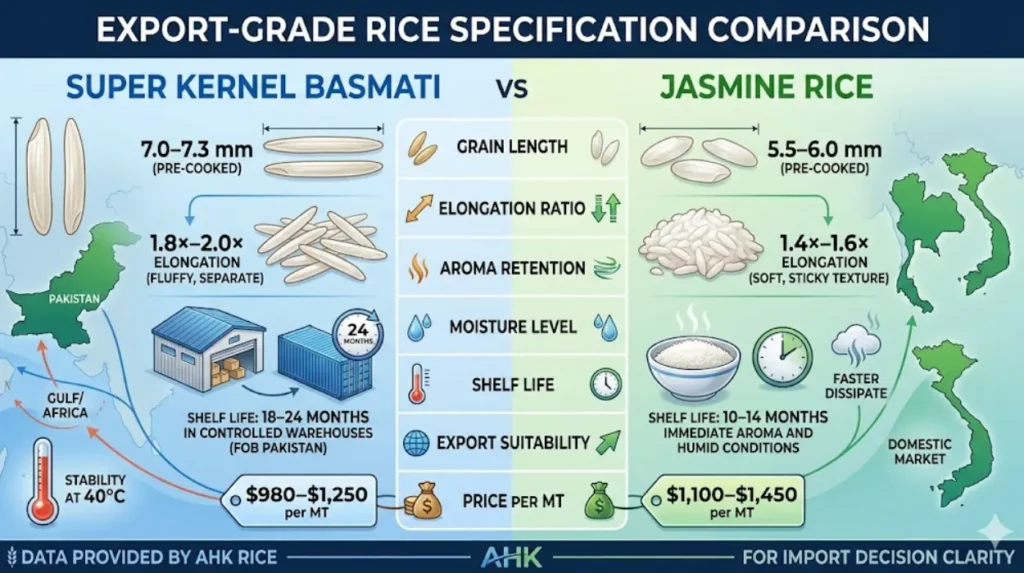
Below is a structured specification comparison for import decision clarity.
Export-grade specification comparison
Core rice specification table
| Attribute | Super Kernel Basmati | Jasmine Rice |
|---|---|---|
| Grain length (mm) | 7.0–7.3 mm before cooking | 5.5–6.0 mm before cooking |
| Elongation ratio | 1.8×–2.0× after cooking | 1.4×–1.6× after cooking |
| Aroma retention | High during export storage | Medium with faster dissipation |
| Moisture level | 12–13% controlled export grade | 13–14% domestic preference range |
| Shelf life | 18–24 months in controlled warehouses | 10–14 months under humid conditions |
| Export suitability | High for Gulf and Africa logistics | High for Southeast Asian markets |
| Price per MT | $980–$1,250 FOB Pakistan (avg export range) | $1,100–$1,450 FOB Thailand/Vietnam range |
Super Kernel Basmati maintains structural stability during long shipping cycles. In 40°C warehouse conditions in UAE, it maintains grade integrity for up to 18 months. Jasmine Rice typically requires faster consumption cycles within 12 months under similar humidity exposure.
AHK Rice processes Super Kernel batches through controlled milling, polishing, and grading lines to maintain export uniformity across container shipments.
With specification differences established, the next step is understanding which rice performs best in specific import environments.
Which rice method works best for different import markets and use cases?
Super Kernel Basmati performs best in Gulf catering, African institutional supply, and European ethnic retail channels, while Jasmine Rice performs best in Southeast Asian domestic markets and premium fragrance-driven restaurant systems requiring soft texture profiles.
Super Kernel Basmati suits importers prioritizing long storage cycles and logistics-heavy distribution. AHK Rice supplies this grade to distributors handling re-export hubs in Dubai, Jeddah, and Mombasa.
Jasmine Rice suits importers focused on immediate cooking quality and domestic retail turnover in Thailand, Vietnam, and Singapore.
Market-specific suitability analysis
Gulf markets prioritize long grain stability due to re-export cycles. Super Kernel Basmati dominates institutional catering contracts in these regions.
African markets prioritize bulk stability and cost efficiency. Super Kernel Basmati performs well in non-climate-controlled storage environments.
AHK Rice aligns export batches based on these market-specific requirements through grading, sorting, and shipment planning.
With market suitability defined, the next section evaluates advantages and limitations of both rice categories.
What are the pros and cons of Super Kernel Basmati and Jasmine Rice for importers?
Super Kernel Basmati offers higher export stability, stronger elongation, and longer shelf life, while Jasmine Rice offers stronger immediate aroma, softer texture, and higher domestic culinary preference but lower export durability.
Super Kernel Basmati provides structural advantages during milling, polishing, and shipping. AHK Rice ensures grading consistency through controlled dehusking and moisture calibration.
Jasmine Rice provides sensory advantages in immediate cooking applications but loses aroma intensity faster in long transport routes.
Super Kernel Basmati advantages and limitations
Advantages include long grain elongation, export stability, and moisture resilience. These features support bulk import contracts and institutional buyers.
Limitations include slightly higher cooking time and lower immediate fragrance compared to Jasmine Rice.
Jasmine Rice advantages and limitations
Advantages include strong fragrance release, soft texture, and strong domestic culinary identity in Southeast Asia.
Super Kernel Basmati remains dominant in export-heavy logistics systems, while Jasmine Rice dominates domestic freshness-driven markets.
With advantages clarified, the next section focuses on decision-making criteria for importers.
What are the key decision factors for selecting between Super Kernel Basmati and Jasmine Rice?
Importers choose based on storage duration, target geography, price stability, grain performance, and end-user cooking expectations, with Super Kernel Basmati preferred for long-distance export logistics and Jasmine Rice preferred for short-cycle domestic consumption markets.
Super Kernel Basmati suits importers who prioritize export stability, warehouse storage efficiency, and institutional catering supply chains. AHK Rice structures its export batches to meet these requirements through grading and certification.
Jasmine Rice suits importers focused on retail freshness, regional culinary identity, and high-frequency turnover in domestic markets.
Key decision framework
Super Kernel Basmati consistently performs better in controlled export environments due to its milling stability and moisture control. Jasmine Rice remains strong in sensory-driven markets requiring immediate aroma release.
AHK Rice supports both categories through structured procurement, grading, and export documentation systems.
With decision factors clarified, importers can now align procurement strategies with market demand cycles and logistics realities.
Importers who are ready to proceed with bulk procurement can request a customized quotation for Super Kernel Basmati rice directly from AHK Rice. By submitting your required specifications such as quantity, destination port, packaging type, and preferred delivery terms, you can receive a detailed export quote within 24 hours. This ensures fast decision-making for buyers managing time-sensitive supply chains and helps streamline procurement for Gulf, African, and European markets where consistent long-grain rice supply is required.
Frequently Asked Question
What is the main difference between Super Kernel Basmati and Jasmine Rice?
Super Kernel Basmati is a long-grain export rice known for high elongation, strong structure, and long shelf life. Jasmine Rice is a fragrant rice with softer texture but lower export durability.
Which rice performs better in long-distance shipping?
Super Kernel Basmati performs better in long-distance shipping because it maintains moisture stability, grain integrity, and aroma for longer periods compared to Jasmine Rice.
Which rice is better for Gulf and African import markets?
Super Kernel Basmati is better suited for Gulf and African markets due to its long storage life, heat resistance, and suitability for bulk institutional supply chains.
Why does Jasmine Rice lose value in export logistics?
Jasmine Rice loses value in export logistics because its aroma fades faster and it has a shorter shelf life, especially in humid and high-temperature shipping environments.
Which rice should importers choose for retail and catering?
Importers should choose Super Kernel Basmati for catering and bulk distribution, while Jasmine Rice is better for premium retail and markets that prioritize fragrance and soft texture.