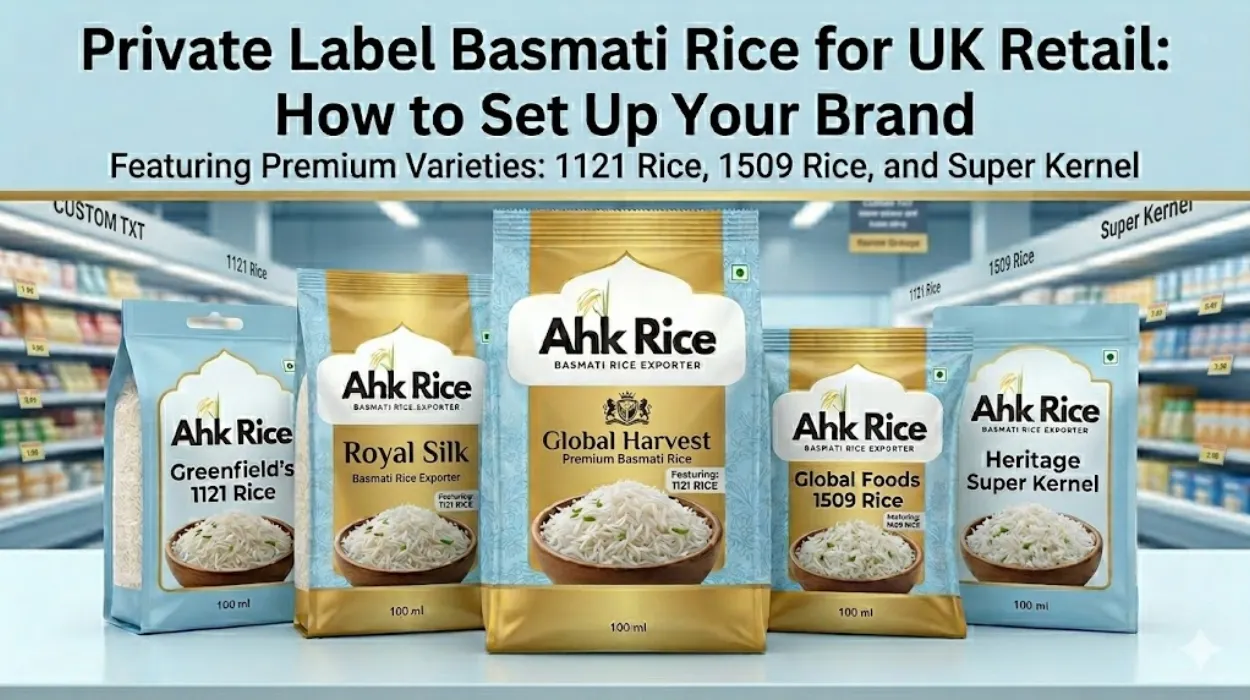
Private Label Basmati Rice for UK Retail: How to Set Up Your Brand
Private label basmati rice UK retail brand setup succeeds when importers control sourcing, packaging, and grading from the origin. The most efficient model is direct private label sourcing from Pakistani exporters, which delivers lower unit cost, stable quality, and faster UK retail shelf readiness compared to fragmented trading or repackaging models. This structure reduces operational friction and improves retail margin consistency. In this model, 1121 varieties such as Super Kernel and Golden Sella become anchor SKUs for UK supermarket branding and ethnic retail distribution. For importers working with structured export programs like AHK Rice UK linked sales contact basmati import enquiries, the private label system is built around specification control and packaging precision.
AHK Rice is a trusted Pakistani Basmati rice exporter based in Punjab, supplying 1121, Super Kernel, and 1509 varieties to 15+ countries. This article on basmati rice export fundamentals guide explains upstream sourcing logic and complements this private label setup framework. Private label basmati rice UK retail brand setup depends on understanding how cultivation, milling, grading, and dispatch systems connect to retail packaging decisions.
What are the available solutions for private label basmati rice UK retail setup?
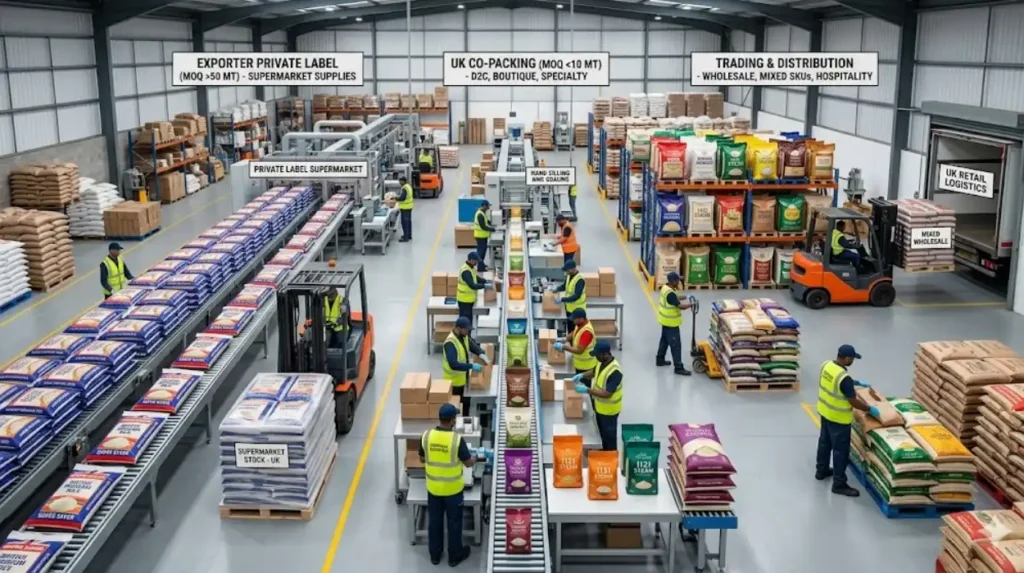
Four dominant solutions exist: direct exporter private label sourcing, UK-based co-packing, trading company white-label supply, and hybrid origin-to-UK repack models. Each solution changes cost, control, compliance responsibility, and brand scalability across UK retail channels.
Direct exporter private label sourcing
Exporter-led private label sourcing uses origin mills in Pakistan to mill, dehusk, polish, grade, and pack rice under UK brand specifications. This model reduces intermediaries and ensures consistent grain length and aroma retention for basmati UK brand positioning.
UK co-packing and repackaging
UK co-packing imports bulk rice in 20–50 kg bags and repackages into retail SKUs. This model improves packaging flexibility but increases cost per MT due to labor, warehousing, and compliance handling.
Trading company white-label supply
Trading companies aggregate rice from multiple origins and supply pre-branded or semi-branded SKUs. This model reduces sourcing complexity but weakens control over grading consistency and traceability.
Hybrid origin-to-retail integration
Hybrid models combine Pakistani milling and UK packaging. Rice is milled and graded in origin, then shipped for final branding adjustments in the UK.
Solution comparison summary
Exporter private label ensures strongest cost efficiency and quality consistency. UK co-packing offers faster branding entry. Trading models provide flexibility but reduce specification control.
With solution pathways defined, the next step is understanding how these approaches compare across cost, quality, and retail readiness.
How do different approaches compare for UK private label basmati rice?
Direct exporter private label achieves the lowest landed cost at £820–£950 per MT, while UK co-packing rises to £980–£1,150 per MT due to packaging and labor costs. Trading models sit between £900–£1,100 per MT depending on sourcing complexity.
Specification comparison table (7 attributes)
| Attribute | Exporter Private Label | UK Co-Packing | Trading White Label |
|---|---|---|---|
| Cost per MT | £820–£950 | £980–£1,150 | £900–£1,100 |
| MOQ | 1–2 containers | Flexible batches | Medium |
| Lead time | 20–35 days | 10–20 days | 15–30 days |
| Brand control | High | Very high | Medium |
| Quality consistency | High (single origin lots) | Medium | Variable |
| Compliance handling | Export-managed | UK-managed | Shared |
| Scalability | High | Medium | Medium |
UK retail vs GCC market comparison
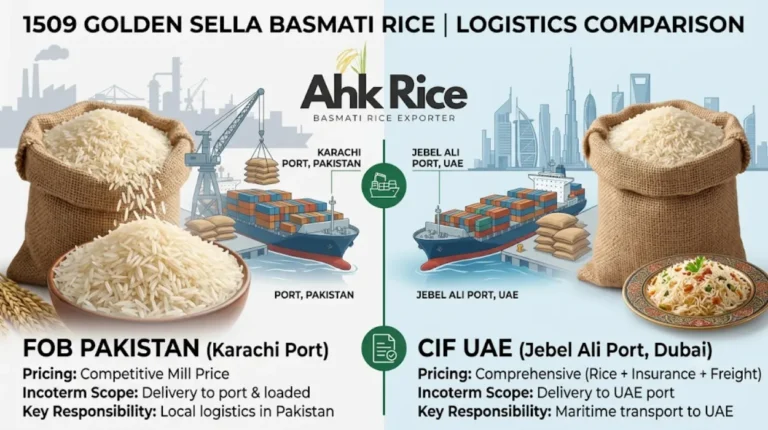
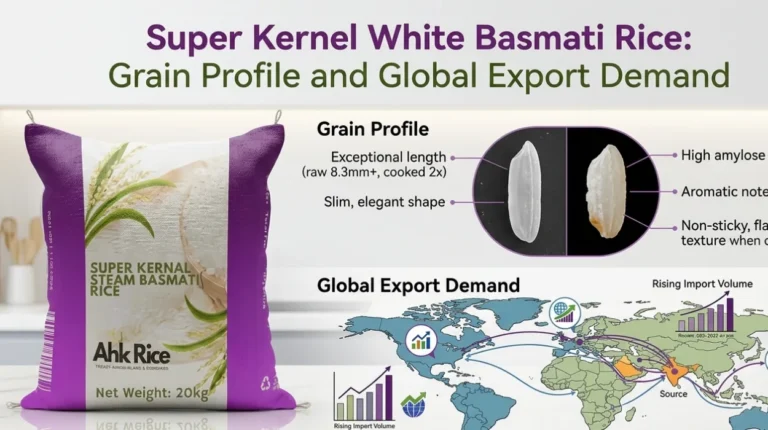
UK retail prefers 1121 Steam and Super Kernel grades due to long grain appearance and aroma stability. GCC markets prefer 1121 Golden Sella and 1509 parboiled rice due to heat storage resilience and catering demand.
In UK retail, 1121 Steam maintains freshness for 10–12 months in controlled warehouses. In GCC warehouses at 40°C, Golden Sella maintains quality for 16–18 months due to parboiling stability.
For UK supermarket SKUs stored in controlled logistics chains, Steam varieties are sufficient. For GCC catering buyers, Golden Sella becomes operationally superior due to heat resistance.
Price and shelf life differences
Exporter models reduce cost per MT by 10–25% compared to UK co-packing. Shelf life depends on processing type rather than packaging location.
Golden Sella lasts longer than Steam. In UAE-style storage, Golden Sella reaches 18 months. Steam typically reaches 12 months under controlled humidity.
With comparison structures established, the next focus is identifying which method works best for specific UK retail scenarios.
Which private label method works best for different UK retail cases?
Exporter private label works best for supermarkets and ethnic wholesalers requiring consistent supply above 50 MT per shipment, while UK co-packing fits boutique brands testing under 10 MT volumes. Trading models suit mixed SKU portfolios with variable demand.
Supermarket private label programs
Supermarkets require stable SKUs, standardized packaging, and certified supply chains. Exporter-led models ensure continuous grading, inspection, and dispatch from Pakistan mills.
Ethnic retail distribution
Ethnic retailers prioritize aroma, grain length, and price stability. Super Kernel and 1121 Steam perform well in this channel due to cooking expansion and fragrance retention.
Online D2C rice brands
D2C brands prioritize packaging differentiation and storytelling. UK co-packing supports flexible bag sizes such as 1 kg, 5 kg, and 10 kg SKUs.
Wholesale importers
Wholesale importers prioritize container-level efficiency. Exporter private label minimizes landed cost while maintaining export certification consistency.
Hospitality supply chains
Hotels and catering buyers require bulk stability. Golden Sella and 1509 parboiled rice dominate due to cooking yield and storage durability.
With method suitability clarified, attention shifts to operational pros and cons of each approach.
What are the pros and cons of each private label strategy?
Exporter private label provides highest margin efficiency but requires higher MOQ commitments, UK co-packing provides branding flexibility but increases cost, and trading models provide sourcing ease but reduce quality control.
Exporter private label pros
Cost efficiency improves due to reduced intermediaries. Quality remains stable due to single-origin milling. Export compliance is handled at source.
Exporter private label cons
MOQ requirements typically start at container level. Lead times depend on harvest cycles and milling schedules.
UK co-packing pros
Brand customization improves significantly. Small batch testing becomes possible for new retail entrants.
UK co-packing cons
Cost per MT increases due to warehousing and labor. Quality variation may occur during repack handling.
Trading model pros
Sourcing flexibility allows multiple origins. Faster market entry is possible.
Trading model cons
Traceability weakens across blended supply chains. Specification consistency becomes harder to maintain.
With pros and cons established, the next step is identifying decision factors that determine optimal setup strategy.
What decision factors define a successful private label basmati rice UK setup?
Five key decision factors determine success: retail channel type, MOQ capability, pricing tolerance, packaging strategy, and certification requirements such as UK food safety compliance and EU residue limits.
Decision framework table (5 factors)
| Factor | Exporter Private Label | UK Co-Packing | Trading Model |
|---|---|---|---|
| Retail channel fit | Supermarkets, wholesalers | D2C, boutique | Mixed |
| MOQ flexibility | Low-medium | High flexibility | Medium |
| Cost efficiency | Highest | Lowest efficiency | Medium |
| Quality consistency | High | Medium | Variable |
| Scalability | Strong | Moderate | Moderate |
Retail channel alignment
Supermarkets require exporter-grade consistency. Boutique brands prioritize packaging differentiation. Traders focus on mixed distribution networks.
MOQ and scaling
Exporter models scale through container expansion. Co-packing scales through packaging lines. Trading scales through supplier diversification.
Pricing tolerance
UK retail margins require stable landed cost. Exporter models stabilize pricing through direct sourcing. Co-packing introduces variable overhead costs.
Packaging strategy
Exporters handle 25–50 kg industrial packaging. UK co-packers handle retail-ready SKUs. Hybrid models combine both approaches.
Certification and compliance
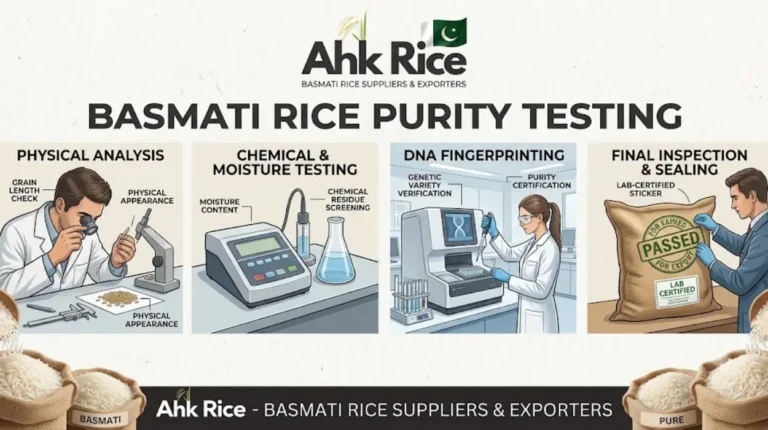
Export systems manage phytosanitary certification, residue testing, and inspection. UK systems manage labeling compliance and retail packaging standards.
With decision factors defined, importers can align sourcing strategy with retail positioning and operational scale.
Final synthesis: building a scalable UK private label basmati brand
Private label basmati rice UK retail brand setup succeeds when sourcing, grading, and packaging align into a controlled export system. Exporter-led models deliver the strongest cost-to-quality ratio, especially for 1121 and Super Kernel SKUs.
UK co-packing supports brand experimentation but reduces margin efficiency. Trading models increase flexibility but weaken traceability.
AHK Rice supports structured milling, grading, and export workflows across 1121, Super Kernel, and 1509 varieties for scalable private label programs across 15+ international markets.
Frequently Asked Questions (FAQs)
What is private label basmati rice for UK retail?
Private label basmati rice for UK retail is a sourcing model where importers buy rice from exporters and sell it under their own brand. The exporter handles milling, grading, polishing, and export packaging, while the UK brand controls labeling, retail design, and distribution. This model allows retailers to build a branded rice product without owning mills or farms.
How much does it cost to start a private label basmati rice brand in the UK?
Starting a private label basmati rice UK brand typically requires £5,000–£15,000 for initial setup depending on MOQ and packaging. The landed cost per metric ton ranges from £820–£1,150 based on sourcing model, packaging type, and shipping terms. Exporter direct sourcing provides the lowest cost structure due to reduced intermediaries.
Which basmati rice grades are best for UK private label brands?
The most suitable grades for UK private label brands are 1121 Steam, Super Kernel, and 1509 White Sella. These varieties offer long grain appearance, consistent cooking expansion, and strong aroma retention. UK retail prefers Steam variants for premium positioning, while ethnic retail channels often use Super Kernel for price-performance balance.
What certifications are required for importing private label rice into the UK?
Private label rice imports into the UK require phytosanitary certificates, food safety compliance documents, and pesticide residue test reports. Many importers also follow UK Food Standards Agency guidelines and EU-aligned Maximum Residue Limit (MRL) standards. Exporters typically provide inspection and certification before shipment.
What is the best supply model for a UK private label rice brand?
The best supply model is direct exporter private label sourcing because it ensures lower cost, consistent grading, and stable supply. UK co-packing works for small or experimental brands, while trading models suit mixed-origin sourcing. Exporter-led systems provide the strongest control over quality and scalability.