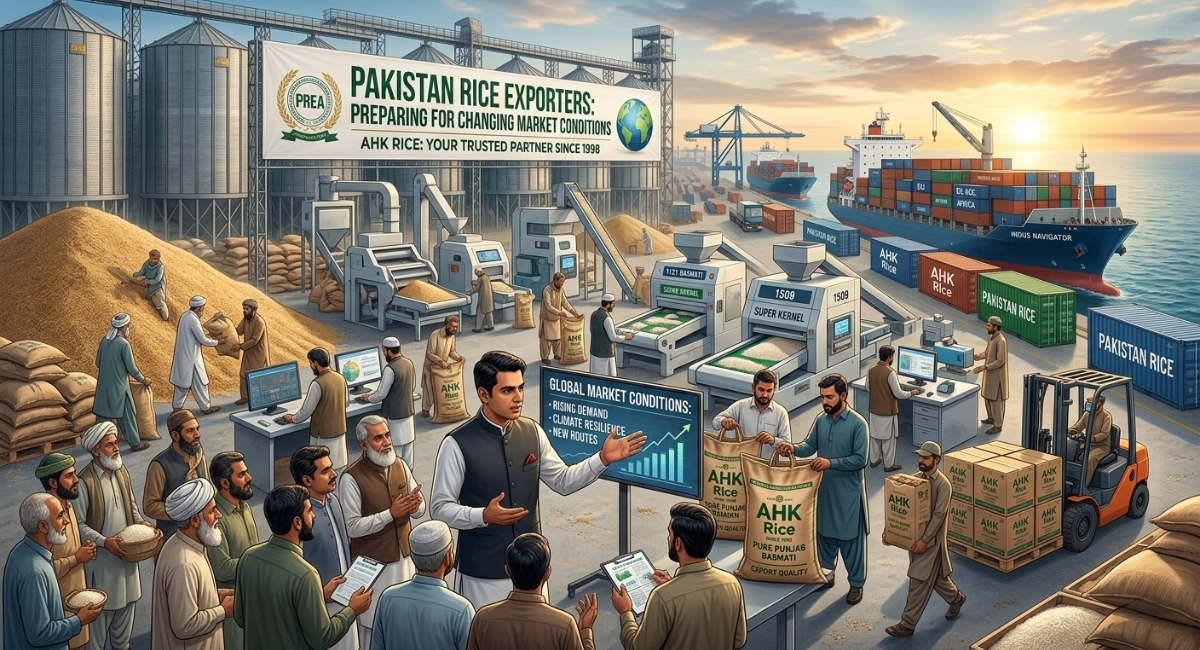
Pakistan Rice Exporters Prepare for Changing Market Conditions
What Is the Pakistan Rice Export Industry?
The Pakistan Rice Export Industry is a multibillion-dollar agricultural sector that provides premium Basmati and coarse rice varieties to global food markets. Pakistan ranks as the fourth-largest rice exporter globally, leveraging fertile Indus River basin soils to sustain massive production volumes.
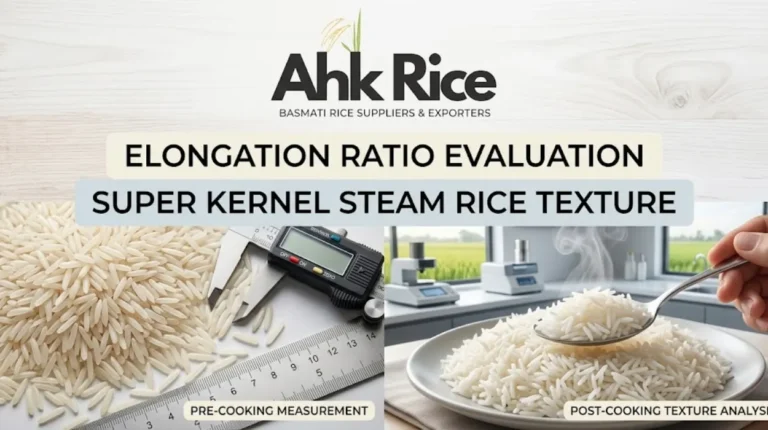
The primary product of this industry is Basmati rice. Basmati rice is a long-grain, aromatic rice variety native to the Indian subcontinent. The legal definition of Basmati rice requires a specific grain length, distinct aroma, and elongation ratio upon cooking. Pakistani Basmati rice possesses a unique elongation ratio of 2.0, meaning the grain doubles in size when boiled.
The second category is non-Basmati or coarse rice, which includes varieties like IRRI-6 and IRRI-9. These varieties lack the distinct aroma of Basmati but offer high yields and affordable price points for bulk staple markets. Global buyers categorize these varieties based on broken grain percentages, such as 5% broken or 25% broken rice.
The cultivation geography centers on the Punjab province. The combination of alluvial soil, semi-arid climate, and canal irrigation systems creates optimal growing conditions for aromatic rice. This specific terroir enhances the accumulation of 2-acetyl-1-pyrroline, the chemical compound responsible for the signature popcorn-like aroma of Basmati rice.
Global trade dynamics heavily influence the strategic direction of Pakistani exporters. Changes in international trade barriers, minimum export prices, and freight costs dictate monthly volume fluctuations. Exporters must maintain rigid quality control frameworks to preserve their market share in strict regulatory environments, including the European Union and North American territories.
Understanding the Rice Varieties of Punjab
The Punjab region produces distinct rice cultivars that cater to specific market preferences worldwide. The 1121 Basmati variety stands out for its extraordinary grain length, reaching up to 8.4 millimeters before cooking. This variety serves premium dining sectors in countries like Saudi Arabia and the United Arab Emirates.
Super Kernel Basmati represents the traditional aromatic standard of Pakistan. It features a strong fragrance and a delicate texture that remains popular in European retail markets. Exporters age Super Kernel Basmati for 12 to 24 months to minimize moisture content and maximize cooking fluffiness.
The 1509 Basmati variety is a newer, short-duration crop. It matures within 90 days compared to the 120-day cycle of traditional Super Kernel. This rapid growth cycle allows farmers to conserve water resources while delivering a long-grain profile that rivals older varieties in international retail sectors.
Where Is Pakistani Export Rice Grown?
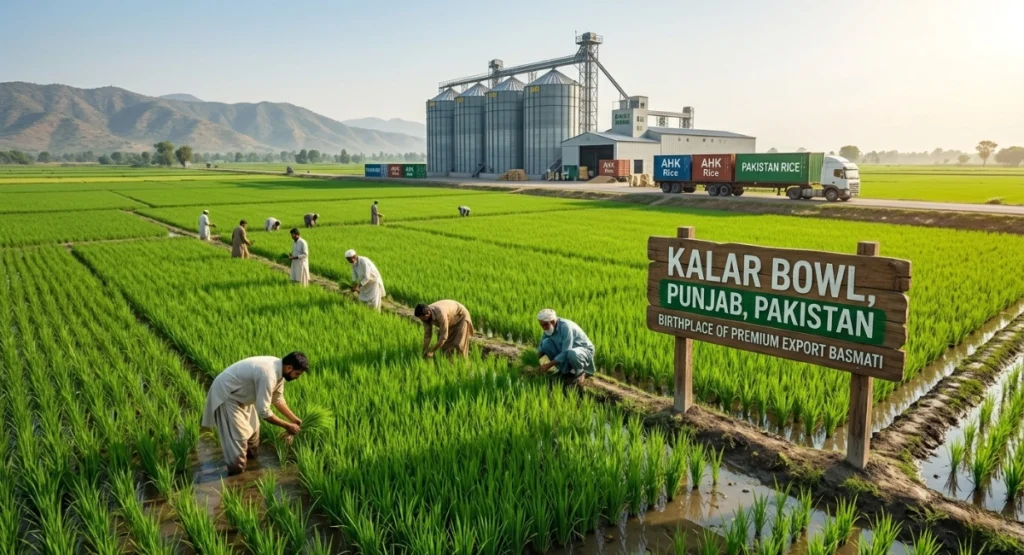
Pakistani export rice grows predominantly in the fertile Kalar Bowl tract of Punjab and specific irrigated zones of the Sindh province. These geographic regions supply 100% of the premium Basmati and high-yield coarse varieties sent to international buyers.
The Kalar Bowl represents the historic heartland of authentic Basmati rice production. This geographical zone spans across specific districts in northeastern Punjab, including Gujranwala, Sialkot, Sheikhupura, Nankana Sahib, and Hafizabad. The soil here consists of heavy clay with high water-retention capacity, which keeps rice roots submerged without depleting deep aquifers.
The meltwater from the Himalayan mountain range feeds the Chenab and Ravi rivers, which supply the canal networks of these districts. This water carries nutrient-rich silt that naturalizes the soil chemistry. The temperature differential between hot summer days and cool autumn nights during the grain-filling stage locks the aromatic compounds into the endosperm
Sindh province focuses heavily on long-grain non-Basmati rice production. Districts like Jacobabad, Larkana, and Shikarpur utilize the Indus River irrigation systems to cultivate heat-tolerant varieties. These regions experience higher ambient temperatures, which accelerate crop maturity and allow for early-season export availability to African and East Asian markets.
Global sourcing managers track these specific regional harvests to secure predictable grain quality. Soil salinity levels vary between Upper Sindh and Lower Punjab, directly impacting the amylose content of the harvested paddy. Amylose content determines the stickiness of the rice, making regional tracking a critical element of technical procurement.
How Is Export Rice Processed Step by Step?
Export rice processing follows a systematic seven-stage mechanical sequence designed to transform raw field paddy into polished, color-sorted, and uniform grains. This automated pipeline eliminates impurities, stabilizes shelf life, and ensures compliance with international phytosanitary import regulations.
Paddy Drying and Cleaning
Processing begins with moisture reduction. Raw paddy arrives from farms with a moisture content of 20% to 25%. Processing facilities pass the paddy through vertical mechanical driers to reduce this moisture level to a stable 12% to 13%. This specific moisture range prevents fungal growth and grain breakage during subsequent milling stages.
Once dried, the paddy enters pre-cleaners. These machines use oscillatory sieves and aspirators to remove foreign materials, including straw, dust, stones, and weed seeds. Eliminating these materials protects downstream milling machinery from premature mechanical wear.
De-husking and De-stoning
The cleaned paddy moves to pneumatic rubber roll huskers. These machines apply mechanical pressure and shear force to strip the fibrous outer hull from the rice grain. This process yields brown rice, while the separated hulls travel to biomass furnaces to generate operational factory steam.
The brown rice then passes through a de-stoner. This machine leverages density differentials, using air flotation and vibrating decks to separate heavy stones and glass fragments from the lighter rice grains.
Rice Whitening and Polishing
Brown rice retains its nutrient-rich bran layer. To produce white rice, processors route the grain through a series of abrasive and friction whitening machines. These vertical carborundum rollers gently scrape away the bran layers without fracturing the starch core.
Following whitening, the rice enters mist polishers. These machines inject a fine water vapor mist into the polishing chamber. The friction between grains rubs off remaining bran dust, giving the rice a translucent, glossy appearance that global consumer markets demand.
Grading and Color Sorting
The polished rice requires precise dimensional uniforming. Rotary sifters separate broken grains from whole grains based on size tolerances. Exporters configure these plan-sifters to meet specific contract requirements, such as a maximum of 2% broken grains for premium packaging lines.
The uniform whole grains then drop into optical color sorters. High-speed CCD cameras inspect individual grains mid-air, using pneumatic air valves to blast away defective items. This step removes discolored grains, yellow defects, and chalky bellies from the final export batch.
What Are the Available Grades of Pakistani Rice?
Pakistani rice grades consist of premium A-Grade aromatic Basmati, standard B-Grade long-grain varieties, and functional C-Grade broken rice fractions. International trade bodies classify these grades by grain length, broken percentages, and specialized processing treatments like parboiling.
Grade A premium encompasses long-grain Basmati varieties with a minimum pre-cooked grain length of 8.2 millimeters. This grade permits a maximum broken grain tolerance of 1% to 2%. It includes premium 1121 Steam Basmati and Super Kernel varieties that undergo extensive aging regimes to guarantee maximum volume expansion during preparation.
Grade B consists of standard long-grain non-Basmati options and commercial-grade Basmati crops. These varieties, including IRRI-9 and PK-386, feature average grain lengths between 6.8 millimeters and 7.3 millimeters. The allowed broken grain content scales up to 5% or 10%, depending on the specific import contract.
Grade C comprises functional broken rice, specifically 25% broken, 50% broken, and 100% broken mixtures. These grades originate primarily from IRRI-6 varieties. West African nations import these grades in bulk due to their high caloric value and lower price per metric ton.
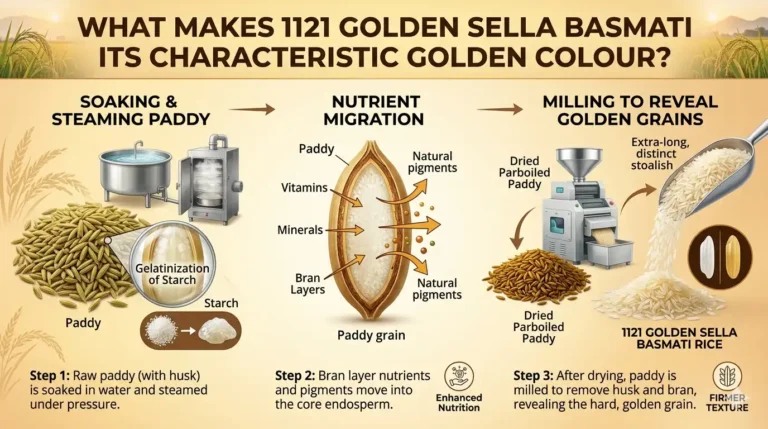
Processing variations create distinct sub-grades within these categories. White rice represents the standard milled product. Brown rice retains the outer bran for health-oriented markets. Parboiled or Sella rice undergoes a hydrothermic process before milling, locking nutrients into the starch and altering cooking properties.
Which International Markets Import Pakistani Rice?
International markets importing Pakistani rice span across China, East Africa, the European Union, and the Gulf Cooperation Council region. These distinct geographic territories source specific grain classifications based on regional culinary habits, income dynamics, and industrial processing requirements.
China stands as a massive volume importer of Pakistani non-Basmati rice. Chinese buyers purchase 100% broken rice fractions to supply domestic starch manufacturing, animal feed production, and traditional rice noodle processing lines. This bulk demand stabilizes the floor price for Pakistani coarse rice varieties.
East African countries, including Kenya, Madagascar, and Tanzania, import vast quantities of IRRI-6 white rice. The 25% broken variation serves as a critical dietary staple in these economies. Pakistani exporters maintain highly efficient logistics channels to Mombasa and Tamatave ports to service these price-sensitive markets.
The Gulf Cooperation Council region represents the primary destination for premium Grade A Basmati. Saudi Arabia, the United Arab Emirates, and Oman purchase large volumes of 1121 Sella rice. These markets prioritize extreme grain elongation and rigorous cleaning standards for upscale consumer retail and hospitality sectors.
The European Union operates under strict maximum residue limit standards for agricultural chemicals. European importers focus on purchasing brown Basmati and organic Super Kernel varieties. Exporters must provide comprehensive laboratory validation to clear customs entry gates at major European ports like Rotterdam and Hamburg.
What Certifications Apply to Pakistan Rice Exports?
Certifications applying to Pakistan rice exports encompass international food safety frameworks, regional phytosanitary clearances, and specific religious dietary compliance seals. These legal validations guarantee that shipped food products meet the statutory consumer safety regulations of importing nations.
The baseline requirement for global entry is ISO 22000 or Hazard Analysis Critical Control Point certification. These management system frameworks prove that a milling facility systematically monitors biological, chemical, and physical hazards throughout the processing line. Auditors evaluate everything from pest control protocols to machinery sanitation logs.
Regional regulatory bodies require specialized technical compliance certificates. For example, the Department of Plant Protection in Pakistan issues Phytosanitary Certificates for every outbound container. This document verifies that the rice underwent proper fumigation using approved agents like phosphine to eliminate insect larvae and agricultural pests.
Religious dietary certifications are mandatory for targeted demographic regions. Halal certification issued by accredited Islamic bodies confirms that processing facilities use zero animal-derived lubricants or forbidden chemical additives during production. Kosher certification fulfills similar systemic tracing requirements for specific North American retail networks.
Social accountability and sustainability compliance represent growing trends in global procurement. The Sustainable Rice Platform certification verifies that farm cultivation networks utilize water-conserving irrigation methods and ethical labor practices. Large multinational grocery chains utilize these verifications to satisfy corporate environmental mandates.
Benefits of Sourcing Rice from Pakistan
The benefits of sourcing rice from Pakistan include access to distinct genetic crop varieties, highly competitive pricing structures, and agile, customized export packaging operations. International procurement teams leverage these economic and physical structural advantages to maintain stable retail operating margins.
Pakistani Basmati possesses unique cooking properties that alternative origins cannot duplicate. The natural composition of the Punjab soil creates an exceptionally high amylose percentage. This structural characteristic ensures that individual grains remain separate and non-sticky after cooking, an essential requirement for traditional dishes like biryani and pilaf.
The domestic supply chain structure provides a distinct price advantage. Vertically integrated processing mills in Punjab operate directly adjacent to primary agricultural fields, minimizing inner-country transport costs. Lower domestic overhead allows Pakistani suppliers to offer highly competitive FOB pricing at Karachi ports.
Exporters provide extensive structural flexibility in secondary packaging operations. Modern processing plants operate high-speed packaging machinery capable of handling diverse materials, including non-woven bags, laminated polypropylene sacks, jute bags, and consumer-facing cardboard cartons. This range scales from 1-kilogram retail pouches to 50-kilogram bulk transport bags.
The logistical framework supports reliable year-round shipping schedules. Two main deep-water ports, Karachi Port and Port Qasim, handle high container volumes with multiple weekly vessel departures to major global shipping lanes. This port infrastructure limits delivery delays even during periods of heavy seasonal volume.
Use Cases for Varied Pakistani Rice Grades
Use cases for varied Pakistani rice grades range from high-volume industrial food manufacturing to premium fine-dining preparation and bulk institutional catering operations. Each grain classification serves an exact culinary and financial role based on texture properties, starch content, and preparation durability.
Fine Dining and Luxury Retail
Premium 1121 Steam and Aged Super Kernel Basmati grades serve high-end restaurants and specialty grocery chains. Chefs choose these grades for gourmet menus where visual presentation dictates consumer value. The extreme grain length and fragrant aroma elevate luxury rice platters in premium venues.
Specialty organic retail shops package these whole-grain aromatic varieties under custom private labels. Consumers purchase these high-grade products for home preparation, paying a premium for guaranteed authenticity and low broken grain percentages.