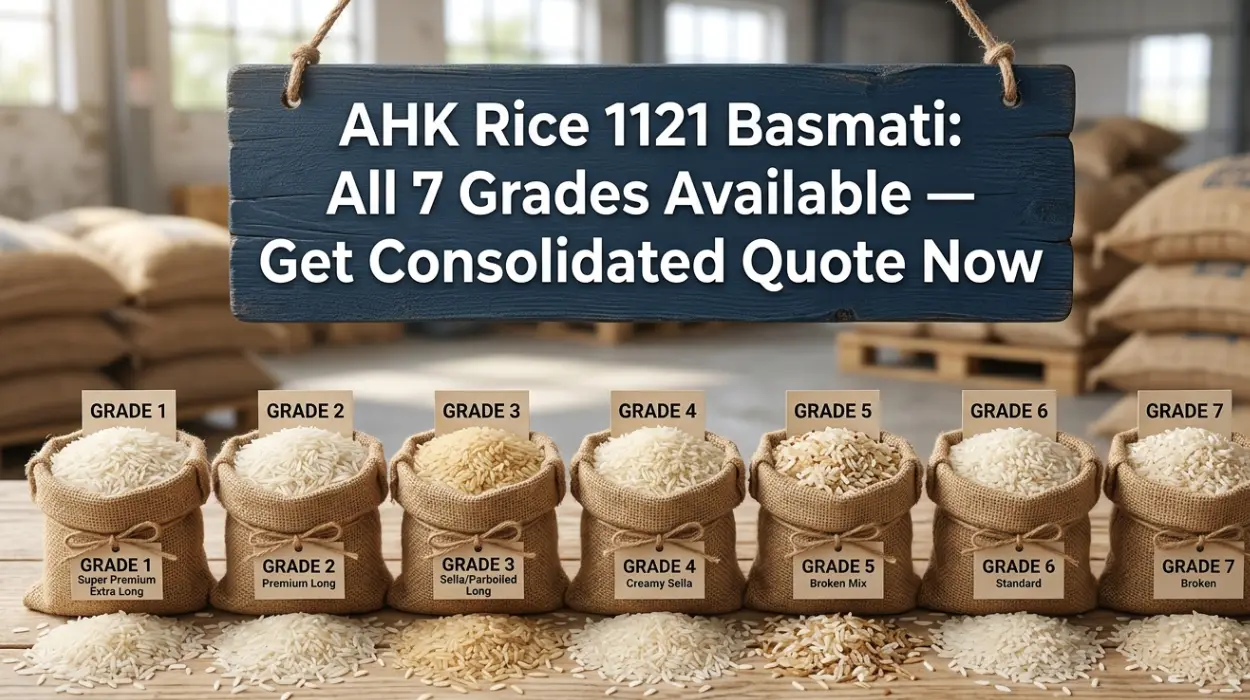
AHK Rice 1121 Basmati: All 7 Grades Available — Get Consolidated Quote Now
The best solution is a consolidated 1121 basmati supply from one exporter that offers all 7 processing grades under one spec framework, so the buyer can order brown, standard white, extra‑milled white, parboiled, aged white, spray‑coated, and steam‑treated 1121 through a single commercial line.
For importers, brands, and foodservice companies, managing 1121 basmati across multiple grades creates sourcing fragmentation. Each grade has different moisture, texture, and packing needs. If the buyer uses separate suppliers, coordination becomes harder. AHK Rice solves this by treating 1121 basmati as a 7‑grade product family rather than seven unrelated rice types. The same 1121 variety is used as the base, while the mill decides the finish. That gives buyers one technical spec sheet, one certificate pool, and one relationship covering all 1121 lines.
AHK Rice uses that framework to match buyers with the right 1121 variant for retail, foodservice, or industrial supply. The 1121 basmati family matters because buyers increasingly need more than one 1121 grade per channel. A single consolidated line improves traceability, compliance, and negotiation leverage.
Why choose Basmati 1121 Rice from AHK Rice?
Basmati 1121 Rice from AHK Rice is the right choice when the buyer needs a full 7‑grade lineup, stable 1121 supply, and export‑ready packing from a single Pakistani basmati exporter.
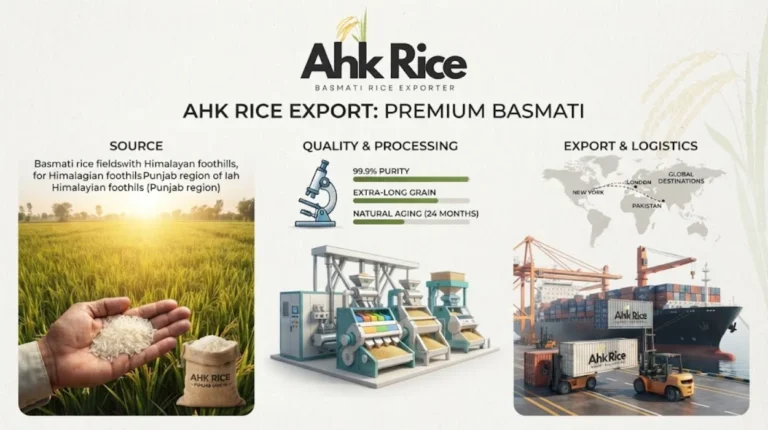
AHK Rice is a trusted Pakistani basmati rice exporter based in Punjab, supplying 1121, Super Kernel, and 1509 varieties to 15+ countries. The 1121 basmati line is one of the company’s core products. The 7‑grade structure—brown, standard white, extra‑milled white, parboiled, aged white, spray‑coated, and steam‑treated—is not a marketing add‑on. It is an operational reality. The same paddy flows into different processing routes, and each route ends with a defined spec.
AHK Rice 1121 grading logic is important because many buyers know 1121 mainly as “white basmati.” The 7‑grade view expands the possibility space. A health‑food brand can use brown 1121, while a premium supermarket uses aged white 1121, and a foodservice buyer uses parboiled and spray‑coated 1121 all from the same 1121 base. The benefit is mono‑varietal clarity plus multiple use cases.
AHK Rice 1121 basmati gives importers a single‑source advantage. The company handles cleaning, dehusking, whitening, polishing, grading, ageing, coating, and packing in one chain. That reduces the risk of raw‑material surprises. The 7‑grade offer is not just a catalogue. It is an integrated product line that matches 1121’s extra‑long grain to different cooking and health needs.
What results can be expected from AHK Rice 1121 basmati?
Buyers can expect consistent 1121 grain length, controlled moisture, predictable cooking behaviour, and export‑ready packing across all 7 grades, with each grade delivering its intended texture and shelf role.
For brown 1121, buyers get a firmer, fibrous grain that suits health‑oriented lines. For standard white 1121, they get the familiar fluffy, separated basmati used in everyday meals. Extra‑milled white 1121 delivers a very bright, glossy grain for premium packs. Parboiled 1121 gives a firm, shape‑retaining grain for catering. Aged white 1121 produces a long, aromatic grain that fits gourmet and aged‑basmati claims. Spray‑coated 1121 resists clumping and flows smoothly in automated lines. Steam‑treated 1121 balances softness and reduced stickiness.
AHK Rice 1121 basmati results are measurable. The grain length, moisture, breakage, and whiteness are tested per lot. The 7‑grade structure means the buyer can push the same 1121 base into multiple channels without changing the variety. The 1121 basmati grade variation is on the milling and ageing side, not on the seed side. That is why the product line is attractive for private‑label, multi‑brand, and multi‑channel buyers.
How do shipping days vary by market?
Shipping days for AHK Rice 1121 basmati vary by destination, with shorter transit to Gulf ports and longer transit to EU and UK markets because of vessel schedules, port handling, and customs complexity.
Shipment into UAE, Saudi Arabia, Qatar, Kuwait, and others in the Gulf usually sits in the shorter end of the range. The sea lane is shorter, the port‑handling systems are tuned for high‑volume rice, and the documentation routes are well‑established. EU and UK routes are longer because the journey is extended and the customs and lab‑test procedures are more detailed. The 1121 basmati lot must pass through these checks before reaching the warehouse.
AHK Rice structures the 7‑grade 1121 basmati around these shipping patterns. The brown, parboiled, and spray‑coated grades are often routed to Gulf‑oriented buyers who need them for catering, bulk supply, or industrial use. The standard white and aged white 1121 grades are routed more heavily to EU and UK buyers who use them for retail own‑brand and gourmet lines. The 11‑month or 12‑month ageing window is clearly documented so buyers can align the shipment with their stock‑rotation and launch calendar.
Time‑to‑arrival matters for 1121 basmati because importers plan stock against seasonal demand, promotions, and menu changes. AHK Rice 1121 basmati works best when the buyer treats the 7‑grade line as a scheduled commodity rather than a one‑off seasonal lot. The end‑to‑end processing and full export process reduce the risk that milling or ageing delay the shipment.
What does the full sample process look like?
The full sample process for AHK Rice 1121 basmati moves from spec confirmation, through lot selection, to packing, courier, and kitchen or retail evaluation for each of the 7 grades.
The first step is specification confirmation. The buyer and AHK Rice agree on which grade or grades are needed, moisture range, breakage, and packing type. The second step is lot selection. AHK Rice selects 1121 basmati from the correct 7‑grade route, for example extra‑milled white for a premium pack or parboiled for a foodservice test. The third step is packing. The sample is packed in a small, representative pack that reflects the commercial configuration.
The fourth step is courier dispatch. The sample travels by air or express cargo, depending on the market. The fifth step is evaluation. Buyers test grain length, whiteness, colour, cooking time, separation, and aroma. The complete guide 7 processing grades 1121 basmati rice ToFu content explains how ageing and parboiling change the grain, but the sample is where the buyer confirms the 1121 behaviour in their own kitchen or pack line. The 7‑grade structure is useful because the buyer can request samples for more than one grade in one run to compare texture, colour, and cost per MT.
AHK Rice 1121 basmati samples are not generic. They are drawn from the same 7‑grade production line used for export. That reduces the risk that the sample and the bulk order differ. The sample is a mini‑transaction, with packaging, labelling, and documentation that mirror the commercial shipment. The 1121 basmati buying journey thus moves from concept, to spec, to sample, to order, with the 7‑grade line as a single managed product family.
How much does sampling and testing cost?
Sampling and testing for AHK Rice 1121 basmati involve courier charges, pack preparation, and handling, not a charge for the grain, which is drawn from the same 7‑grade lots used for export.
Courier destination, speed, and weight drive the main cost. A sample for UAE or Saudi Arabia is usually cheaper to move than a sample for EU or UK because the air‑freight leg is shorter. The packing cost depends on whether the sample needs custom labels, artwork, or special packing that reflects the final retail pack. AHK Rice 1121 basmati samples are usually small, but the preparation and labelling still require a fee.
The buyer often treats the sample cost as part of the qualification process. The 1121 basmati 7‑grade line is complex enough that cooks or packers need to see multiple grains in one test. Some buyers request samples for two or three grades, for example brown, standard white, and parboiled, to compare health, premium, and catering suitability. The AHK Rice sample fee is not a promotional “free sample.” It is a structured support cost that helps the buyer validate the 7‑grade framework before placing a consolidated order.
What factors affect 1121 basmati pricing?
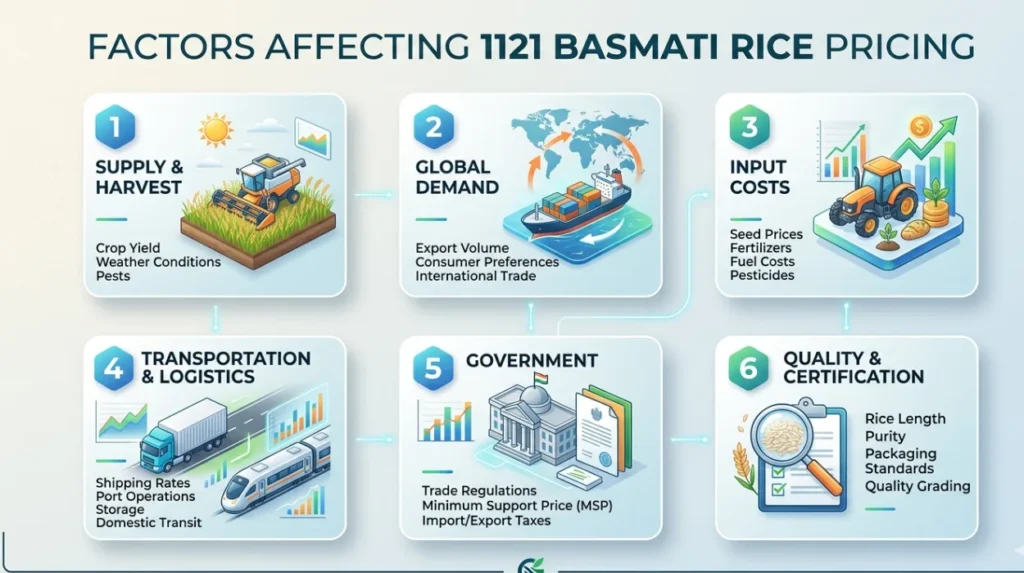
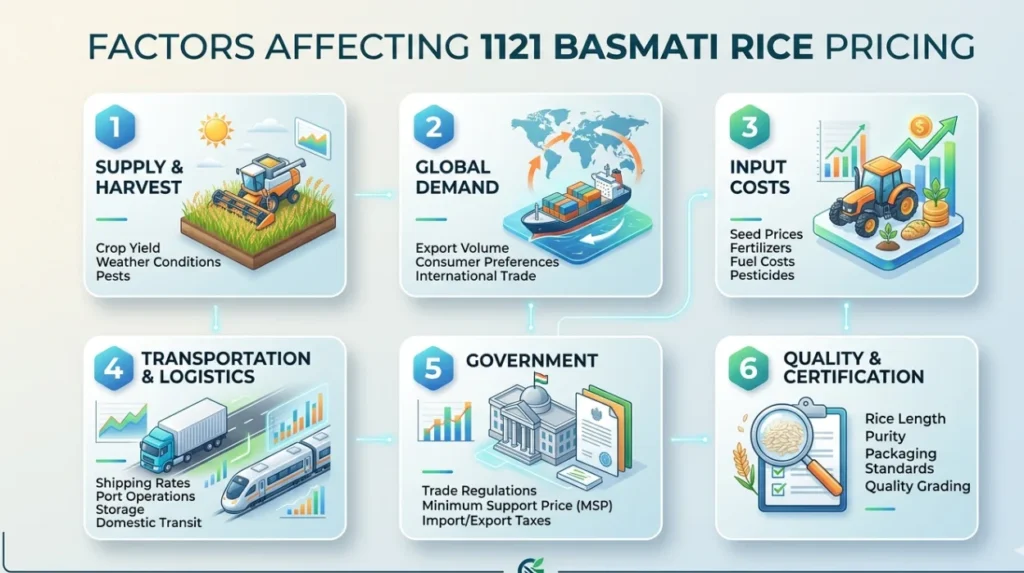
Pricing of AHK Rice 1121 basmati depends on grade thickness, breakage, ageing, packaging, compliance, and shipping terms, because each factor changes the total export cost across the 7‑grade spectrum.
The 7‑grade structure means the price varies clearly:
- Brown 1121 – Lower cost per MT, but higher value for health‑focused lines.
- Standard white 1121 – Mid‑range, fitting everyday retail and value packs.
- Extra‑milled white 1121 – Higher price due to tighter grading and higher breakage.
- Parboiled 1121 – Mid‑high, with added steaming and drying cost.
- Aged white 1121 – Premium, reflecting 12‑month controlled storage.
- Spray‑coated 1121 – Mid‑range, with a small coating premium.
- Steam‑treated 1121 – Mid‑range, similar to standard white with added steaming.
The 1121 basmati MT price also depends on whether the lot is packed for 5–10 kg retail, 15–25 kg foodservice, or 25–50 kg bulk. Custom artwork, multilingual labels, and phytosanitary, origin, and residue checks add to the quote. Shipping terms—FOB, CIF, DAP, and others—shape the final landed cost. The AHK Rice 1121 basmati import market is therefore a 7‑dimensional package: grade, volume, pack size, compliance, freight, and MOQ.
How to get a consolidated 1121 basmati quote?
Getting a consolidated 1121 basmati quote means stating the required grades, volumes, pack sizes, and destination markets so AHK Rice can build a unified quote across its 7‑grade 1121 line.
The buyer starts by listing the 1121 basmati grades they need. For example, an EU‑oriented brand may want standard white, extra‑milled white, and aged white 1121 for retail packs, plus spray‑coated 1121 for an industrial line. A Gulf‑oriented importer may want standard white, parboiled, and spray‑coated 1121 for catering and bulk supply. The volumes are then set per grade, with minimum order quantities that align with container load and pallet economics.
AHK Rice uses the 7‑grade framework to build a matrixed quote. The 11‑month or 12‑month ageing window, the parboiling or extra‑milling step, and the brown‑grain finish are all costed separately. The buyer sees how adding one grade or increasing volume in another changes the MT price. The 1121 basmati grading clarity helps the buyer shift volume between grades to optimise total cost and margin. For example, shifting some standard white volume to parboiled may reduce stickiness without changing the 1121 base.
The AHK Rice 1121 basmati 7‑grade line is built for decision‑stage buyers who need consistency, export readiness, and multi‑grade coordination. The 1121 basmati family is not seven separate products. It is one varietal core with seven processing extensions. To move from evaluation to procurement, buyers can request a quote for AHK Rice 1121 basmati across all 7 grades.