Pakistani Rice Grades and Packaging Options Favoured by Malaysian Buyers
Malaysia imports large volumes of Pakistani rice because different consumer segments require different grain lengths, aroma levels, cooking characteristics, and packaging formats. Malaysian buyers select rice grades according to retail demand, food service requirements, ethnic preferences, and price positioning within the local market.
Pakistan ranks among the world’s leading rice-exporting countries. The country produces aromatic Basmati rice and high-yield non-Basmati varieties across the fertile plains of Punjab and Sindh. Malaysian importers evaluate rice based on grade specifications, grain uniformity, moisture content, broken percentage, and packaging suitability before purchasing.
Understanding these preferences helps explain how rice moves from Pakistani farms to Malaysian supermarkets, wholesalers, restaurants, and food distributors. Readers interested in the importer-exporter relationship can also learn more through the article about how sourcing partnerships develop between both countries.
What are the Pakistani rice grades preferred by Malaysian buyers?
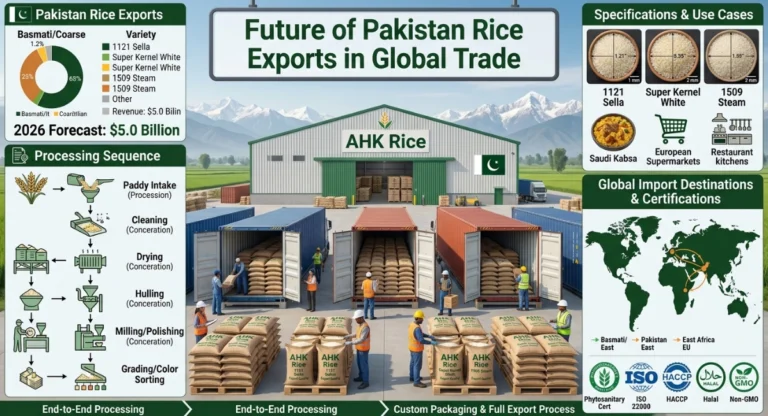
Malaysian buyers primarily import 1121 Basmati, Super Kernel Basmati, 1509 Basmati, PK-386, IRRI-6, and IRRI-9 rice grades because these varieties satisfy different consumer segments, ranging from premium retail markets to restaurants, wholesalers, and large-scale food service operations.
Rice grade refers to a classification system based on variety, grain dimensions, purity level, broken percentage, milling quality, and overall appearance. Each grade serves a specific commercial purpose.
1121 Basmati Rice
1121 Basmati rice contains extra-long grains that exceed 8 millimeters before cooking. The grain elongates significantly after cooking while maintaining separation.
Malaysian retailers position this variety in premium market segments. Consumers purchase it for weddings, celebrations, and traditional meals where aroma and grain appearance influence purchasing decisions.
Super Kernel Basmati Rice
Super Kernel Basmati is one of Pakistan’s traditional aromatic varieties. It offers strong fragrance and consistent cooking performance.
Importers supply this variety to households seeking authentic Basmati characteristics at competitive prices.
1509 Basmati Rice
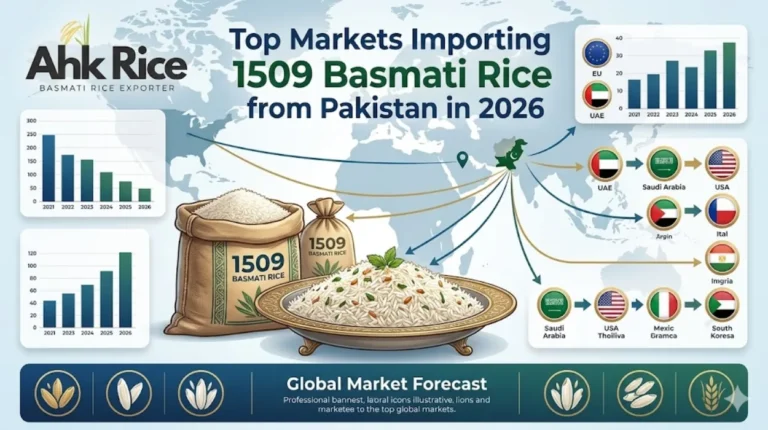
1509 Basmati rice matures earlier than many traditional Basmati varieties. It produces long grains and delivers good cooking expansion.
Malaysian buyers select this variety because it balances quality and affordability.
Non-Basmati Rice Grades
Non-Basmati varieties include examples such as PK-386, IRRI-6, and IRRI-9.
These grades support food processing companies, institutional kitchens, catering businesses, and budget-conscious retail segments. Their lower price per metric ton increases accessibility across broader consumer groups.
How is Pakistani rice grown before reaching Malaysian importers?
Pakistani rice originates from irrigated agricultural regions where farmers follow a structured cultivation process involving land preparation, seed selection, transplantation, irrigation management, harvesting, drying, and post-harvest quality control before commercial processing begins.
Punjab produces most Pakistani Basmati rice exports. The region benefits from fertile alluvial soils, river-fed irrigation systems, and climatic conditions that support aromatic rice cultivation.
The cultivation cycle begins with seed selection. Farmers choose certified seeds to maintain varietal purity and improve crop consistency.
The second stage involves nursery preparation. Seeds germinate in controlled nursery beds before transplantation into larger fields.
The third stage involves irrigation management. Rice fields require controlled water levels throughout the growing season.
The fourth stage includes nutrient management and pest control. Farmers monitor crop health to preserve grain quality and yield.
The final stage is harvesting. Mature crops are harvested when grain moisture reaches suitable levels for processing and storage.
These agricultural practices directly influence export quality standards.
How does rice processing work after harvesting?
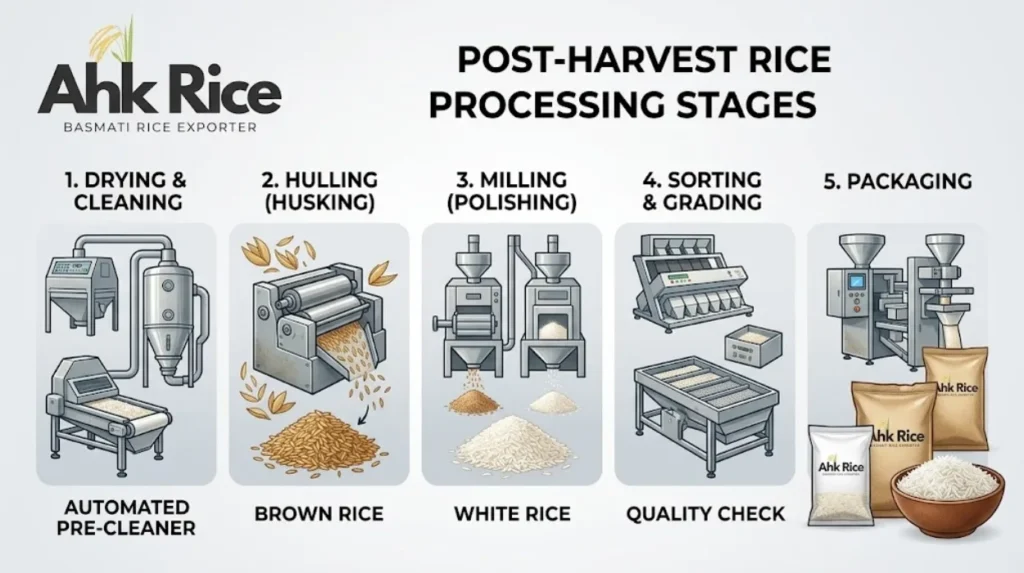
Rice processing transforms harvested paddy into export-ready rice through drying, cleaning, de-husking, polishing, grading, sorting, quality inspection, and packaging procedures that ensure consistency, food safety, and international trade compliance.
Processing begins immediately after harvesting.
Drying
Freshly harvested paddy contains elevated moisture levels. Drying reduces moisture to stable storage levels and prevents spoilage.
Cleaning
Processing facilities remove stones, dust, straw fragments, and foreign materials.
Modern cleaning equipment improves purity and protects downstream machinery.
De-Husking
Machines remove the outer husk layer from paddy rice.
The result becomes brown rice, which still contains bran layers.
Milling and Polishing
Milling removes bran layers to create white rice.
Polishing improves appearance and creates the bright finish preferred in many export markets.
Length Grading
Length graders separate rice according to grain size.
This stage helps maintain uniformity throughout each shipment.
Color Sorting
Optical sorting equipment identifies and removes defective grains.
Examples include discolored grains, damaged grains, immature grains, and foreign particles.
Final Quality Inspection
Inspectors verify moisture content, purity, grain length, and broken percentage.
Only compliant lots proceed to packaging and export preparation.
What packaging options do Malaysian buyers prefer?
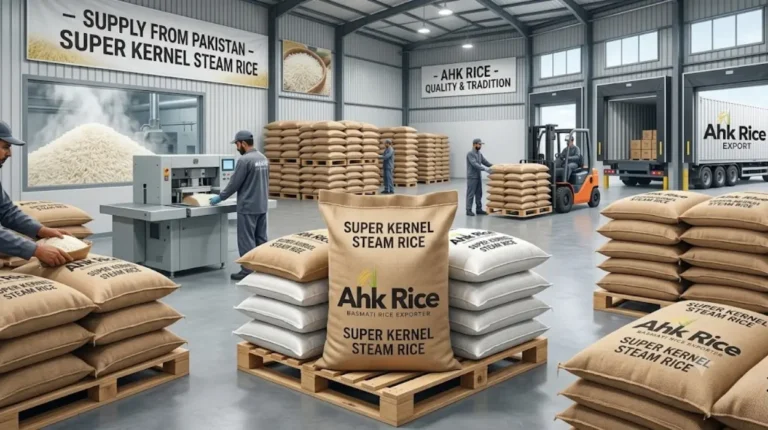
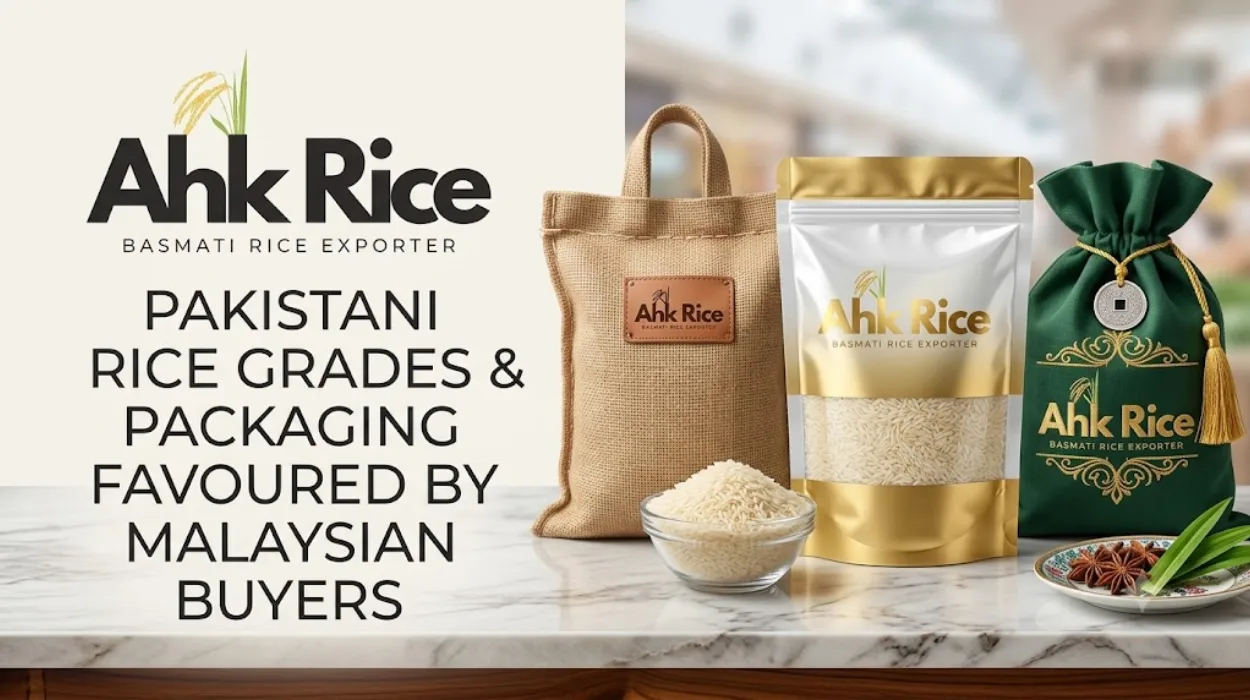
Malaysian buyers select packaging formats based on distribution channels, retail requirements, transportation efficiency, product positioning, and storage needs, with 1-kilogram, 5-kilogram, 10-kilogram, 25-kilogram, and 50-kilogram packaging formats being the most common.
Packaging affects product protection, branding, logistics efficiency, and shelf presentation.
Retail Packaging
Retail packaging targets supermarkets, grocery stores, and convenience retailers.
Common retail sizes include:
- 1 kg
- 2 kg
- 5 kg
- 10 kg
These formats improve convenience for household consumers.
Wholesale Packaging
Wholesale buyers prefer larger formats.
Examples include:
- 25 kg bags
- 50 kg bags
Restaurants, food distributors, and institutional buyers often purchase these sizes.
Packaging Materials
Several packaging materials support rice exports.
Examples include:
- Woven polypropylene bags
- BOPP laminated bags
- Paper bags
- Vacuum packaging
- Non-woven bags
Each material provides different levels of durability, presentation quality, and moisture protection.
Private Label Packaging
Many Malaysian importers request private label packaging.
Private labeling allows importers to market products under their own brand names while maintaining consistent product specifications.
Why do Malaysian buyers pay attention to rice grades and packaging?
Rice grades and packaging directly influence product quality, shelf life, transportation performance, consumer perception, inventory management, and profitability throughout the distribution chain.
Uniform grain size creates a consistent cooking experience.
Lower broken percentages improve visual quality.
Proper packaging protects rice against contamination and moisture exposure.
Retail packaging improves shelf appeal.
Bulk packaging reduces handling costs for commercial buyers.
These factors affect customer satisfaction and repeat purchases.
Importers therefore evaluate both product specifications and packaging standards before selecting suppliers.
Which certifications are important for rice exports to Malaysia?
Malaysian buyers review certifications because documented compliance demonstrates food safety, quality management, traceability, and international manufacturing standards throughout the rice supply chain.
Certification verifies that exporters follow established operational procedures.
Common certifications include:
ISO 22000
ISO 22000 focuses on food safety management systems.
The standard establishes procedures for identifying and controlling food safety risks.
HACCP
Hazard Analysis and Critical Control Points identifies critical stages where food safety controls must operate.
The system supports preventive risk management.
Halal Certification
Malaysia has a significant Muslim consumer population.
Halal certification confirms compliance with recognized Islamic dietary requirements.
Phytosanitary Certification
Government authorities issue phytosanitary certificates to confirm compliance with plant health regulations.
These documents support international agricultural trade.
Fumigation Certification
Fumigation certificates verify pest-control treatment before shipment.
Import authorities often review these documents during customs clearance procedures.
What are the main uses of Pakistani rice in Malaysia?
Pakistani rice serves multiple commercial and consumer applications, including household consumption, restaurant operations, catering services, food manufacturing, hospitality businesses, and institutional food programs.
Households purchase premium Basmati rice for daily cooking and special occasions.
Restaurants use aromatic rice varieties for biryani, pulao, and rice-based specialty dishes.
Hotels purchase premium grades to maintain consistent food quality.
Food manufacturers use selected rice varieties for packaged food production.
Institutional buyers purchase bulk quantities for schools, hospitals, and large catering operations.
Different applications require different grades, packaging sizes, and quality specifications.
What misconceptions exist about Pakistani rice grades and packaging?
Many buyers incorrectly assume all rice grades deliver identical quality, all packaging formats provide equal protection, and premium grades differ only in price, when measurable specification differences separate each category.
One misconception states that all Basmati rice varieties are identical.
In reality, varieties differ in grain length, aroma intensity, cooking expansion, and market positioning.
Another misconception states that packaging affects only appearance.
Packaging influences transportation performance, shelf life, moisture protection, and storage stability.
Some buyers also assume lower-priced grades indicate poor quality.
Different grades serve different market requirements. Commercial kitchens often prioritize cooking efficiency and cost management over premium presentation characteristics.
Understanding these distinctions improves purchasing decisions and supply chain planning.
How do Malaysian market preferences influence Pakistani rice exports?
Malaysian consumer preferences shape export specifications by influencing variety selection, grain standards, packaging formats, certification requirements, and quality expectations across different distribution channels.
Premium urban consumers often purchase long-grain aromatic Basmati rice.
Food service operators frequently balance quality with cost efficiency.
Retail chains prioritize attractive packaging and consistent specifications.
Distributors require packaging formats optimized for warehousing and transportation.
These requirements influence production planning, processing decisions, and packaging strategies throughout Pakistan’s export sector.
As Malaysian demand evolves, exporters adjust product offerings to align with changing consumer expectations and regulatory requirements.
Conclusion
Pakistani rice exports to Malaysia consist of multiple rice grades designed for different market segments. Premium varieties such as 1121 Basmati, Super Kernel Basmati, and 1509 Basmati support high-value retail and food service channels. Non-Basmati grades serve bulk commercial applications and cost-sensitive markets.
The journey from farm to Malaysian consumer involves cultivation, harvesting, drying, milling, grading, sorting, certification, and packaging. Packaging formats range from 1-kilogram retail bags to 50-kilogram wholesale sacks, while certifications such as ISO 22000, HACCP, Halal, phytosanitary, and fumigation documentation support international trade requirements.
Understanding rice grades and packaging preferences provides the foundation for understanding the commercial relationship between Malaysian buyers and Pakistani suppliers.
Frequently Asked Questions
Which Pakistani rice grade is most popular in Malaysia?
1121 Basmati rice is among the most popular premium grades because of its extra-long grain length, aroma, and cooking expansion characteristics.
What packaging size do Malaysian rice importers buy most often?
Importers commonly purchase 5 kg and 10 kg retail packs for supermarkets, while wholesalers and food service operators prefer 25 kg and 50 kg bags.
What is the difference between 1121 and Super Kernel Basmati rice?
1121 Basmati has longer grains and greater elongation after cooking. Super Kernel Basmati is known for its traditional aroma and balanced cooking characteristics.
Why are certifications important for rice exports?
Certifications verify food safety, quality management, traceability, and compliance with importing country requirements.
Which region produces most Pakistani Basmati rice?
Punjab produces the majority of Pakistan’s Basmati rice due to its fertile soils, irrigation infrastructure, and favorable climate conditions.