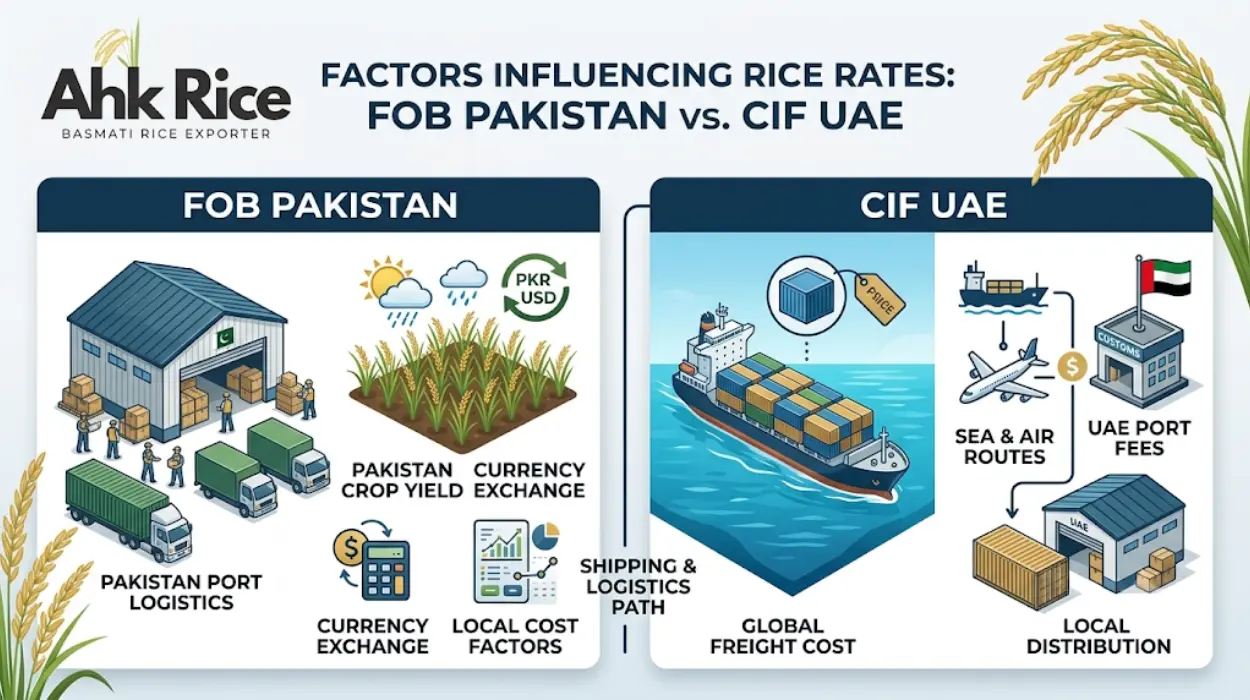
Factors Influencing 1121 Basmati Sella Rice FOB Pakistan and CIF UAE Rates
The most important factor influencing 1121 Basmati Sella Rice FOB Pakistan and CIF UAE rates is the combined impact of raw paddy prices, processing costs, export demand, and freight charges. Buyers who understand how these variables interact can evaluate quotations accurately, compare suppliers effectively, and make procurement decisions based on value rather than price alone.
Pakistan remains one of the world’s leading exporters of 1121 Basmati rice because of its ideal growing conditions in Punjab, established milling infrastructure, and strong trade links with Gulf markets. Companies such as AHK Rice provide end-to-end export solutions, enabling importers to source rice directly from origin while controlling quality, packaging, documentation, and logistics. Before evaluating supplier quotations, buyers should first understand the pricing mechanisms explained in this educational guide on how Pakistani Basmati rice export pricing works.
What Do FOB Pakistan and CIF UAE Rates Mean?
FOB rates represent the rice price up to loading at the Pakistani port, while CIF rates include freight and insurance costs until the cargo reaches the UAE. Understanding the difference helps importers compare quotations correctly and calculate their actual landed cost before purchasing decisions.
FOB stands for Free on Board. Under FOB terms, the exporter bears all costs until the goods are loaded onto the vessel at the departure port. The buyer assumes responsibility for ocean freight, insurance, customs clearance, and destination handling charges.
CIF stands for Cost, Insurance, and Freight. Under CIF terms, the exporter arranges transportation and insurance to the destination port. The buyer receives a more complete landed-cost quotation and faces fewer logistics management requirements.
For UAE buyers, CIF pricing is commonly preferred because it simplifies procurement and provides greater visibility into total import costs. However, large importers with freight contracts often prefer FOB purchases to negotiate shipping separately.
What Factors Influence 1121 Basmati Sella Rice FOB Pakistan Prices?
The FOB price of 1121 Basmati Sella Rice is determined primarily by paddy availability, processing costs, grade quality, market demand, packaging specifications, currency fluctuations, and export competition. Each factor directly impacts the final quotation received by international buyers.
1121 Basmati rice originates from carefully cultivated paddy grown in Punjab. When paddy prices increase during the procurement season, millers experience higher raw material costs. These increases immediately affect export pricing.
Processing costs also play a major role. Sella rice undergoes soaking, steaming, drying, milling, polishing, grading, sorting, and packing. Every stage consumes energy, labor, machinery, and quality-control resources.
Export demand significantly affects pricing. Strong buying activity from Gulf countries, Europe, North America, and Africa creates competition for available stocks. Higher demand generally increases FOB quotations.
Packaging requirements influence costs as well. Standard 25kg and 50kg PP bags are economical, while customized retail packaging requires additional materials, printing, and handling.
Exchange-rate movements between the Pakistani Rupee and the US Dollar affect exporter calculations. Since international trade transactions are generally settled in US Dollars, currency volatility impacts margins and pricing decisions.
How Do Different Grades of 1121 Basmati Sella Rice Compare?
Different grades of 1121 Basmati Sella Rice command different export values because grain length, purity, broken percentage, moisture level, and appearance directly influence buyer acceptance, retail positioning, and final market price.
The rice industry uses grading standards to classify products according to measurable specifications.
| Attribute | Premium Grade | Standard Export Grade | Economy Grade |
|---|---|---|---|
| Average Grain Length | 8.30 mm+ | 8.10 mm+ | 7.90 mm+ |
| Broken Grains | 1-2% | 3-5% | 5-10% |
| Purity | 95%+ | 90-95% | 85-90% |
| Moisture | 12-13% | 13% Max | 14% Max |
| Color Uniformity | Excellent | Good | Moderate |
| Foreign Matter | Minimal | Controlled | Higher Tolerance |
| Market Position | Premium Retail | Mainstream Retail | Value Segment |
Premium grades consistently achieve higher FOB rates because buyers receive better cooking performance, appearance, and consumer acceptance.
How Do FOB and CIF Pricing Structures Compare?
FOB and CIF pricing differ because freight and insurance costs become part of the CIF quotation. Importers must evaluate both structures carefully to determine the most cost-effective procurement strategy for their business model and shipment volume.
FOB vs CIF Comparison
| Factor | FOB Pakistan | CIF UAE |
|---|---|---|
| Rice Cost | Included | Included |
| Inland Transport | Included | Included |
| Export Documentation | Included | Included |
| Ocean Freight | Buyer Pays | Seller Pays |
| Insurance | Buyer Pays | Seller Pays |
| Freight Risk Management | Buyer | Seller |
| Cost Visibility | Moderate | High |
Small and medium importers often prefer CIF because budgeting becomes easier. Large trading companies frequently choose FOB because they already manage shipping logistics and can secure competitive freight rates.
Which Market Regions Influence Pricing the Most?
The Gulf region and African markets are among the strongest demand centers for Pakistani 1121 Basmati Sella Rice. Their purchasing preferences significantly influence export pricing trends, grade selection, packaging requirements, and shipment scheduling throughout the year.
UAE and GCC Market Preferences
The UAE serves as both a consumer market and a redistribution hub for the Gulf region.
Importers in Dubai, Abu Dhabi, and Sharjah generally prefer premium and standard export grades. Demand is driven by supermarkets, foodservice operators, restaurants, and wholesale distributors.
Typical preferences include:
- Premium grain length
- Low broken percentage
- Branded retail packs
- Attractive packaging
- Consistent cooking performance
African Market Preferences
Many African importers prioritize value-oriented procurement.
Common purchasing preferences include:
- Competitive pricing
- Larger shipment volumes
- Standard export grades
- 25kg and 50kg packaging
- Reliable shipment schedules
These differing preferences create separate demand patterns that influence Pakistani export pricing throughout the year.
How Does Freight Impact CIF UAE Rates?
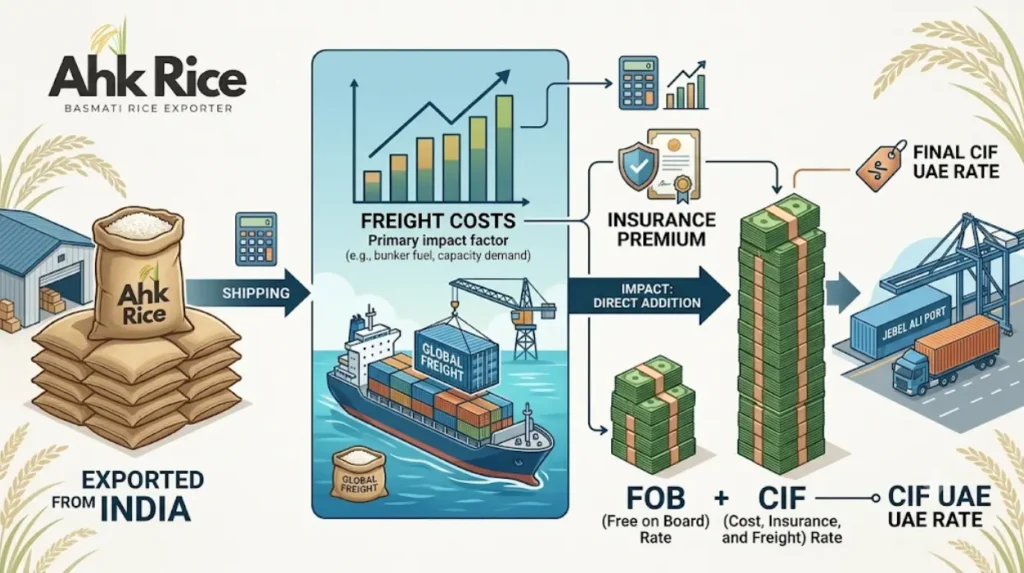
Freight costs are one of the most dynamic components of CIF pricing because shipping rates fluctuate according to fuel costs, vessel availability, seasonal demand, port congestion, and international logistics conditions.
Even when FOB rice prices remain stable, CIF rates may increase because freight charges rise.
Major freight variables include:
- Container availability
- Fuel surcharges
- Shipping line capacity
- Seasonal trade demand
- Port handling costs
- Marine insurance premiums
For UAE-bound cargo, transit times are relatively short compared with Europe or North America. This logistical advantage helps maintain competitive CIF rates for Pakistani rice exporters.
How Long Is the Shelf Life of 1121 Basmati Sella Rice?
Properly processed and stored 1121 Basmati Sella Rice offers an extended shelf life, making it suitable for international trade, long-distance shipping, wholesale inventory management, and retail distribution across multiple markets.
Shelf Life Comparison
| Product Type | Expected Shelf Life |
|---|---|
| 1121 Sella Rice | 24 Months |
| 1121 Steam Rice | 18–24 Months |
| White Basmati Rice | 12–18 Months |
Storage conditions remain critical.
Rice should be protected from:
- Excess moisture
- Direct sunlight
- Extreme temperatures
- Pest contamination
- Damaged packaging
Consistent storage practices preserve grain quality throughout the supply chain.
What Are the Available Procurement Solutions?
Importers can source rice through traders, distributors, brokers, or direct exporters. Each procurement model offers different advantages regarding pricing transparency, quality control, communication efficiency, and long-term supply reliability.
Trader-Based Procurement
Traders aggregate products from multiple suppliers.
Advantages include supplier diversity and market access.
Disadvantages include reduced traceability and less direct quality oversight.
Broker-Based Procurement
Brokers connect buyers and sellers.
Advantages include sourcing support and negotiation assistance.
Disadvantages include additional intermediary costs.
Direct Export Procurement
Direct sourcing from exporters such as AHK Rice export services provides greater visibility into production, grading, packaging, and documentation.
Advantages include:
- Better quality control
- Faster communication
- Customized packaging
- Improved traceability
- Long-term supply consistency
Which Procurement Method Works Best for Different Buyers?
The ideal sourcing method depends on shipment volume, procurement experience, quality requirements, logistics capabilities, and desired supplier relationships. Different buyer profiles benefit from different procurement strategies and operational structures.
Decision Framework
| Buyer Situation | Recommended Method | Reason |
|---|---|---|
| First-Time Importer | CIF Direct Export | Simplified logistics |
| Retail Brand | Direct Export | Packaging control |
| Large Distributor | FOB Direct Export | Freight flexibility |
| Commodity Trader | Trader Network | Market access |
| Foodservice Chain | Direct Export | Consistent quality |
Selecting the appropriate sourcing model reduces operational risks and improves procurement efficiency.
What Are the Main Pros and Cons Buyers Should Evaluate?
Every pricing structure and sourcing method involves trade-offs. Buyers achieve better outcomes when they compare total value, operational control, risk exposure, and long-term supply stability instead of focusing solely on headline prices.
FOB Procurement
Pros
- Greater freight control
- Flexible logistics options
- Potential freight savings
Cons
- More operational complexity
- Additional logistics management
- Higher coordination requirements
CIF Procurement
Pros
- Simpler purchasing process
- Predictable landed costs
- Reduced logistics burden
Cons
- Less freight flexibility
- Limited carrier selection
Direct Export Sourcing
Pros
- Better transparency
- Stronger quality control
- Direct communication
Cons
- Supplier qualification required
- Relationship-building effort
What Decision Factors Should Importers Prioritize?
Successful rice procurement depends on evaluating quality specifications, total landed cost, supplier capability, shipment reliability, documentation compliance, and long-term consistency rather than focusing exclusively on the lowest quoted rate available in the market.
Importers should assess:
- Grade specifications.
- Broken percentage.
- Packaging requirements.
- Freight terms.
- Export certifications.
- Supply consistency.
- Historical shipment performance.
- Documentation accuracy.
- Market demand trends.
- Total landed cost.
A comprehensive evaluation framework leads to stronger purchasing decisions and more predictable business outcomes.
1121 Basmati Sella Rice FOB Pakistan and CIF UAE rates are influenced by multiple interconnected variables including paddy costs, processing expenses, grade quality, export demand, freight charges, packaging requirements, and market preferences. Buyers who understand these factors can compare quotations more effectively, select appropriate sourcing models, and optimize procurement strategies based on total value rather than price alone.
Frequently Asked Questions
Why does the FOB price of 1121 Basmati Sella Rice change throughout the year?
FOB prices fluctuate because paddy procurement costs, export demand, exchange rates, processing expenses, and market availability change throughout the season. Higher demand and limited supply generally increase export prices.
Which is better for UAE importers, FOB or CIF?
CIF is often preferred by small and medium importers because freight and insurance are included. FOB is generally preferred by larger importers that manage their own shipping arrangements.
What is the most important quality factor affecting export prices?
Grain length, purity, broken percentage, color consistency, and moisture content are the primary quality indicators influencing export pricing.
Does packaging affect rice export rates?
Yes. Customized retail packaging, printed bags, private labeling, and specialized materials increase production and packing costs, resulting in higher export quotations.
How can buyers compare quotations accurately?
Buyers should compare grade specifications, broken percentage, packaging type, shipment terms, certifications, freight inclusions, and total landed cost instead of comparing price alone.