Supplier Evaluation Criteria Used by Malaysian Rice Importers When Buying from Pakistan
Malaysian rice importers select Pakistani suppliers based on quality consistency, export compliance, logistics performance, pricing transparency, and long-term supply reliability. Here is why: rice import businesses operate on thin margins, strict food regulations, and continuous inventory requirements. A supplier that fails in one area can disrupt an entire distribution network.
Malaysia remains an important destination for Pakistani rice exports because consumers value aromatic Basmati varieties and food service operators require dependable supply chains. Importers therefore evaluate suppliers through measurable procurement criteria rather than marketing claims.
Understanding these criteria helps exporters align their operations with buyer expectations. It also helps procurement teams create objective supplier selection frameworks. Businesses seeking broader market insights can also explore how Pakistani rice demand evolves across global destinations through our guide on Pakistani Basmati rice opportunities in North African markets.
Pakistani exporters such as basmati rice exporter pakistan AHK Rice’s export services operate within this competitive environment by supplying 1121 Basmati, Super Kernel Basmati, and 1509 Basmati to international buyers while managing processing, packaging, documentation, and export logistics.
What supplier evaluation criteria do Malaysian rice importers use?
Quality consistency, export compliance, logistics reliability, certification status, pricing transparency, packaging flexibility, and supply capacity form the seven core criteria used by Malaysian buyers when selecting Pakistani rice suppliers.
Malaysian rice importers define supplier evaluation as a structured procurement process used to reduce operational risk. Every criterion influences profitability, product quality, and customer satisfaction.
Importers rarely evaluate only price. Low-cost rice can create higher costs later through quality claims, shipment delays, or customer complaints.
Quality evaluation criteria
Rice quality determines consumer acceptance and repeat purchases. Malaysian importers assess:
- Grain length
- Grain uniformity
- Broken percentage
- Moisture content
- Purity level
- Aroma retention
- Cooking performance
Laboratories inspect samples before contracts are finalized. Buyers compare sample results against contract specifications.
Compliance evaluation criteria
Compliance ensures imported rice meets Malaysian food safety regulations.
Importers inspect:
- Phytosanitary certificates
- Fumigation certificates
- Health certificates
- Certificate of Origin
- Laboratory reports
- Export documentation
Documentation accuracy reduces customs clearance delays.
Supplier evaluation comparison table
| Evaluation Attribute | What Malaysian Buyers Check | Importance Level |
|---|---|---|
| Grain Quality | Length, purity, broken ratio | Very High |
| Certifications | ISO, HACCP, food safety systems | Very High |
| Export Experience | Market history and references | High |
| Packaging Options | Retail and bulk flexibility | High |
| Logistics Performance | Shipping schedules and delivery consistency | Very High |
| Pricing Structure | Transparency and stability | High |
| Production Capacity | Ability to fulfill recurring orders | Very High |
Quality and compliance establish supplier credibility. The next question becomes how different supplier approaches compare in practice.
How do different supplier approaches compare?
Integrated exporters provide greater consistency, while trader-based sourcing offers flexibility but creates higher variability in quality, documentation, and shipment control.
Pakistani rice suppliers generally operate through different business models. Malaysian importers compare these models before committing to long-term contracts.
Integrated processing exporters
Integrated exporters control multiple stages.
They:
- Procure paddy
- Mill rice
- Grade rice
- Sort rice
- Inspect rice
- Package products
- Dispatch shipments
This structure improves traceability.
Integrated operations simplify quality control because the same organization manages the entire process.
Trading companies
Trading companies source rice from multiple mills.
This approach can increase sourcing flexibility. It can also create variation between shipments because products originate from different facilities.
Buyers often require additional inspections when working with multiple-source suppliers.
Comparative evaluation
| Factor | Integrated Exporter | Trading Company |
|---|---|---|
| Quality Consistency | Higher | Variable |
| Traceability | Strong | Moderate |
| Documentation Control | Strong | Moderate |
| Supply Stability | High | Moderate |
| Product Customization | High | Variable |
| Procurement Flexibility | Moderate | High |
Malaysian importers typically prioritize consistency because retail and food service customers expect predictable quality.
Consistency matters differently across buyer categories. Understanding those differences helps determine which approach works best.
Which supplier type works best for different Malaysian buyer segments?
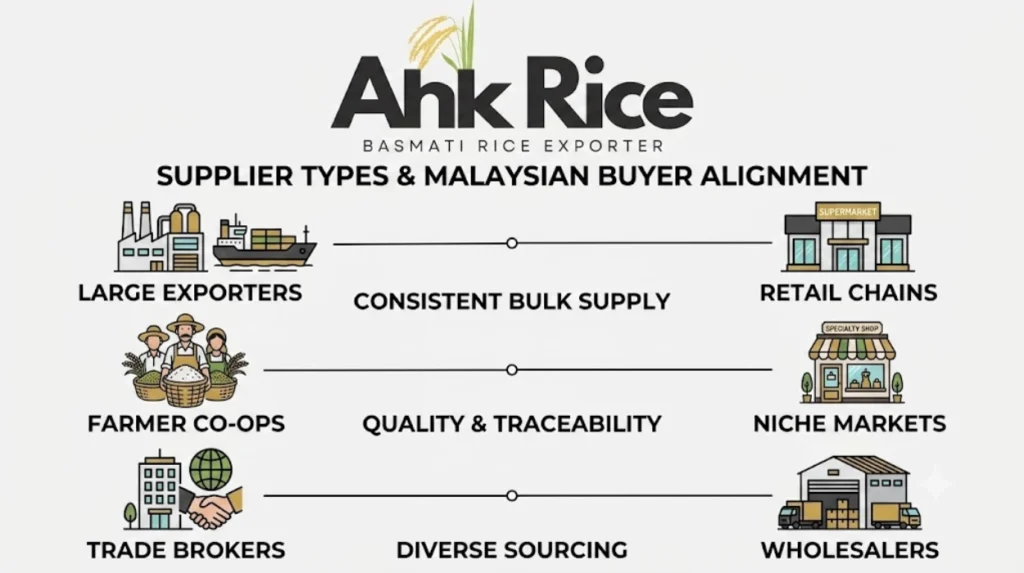
Retail distributors prioritize consistency, food service operators prioritize value, and wholesalers prioritize supply continuity and pricing competitiveness.
Different procurement objectives require different supplier strengths.
Retail distributors
Retail brands sell directly to consumers.
Consumers notice:
- Grain appearance
- Aroma
- Cooking expansion
- Packaging quality
Retail-focused buyers therefore emphasize quality assurance and packaging capabilities.
Food service operators
Hotels, restaurants, and catering companies evaluate rice differently.
Food service buyers prioritize:
- Cooking yield
- Cost efficiency
- Consistent texture
- Bulk packaging
A slightly lower-cost grade can significantly improve operational margins.
Wholesale importers
Wholesale businesses distribute rice to multiple downstream customers.
Supply continuity becomes critical because inventory shortages affect multiple buyers simultaneously.
Wholesalers therefore evaluate production capacity and shipment reliability more heavily.
Regional preference comparison
Different Malaysian regions often show distinct purchasing preferences.
| Region | Preferred Grades | Primary Buyer Focus |
|---|---|---|
| Peninsular Malaysia | 1121 Basmati, Super Kernel | Premium retail and hospitality |
| East Malaysia | 1509 Basmati, Standard Basmati grades | Value-focused distribution |
Regional demand influences procurement strategies. Price and shelf life then become the next major evaluation factors.
How do Malaysian importers compare price and shelf life?
Importers evaluate total value rather than purchase price alone, comparing shelf life, storage stability, cooking yield, and customer acceptance alongside cost per metric ton.
Rice pricing affects profitability. Shelf life affects inventory risk.
Both factors must be evaluated together.
Price comparison by grade
Average export prices fluctuate throughout the year based on crop conditions and global demand.
| Rice Grade | Typical Export Price Position |
|---|---|
| 1121 Basmati | Premium |
| Super Kernel Basmati | Upper Mid-Range |
| 1509 Basmati | Competitive Value |
| Non-Basmati Long Grain | Budget-Oriented |
Price alone does not determine value.
1121 Basmati commands premium pricing because of its grain length, aroma, and cooking expansion.
1509 Basmati offers a balance between affordability and premium characteristics.
Shelf life comparison
| Rice Type | Typical Commercial Shelf Life |
|---|---|
| Steam Basmati | 12–18 months |
| White Basmati | 12–18 months |
| Golden Sella Basmati | 18–24 months |
| Parboiled Rice | 18–24 months |
Golden Sella lasts longer than Steam rice. In high-temperature storage environments, Golden Sella maintains grain stability for extended periods. Distributors managing large inventories often prefer this specification.
Longer shelf life reduces inventory loss. Reduced inventory loss improves overall procurement value.
Price and shelf life create measurable value. The next step is evaluating advantages and disadvantages of supplier selection methods.
What are the pros and cons of common supplier evaluation methods?
Factory audits provide operational visibility, sample testing validates quality, documentation reviews confirm compliance, and trial shipments verify real-world performance before large contracts.
Importers use several evaluation methods simultaneously.
Factory audits
Pros:
- Verify production capabilities
- Verify quality systems
- Verify hygiene standards
Cons:
- Require travel costs
- Require scheduling resources
Example: A Malaysian importer can directly inspect milling lines, sorting equipment, and packaging operations.
Sample testing
Pros:
- Confirm specifications
- Measure cooking performance
- Compare suppliers objectively
Cons:
- Small samples may not represent full production batches
Example: Laboratory testing verifies moisture content before procurement approval.
Documentation reviews
Pros:
- Verify compliance
- Verify certifications
- Verify export readiness
Cons:
- Documents alone cannot confirm operational performance
Example: HACCP documentation demonstrates food safety procedures.
Trial shipments
Pros:
- Validate actual performance
- Verify logistics reliability
- Verify shipment consistency
Cons:
- Require longer evaluation periods
Example: A container trial reveals whether quality remains consistent after transit and storage.
Each method addresses different risks. Combining methods creates a stronger procurement framework.
What decision factors determine the final supplier selection?
Risk reduction, quality assurance, supply continuity, market positioning, and long-term profitability determine final supplier approval decisions.
Procurement teams often use weighted scoring systems.
Each criterion receives a score based on strategic importance.
Supplier decision framework
| Decision Factor | Procurement Question | Priority |
|---|---|---|
| Quality Assurance | Can quality remain consistent every shipment? | Critical |
| Regulatory Compliance | Can products clear Malaysian regulations smoothly? | Critical |
| Supply Capacity | Can volume increase during demand growth? | High |
| Commercial Stability | Are pricing policies predictable? | High |
| Logistics Reliability | Can shipments arrive according to schedule? | Critical |
Long-term partnership evaluation
Importers rarely seek one-time transactions.
They evaluate:
- Response times
- Problem resolution
- Contract flexibility
- Production planning
- Communication quality
Reliable communication reduces operational uncertainty.
Reliable planning improves inventory management.
Strong partnerships create sustainable procurement outcomes.
Supplier evaluation ultimately combines measurable quality metrics with operational reliability. Buyers who assess both dimensions consistently achieve better procurement performance.
Frequently Asked Questions
How do Malaysian importers verify Pakistani rice quality?
Malaysian importers verify quality through laboratory testing, physical inspections, cooking evaluations, and shipment sample approvals before signing supply contracts.
Which certification is most important for rice exports to Malaysia?
Food safety certifications, phytosanitary certificates, fumigation certificates, and export compliance documents are among the most important requirements for Malaysian imports.
Why do Malaysian buyers request rice samples?
Rice samples allow buyers to inspect grain length, purity, moisture levels, aroma, and cooking performance before placing commercial orders.
Which Pakistani Basmati variety is most popular in Malaysia?
1121 Basmati remains one of the most demanded varieties because of its extra-long grain, aroma, and cooking expansion characteristics.
Do Malaysian importers focus only on rice price?
No. Importers evaluate total value by considering quality consistency, logistics reliability, shelf life, compliance standards, and customer satisfaction.
How important is logistics performance in supplier selection?
Logistics performance is critical because delayed shipments can create inventory shortages, increase storage costs, and disrupt distribution schedules.