What Quality Standards Must Pakistani Basmati Rice Meet for Saudi Imports?
Pakistani Basmati rice imported into Saudi Arabia must comply with Saudi Food and Drug Authority (SFDA) regulations, Gulf Standardization Organization (GSO) food standards, phytosanitary requirements, residue limits, labeling rules, and quality specifications related to grain length, moisture, purity, and contamination levels. Here is why: Saudi Arabia is one of the largest importers of Pakistani Basmati rice, and every shipment undergoes document verification, laboratory testing, and quality inspections before market entry (source: SFDA Food Import Regulations 2026; REAP export data, December 2025).
Saudi Arabia imports significant volumes of Pakistani Basmati rice because the rice matches local consumer preferences for long grains, aroma retention, and high cooking elongation. Pakistani Basmati varieties such as 1121, Super Kernel, and 1509 dominate retail, wholesale, catering, and hospitality channels across the Kingdom.
Rice exporters must understand more than grain quality. Saudi import compliance includes production standards, processing controls, food safety systems, export documentation, and packaging regulations. Understanding these requirements helps explain why only certified and tested rice successfully enters the Saudi market.
What quality standards apply to Pakistani Basmati rice exports to Saudi Arabia?
Saudi imports require compliance with SFDA regulations, GSO food standards, moisture levels below 14%, high purity percentages, phytosanitary certification, residue testing, and accurate Arabic-English labeling.
Saudi Arabia regulates imported rice through the Saudi Food and Drug Authority. SFDA establishes food safety requirements that apply to all imported grains. Pakistani Basmati rice must satisfy these standards before customs clearance and distribution.
Quality standards begin at the milling stage. Rice mills inspect paddy quality, remove impurities, control moisture, and verify grain consistency. These controls help maintain compliance throughout the export process.
Saudi buyers commonly specify measurable quality parameters. These parameters include grain length, broken percentage, moisture content, damaged kernels, foreign matter, and cooking performance. Importers often include these specifications directly in procurement contracts.
Food safety standards represent another critical requirement. Rice shipments undergo testing for pesticide residues, heavy metals, microbiological contamination, and prohibited substances according to Saudi import regulations.
Documentation supports physical inspections. Exporters submit certificates proving product safety, origin, and phytosanitary compliance before shipment arrival.
With the regulatory framework established, the next question is how Pakistani Basmati rice achieves these standards through processing.
How does Pakistani Basmati rice meet Saudi import requirements?
Pakistani Basmati rice meets Saudi requirements through controlled cultivation, scientific milling, laboratory testing, certification procedures, and export inspections conducted before shipment dispatch.
Quality compliance begins during cultivation in Punjab. Punjab produces most Pakistani Basmati rice because the region provides fertile soil, irrigation networks, and climatic conditions suitable for aromatic rice production.
The process follows a structured sequence.
How is Basmati rice processed before export?
- Clean the harvested paddy.
- Dry the paddy to target moisture levels.
- De-husk the grain.
- Separate immature kernels.
- Polish the rice.
- Grade by size and quality.
- Sort through color sorting machines.
- Inspect physical specifications.
- Pack according to buyer requirements.
Each processing stage removes quality risks. Cleaning removes stones and dust. De-husking separates husks from kernels. Color sorting eliminates discolored grains. Final grading creates uniform export lots.
Laboratory testing follows processing. Testing verifies moisture levels, broken percentages, purity rates, and food safety parameters. Results support export documentation required by Saudi authorities.
Inspection agencies frequently verify shipment conformity before container loading. These inspections reduce rejection risks at destination ports.
With processing explained, the next question concerns the specific quality components Saudi buyers evaluate.
What quality components do Saudi rice importers inspect?
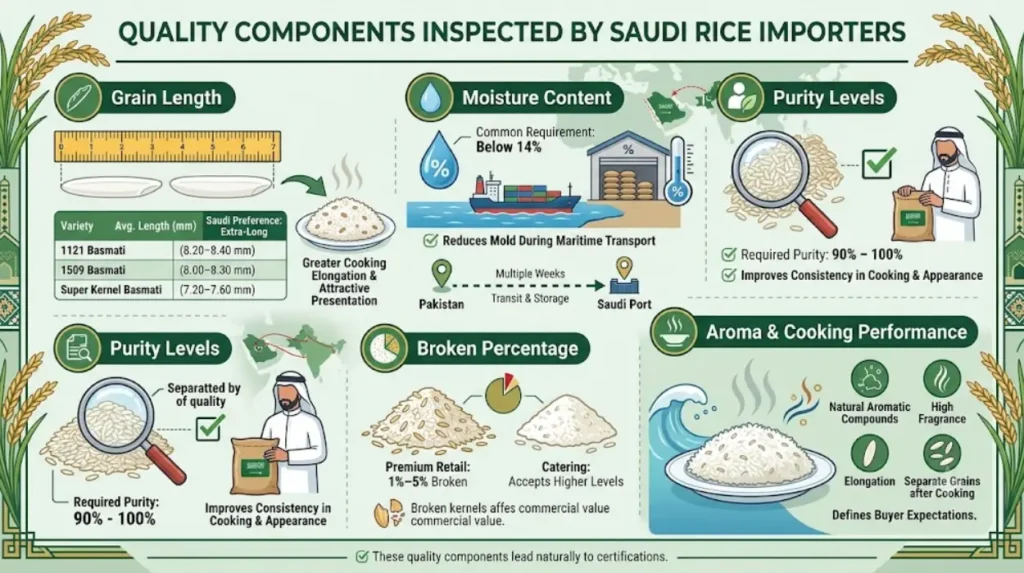
Saudi importers primarily inspect grain length, aroma, purity, moisture content, broken percentage, cooking elongation, residue compliance, and packaging integrity.
Saudi buyers often compare grain length, cooking elongation, and market suitability before selecting a variety. A detailed comparison of popular Saudi import grades explains how different specifications affect purchasing decisions in our guide on choosing between 1121 and 1509 Basmati varieties for Saudi procurement requirements.
Grain Length
Basmati rice is distinguished by naturally long grains. Saudi retail consumers prefer extra-long grain varieties because they produce attractive presentation after cooking.
Common export specifications include:
| Variety | Average Grain Length |
|---|---|
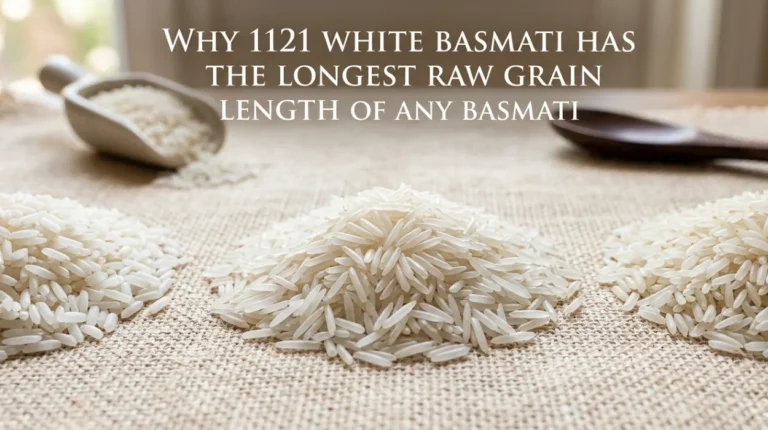
| 1121 Basmati | 8.20–8.40 mm |
| 1509 Basmati | 8.00–8.30 mm |
| Super Kernel Basmati | 7.20–7.60 mm |
Longer grains generally achieve higher cooking elongation ratios.
Moisture Content
Moisture affects shelf life and storage stability. Saudi import specifications commonly require moisture below 14%.
Lower moisture reduces mold development during maritime transport. Container shipments traveling from Pakistan to Saudi ports typically spend several weeks in transit and storage.
Purity Levels
Purity refers to the percentage of rice matching the declared variety. Saudi importers often require purity levels between 90% and 100%, depending on contract specifications.
Higher purity improves consistency in cooking behavior and visual appearance.
Broken Percentage
Broken kernels influence commercial value. Premium Saudi retail segments frequently require 1% to 5% broken rice, while catering sectors often accept higher levels.
Aroma and Cooking Performance
Basmati rice derives value from natural aromatic compounds. Saudi consumers prefer rice that delivers fragrance, elongation, and separate grains after cooking.
These quality components define buyer expectations, leading naturally to the certifications supporting compliance.
Which certifications are required for Saudi Basmati rice imports?
Phytosanitary certification, certificate of origin, food safety certifications, laboratory reports, and export compliance documents are required for successful Saudi import clearance.
Certification verifies that rice complies with international and Saudi regulations.
Phytosanitary Certificate
National Plant Protection Organizations issue phytosanitary certificates. These certificates confirm that rice shipments are free from regulated pests and diseases.
Saudi customs authorities require this document for agricultural imports.
Certificate of Origin
A certificate of origin confirms Pakistan as the production source. Chambers of commerce typically authenticate this document before export.
Food Safety Certifications
Common certifications include:
- ISO 22000
- HACCP
- BRCGS
- FSSC 22000
These certifications demonstrate structured food safety management systems.
Laboratory Test Reports
Laboratories verify:
- Pesticide residues
- Heavy metals
- Moisture content
- Microbiological safety
- Physical specifications
Saudi buyers often request these reports before shipment approval.
Export Documentation
Required documents commonly include:
- Commercial Invoice
- Packing List
- Bill of Lading
- Certificate of Origin
- Phytosanitary Certificate
- Health Certificate
- Laboratory Reports
These certifications establish compliance, which directly contributes to importer confidence and commercial benefits.
What benefits do Saudi importers gain from compliant Pakistani Basmati rice?
Compliant Pakistani Basmati rice provides regulatory approval, consistent quality, reduced rejection risks, longer shelf life, and stronger consumer acceptance.
Regulatory compliance reduces customs delays. Saudi authorities process properly documented shipments more efficiently than shipments requiring corrective actions.
Consistent grain quality improves customer satisfaction. Retail buyers expect uniform cooking performance across every package purchased.
Food safety compliance protects brand reputation. Importers avoid commercial losses associated with rejected shipments or product recalls.
Extended shelf stability creates logistical advantages. Rice with controlled moisture maintains quality during warehousing and distribution.
Commercial predictability improves procurement planning. Importers can forecast product performance more accurately when quality specifications remain consistent.
These benefits explain widespread Saudi demand, which raises the question of where compliant Pakistani Basmati rice is used.
Where is Pakistani Basmati rice used in the Saudi market?
Pakistani Basmati rice serves retail consumers, foodservice distributors, hospitality operators, catering companies, and institutional food procurement programs throughout Saudi Arabia.
Saudi retail markets represent the largest consumer segment. Families purchase Basmati rice for traditional dishes requiring long grains and aromatic characteristics.
Hospitality operators use premium Basmati grades in hotels and restaurants. Consistent cooking performance supports large-scale meal preparation.
Catering companies purchase significant volumes for weddings, corporate events, and religious gatherings. These buyers prioritize grain elongation and plate presentation.
Institutional procurement programs source rice for educational, healthcare, and workforce catering operations. Cost efficiency and quality consistency drive purchasing decisions.
Food distributors supply wholesalers and independent retailers throughout major Saudi cities including Riyadh, Jeddah, Dammam, and Medina.
These applications demonstrate market demand, but several misconceptions continue to influence buyer decisions.
What misconceptions exist about Saudi rice import standards?
The most common misconceptions involve assuming all Basmati grades qualify automatically, believing certification alone guarantees approval, and treating quality standards as identical across all buyer segments.
Many buyers assume every Basmati variety satisfies Saudi specifications. Actual requirements depend on contractual specifications, market positioning, and intended use.
Certification alone does not guarantee import approval. Laboratory compliance, shipment inspections, and documentation accuracy remain necessary throughout the export process.
Another misconception involves grain length. Longer grain does not automatically indicate superior quality. Purity, aroma, moisture control, and cooking performance also influence commercial value.
Some importers treat retail and catering specifications as identical. Retail markets frequently demand stricter broken percentages and presentation quality than bulk foodservice sectors.
Another misunderstanding concerns packaging. Packaging compliance includes labeling accuracy, traceability information, and regulatory requirements in addition to physical bag quality.
Correcting these misconceptions helps buyers evaluate suppliers and specifications more effectively.
Why does Saudi Arabia continue importing large volumes of Pakistani Basmati rice?
Pakistani Basmati rice combines recognized aroma, long-grain characteristics, competitive supply capacity, and compliance with Saudi food safety requirements.
Pakistan remains one of the world’s leading Basmati exporters (source: Pakistan Bureau of Statistics FY2024-25). Punjab produces the majority of export-quality Basmati rice through established cultivation systems and specialized milling infrastructure.
Pakistani varieties align closely with Saudi culinary preferences. Long grains, aroma retention, and strong elongation performance support traditional rice dishes consumed throughout the Kingdom.
Export infrastructure also supports large-scale supply. Modern rice mills inspect, grade, sort, certify, and dispatch rice according to international specifications.
Compliance systems continue evolving as Saudi regulations become increasingly focused on food safety, traceability, and product transparency. Exporters that maintain these standards strengthen long-term access to one of the most important Basmati import markets in the world.
Frequently Asked Questions
What is the maximum moisture level allowed for Pakistani Basmati rice imported into Saudi Arabia?
Saudi importers generally require Basmati rice with a moisture content below 14%. Lower moisture helps maintain grain quality during storage, transportation, and distribution. It also reduces the risk of mold growth and quality deterioration during shipping.
Which Pakistani Basmati rice varieties are most popular in Saudi Arabia?
The most imported Pakistani Basmati varieties in Saudi Arabia are 1121 Basmati, 1509 Basmati, and Super Kernel Basmati. These varieties are preferred because of their long grain length, natural aroma, and strong cooking elongation that match Saudi consumer preferences.
What documents are required to export Basmati rice to Saudi Arabia?
Saudi-bound rice shipments typically require a Phytosanitary Certificate, Certificate of Origin, Commercial Invoice, Packing List, Bill of Lading, Health Certificate, and Laboratory Test Reports. These documents support customs clearance and food safety compliance.
Why do Saudi importers prefer certified Basmati rice suppliers?
Certified suppliers follow recognized food safety and quality management systems such as ISO 22000, HACCP, BRCGS, and FSSC 22000. These certifications help ensure product consistency, traceability, and compliance with Saudi food import regulations.
How is Pakistani Basmati rice tested before export to Saudi Arabia?
Export-quality Basmati rice undergoes laboratory testing for moisture content, purity levels, broken percentage, pesticide residues, heavy metals, and microbiological safety. Testing verifies that the rice meets both international standards and Saudi import requirements.