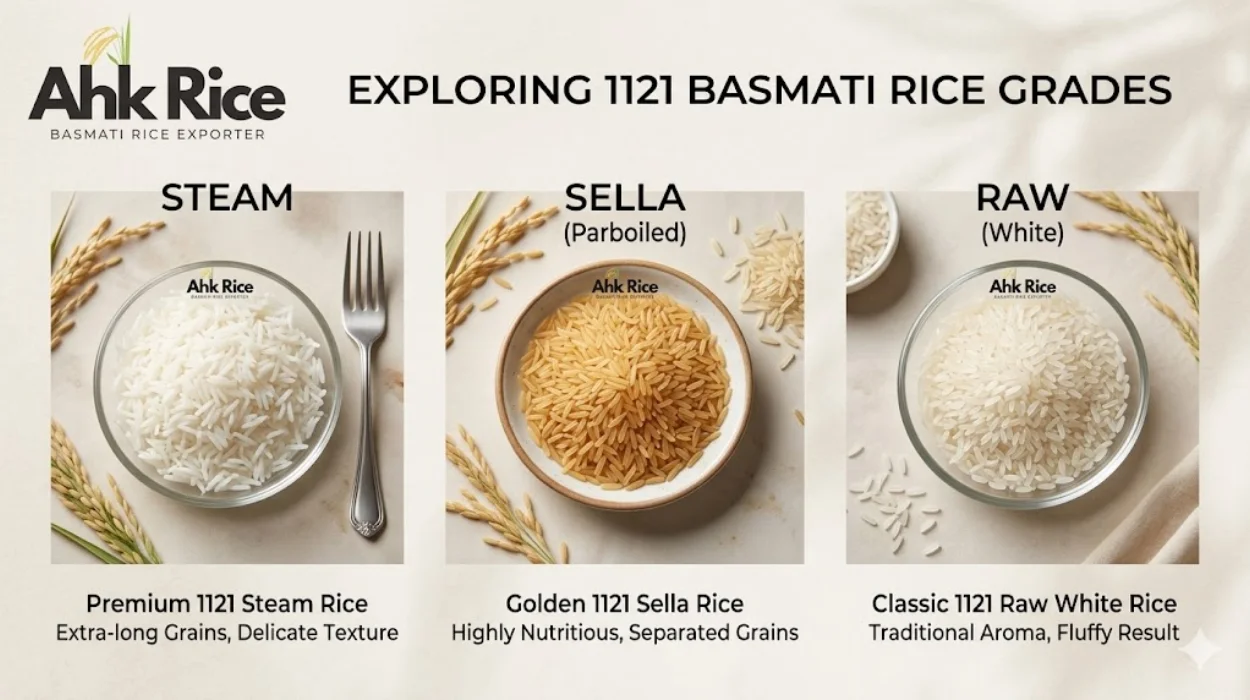
Different Grades of 1121 Basmati Rice Explained
1121 Basmati rice is available in multiple processing grades, including White, Steam, Golden Sella, Creamy Sella, Brown, and broken rice categories. Here is why: each grade undergoes a different processing method, resulting in distinct color, texture, cooking performance, shelf life, and market demand.
1121 Basmati rice stands among the longest grain rice varieties cultivated in Pakistan and India. The variety is known for its exceptional grain length, aromatic profile, and elongation after cooking. Global importers source different grades according to consumer preferences, food service requirements, storage conditions, and price targets.
Understanding these grades helps importers, distributors, wholesalers, and retailers select the correct specification for their markets.
What Is 1121 Basmati Rice?
1121 Basmati rice is a premium extra-long grain aromatic rice variety with raw grain lengths of approximately 8.20–8.50 mm and cooked elongation exceeding 18 mm.
1121 Basmati rice was developed to improve grain length, yield, and cooking performance. Farmers cultivate the variety primarily in the Punjab region of Pakistan. The fertile plains, irrigation systems, and climate conditions support the development of long grains and distinctive aroma.
1121 Basmati rice contains natural aromatic compounds that create the characteristic fragrance associated with premium Basmati varieties. Importers prefer the variety because it delivers visual appeal, consistent cooking results, and high consumer acceptance.
The variety serves retail consumers, restaurants, catering companies, food processors, and hospitality businesses across Asia, the Middle East, Europe, Africa, and North America.
With the definition of 1121 Basmati rice established, the next question is how different grades emerge during processing.
What Does 1121 Rice Mean in Basmati Rice Grades?
1121 refers to the rice variety, while White, Steam, Sella, and similar terms identify its processing grade. The number 1121 does not describe the colour, cooking method, or broken percentage of the rice. It identifies a specific long-grain Basmati variety used in commercial rice specifications.
This distinction is important when discussing Basmati rice grades. A buyer can request 1121 White, 1121 Steam, or 1121 Golden Sella because the same variety is processed in different ways. The variety establishes the underlying grain characteristics, while the processing grade describes what happens to the paddy during milling and heat treatment.
Rice grades can also include measurable quality attributes such as grain length, broken percentage, moisture, purity, appearance, and cooking performance. Therefore, a complete export specification combines the variety with the processing type and the required quality parameters.
For example, “1121 Steam” identifies the 1121 variety processed with steam treatment, while “1121 Golden Sella” identifies the same variety processed through parboiling. This explains why different 1121 grades can have different colours, textures, grain strength, and cooking behaviour while remaining part of the same Basmati variety.
How Are Different Grades of 1121 Basmati Rice Produced?
9 major processing steps create different 1121 Basmati grades: cleaning, drying, storage, dehusking, milling, polishing, parboiling, grading, and sorting.
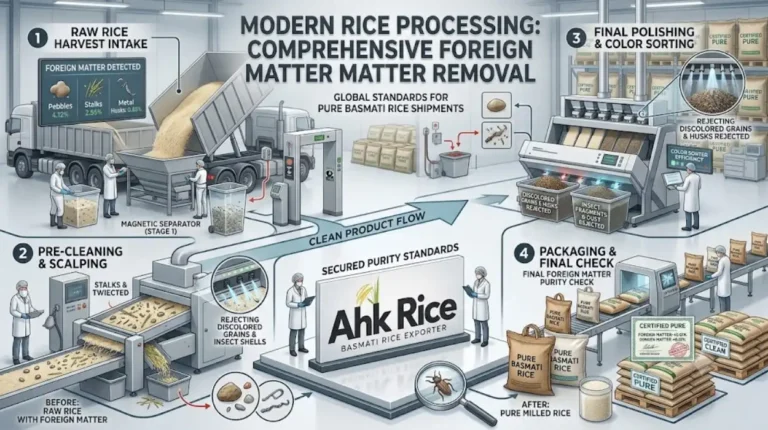
Rice processors transform harvested paddy into specific commercial grades through controlled operations. Each processing stage changes the appearance and performance of the rice.
White Rice Processing
White 1121 Basmati rice follows a direct milling process.
- Clean the harvested paddy.
- Dry the paddy to target moisture levels.
- Store the paddy for aging.
- De-husk the grain.
- Mill the rice.
- Polish the kernels.
- Grade by length.
- Sort by color.
- Pack for export.
This process produces bright white grains with soft cooking characteristics.
Steam Rice Processing
Steam rice receives controlled steam treatment before milling.
- Clean the paddy.
- Steam the grain.
- Dry the grain.
- De-husk the rice.
- Mill the kernels.
- Polish the surface.
- Grade by size.
- Sort defects.
- Pack the product.
Steam treatment strengthens grain structure and improves cooking stability.
Sella Rice Processing
Sella rice undergoes parboiling before milling.
- Clean the paddy.
- Soak the grain.
- Parboil the rice.
- Dry the paddy.
- De-husk the grain.
- Mill the rice.
- Grade by length.
- Sort impurities.
- Pack for shipment.
Parboiling transfers nutrients from the outer layers into the grain and increases shelf life.
Processing creates the characteristics that define each grade. The next section explains the specific grades available in global markets.
What Are the Main Grades of 1121 Basmati Rice?
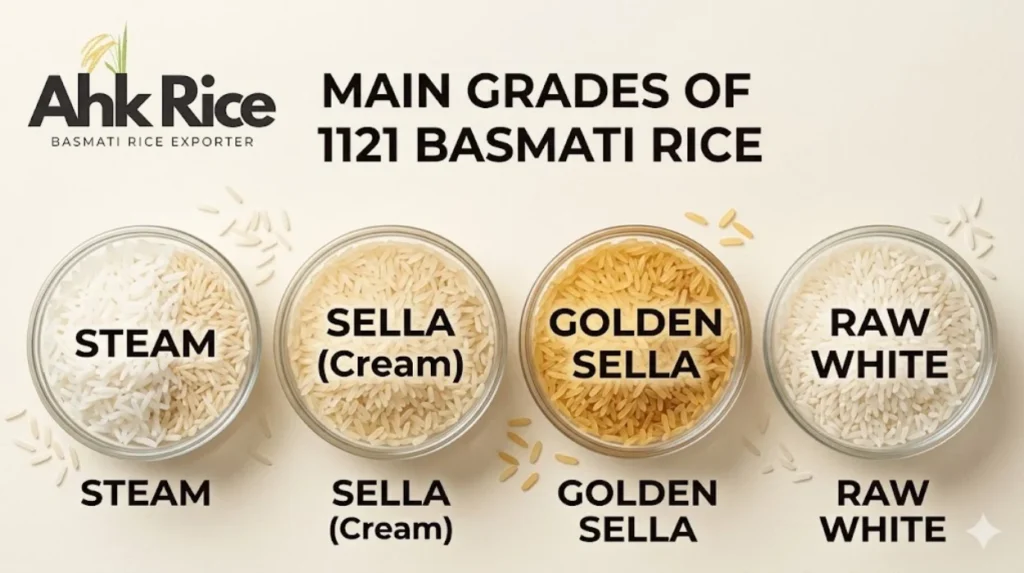
The main commercial grades are White Rice, Steam Rice, Golden Sella Rice, Creamy Sella Rice, Brown Rice, and Broken Rice.
Each grade serves different consumer preferences and commercial applications.
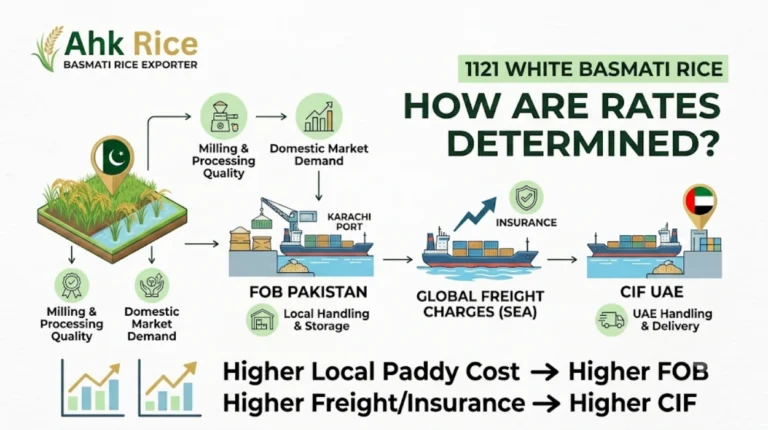
1121 White Basmati Rice
Raw grain length: 8.20–8.50 mm
White rice undergoes complete milling and polishing. The grains appear bright white and cook into soft, fluffy rice.
Retail consumers often prefer this grade because of its appearance and premium presentation. White rice dominates supermarket shelves in many countries.
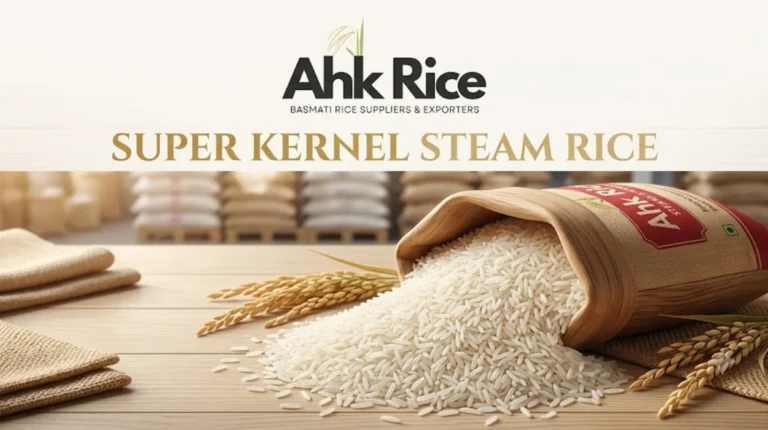
1121 Steam Basmati Rice
Moisture content: approximately 12–14%
Steam rice receives steam treatment before milling. The process improves grain strength and reduces breakage during handling.
Steam rice cooks with separate grains and maintains consistency in restaurants and catering operations.
1121 Golden Sella Basmati Rice
Shelf life: up to 24 months under proper storage
Golden Sella rice develops its golden color through the parboiling process. Heat treatment strengthens the grain structure and improves durability.
Golden Sella rice performs well in hot climates. Many importers select this grade for large-scale food service operations.
1121 Creamy Sella Basmati Rice
Color: light cream to pale golden
Creamy Sella rice undergoes controlled parboiling that produces a lighter appearance than Golden Sella.
The grade combines enhanced grain strength with a softer visual profile. Many markets prefer Creamy Sella when consumers seek premium presentation with parboiled benefits.
1121 Brown Basmati Rice
Higher fiber content than polished rice
Brown rice retains the bran layer after dehusking. The grain contains additional fiber, vitamins, and minerals.
Health-conscious consumers often purchase Brown Basmati rice because of its nutritional profile.
1121 Broken Rice Grades
Typical categories: 1%, 2%, 5%, 10%, 15%, 25%, and 100% broken
Broken rice originates during milling and grading operations. Different industries use broken rice for flour production, processed foods, snacks, and industrial applications.
Understanding the available grades leads naturally to the specifications that distinguish them.
What Specifications Differentiate 1121 Basmati Grades?
Processing method, color, grain strength, cooking behavior, shelf life, and market preference separate one grade from another.
| Attribute | White Rice | Steam Rice | Golden Sella | Creamy Sella |
|---|---|---|---|---|
| Color | White | Off-white | Golden | Creamy |
| Processing | Milled | Steamed | Parboiled | Parboiled |
| Grain Strength | Good | Better | Excellent | Excellent |
| Shelf Life | 12-18 Months | 18 Months | 18-24 Months | 18-24 Months |
| Breakage Resistance | Moderate | High | Very High | Very High |
| Cooking Separation | Good | Excellent | Excellent | Excellent |
| Export Demand | High | High | Very High | High |
White rice offers a softer texture. Steam rice provides stronger grain integrity. Golden Sella delivers maximum durability. Creamy Sella balances appearance and performance.
Specification differences influence import decisions across different regions. The next section explains those market preferences.
Which Countries Import Different 1121 Basmati Grades?
The Middle East, Africa, Europe, North America, and Asia import different grades according to local consumption habits and distribution channels.
Middle East Markets
Countries across the Gulf region import large quantities of Golden Sella and Steam rice. Food service businesses value grain separation and storage stability.
Saudi Arabia, the United Arab Emirates, Oman, Qatar, Bahrain, and Kuwait remain significant Basmati destinations (source: REAP export data, December 2025).
African Markets
African importers frequently source Golden Sella grades because the product performs well in extended storage environments and bulk distribution networks.
European Markets
European retailers often import White Rice and Steam Rice. Consumers prioritize appearance, aroma, and premium packaging.
North American Markets
North American buyers focus on White Rice and Brown Rice categories. Retail consumers often seek premium quality and health-oriented products.
Asian Markets
Asian markets import multiple grades depending on local cuisine requirements and food service applications.
Market demand depends heavily on quality standards. The next section explains the certifications that support international trade.
What Certifications Apply to 1121 Basmati Rice Exports?
Common certifications include ISO 22000, HACCP, Halal, Phytosanitary Certification, Fumigation Certification, and Quality Inspection Reports.
International rice trade requires documented compliance with food safety and quality requirements.
Food Safety Certifications
Food safety certifications verify controlled production environments.
Examples include:
- ISO 22000 Certification
- HACCP Certification
- GMP Certification
These systems establish documented controls throughout processing operations.
Export Documentation
Export shipments require supporting documents.
Examples include:
- Commercial Invoice
- Packing List
- Certificate of Origin
- Phytosanitary Certificate
- Fumigation Certificate
- Bill of Lading
These documents support customs clearance and regulatory compliance.
Quality Verification
Quality verification confirms specification compliance.
Examples include:
- Moisture Analysis Reports
- Grain Length Reports
- Broken Percentage Reports
- Purity Reports
- Laboratory Test Reports
Certification establishes confidence in product quality. The next section examines the practical benefits of different grades.
What Benefits Do Different 1121 Basmati Rice Grades Provide?
Different grades provide advantages in cooking performance, storage stability, appearance, logistics efficiency, and market positioning.
White rice delivers premium visual appeal. Consumers recognize the bright white appearance immediately.
Steam rice improves grain strength. Restaurants benefit from reduced breakage and better consistency.
Golden Sella increases storage performance. Importers handling long distribution cycles prefer the enhanced durability.
Creamy Sella combines premium appearance with parboiled functionality. Retailers often position it as a higher-value option.
Brown rice supports health-oriented product portfolios. Consumers seeking fiber-rich foods frequently choose this category.
Broken rice creates value from milling outputs. Food manufacturers use these grades in processed food production.
Benefits become clearer when viewed alongside common misconceptions. The next section addresses frequent misunderstandings.
What Misconceptions Exist About 1121 Basmati Rice Grades?
Color differences do not indicate quality differences, and higher processing levels do not automatically mean better rice.
Many buyers assume Golden Sella rice is lower quality because of its darker color. The color originates from parboiling, not from inferior grain quality.
Many consumers believe White Rice contains longer grains than Steam Rice. Grain length depends on the underlying variety and grading standards, not processing type.
Some importers assume broken rice indicates poor quality. Broken rice serves different industrial and commercial applications and remains a recognized export category.
Many buyers view Brown Rice as unprocessed paddy. Brown Rice has undergone dehusking and grading but retains the bran layer.
These clarifications help buyers understand that each grade serves a specific commercial purpose rather than a quality hierarchy.
1121 Basmati rice includes White, Steam, Golden Sella, Creamy Sella, Brown, and Broken Rice grades, each designed for specific market requirements and applications.
Processing methods create the differences between grades. White Rice emphasizes appearance. Steam Rice enhances cooking stability. Golden Sella maximizes durability. Creamy Sella balances presentation and strength. Brown Rice focuses on nutrition. Broken Rice supports industrial applications.
Importers select grades according to consumer preferences, storage conditions, cooking requirements, and distribution channels. Understanding these distinctions allows buyers to match the correct specification with the intended market.
Frequently Asked Questions
What is the longest grain grade of 1121 Basmati rice?
1121 Basmati rice grades generally maintain raw grain lengths between 8.20 mm and 8.50 mm. Length differences depend on grading specifications rather than processing type.
Which 1121 Basmati grade has the longest shelf life?
Golden Sella and Creamy Sella grades typically offer the longest shelf life because parboiling strengthens the grain and improves storage stability.
Which 1121 grade is most popular in the Middle East?
Golden Sella and Steam Rice remain among the most imported grades in Gulf countries because they provide excellent grain separation and storage performance.
Is Golden Sella better than White Rice?
Golden Sella and White Rice serve different purposes. Golden Sella offers stronger grains and longer storage life, while White Rice provides a brighter appearance and softer texture.
What certifications are required for exporting 1121 Basmati rice?
Export shipments commonly require a Phytosanitary Certificate, Certificate of Origin, Commercial Invoice, Packing List, and quality inspection documentation. Additional certifications depend on destination-country regulations.