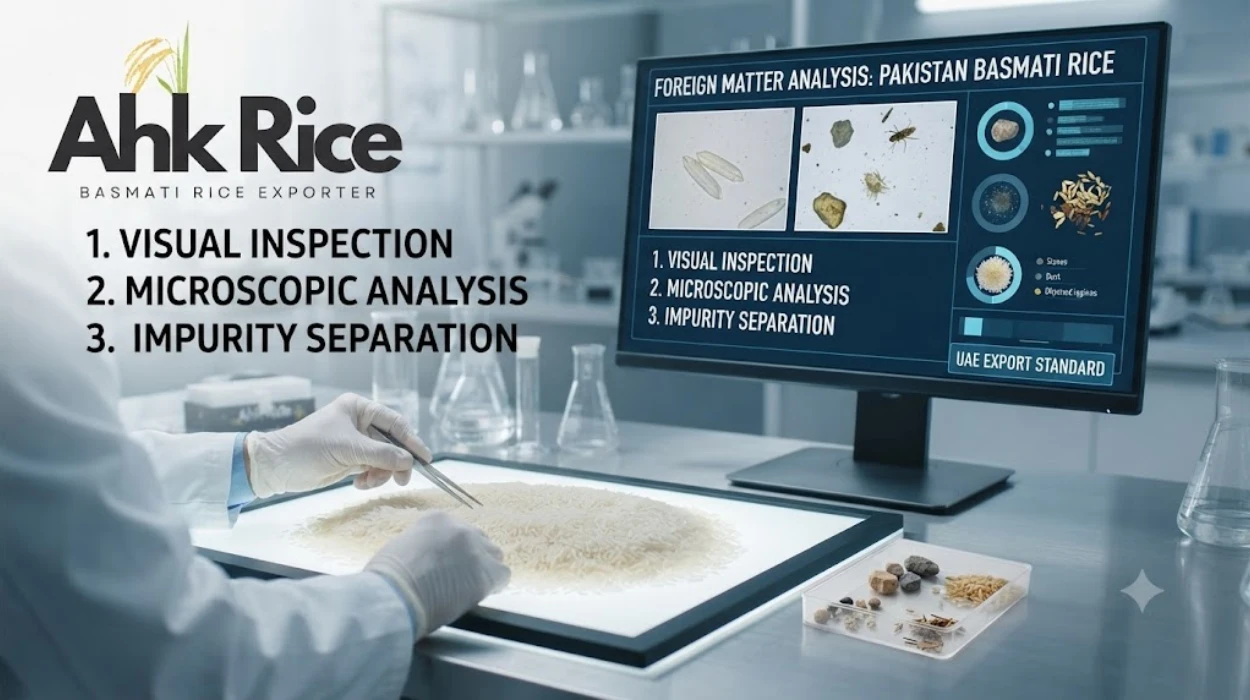
Foreign Matter Testing Methods Used for Pakistan Basmati Rice Exported to the UAE
Pakistan Basmati rice exported to the United Arab Emirates undergoes systematic foreign matter testing before shipment. The inspection process removes unwanted materials such as stones, dust, straw, weed seeds, damaged grains, plastic particles, and metal fragments. These testing methods ensure that imported rice complies with UAE food safety requirements while preserving grain purity, consumer safety, milling quality, and commercial value. Every stage, from harvesting to container loading, contributes to reducing contamination and delivering consistent export quality.
The UAE imports significant volumes of Pakistani Basmati rice each year because of its aroma, cooking performance, and long grain characteristics. Importers evaluate not only grain length and moisture but also cleanliness. Foreign matter percentage directly affects product acceptance, customs clearance, shelf stability, and buyer confidence. Understanding how foreign matter testing works explains why quality inspection has become a standard part of modern rice exports.
What is foreign matter testing in Pakistan Basmati rice exports?
Foreign matter testing is the inspection process used to identify, separate, measure, and record non-rice materials before export. The objective is to verify that every shipment satisfies cleanliness standards, food safety requirements, and contractual specifications established between Pakistani exporters and UAE importers.
Foreign matter refers to every material that is not part of the intended rice product. These materials include stones, sand, dust, husks, straw, weed seeds, insects, insect fragments, plastic pieces, string fibers, paper particles, metal fragments, and other agricultural debris.
The testing process determines the percentage of these unwanted materials in a representative rice sample. Results are expressed as a measurable percentage or weight.
Clean rice improves food safety, milling efficiency, cooking quality, packaging appearance, and storage performance.
For readers interested in how verified inspection results support purchasing decisions, a detailed explanation belongs naturally in the companion article on verified quality documentation for UAE imports.
Types of foreign matter found during inspection
Foreign matter generally falls into several categories.
- Mineral matter, for example stones, sand, gravel, and soil.
- Organic matter, for example straw, leaves, weed seeds, husks, and stems.
- Metal contamination, for example wire fragments, machine particles, and screws.
- Artificial contamination, for example plastic pieces, packaging fibers, rubber fragments, and paper.
- Biological contamination, for example insects, insect fragments, and rodent contamination.
Each category requires different detection equipment during processing.
How does foreign matter testing work before rice reaches the UAE?
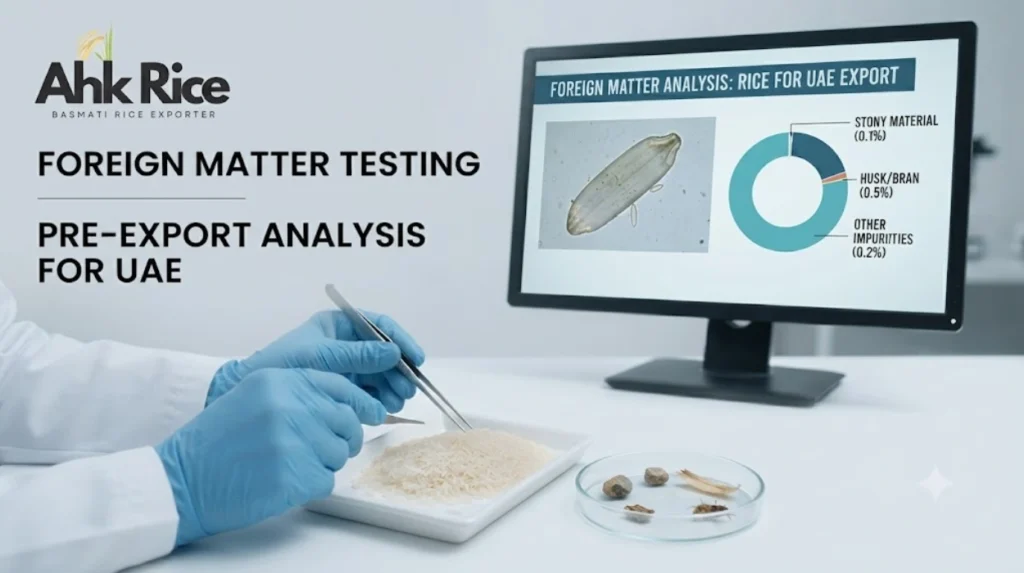
Foreign matter testing follows a structured inspection sequence beginning with sampling and ending with laboratory verification. Every production stage removes additional contaminants while recording measurable quality data that demonstrates compliance with export specifications required by UAE buyers.
The inspection begins when rice arrives from farms.
Representative samples are collected from different sections of the lot. Sampling from multiple locations produces accurate results because contamination is rarely distributed evenly.
Laboratory technicians weigh the sample before inspection.
Mechanical separators remove large foreign materials.
Sieves separate particles according to size.
Air aspiration systems remove lightweight impurities.
Magnification equipment helps inspectors identify tiny contaminants.
Metal detectors locate metallic particles that mechanical cleaning cannot remove.
The cleaned sample is weighed again.
The remaining foreign matter percentage is calculated by comparing removed material against the original sample weight.
Inspection reports become part of the shipment quality documentation.
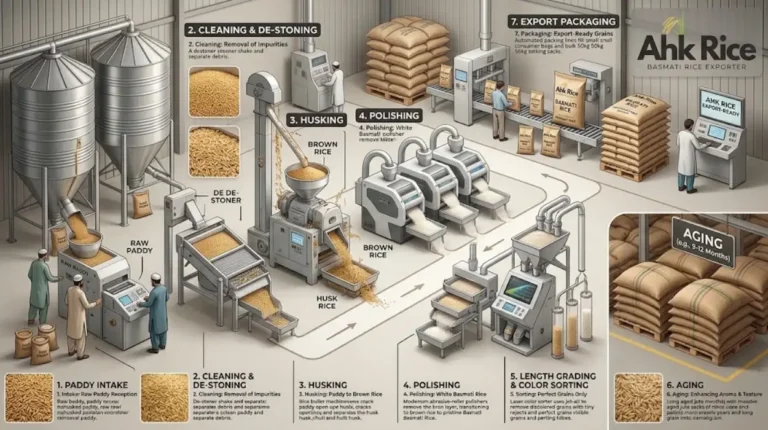
Step-by-step testing process
Raw paddy reception
Freshly harvested paddy arrives from farms across Punjab.
Initial inspection identifies visible contamination before storage.
Pre-cleaning
Large separators remove straw, sticks, leaves, and oversized materials.
Fine cleaning
Rotary screens and vibrating sieves remove smaller particles including broken husks and weed seeds.
Destoning
Gravity separators remove heavy mineral materials such as stones and sand.
Magnetic inspection
Industrial magnets capture iron particles generated during harvesting and processing.
Optical color sorting
High-speed cameras identify foreign particles by color differences.
Air jets immediately eject unwanted materials.
Final laboratory inspection
Technicians verify cleanliness before packaging.
Only approved lots proceed toward export documentation.
Which equipment removes foreign matter from Pakistan Basmati rice?
Modern rice processing facilities combine mechanical separation, optical technology, magnetic systems, and laboratory inspection equipment to eliminate contaminants. Every machine removes a specific category of foreign matter, creating multiple layers of quality control before export packaging begins.
No single machine removes every contaminant.
Different technologies perform different functions.
Cleaning machines
Pre-cleaners remove large agricultural debris.
Examples include straw, stems, husks, and leaves.
Vibratory sieves
These machines classify particles according to size.
Small stones, broken materials, and weed seeds pass through different screens.
Destoners
Destoners separate heavy materials using density differences.
Examples include gravel, stones, and compact soil.
Magnetic separators
These systems attract iron and steel particles.
Metal contamination usually originates from harvesting equipment or processing machinery.
Optical color sorters
Optical sorting machines use digital cameras and artificial intelligence to compare every grain against programmed quality parameters.
Discolored grains, foreign seeds, black particles, plastics, and unusual objects are automatically rejected.
Metal detectors
Final metal detectors inspect packaged rice before sealing.
This inspection provides another safety checkpoint before export.
Why is foreign matter testing important for UAE rice imports?
Foreign matter testing protects food safety, supports regulatory compliance, improves consumer confidence, reduces shipment rejection, and maintains consistent product quality throughout international transportation from Pakistan to the UAE.
The UAE maintains food safety regulations that require imported food products to satisfy established quality standards.
Rice containing excessive contamination risks shipment delays, additional inspection, or rejection.
Clean rice also improves cooking performance.
Consumers expect rice that contains only edible grains.
Restaurants, hotels, supermarkets, and wholesalers all benefit from consistent product quality.
Foreign matter testing also protects milling yields.
Clean grain experiences less equipment wear during additional processing.
Reliable inspection records strengthen long-term trade relationships between exporters and importers.
What grades of Pakistan Basmati rice undergo foreign matter testing?
Every commercial export grade undergoes foreign matter inspection before shipment. Testing requirements remain consistent because food safety standards apply equally across premium, standard, steamed, parboiled, and white Basmati rice varieties exported from Pakistan.
Foreign matter inspection is not limited to premium rice.
Every export grade requires quality evaluation.
Common export grades include:
1121 Basmati Rice
Available as white, steam, parboiled, and sella rice.
Super Kernel Basmati Rice
Known for traditional aroma and cooking quality.
1509 Basmati Rice
Offers early maturity and long grain characteristics.
Brown Basmati Rice
Retains bran layers while undergoing foreign matter inspection.
Broken Rice Grades
Broken rice also requires contamination inspection before export.
Testing standards remain important regardless of grain size.
Which countries require foreign matter testing for imported Pakistan Basmati rice?
Many international markets require documented quality inspection before import approval. Foreign matter testing supports compliance with national food regulations while reducing commercial risks associated with contaminated agricultural products.
The UAE represents one of the largest destinations for Pakistani Basmati rice.
Other importing markets also require quality inspection.
Examples include:
- Saudi Arabia
- Oman
- Qatar
- Kuwait
- Bahrain
- Iraq
- United Kingdom
- Canada
- Australia
- United States
- Germany
- Netherlands
Each market maintains its own import documentation requirements.
However, cleanliness remains a universal quality indicator.
Which certifications support foreign matter testing during rice exports?
International certifications establish documented food safety systems that support foreign matter control through traceability, inspection procedures, equipment maintenance, employee training, and continuous quality monitoring across processing facilities.
Certification strengthens confidence in inspection procedures.
Common certifications include:
ISO 22000
Focuses on food safety management systems.
HACCP
Identifies hazards and establishes preventive controls.
GMP
Defines good manufacturing practices throughout processing.
Halal Certification
Confirms compliance with Halal processing requirements.
Phytosanitary Certification
Verifies that agricultural products satisfy plant health regulations.
Inspection reports complement these certifications by providing measurable quality data for every shipment.
What problems occur when foreign matter testing is ignored?
Insufficient inspection increases contamination risks, damages commercial reputation, reduces customer confidence, raises processing costs, and creates avoidable regulatory issues throughout international food supply chains.
Poor inspection affects every participant in the supply chain.
Importers spend additional time sorting contaminated products.
Retailers receive customer complaints.
Consumers lose confidence.
Restaurants experience inconsistent cooking results.
Exporters face financial losses from rejected shipments.
Additional cleaning increases operational costs after arrival.
Proper testing prevents these avoidable problems before containers leave Pakistan.
What misconceptions exist about foreign matter testing?
Foreign matter testing measures overall product cleanliness instead of only visible contamination. Modern inspection evaluates microscopic particles, metallic fragments, agricultural debris, artificial materials, and biological contaminants using multiple technologies rather than simple visual observation.
Several misunderstandings continue to appear throughout international rice trade.
One misconception assumes clean-looking rice requires no testing.
Laboratory inspection frequently identifies contaminants invisible to the human eye.
Another misconception assumes color sorting removes every contaminant.
Color sorting works alongside sieves, magnets, gravity separators, and laboratory analysis.
Some buyers believe premium rice never contains foreign matter.
Every agricultural crop requires systematic inspection regardless of quality grade.
Testing confirms cleanliness instead of assuming it.
Foreign matter testing forms one of the most important quality control procedures for Pakistan Basmati rice exported to the UAE. Inspection begins with representative sampling and continues through mechanical cleaning, gravity separation, magnetic inspection, optical sorting, laboratory verification, and final packaging checks. These combined procedures remove mineral, organic, biological, metallic, and artificial contaminants while supporting food safety, regulatory compliance, and consistent product quality. As international food standards continue to prioritize traceability and measurable quality, foreign matter testing remains an essential component of modern Pakistani Basmati rice exports.
Frequently Asked Questions
What is considered foreign matter in Basmati rice?
Foreign matter includes stones, sand, straw, husks, weed seeds, dust, insects, plastic fragments, paper pieces, metal particles, and other materials that are not rice grains.
Why is foreign matter testing important before exporting rice to the UAE?
Testing ensures that exported rice meets UAE food safety and import quality requirements, reduces the risk of shipment rejection, and protects consumer safety.
Which machines are commonly used for foreign matter removal?
Processing facilities use pre-cleaners, vibrating sieves, gravity destoners, magnetic separators, optical color sorters, metal detectors, and laboratory inspection equipment.
Does every grade of Pakistan Basmati rice require foreign matter testing?
Yes. All export grades, including 1121 Basmati, Super Kernel, 1509, brown Basmati, steam rice, sella rice, and broken rice, undergo cleanliness inspection before export.
Which certifications support foreign matter control in rice exports?
Common certifications include ISO 22000, HACCP, GMP, Halal Certification, and Phytosanitary Certification, along with laboratory inspection reports that verify product cleanliness.