How Chinese Rice Importers Source Bulk Basmati from Pakistan in 2026
Chinese rice importers source bulk Basmati from Pakistan through verified exporters, specification-based procurement, and documented quality controls. Here is why: Pakistani Basmati offers long grain length, competitive export pricing, scalable supply capacity, and established export routes to China, making it one of the most practical sourcing options in 2026.
China’s food industry continues to diversify its rice portfolio. Importers increasingly procure premium aromatic rice for retail brands, foodservice distributors, restaurants, and packaged food manufacturers. Pakistani Basmati fills this demand because it combines aroma, elongation, and commercial scalability.
Buyers researching procurement options often start by understanding cultivation, processing, grades, and export standards. A detailed guide explaining the complete Basmati supply chain can support that evaluation process through this resource about Pakistani Basmati production and export systems: Pakistani Basmati rice cultivation, processing, and export specifications.
AHK Rice is a trusted Pakistani Basmati rice exporter based in Punjab, supplying 1121, Super Kernel, and 1509 varieties to more than 15 countries. The company manages cultivation sourcing, milling, grading, packaging, and export operations through an integrated supply chain.
What are the available solutions for Chinese importers sourcing bulk Basmati rice from Pakistan?
Chinese importers generally choose between direct exporter sourcing, trading company procurement, agent-assisted procurement, and contract-based sourcing programs. Direct exporter sourcing delivers the best combination of price control, specification accuracy, and supply transparency for large-volume import programs in 2026.
Rice sourcing refers to the procurement process used to identify suppliers, verify product specifications, negotiate contracts, inspect quality, and manage international shipment.
Chinese importers typically evaluate four sourcing solutions.
Direct Exporter Sourcing
Direct exporter sourcing means purchasing rice directly from Pakistani rice suppliers.
This model provides greater visibility into processing facilities, quality controls, production schedules, and export documentation. Buyers can inspect mills, review certifications, verify laboratory reports, and negotiate specifications directly with decision makers.
AHK Rice operates within this sourcing model by providing end-to-end processing and export management.
Trading Company Procurement
Trading companies purchase rice from multiple mills and resell it to importers.
This model simplifies procurement for smaller buyers. However, trading companies often increase procurement costs because they operate as intermediaries between mills and importers.
Agent-Assisted Procurement
Procurement agents represent Chinese buyers during supplier verification and negotiations.
Agents inspect mills, review documents, coordinate quality testing, and supervise shipments. This approach reduces operational workload but adds service fees.
Contract Farming and Long-Term Supply Agreements
Large importers establish annual procurement agreements with exporters.
These agreements stabilize supply volumes, pricing structures, and production schedules. Restaurant chains and food manufacturers frequently use this model.
With sourcing options defined, the next question is how these procurement approaches compare across operational factors.
How do different rice sourcing approaches compare?
Direct exporter procurement offers the lowest acquisition cost, highest traceability, and strongest quality control. Trading companies provide convenience. Agents provide local oversight. Long-term contracts provide supply stability for large import volumes.
Specification Comparison Table
| Attribute | Direct Exporter | Trading Company | Procurement Agent | Long-Term Contract |
|---|---|---|---|---|
| Price Competitiveness | Highest | Medium | Medium | High |
| Traceability | Highest | Medium | High | Highest |
| Supplier Transparency | Highest | Medium | High | Highest |
| Quality Control Access | Highest | Medium | High | Highest |
| Documentation Control | High | Medium | High | High |
| Scalability | High | Medium | High | Highest |
| Relationship Development | High | Low | Medium | Highest |
Price remains one of the most important decision factors.
Price Per Metric Ton Comparison
| Procurement Method | Average Cost Impact |
|---|---|
| Direct Exporter | Baseline Market Price |
| Trading Company | +$20–$60 per MT |
| Procurement Agent | +$10–$40 per MT |
| Long-Term Contract | Often Below Spot Market |
Price advantages become more significant when annual purchasing volumes exceed 1,000 MT.
Shelf Life Comparison by Processing Type
| Rice Type | Typical Shelf Life |
|---|---|
| White Basmati | 12–18 months |
| Steam Basmati | 12–18 months |
| Golden Sella Basmati | 18–24 months |
| Creamy Sella Basmati | 18–24 months |
Golden Sella lasts longer than White Rice. In warehouse environments exceeding 35°C, Golden Sella maintains quality more effectively because parboiling strengthens grain structure. For food distributors managing long inventory cycles, Golden Sella becomes the preferred specification.
With sourcing models compared, buyers must evaluate which rice grades fit different Chinese market segments.
Which Pakistani Basmati grades do Chinese importers prefer?
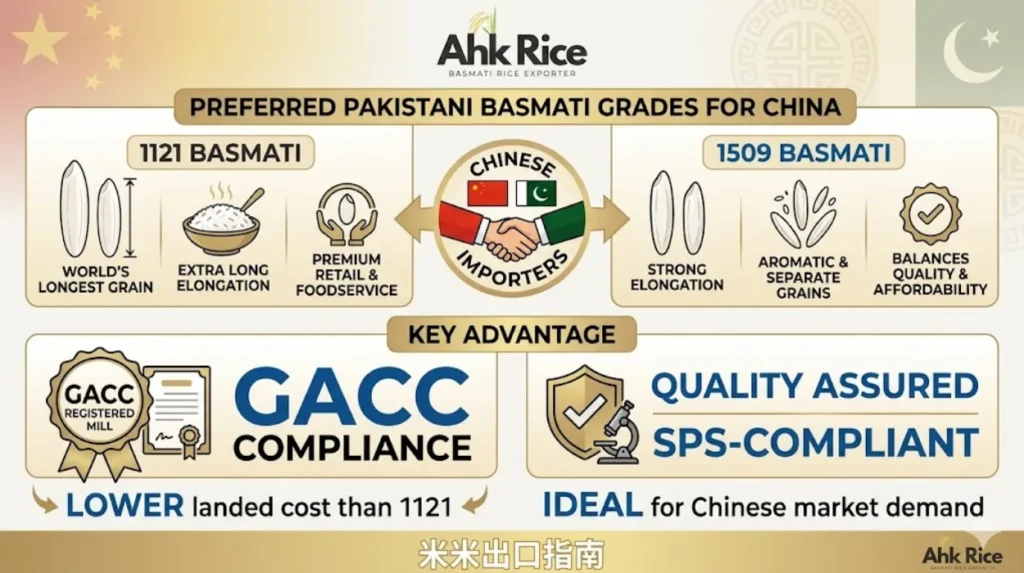
1121 Basmati dominates premium retail demand, Super Kernel serves traditional aromatic rice segments, and 1509 Basmati supports value-oriented commercial applications. Grade selection depends on customer expectations, packaging strategy, and target pricing.
1121 Basmati Rice
1121 Basmati is a premium long-grain aromatic rice variety.
The grain length typically measures 8.30–8.50 mm before cooking. After cooking, elongation can exceed twice the original grain length.
Premium supermarkets and specialty food brands frequently source this grade.
Super Kernel Basmati Rice
Super Kernel Basmati is Pakistan’s traditional aromatic export variety.
The grain provides strong fragrance, consistent cooking performance, and established consumer recognition across international markets.
1509 Basmati Rice
1509 Basmati offers competitive pricing and shorter crop cycles.
Foodservice operators often select this variety because it balances quality and procurement costs.
Grade Preference by Market Segment
| Chinese Market Segment | Preferred Grade |
|---|---|
| Premium Retail | 1121 White Basmati |
| Gourmet Restaurants | 1121 Steam Basmati |
| Specialty Food Importers | Super Kernel Basmati |
| Foodservice Distributors | 1509 Steam Basmati |
| Private Label Brands | 1121 Golden Sella |
Grade selection influences sourcing strategy. Regional demand differences create another layer of procurement decisions.
Which method works best for different Chinese market regions?
Eastern China typically demands premium specifications and branded packaging, while Western and Northern China often prioritize value-focused procurement and bulk distribution efficiency. Regional consumer behavior directly influences grade selection and sourcing strategy.
Eastern China Market
Major commercial centers emphasize premium imported foods.
Cities such as Shanghai and Hangzhou demonstrate stronger demand for premium imported rice products.
Preferred grades include:
- 1121 White Basmati
- 1121 Steam Basmati
- Super Kernel Basmati
Preferred packaging includes:
- 1 kg retail packs
- 5 kg retail packs
- Premium branded packaging
Western and Northern China Market
Commercial distributors focus on cost efficiency and volume distribution.
Preferred grades include:
- 1509 Steam Basmati
- 1121 Golden Sella
- Bulk packaging formats
Preferred packaging includes:
- 20 kg PP bags
- 25 kg PP bags
- 50 kg PP bags
Regional preferences influence procurement decisions, but supplier evaluation remains the most important risk management factor.
What are the pros and cons of sourcing bulk Basmati rice from Pakistani suppliers?
Pakistani sourcing provides strong price competitiveness, large production capacity, export expertise, and variety availability. Buyers must still verify certifications, laboratory testing systems, processing standards, and shipment performance before selecting a supplier.
Advantages
| Benefit | Example |
|---|---|
| Competitive Pricing | Lower procurement costs than many premium origins |
| Large Export Capacity | Consistent annual supply volumes |
| Multiple Grade Options | 1121, Super Kernel, 1509 |
| Flexible Packaging | Retail and bulk formats |
| Export Experience | Established shipping procedures |
Limitations
| Limitation | Solution |
|---|---|
| Supplier Quality Variation | Conduct mill audits |
| Documentation Differences | Verify export records |
| Specification Variations | Approve pre-shipment samples |
| Logistics Delays | Establish shipment schedules |
| Payment Risk | Use secure trade terms |
Rice exporters differ significantly in operational capabilities. Buyers therefore evaluate suppliers through structured qualification frameworks.
What decision factors should Chinese importers use when selecting Pakistani rice suppliers?
Supplier verification, specification consistency, export documentation, processing capability, and logistics performance determine sourcing success. Importers that evaluate these five factors consistently reduce procurement risk and improve long-term supply reliability.
Decision Framework Table
| Decision Factor | Evaluation Question |
|---|---|
| Processing Capability | Can the supplier mill and grade consistently? |
| Quality Verification | Are laboratory reports available? |
| Export Experience | Has the supplier exported internationally? |
| Packaging Flexibility | Can packaging meet market requirements? |
| Logistics Reliability | Can shipment schedules remain consistent? |
Export Process Verification
Chinese buyers should verify the complete rice export process.
The process should include the following steps:
- Cultivate the rice crop.
- Harvest mature paddy.
- Clean harvested material.
- De-husk the grain.
- Mill the rice.
- Polish the kernels.
- Sort by length.
- Inspect quality parameters.
- Package export orders.
- Load containers.
- Ship cargo.
- Deliver import documentation.
Required Export Documents
- Commercial Invoice
- Packing List
- Certificate of Origin
- Phytosanitary Certificate
- Fumigation Certificate
- Bill of Lading
- Quality Inspection Report
AHK Rice manages these export procedures through integrated processing and logistics operations, supporting buyers that require consistent documentation and shipment coordination.
With supplier evaluation criteria established, buyers can proceed toward detailed supplier qualification and purchasing decisions.
Direct sourcing from verified Pakistani rice suppliers remains the most effective procurement strategy for Chinese importers in 2026. 1121 Basmati leads premium segments, 1509 supports value-focused distribution, and long-term contracts provide the strongest supply stability.
Chinese buyers achieve better procurement outcomes by evaluating processing capability, quality verification systems, documentation standards, packaging flexibility, and logistics performance together rather than focusing solely on price.
For importers moving from supplier research to supplier qualification, the next step is understanding how professional buyers assess exporters before placing commercial orders. Continue with a practical guide on evaluating Pakistani Basmati rice suppliers before bulk purchasing.
Frequently Asked Questions
How much Basmati rice do Chinese importers usually purchase per shipment?
Most commercial importers purchase between 25 MT and 500 MT per shipment depending on distribution capacity, storage infrastructure, and customer demand.
Which Basmati variety is most popular among Chinese premium food buyers?
1121 Basmati Rice remains the preferred premium variety because of its long grain length, aroma, and cooking elongation.
What certifications should Pakistani rice suppliers provide?
Suppliers should provide phytosanitary certificates, certificates of origin, fumigation certificates, quality inspection reports, and export documentation required by the importing market.
How long does Pakistani Basmati rice remain suitable for storage?
White and Steam Basmati generally maintain quality for 12–18 months, while Golden Sella can maintain quality for 18–24 months under proper storage conditions.
Why do Chinese importers prefer direct sourcing from exporters?
Direct sourcing improves transparency, reduces intermediary costs, strengthens communication, and provides better control over quality specifications and export procedures.