How Do UAE Importers Evaluate Crop Year Before Buying Pakistan Basmati Rice?
UAE importers evaluate the crop year because it directly determines aroma, moisture, grain stability, cooking performance, and storage life. Here is why: freshly harvested Basmati contains higher moisture, while properly matured rice develops stronger fragrance, lower breakage, and better cooking consistency. Buyers compare crop year with laboratory reports, moisture percentages, milling quality, and export specifications before placing bulk orders.
Pakistan produces some of the world’s most recognized Basmati rice varieties, including 1121 Basmati, Super Kernel Basmati, and 1509 Basmati. The Punjab region provides fertile soil, glacier-fed irrigation, and seasonal climate conditions that support long-grain cultivation. According to Pakistan Bureau of Statistics and Rice Exporters Association of Pakistan (REAP), the UAE remains one of Pakistan’s largest rice export destinations because of strong demand from supermarkets, hotels, restaurants, catering companies, and private-label food brands (Source: Pakistan Bureau of Statistics FY2024-25; REAP Export Data 2025).
Understanding crop year helps importers compare rice beyond price alone. Buyers examine harvest timing, processing methods, grain maturity, certifications, and storage conditions before approving shipments. Readers who want a detailed understanding of buyer specifications can continue with the guide on crop-year quality requirements requested by Gulf rice buyers.
What Is Crop Year in Pakistan Basmati Rice?
Crop year identifies the exact harvesting season of Basmati rice. It determines grain maturity, moisture level, aroma development, storage stability, and commercial value. UAE importers use crop year as a primary quality indicator before evaluating laboratory reports and export specifications.
Crop year refers to the agricultural season during which Basmati paddy is cultivated and harvested. Pakistan normally harvests Basmati between September and November. Exporters record this harvest period because it affects every quality characteristic buyers inspect.
Freshly harvested rice differs from naturally matured rice. Fresh rice contains higher moisture and stronger internal starch activity. Matured rice develops improved aroma, firmer grain texture, and greater cooking consistency after controlled storage.
Crop year also provides traceability. Export documents identify harvest season, processing date, packing date, and shipment schedule. This information helps buyers verify product authenticity and inventory age.
Pakistan cultivates several export varieties during each crop year.
1121 Basmati Rice
1121 Basmati produces exceptionally long grains. Average grain length exceeds 8.30 mm before cooking and expands significantly after cooking. UAE retailers commonly select this variety for premium consumer packs.
Super Kernel Basmati Rice
Super Kernel Basmati develops a traditional aroma and medium-long grain profile. Hotels and restaurants frequently purchase this variety because it balances quality and price.
1509 Basmati Rice
1509 Basmati matures earlier than traditional varieties. It delivers long grains with competitive pricing for commercial food service operations.
Understanding crop year establishes the foundation for evaluating rice quality. The next question explains how buyers perform that evaluation.
How Do UAE Importers Evaluate Crop Year Before Buying Pakistan Basmati Rice?
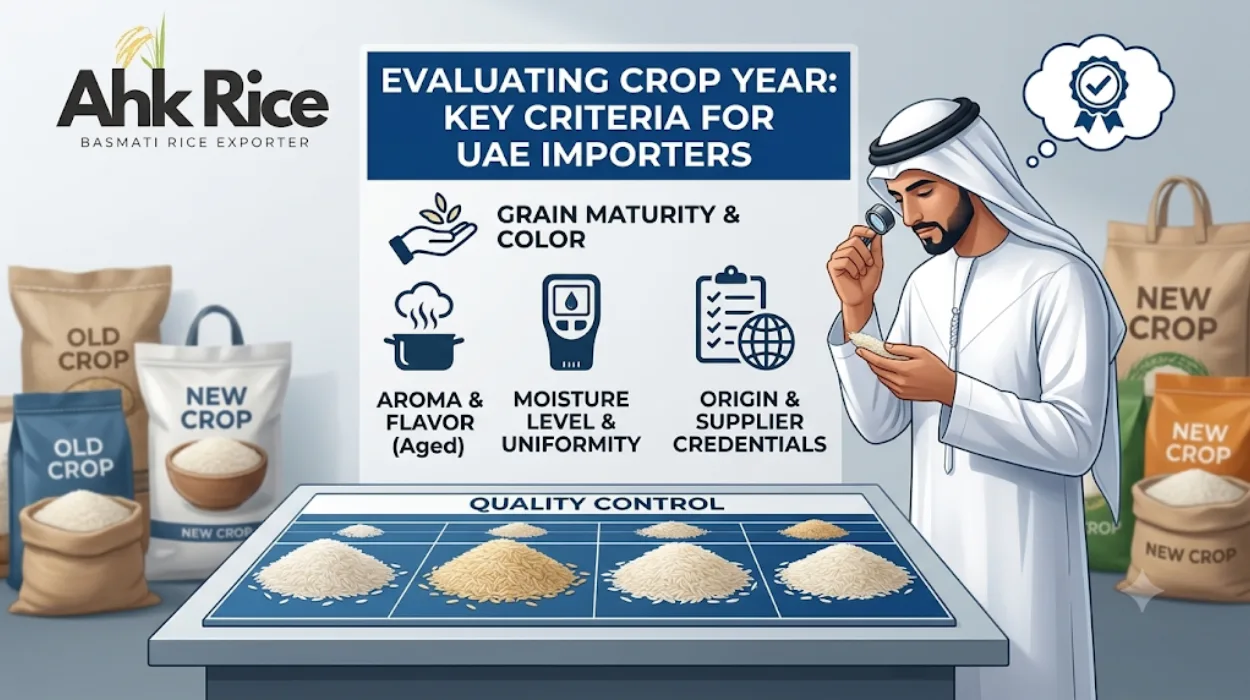
UAE importers evaluate crop year through harvest records, laboratory testing, milling quality, moisture measurement, grain appearance, cooking performance, and export documentation. These objective factors confirm whether rice meets commercial purchasing standards.
Professional buyers follow a structured inspection process instead of relying on supplier descriptions. Every specification supports procurement decisions for large-volume imports.
Inspect the harvest records
Harvest records confirm the cultivation season and harvesting period. Buyers compare these records with production schedules to verify crop authenticity.
Test moisture content
Laboratories measure moisture before shipment. Export-quality Basmati generally remains around 12–14% moisture, supporting safe storage and international transport.
Verify grain dimensions
Inspectors measure grain length, width, uniformity, and broken percentage. Uniform grains improve retail presentation and cooking consistency.
Examine aroma
Natural aging strengthens the characteristic Basmati fragrance. Buyers inspect aroma after milling and again after cooking representative samples.
Cook representative samples
Cooking tests evaluate grain elongation, stickiness, texture, and flavor. Consistent expansion demonstrates proper maturity.
Review laboratory reports
Independent laboratories verify purity, broken percentage, foreign matter, damaged grains, and moisture values before shipment approval.
Confirm export documentation
Commercial invoices, packing lists, phytosanitary certificates, fumigation certificates, certificates of origin, and quality certificates support product traceability.
These evaluation steps reduce commercial risk by replacing assumptions with measurable specifications. After understanding inspection methods, buyers also examine how the rice reaches export quality.
How Is Pakistan Basmati Rice Processed Before Export?
Pakistan Basmati rice passes through nine controlled processing stages. Every stage protects grain quality, food safety, and export consistency before international shipment.
Processing begins immediately after harvested paddy reaches the rice mill. Modern facilities combine automated equipment with quality inspections to maintain uniform specifications.
Clean the paddy
Cleaning machines remove dust, stones, straw, metal particles, and other field impurities.
Dry the paddy
Controlled drying reduces moisture to suitable storage levels while protecting grain integrity.
De-husk the grain
Rubber rollers separate the husk without damaging the rice kernel.
Polish the rice
Polishing removes bran layers according to customer specifications. White rice receives additional polishing than brown rice.
Grade the rice
Length graders separate whole grains from broken kernels using precision screens.
Sort the rice
Color sorters remove damaged, discolored, immature, and defective grains through optical scanning.
Inspect the quality
Quality inspectors verify moisture, broken percentage, grain length, purity, and appearance before packaging.
Pack the rice
Packing lines fill PP woven bags, BOPP bags, paper bags, jute bags, or private-label retail packaging according to buyer requirements.
Load and dispatch
Export teams load containers, seal shipments, complete customs documentation, and dispatch cargo through Pakistan’s seaports.
Standardized processing protects grain quality from harvest to destination. The next section explains the quality components buyers evaluate after processing.
What Are the Key Components UAE Buyers Evaluate?
UAE buyers compare measurable quality specifications instead of marketing claims. Grain length, moisture, purity, broken percentage, aroma, cooking performance, certifications, and packaging determine purchasing decisions.
| Specification | Typical Evaluation |
|---|---|
| Grain Length | 8.30 mm+ for 1121 |
| Moisture | 12–14% |
| Broken Rice | Customer specification |
| Purity | High varietal purity |
| Foreign Matter | Minimal according to export standards |
| Aroma | Natural Basmati fragrance |
| Grain Colour | Uniform creamy white or required processing grade |
Food safety also influences supplier selection. Buyers request internationally recognized certifications before approving shipments.
Common certifications include:
- ISO 22000 Food Safety Management
- HACCP
- GMP
- Halal Certification
- Phytosanitary Certificate
- Certificate of Origin
- Fumigation Certificate
These specifications create objective comparisons between suppliers instead of relying solely on pricing.
What Benefits Does Crop Year Evaluation Provide UAE Importers?
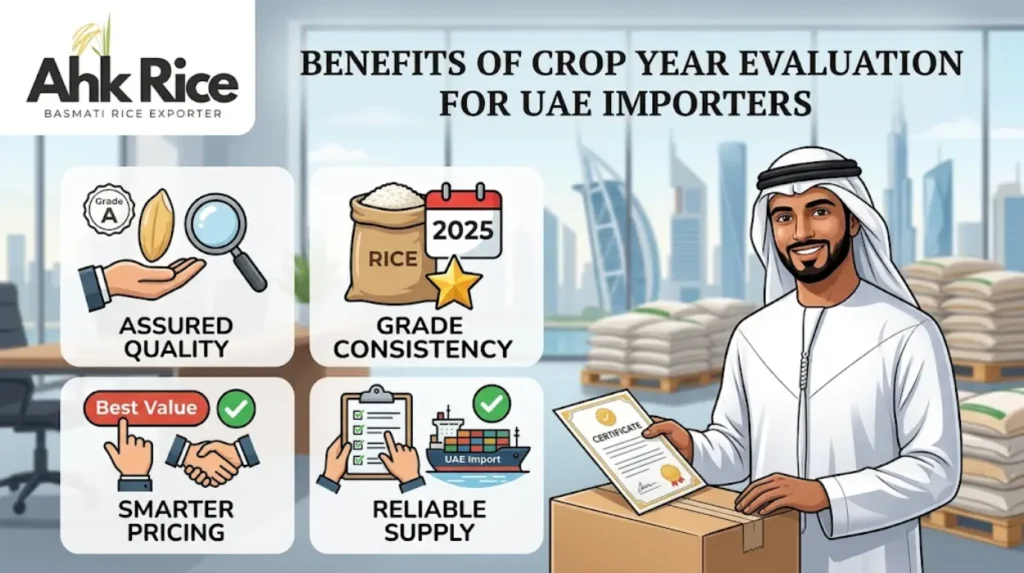
Crop year evaluation improves purchasing accuracy, cooking consistency, inventory management, customer satisfaction, and long-term profitability. Buyers reduce quality disputes because harvest timing directly affects aroma, moisture, grain stability, and storage performance.
Crop year helps importers purchase rice that matches their target market. Premium supermarkets, luxury hotels, fine-dining restaurants, and catering companies require different quality standards. Crop year allows buyers to match those requirements with measurable specifications instead of assumptions.
Naturally matured Basmati develops stronger aroma because controlled storage allows moisture to stabilize and aromatic compounds to mature. The grain also becomes firmer during cooking. Consumers notice longer grains, separate kernels, and improved texture.
Crop year also improves inventory planning. Aged rice performs better during extended warehouse storage in the UAE’s hot climate. Stable moisture reduces the risk of quality deterioration during distribution.
Commercial buyers also experience fewer customer complaints. Consistent cooking performance supports restaurants serving hundreds of meals daily. Retail brands also receive fewer quality claims because grain appearance remains uniform throughout production batches.
Another benefit involves pricing transparency. Buyers understand why naturally aged rice usually costs more than freshly harvested rice. Higher prices reflect storage costs, inventory management, and improved commercial quality rather than marketing claims.
Understanding these advantages explains why crop year receives close attention. The next section examines where this information creates the greatest commercial value.
Where Is Crop Year Information Most Important?
Crop year information supports purchasing decisions across retail, food service, hospitality, wholesale distribution, and private-label manufacturing. Every market segment evaluates harvest year according to its quality expectations and customer requirements.
Retail Supermarkets
Retail brands prioritize attractive packaging, grain uniformity, and consistent cooking quality. Consumers compare aroma, grain length, and appearance before making repeat purchases.
Hotels
Luxury hotels require premium Basmati because buffet service demands consistent grain elongation across large cooking batches. Naturally matured rice produces reliable presentation.
Restaurants
Restaurants purchase rice that delivers repeatable cooking results. Uniform grains simplify kitchen operations and reduce waste.
Catering Companies
Large catering businesses prepare thousands of meals each day. Stable moisture and predictable cooking performance improve operational efficiency.
Wholesale Distributors
Wholesale traders compare crop year before purchasing container quantities. Product consistency supports long-term relationships with retailers and food distributors.
Private Label Brands
Private-label companies require identical specifications across multiple shipments. Crop year documentation supports consistent product quality throughout annual supply programs.
Each commercial sector applies crop year differently. Understanding these applications helps explain several misconceptions surrounding harvest year.
What Are Common Misconceptions About Crop Year?
Crop year does not determine quality by itself. Processing quality, storage conditions, laboratory testing, and export standards work together with harvest year to define commercial value.
One common misconception states that every fresh crop performs poorly. Freshly harvested rice remains suitable for many commercial applications after proper milling, drying, and quality control.
Another misconception assumes every older crop provides better quality. Poor storage conditions reduce quality regardless of harvest year. Temperature control, moisture management, warehouse hygiene, and regular inspections determine successful aging.
Some buyers believe grain length alone indicates premium quality. Grain length represents only one specification. Moisture, purity, aroma, broken percentage, and cooking performance remain equally important.
Another misunderstanding involves pricing. Higher prices do not automatically indicate older or better rice. Buyers should compare laboratory reports, harvest documentation, and processing specifications before evaluating commercial value.
Some importers also assume every supplier follows identical processing methods. Modern rice mills differ in grading technology, colour sorting systems, laboratory testing, packaging capability, and quality management procedures.
Understanding these misconceptions completes the evaluation process. Buyers can now combine crop year with measurable specifications when selecting export-quality Pakistan Basmati rice.
Pakistan Basmati rice crop year provides valuable information about harvest timing, grain maturity, aroma development, moisture stability, and storage performance. UAE importers examine crop year because it supports objective purchasing decisions rather than subjective quality claims.
Professional buyers never evaluate crop year alone. They combine harvest records with laboratory testing, milling quality, grain dimensions, moisture analysis, cooking trials, certifications, and export documentation. This structured approach reduces purchasing risk and improves product consistency throughout the supply chain.
Pakistan’s major export varieties, including 1121 Basmati, Super Kernel Basmati, and 1509 Basmati, each respond differently to storage and processing. Understanding those differences helps importers select specifications that match retail, hospitality, food service, wholesale, and private-label markets.
A complete crop year evaluation creates better procurement decisions, stronger customer satisfaction, and consistent long-term commercial performance.
Frequently Asked Questions
Why do UAE importers ask for the crop year?
Importers use crop year to evaluate grain maturity, aroma development, moisture content, cooking quality, and expected storage performance before purchasing bulk shipments.
Which crop year is preferred for premium Basmati rice?
Naturally matured crop years are generally preferred because they deliver stronger aroma, better grain separation, and improved cooking consistency after controlled storage.
Does crop year affect rice price?
Yes. Older, naturally matured Basmati usually commands higher prices because storage increases operational costs while improving commercial quality.
Which Pakistan Basmati varieties are commonly exported to the UAE?
The UAE imports 1121 Basmati Rice, Super Kernel Basmati Rice, and 1509 Basmati Rice for retail, hospitality, and food service applications.
What documents verify crop year and quality?
Buyers commonly review harvest records, laboratory reports, phytosanitary certificates, certificates of origin, fumigation certificates, packing lists, and commercial invoices.