Comparing Pakistani Sella Basmati Rice Grades for US Retail and Foodservice Buyers
Pakistani Sella Basmati rice grades serve different commercial purposes, but for most US importers the best choice depends on whether the rice is intended for retail shelves, restaurant kitchens, institutional foodservice, or private-label distribution.
The US market continues to increase demand for premium aromatic rice as South Asian, Middle Eastern, and multicultural food consumption expands across retail and hospitality channels. Importers often face a common challenge: selecting the correct Pakistani Sella Basmati grade that balances grain appearance, cooking performance, packaging requirements, shelf life, and landed cost.
Before comparing grades, it helps to understand the fundamentals of Pakistani Basmati cultivation, processing methods, and export classifications, which are explained in our guide on understanding Pakistani Sella Basmati rice production and quality standards.
AHK Rice supplies Pakistani Sella Basmati rice through its comprehensive export services page, offering multiple grades tailored to wholesalers, food distributors, retail brands, and foodservice buyers across international markets.
What are the available Pakistani Sella Basmati rice solutions for US buyers?
Pakistani Sella Basmati rice is available in multiple export grades, each designed for specific commercial applications. Retail buyers prioritize appearance and consistency, while foodservice operators focus on yield, cooking performance, and cost efficiency across large-volume purchasing programs.
Sella Basmati rice refers to parboiled Basmati rice. During processing, paddy rice undergoes soaking, steaming, and drying before milling. This treatment strengthens the grain structure, reduces breakage, improves nutrient retention, and creates a golden or creamy appearance depending on the specific processing method.
The most common Pakistani Sella Basmati grades exported to the United States include:
1121 Golden Sella Basmati
1121 Golden Sella is recognized for its extra-long grain length and strong elongation after cooking. It is widely used in premium retail packaging and high-end restaurant operations.
1121 Creamy Sella Basmati
This grade offers similar grain length to Golden Sella but features a lighter appearance. It is commonly selected by importers targeting mainstream retail consumers.
Super Kernel Sella Basmati
Super Kernel remains one of Pakistan’s traditional Basmati varieties. It delivers excellent aroma and consumer familiarity while maintaining competitive pricing.
1509 Sella Basmati
1509 provides a shorter crop cycle and cost advantages. Many foodservice operators select this variety when balancing budget and quality requirements.
Broken and Industrial Grades
Certain institutional buyers use broken rice percentages for prepared meals, frozen food manufacturing, and industrial food production where visual presentation is less important.
How do Pakistani Sella Basmati grades compare technically?
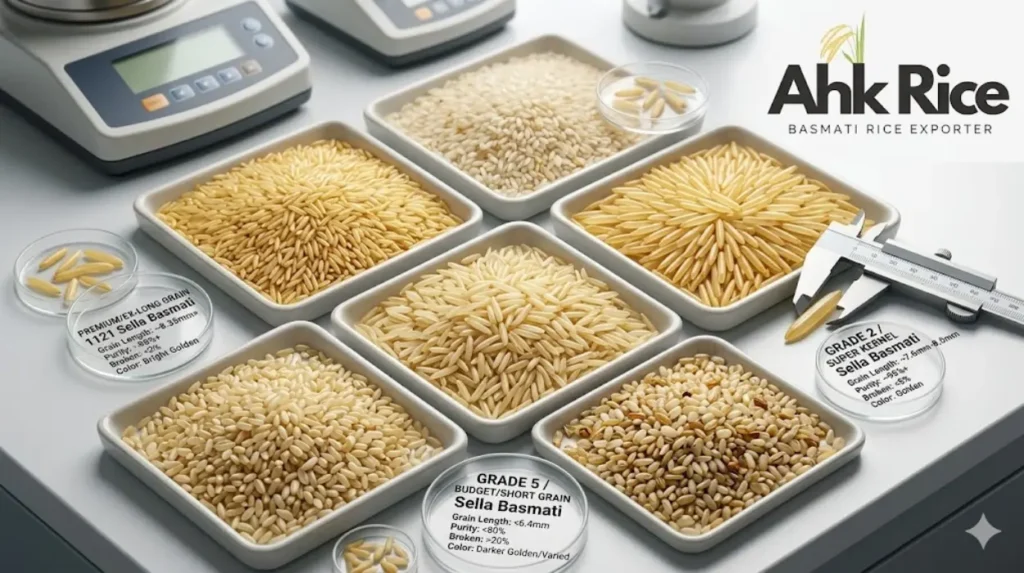
The primary differences between Pakistani Sella grades involve grain length, elongation ratio, aroma intensity, breakage levels, appearance, cooking performance, and export pricing. These factors directly affect importer profitability and end-user satisfaction across different sales channels.
Pakistani Sella Basmati Grade Comparison
| Attribute | 1121 Golden Sella | 1121 Creamy Sella | Super Kernel Sella | 1509 Sella |
|---|---|---|---|---|
| Grain Length Before Cooking | 8.3–8.5 mm | 8.3–8.5 mm | 7.2–7.6 mm | 8.0–8.3 mm |
| Grain Elongation | Very High | Very High | High | High |
| Aroma Strength | Strong | Strong | Traditional Strong | Moderate |
| Visual Appeal | Premium Golden | Premium Creamy White | Traditional Appearance | Commercial |
| Breakage Resistance | Excellent | Excellent | Very Good | Very Good |
| Foodservice Yield | Excellent | Excellent | Good | Very Good |
| Relative Export Price | Highest | High | Medium | Lowest |
The table demonstrates why US importers rarely choose a single grade for all customer segments. Different channels require different value propositions.
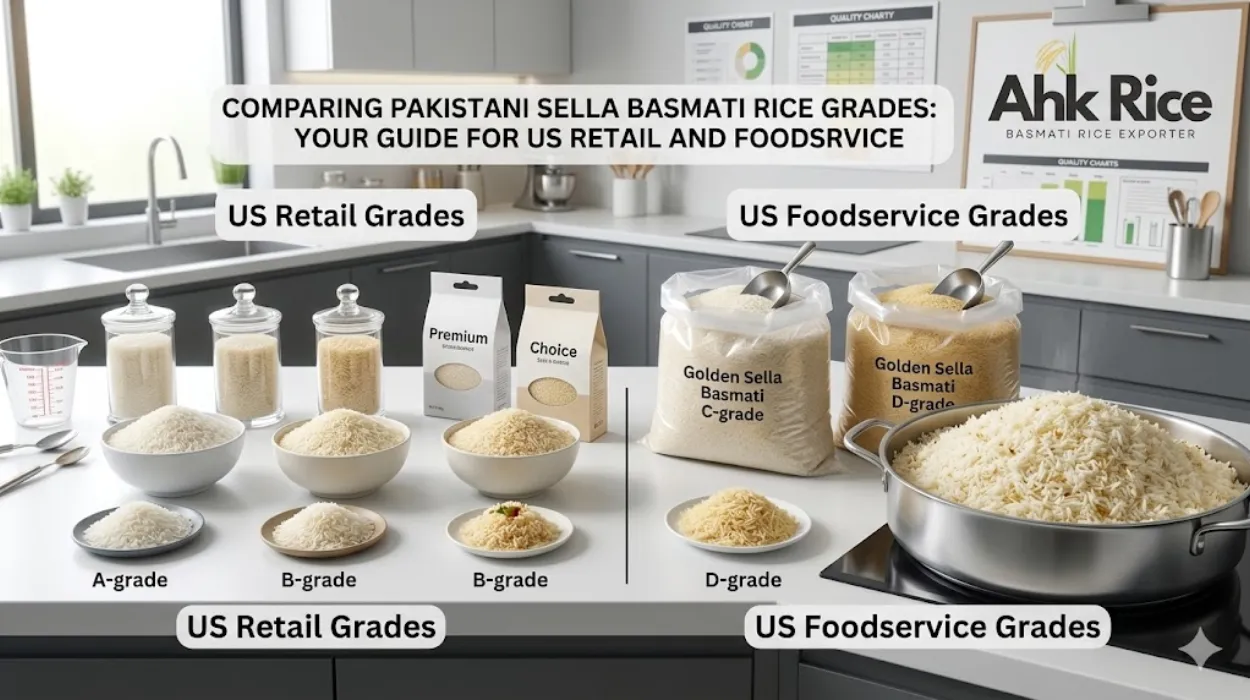
Retail consumers often purchase rice based on packaging appearance, grain length, and perceived quality. Restaurants evaluate cooked grain expansion, plate presentation, and consistency.
How do US retail and foodservice markets differ in grade preferences?
US retail buyers generally prioritize visual quality and premium branding, while foodservice buyers prioritize cooking yield, consistency, inventory efficiency, and operational cost management. The same rice grade rarely optimizes both objectives equally.
US Retail Market Preferences
Retail brands selling through supermarkets, ethnic grocery chains, and specialty food stores usually prefer:
- 1121 Golden Sella
- 1121 Creamy Sella
- Premium Super Kernel Sella
Retail packaging commonly includes:
- 2 lb bags
- 5 lb bags
- 10 lb bags
- 20 lb bags
Consumers evaluate grain appearance before purchase. Longer grains and uniform color improve shelf appeal and brand positioning.
Private-label importers often select 1121 varieties because premium visual characteristics support higher retail margins.
US Foodservice Market Preferences
Foodservice distributors typically serve:
- Restaurants
- Catering companies
- Hotels
- Universities
- Hospitals
- Corporate cafeterias
These buyers focus on:
- Cost per cooked serving
- Yield after cooking
- Storage efficiency
- Consistent cooking behavior
Many operators choose Super Kernel Sella or 1509 Sella because the lower procurement cost improves food cost percentages while maintaining acceptable quality standards.
How do prices per metric ton compare across grades?
Price differences between Pakistani Sella Basmati grades are primarily driven by grain length, export demand, crop availability, milling yields, and international market positioning. Understanding these price tiers helps buyers maximize purchasing efficiency.
Indicative export pricing often follows this structure:
| Grade | Relative Price Level |
|---|---|
| 1121 Golden Sella | Highest |
| 1121 Creamy Sella | High |
| Super Kernel Sella | Medium |
| 1509 Sella | Lower |
A distributor importing 500 MT annually can experience significant procurement cost differences depending on grade selection.
For example:
- Premium retail brands may justify higher costs through stronger shelf pricing.
- Restaurant chains may generate better margins using mid-tier grades.
- Institutional foodservice buyers often prioritize lower-cost solutions.
The most profitable choice depends on the final sales channel rather than the lowest purchase price.
Which Pakistani Sella Basmati grade offers the best shelf life?
All properly processed Pakistani Sella Basmati grades provide long storage stability, but grain condition, packaging quality, moisture control, and warehouse management ultimately determine shelf-life performance within retail and foodservice supply chains.
Parboiling improves grain durability compared with many non-parboiled rice categories.
Typical commercial shelf-life expectations include:
| Grade | Shelf Life |
|---|---|
| 1121 Golden Sella | Up to 24 months |
| 1121 Creamy Sella | Up to 24 months |
| Super Kernel Sella | Up to 24 months |
| 1509 Sella | Up to 24 months |
Shelf life depends on:
- Moisture control below export specifications
- Proper fumigation procedures
- Food-grade packaging
- Dry warehouse storage
- Temperature management
US importers commonly request laboratory analysis and quality certificates before shipment to ensure compliance and inventory stability.
What are the pros and cons of each solution?
Every Sella Basmati grade delivers distinct advantages and trade-offs. Buyers achieve better results when selection aligns with business objectives rather than assuming one grade is universally superior across all customer segments.
1121 Golden Sella
Advantages
- Longest grain appearance
- Premium market perception
- Excellent elongation
- Strong retail positioning
Limitations
- Higher procurement cost
- Not always necessary for value-focused foodservice
1121 Creamy Sella
Advantages
- Premium visual quality
- Strong consumer acceptance
- Excellent cooking performance
Limitations
- Higher price than commercial grades
Super Kernel Sella
Advantages
- Traditional Basmati aroma
- Balanced pricing
- Established market recognition
Limitations
- Shorter grain length than 1121
1509 Sella
Advantages
- Cost efficiency
- Good cooking performance
- Suitable for large-volume foodservice
Limitations
- Lower premium perception
Which method works best for different buyer types?
The optimal grade depends on the buyer’s business model, customer expectations, and pricing strategy. Matching product specifications with market demand produces stronger long-term purchasing outcomes than focusing solely on unit cost.
Decision Framework for US Buyers
| Buyer Type | Recommended Grade | Reason |
|---|---|---|
| Premium Retail Brand | 1121 Golden Sella | Maximum shelf appeal |
| Private Label Retailer | 1121 Creamy Sella | Premium quality with broader appeal |
| Ethnic Grocery Distributor | Super Kernel Sella | Strong aroma and market familiarity |
| Restaurant Chain | Super Kernel Sella or 1509 | Cost-performance balance |
| Institutional Foodservice | 1509 Sella | Best volume economics |
The decision process should include customer demographics, competitive positioning, package sizes, distribution model, and procurement budget.
Importers serving multiple channels frequently maintain more than one grade in their portfolio.
What decision factors matter most when selecting a Pakistani Sella Basmati supplier?
Supplier selection affects product consistency more than variety selection alone. Processing standards, quality controls, certifications, export experience, packaging capability, and logistics performance determine long-term supply chain success.
Key evaluation criteria include:
- Milling technology
- Grain sorting systems
- Quality inspection procedures
- Export certifications
- Packaging customization
- Container loading standards
- Documentation accuracy
- Supply reliability
- Market experience
- Traceability systems
The most successful US importers evaluate both the rice grade and the exporter behind it.
Pakistani Sella Basmati rice offers multiple solutions for US retail and foodservice buyers. Premium retail brands generally achieve stronger market positioning with 1121 Golden Sella or 1121 Creamy Sella, while foodservice operators often benefit from Super Kernel Sella and 1509 Sella due to favorable cost-performance ratios. The correct choice depends on distribution channel, customer expectations, pricing strategy, and operational objectives rather than a single universal grade preference.
FAQs
Which Pakistani Sella Basmati rice grade is best for US retail stores?
1121 Golden Sella is generally preferred for premium retail shelves because of its extra-long grain and attractive appearance. Consumers often associate longer grains with higher quality. It performs well in branded packaging. The grade also supports premium pricing strategies. Many private-label retailers choose it for differentiation.
What is the difference between 1121 Sella and Super Kernel Sella rice?
1121 Sella offers longer grain length and greater elongation after cooking. Super Kernel Sella is known for its traditional Basmati aroma and heritage appeal. Both provide excellent cooking performance. Super Kernel usually costs less than 1121. The final choice depends on market positioning and budget.
Is 1509 Sella rice suitable for foodservice operations?
Yes, 1509 Sella rice is widely used in restaurants and institutional foodservice. It provides good cooking yield and cost efficiency. Many large-volume buyers prefer it because of lower procurement costs. The variety maintains acceptable grain quality. It is especially useful for high-volume meal preparation.
How long can Pakistani Sella Basmati rice be stored?
Properly processed and packaged Sella Basmati rice can typically be stored for up to 24 months. Moisture levels must remain within export specifications. Storage areas should be cool and dry. Food-grade packaging helps preserve quality. Warehouse management also affects shelf life.
What should US importers evaluate when choosing a rice exporter?
Importers should review processing standards, certifications, quality control systems, and export experience. Packaging capabilities are also important. Consistent supply and documentation accuracy reduce operational risks. A reliable exporter should provide traceability and quality assurance. Long-term consistency matters more than price alone.