How FOB and CIF Pricing Affect 1121 Steam Basmati Rice Imports from Pakistan to UAE?
FOB and CIF pricing determine which party pays for transportation, insurance, and shipping costs. Here is why: FOB transfers responsibility at the Pakistani port, while CIF includes freight and marine insurance until the UAE port. Understanding both pricing methods helps importers compare quotations accurately, calculate total landed costs, and select the correct purchasing strategy.
International rice trade depends on standardized pricing terms. Importers in the UAE purchase thousands of metric tons of Pakistani 1121 Steam Basmati Rice every year because the variety delivers long grain length, consistent cooking quality, and strong consumer demand (source: REAP export data, December 2025).
Pricing affects procurement decisions as much as grain quality. Two quotations with identical rice specifications often produce different final costs because one uses FOB pricing while the other uses CIF pricing. Understanding these differences prevents incorrect budgeting and simplifies supplier comparisons.
Importers seeking a deeper understanding of freight calculations and cost breakdowns should continue with our detailed guide on cost comparison and import expenses through.
What Are FOB and CIF Pricing Terms?
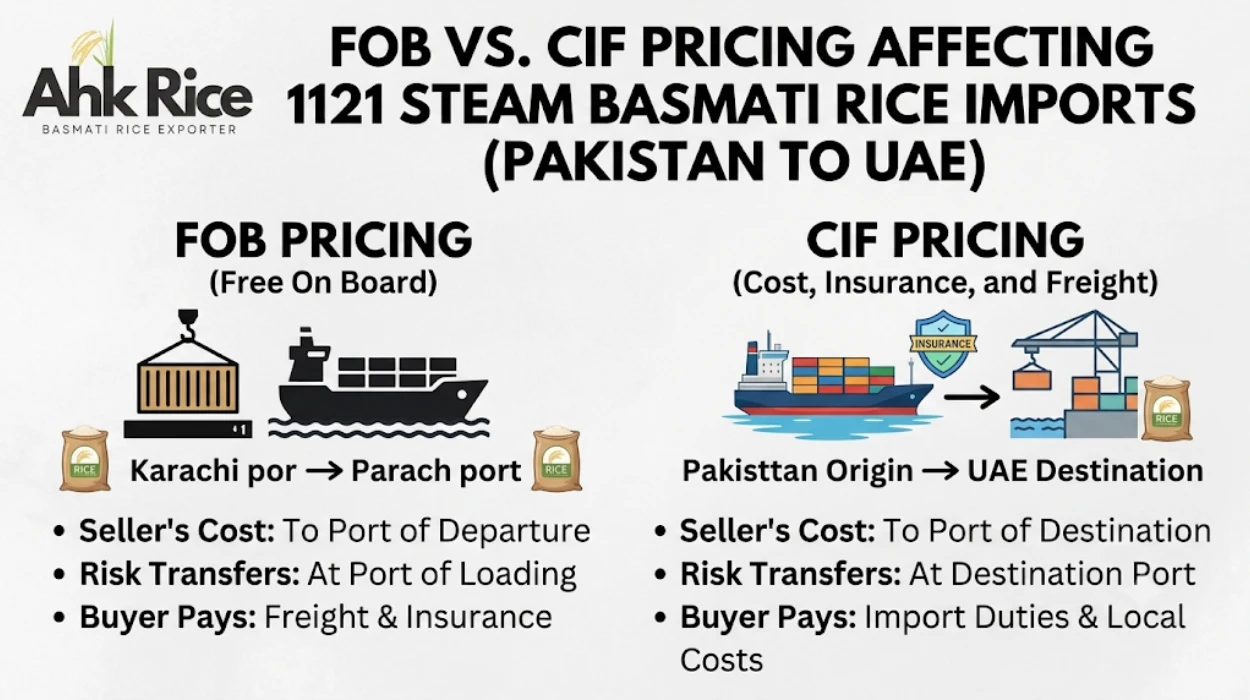
FOB places export responsibility on the seller until the cargo is loaded onto the vessel. CIF extends seller responsibility by including ocean freight and marine insurance until the destination port.
FOB stands for Free on Board. Under FOB terms, the exporter cultivates, mills, grades, inspects, loads, and clears the rice for export before placing the shipment onboard the nominated vessel. Ownership transfers after loading at the Pakistani port.
CIF stands for Cost, Insurance, and Freight. Under CIF terms, the exporter completes every FOB responsibility and also pays ocean freight and cargo insurance until the shipment reaches the UAE port.
Both pricing methods follow internationally recognized Incoterms published by the International Chamber of Commerce. These rules create consistent responsibilities between exporters and importers regardless of country.
What Does FOB Cover?
FOB pricing normally includes:
- Paddy procurement
- Rice milling
- Steam processing
- Colour sorting
- Length grading
- Export packaging
- Quality inspection
- Export customs clearance
- Loading onto vessel
The buyer arranges:
- Ocean freight
- Marine insurance
- UAE customs clearance
- Inland transportation
- Import duties
What Does CIF Cover?
CIF pricing includes every FOB activity plus:
- Ocean freight booking
- Marine cargo insurance
- Shipping documentation
- Freight payment until destination port
Import duties and inland transportation inside the UAE remain the buyer’s responsibility.
With the pricing definitions established, the next question explains how each pricing model operates during an export shipment.
How Do FOB and CIF Pricing Work During Rice Exports?
FOB transfers shipping responsibility after vessel loading. CIF continues seller responsibility until the cargo arrives at the destination port under insured transportation.
International shipments follow a structured logistics sequence. Every participant performs defined responsibilities.
FOB Export Process
Follow these export steps:
- Cultivate the paddy.
- Harvest mature rice.
- Dry harvested paddy.
- Mill the rice.
- Steam process the grains.
- Polish the rice.
- Grade by grain length.
- Inspect quality.
- Package the rice.
- Load containers.
- Clear export customs.
- Load cargo onboard the vessel.
The importer books shipping, purchases insurance, tracks the vessel, clears UAE customs, and arranges final delivery.
CIF Export Process
The first twelve export steps remain identical.
The exporter then:
- Book ocean freight.
- Purchase marine insurance.
- Dispatch shipping documents.
- Deliver cargo to the UAE destination port.
The importer completes customs clearance and inland transportation after vessel arrival.
Example:
An exporter loads 25 metric tons of 1121 Steam Basmati Rice at Karachi Port.
Under FOB pricing, the UAE importer books the shipping line independently.
Under CIF pricing, the exporter arranges shipping and insurance before dispatch.
Both methods transport identical rice. Only commercial responsibility changes.
Understanding shipment flow makes the individual pricing components easier to understand.
What Components Make Up FOB and CIF Prices?
FOB contains product and export costs. CIF adds freight and insurance costs, producing a higher invoice value before import clearance.
Every quotation contains several measurable cost elements.
Components Included in FOB Price
FOB quotations generally include:
| Cost Component | Included |
|---|---|
| Paddy purchase | ✔ |
| Milling | ✔ |
| Steam processing | ✔ |
| Colour sorting | ✔ |
| Grading | ✔ |
| Packaging | ✔ |
| Quality inspection | ✔ |
| Export documentation | ✔ |
| Customs clearance | ✔ |
| Container loading | ✔ |
| Ocean freight | ✘ |
| Marine insurance | ✘ |
Components Included in CIF Price
| Cost Component | Included |
|---|---|
| All FOB costs | ✔ |
| Ocean freight | ✔ |
| Marine insurance | ✔ |
Freight charges vary according to vessel schedules, fuel prices, seasonal demand, and container availability.
Insurance protects cargo against covered transport risks during the sea voyage. Marine insurance generally represents a small percentage of the shipment value but protects against substantial financial losses.
Example:
A shipment valued at USD 1,250 per metric ton FOB Karachi becomes USD 1,340 per metric ton CIF Jebel Ali after adding freight and insurance. Actual freight varies by shipping season and carrier.
What Are the Benefits of Understanding FOB and CIF Pricing?
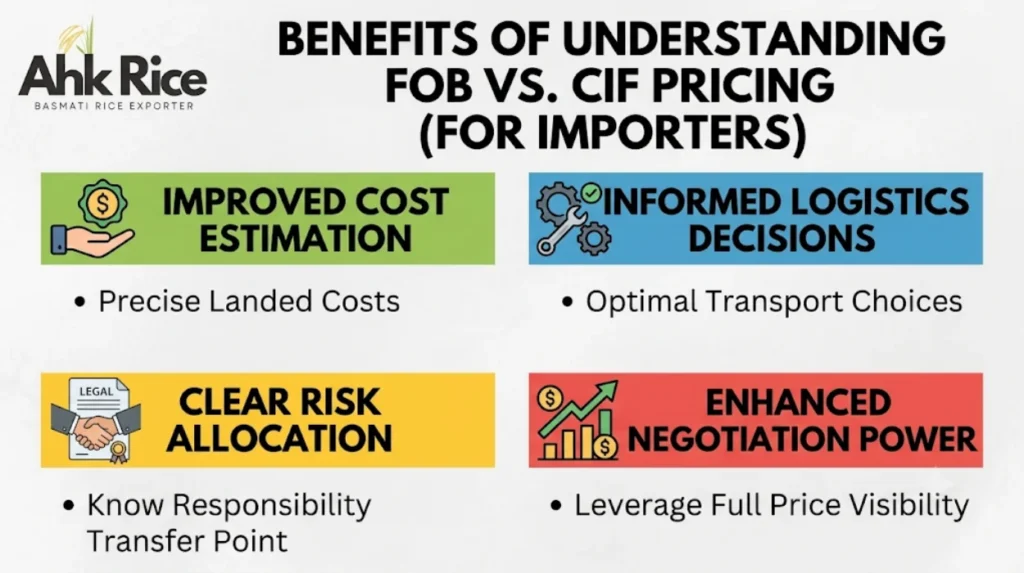
Understanding FOB and CIF pricing improves cost planning, supplier comparison, shipment control, and import budgeting. Importers who understand both pricing methods calculate total landed costs accurately and avoid unexpected logistics expenses.
Pricing transparency supports better purchasing decisions. Importers compare quotations correctly because each supplier follows the same commercial terms. A lower FOB price does not always produce a lower total import cost. Likewise, a higher CIF quotation often includes freight services that reduce administrative work.
Benefits of FOB Pricing
FOB pricing benefits experienced importers who already manage international logistics.
Key advantages include:
- Greater shipping flexibility
- Independent freight negotiations
- Direct carrier selection
- Better container scheduling
- Transparent export pricing
Large UAE importers frequently negotiate annual freight contracts with shipping companies. Those contracts often reduce transportation costs below standard market rates. FOB pricing allows those importers to use their preferred logistics partners.
Benefits of CIF Pricing
CIF pricing benefits buyers seeking a complete shipping solution.
Key advantages include:
- Single supplier quotation
- Included marine insurance
- Simplified freight management
- Lower administrative workload
- Predictable shipping arrangements
Smaller distributors often prefer CIF because one quotation includes the product price, ocean freight, and insurance. Procurement teams spend less time coordinating shipping documents and vessel bookings.
FOB vs CIF Comparison
| Feature | FOB | CIF |
|---|---|---|
| Export Processing | ✔ | ✔ |
| Ocean Freight | Buyer | Seller |
| Marine Insurance | Buyer | Seller |
| Shipping Booking | Buyer | Seller |
| Customs Clearance (Pakistan) | Seller | Seller |
| Customs Clearance (UAE) | Buyer | Buyer |
| Inland UAE Delivery | Buyer | Buyer |
Both pricing methods support international rice trade. The correct option depends on the buyer’s logistics capability and procurement strategy.
With the pricing benefits established, the next section explains where each pricing method works best.
Where Are FOB and CIF Pricing Commonly Used?
FOB pricing serves experienced importers with established logistics networks. CIF pricing serves buyers who prefer complete shipping arrangements from the exporting country to the destination port.
Different buyers purchase rice under different commercial structures.
Large Food Importers
Large supermarket suppliers typically import multiple containers every month.
Examples include:
- Retail distributors
- National wholesalers
- Food processing companies
These businesses often choose FOB pricing because they negotiate freight contracts directly with shipping lines.
Hospitality Suppliers
Hotels, restaurants, and catering suppliers regularly import premium 1121 Steam Basmati Rice.
Examples include:
- Hotel chains
- Airline catering companies
- Restaurant distributors
Many hospitality suppliers purchase under CIF terms because freight planning remains with the exporter.
Government Food Procurement
Government purchasing agencies regularly import staple food products through international tenders.
Tender specifications clearly define FOB or CIF pricing to ensure every supplier submits comparable quotations.
UAE Rice Import Market
The UAE functions as both a consumer market and a regional redistribution hub. Rice imported through Jebel Ali Port reaches retail markets, wholesale distributors, and neighboring Gulf countries. Pakistan remains one of the leading suppliers of premium Basmati rice to the UAE (source: Pakistan Bureau of Statistics, FY2024–25).
Understanding where each pricing method applies naturally leads to the common misunderstandings buyers encounter.
What Common Misconceptions Exist About FOB and CIF Pricing?
FOB does not always produce the lowest total cost, and CIF does not include every import expense. Understanding responsibility transfer prevents budgeting errors and shipment delays.
Several misconceptions create confusion during procurement.
Misconception 1: FOB Is Always Cheaper
FOB quotations appear lower because freight and insurance remain separate.
Actual landed cost depends on freight rates, insurance premiums, customs charges, and inland transportation. Comparing only invoice prices produces incorrect purchasing decisions.
Misconception 2: CIF Covers Every Import Expense
CIF pricing ends at the destination port.
Import duties, customs clearance, storage charges, port handling fees, inspection costs, and inland transportation remain the buyer’s responsibility.
Misconception 3: Freight Costs Never Change
Ocean freight changes throughout the year.
Container demand, fuel prices, vessel availability, and seasonal export volumes influence freight rates. Importers should compare quotations using the same shipment period.
Misconception 4: Insurance Covers Every Risk
Marine insurance follows specific policy terms.
Importers should review insurance coverage before shipment because compensation depends on the insured risks and policy conditions.
Understanding these misconceptions helps buyers evaluate quotations objectively and prepare accurate import budgets.
FOB and CIF pricing define commercial responsibility during international rice trade. FOB transfers responsibility after the shipment loads onboard the vessel in Pakistan. CIF extends seller responsibility by including ocean freight and marine insurance until the shipment reaches the UAE destination port.
Neither pricing method is universally better. Experienced importers often prefer FOB because they control freight negotiations and shipping schedules. Buyers seeking simplified procurement frequently select CIF because transportation arrangements remain with the exporter. Comparing quotations on equal commercial terms produces accurate landed cost calculations and stronger purchasing decisions.
To understand how freight charges, insurance, and landed costs compare in practical purchasing decisions, read our detailed guide on calculating import cost components for 1121 Steam Basmati Rice.
Frequently Asked Questions
What does FOB mean in rice exports?
FOB (Free on Board) means the exporter is responsible for processing, export clearance, and loading the rice onto the vessel at the Pakistani port. The buyer pays for freight, insurance, and costs after loading.
What does CIF mean in rice imports?
CIF (Cost, Insurance, and Freight) includes the rice price, ocean freight, and marine insurance until the destination port. The buyer remains responsible for customs clearance and inland delivery.
Which pricing method is better for UAE importers?
FOB suits importers with established freight contracts and logistics teams. CIF suits buyers who prefer a single quotation that includes shipping and insurance.
Does CIF include UAE customs duties?
No. CIF pricing ends at the destination port. UAE customs duties, port handling charges, inland transport, and warehouse delivery remain the buyer’s responsibility.
Why do freight costs change between FOB and CIF quotations?
Freight costs vary because shipping lines adjust rates based on fuel prices, container availability, seasonal demand, and vessel capacity. Comparing quotations from the same shipment period provides the most accurate evaluation.