Source Pakistan Basmati Rice with Verified Crop Year for UAE Retail and Hospitality Businesses
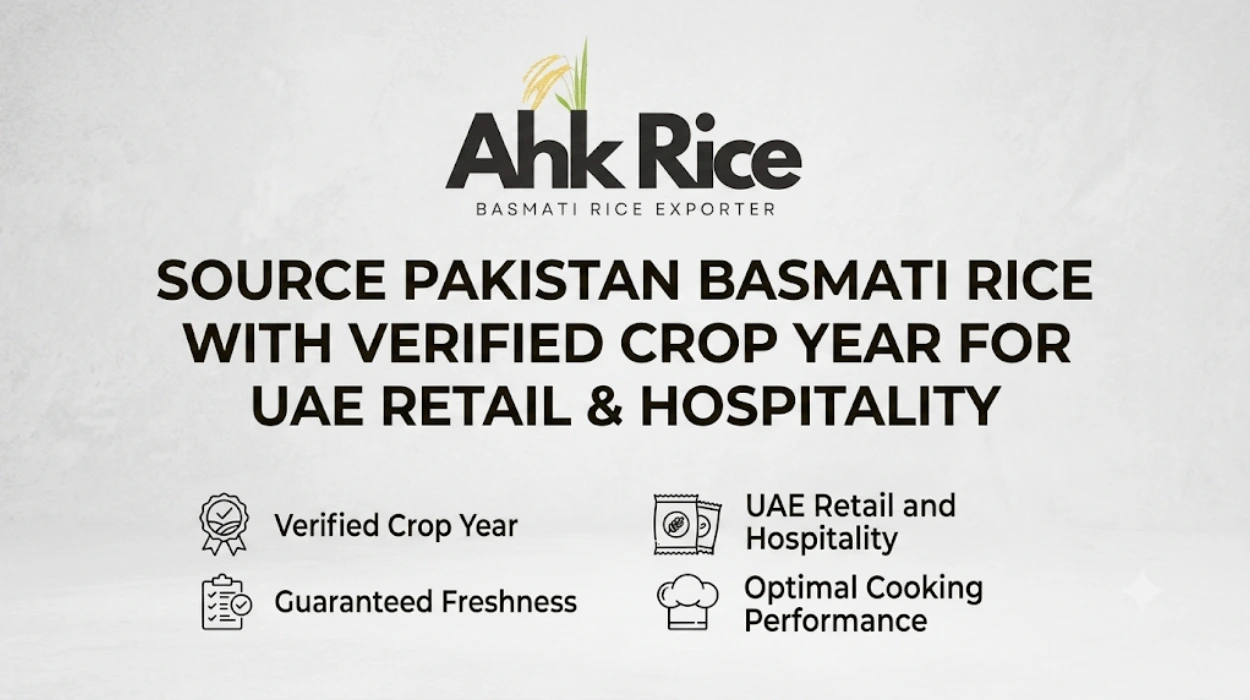
Source Pakistan Basmati Rice with a verified crop year to achieve consistent cooking performance, longer shelf life, and reliable customer satisfaction. Here is why: verified harvest information reduces quality disputes, supports purchasing decisions, and ensures every shipment matches UAE retail and hospitality requirements. Before choosing a supplier, learn why UAE buyers request verified crop year information in our guide why UAE retailers and hotels ask about crop year in Pakistan Basmati Rice.
UAE importers purchase Pakistan Basmati Rice for supermarkets, restaurants, hotels, catering companies, and food distributors. Every buyer expects consistent aroma, grain length, cooking yield, and appearance. Crop year verification helps buyers confirm these quality factors before placing a commercial order.
AHK Rice supplies verified Pakistan Basmati Rice with documented harvest information, quality inspection, export documentation, and international shipping support. AHK Rice helps buyers reduce purchasing risks by providing transparent specifications before production begins. Buyers receive milling reports, moisture information, packaging options, and shipment schedules that simplify procurement.
Pakistan remains one of the world’s leading Basmati rice exporters because its climate and fertile plains support premium aromatic rice cultivation (Source: Pakistan Bureau of Statistics FY2024-25). However, selecting the correct supplier is as important as selecting the correct variety. Verified crop year information provides confidence that every shipment matches the agreed specifications.
What is the best solution for sourcing Pakistan Basmati Rice with a verified crop year?
The best solution is selecting an exporter that verifies the harvest year, documents every processing stage, tests every production batch, provides export certifications, and ships according to agreed specifications. This approach minimizes commercial risk while improving consistency for UAE retail and hospitality businesses.
Verified crop year allows buyers to compare rice objectively instead of relying on marketing descriptions. Freshly harvested rice behaves differently from properly matured rice. Buyers need documented evidence before confirming container bookings.
Why crop year verification matters
Verified crop year helps buyers evaluate:
| Specification | Benefit |
|---|---|
| Harvest Year | Confirms production season |
| Moisture Level | Supports storage stability |
| Grain Length | Maintains premium appearance |
| Broken Percentage | Improves retail presentation |
| Purity Level | Ensures consistent grading |
| Milling Date | Confirms freshness |
| Packing Date | Supports inventory planning |
AHK Rice verifies every production batch before export. Quality inspectors review documentation before rice enters final packaging. This process improves transparency for wholesalers and hospitality buyers.
Nine processing steps followed by AHK Rice
- Clean harvested paddy.
- Dry the grain.
- De-husk the rice.
- Polish the kernels.
- Grade by size.
- Sort using color sorters.
- Test laboratory samples.
- Pack according to specifications.
- Load containers for export.
Each processing stage contributes to consistent product quality. Buyers receive specifications that match the shipment instead of estimated values.
Seven available processing grades
- White Rice
- Steam Rice
- Golden Sella
- Creamy Sella
- Brown Rice
- Extra White Rice
- Sortex Premium Rice
Each grade serves different commercial applications. Retail brands often choose premium white grades, while catering businesses frequently select Steam or Golden Sella because of their cooking stability.
Quality verification establishes the buying foundation. The next question becomes selecting the right export partner.
Why choose AHK Rice for UAE retail and hospitality businesses?
AHK Rice provides verified crop year documentation, multiple processing grades, international certifications, flexible packaging, export experience, and responsive commercial support. UAE buyers receive transparent specifications before production begins, reducing uncertainty and simplifying procurement decisions for long-term business relationships.
Choosing an exporter involves more than comparing prices. Reliable suppliers communicate clearly, document quality consistently, and ship according to schedule.
AHK Rice supports buyers throughout procurement by supplying specification sheets, laboratory reports, photographs, production updates, and shipping documentation. This transparency helps retailers plan inventory while helping hotels maintain consistent menu quality.
The first commercial advantage is traceability. Buyers understand where the rice was cultivated, when it was harvested, how it was milled, and when it was packed.
The second advantage is processing flexibility. AHK Rice supplies multiple grain specifications suitable for supermarkets, restaurants, wholesalers, distributors, and institutional catering companies.
The third advantage is export readiness. AHK Rice prepares commercial documentation including:
- Commercial Invoice
- Packing List
- Certificate of Origin
- Phytosanitary Certificate
- Fumigation Certificate
- Quality Certificate
- Bill of Lading
International buyers also benefit from production updates during manufacturing. This improves planning for warehouse operations and retail promotions.
Cooking performance depends heavily on crop maturity. Learn more in our comparison guide explaining how crop year influences cooking performance in UAE markets.
Understanding supplier capabilities leads naturally to evaluating measurable commercial results.
What results can UAE retail and hospitality businesses expect?
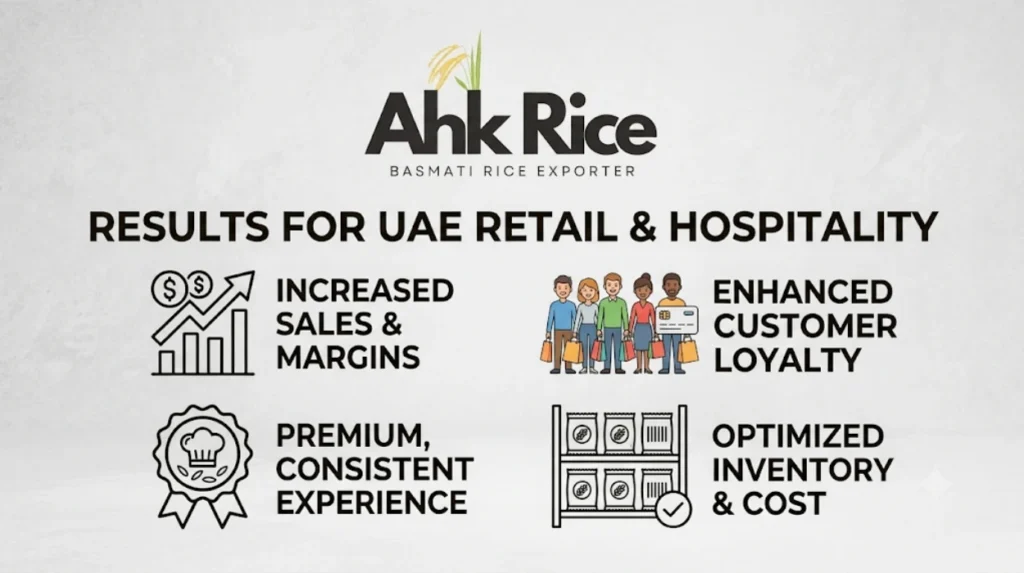
Verified crop year sourcing delivers consistent cooking performance, fewer customer complaints, stronger inventory control, higher retail confidence, and reliable procurement. Buyers receive predictable quality across multiple shipments, helping supermarkets, restaurants, hotels, and distributors protect their brand reputation while improving operational efficiency.
UAE buyers evaluate suppliers based on long-term consistency rather than a single shipment. Verified crop year reduces quality variation because every production batch follows documented harvesting, milling, grading, and inspection procedures. AHK Rice supplies detailed specifications before shipment, enabling buyers to purchase with greater confidence.
Retail businesses benefit from uniform grain appearance. Consistent grain length and colour improve shelf presentation, encouraging repeat purchases from consumers seeking premium Pakistan Basmati Rice.
Hotels and restaurants benefit from predictable cooking performance. Rice with the correct maturity absorbs water evenly, elongates consistently, and maintains its natural aroma after cooking. These qualities help chefs prepare identical dishes every day.
Foodservice distributors gain operational advantages through reliable stock planning. Verified documentation allows purchasing managers to forecast inventory with greater accuracy and reduce unnecessary emergency orders.
Expected commercial outcomes
| Business Objective | Expected Result |
|---|---|
| Consistent Quality | Uniform grain appearance and aroma |
| Customer Satisfaction | Reduced quality complaints |
| Inventory Planning | Better stock forecasting |
| Restaurant Operations | Consistent cooking yield |
| Retail Sales | Improved consumer confidence |
| Brand Reputation | Stronger product reliability |
Each shipment from AHK Rice undergoes inspection before loading. Laboratory testing verifies moisture, purity, grain length, broken percentage, and overall quality. These reports help buyers compare shipments against their purchasing specifications.
Shipping times by export market
Delivery schedules influence purchasing decisions. Transit time varies according to destination, shipping line availability, and customs clearance.
| Market | Estimated Shipping Time |
|---|---|
| UAE (Jebel Ali) | 12–18 days |
| Saudi Arabia | 14–22 days |
| Oman | 10–16 days |
| Qatar | 15–22 days |
| Bahrain | 15–20 days |
| Kuwait | 18–25 days |
| Europe | 28–40 days |
| North America | 35–50 days |
Container loading schedules are confirmed before dispatch. AHK Rice coordinates documentation with freight partners to minimise delays during export clearance.
Reliable delivery completes only one part of the buying decision. Buyers also need confidence in the product before placing a full container order.
How does the sampling process work before placing a bulk order?
**Professional exporters provide product samples, laboratory specifications, packaging options, and commercial documentation before confirming production. This process allows buyers to evaluate quality, cooking performance, and packaging suitability while reducing purchasing risk before committing to full-container shipments.
Sampling protects both buyer and supplier. Product evaluation ensures that specifications meet commercial expectations before production begins.
Sample request process
- Submit product requirements.
- Confirm required rice grade.
- Receive commercial specifications.
- Prepare representative sample.
- Test cooking performance.
- Review laboratory reports.
- Approve production sample.
- Confirm commercial order.
This structured process reduces misunderstandings because both parties approve identical specifications before manufacturing.
Typical sample costs
| Sample Item | Estimated Cost |
|---|---|
| Rice Sample (500g–1kg) | Usually Complimentary |
| Courier Charges | USD 35–80 |
| Laboratory Analysis (optional) | USD 40–120 |
| Customized Packaging Sample | Depends on artwork and packaging |
Courier charges vary according to destination and shipping service. Many commercial buyers request several rice grades simultaneously to compare cooking characteristics before finalising procurement.
Documents provided with commercial samples
- Product Specification Sheet
- Crop Year Information
- Moisture Report
- Grain Length Report
- Broken Percentage
- Packaging Options
- Product Images
- Export Certifications (upon request)
These documents help procurement managers compare suppliers using measurable quality data instead of marketing claims.
Sample approval also accelerates production because the agreed specification becomes the manufacturing standard for the export order.
What factors affect the cost of sourcing Pakistan Basmati Rice?
The final export price depends on rice variety, crop year, processing grade, grain specifications, packaging, order volume, certifications, freight charges, and seasonal market demand. Buyers who compare complete specifications instead of only price achieve better long-term purchasing value and fewer quality disputes.
Pakistan Basmati Rice pricing changes throughout the year because harvest volume, export demand, freight costs, and currency movements influence the market. Comparing only the price per metric ton often results in inconsistent quality. Professional buyers evaluate the complete specification before making a purchasing decision.
AHK Rice provides transparent quotations that include rice grade, crop year, moisture level, broken percentage, packaging type, container quantity, and delivery terms. This approach allows buyers to compare quotations fairly.
Factors influencing export pricing
| Pricing Factor | Impact on Cost |
|---|---|
| Rice Variety | 1121 generally commands a premium over PK 386. |
| Crop Year | Properly matured rice often has higher value. |
| Processing Grade | Golden Sella, Steam, and White grades differ in cost. |
| Grain Length | Longer grains increase market value. |
| Broken Percentage | Lower broken content increases price. |
| Packaging | Customized retail bags cost more than PP export bags. |
| Certifications | Additional inspections and certifications increase processing costs. |
| Freight Charges | Ocean freight varies by destination and season. |
For example, a supermarket importing premium retail packs may require Sortex White Basmati with customized branding. A catering company may prefer Golden Sella in 25 kg or 40 kg PP bags because it provides excellent cooking consistency and lower procurement costs.
The total purchasing cost should include quality, reliability, documentation, and after-sales support. Selecting the lowest quotation without verified specifications can increase operational costs later.
Understanding pricing helps buyers move confidently toward selecting a reliable export partner.
How can UAE buyers get started with AHK Rice?
Getting started is simple. Buyers share their product requirements, receive verified specifications, approve samples, confirm commercial terms, and begin production. This structured procurement process reduces uncertainty while ensuring every shipment matches the agreed quality standards.
AHK Rice begins every project by understanding the buyer’s intended market. Retail brands, hotel groups, wholesalers, and foodservice distributors each require different specifications.
Commercial procurement process
- Submit your rice requirements.
- Select the preferred Basmati variety.
- Receive product specifications.
- Review the verified crop year information.
- Approve product samples.
- Confirm packaging artwork.
- Finalize the commercial quotation.
- Begin production.
- Inspect finished goods.
- Load and dispatch the container.
- Receive export documents.
- Track shipment until delivery.
Throughout the process, AHK Rice maintains communication with buyers to ensure transparency. Export documentation is prepared before dispatch, and shipment schedules are shared in advance.
Choosing AHK Rice means working with a supplier focused on verified quality, documented specifications, and dependable export support. Whether you source for supermarkets, restaurants, hotels, or distributors, the goal is consistent product performance and long-term commercial success.
The procurement process is straightforward, and the next step is requesting a customized quotation based on your exact specifications. Contact our team to request a quote and receive a tailored export proposal within 24 hours.
Frequently Asked Questions
Why is the crop year important when buying Pakistan Basmati Rice?
The crop year indicates when the rice was harvested and helps buyers understand its maturity. Properly matured Basmati Rice delivers better aroma, grain elongation, and cooking performance. Verified crop year information also reduces quality disputes and improves purchasing confidence. Retailers and hotels benefit from consistent quality across multiple shipments.
Why should UAE businesses choose AHK Rice?
AHK Rice offers verified crop year documentation, multiple processing grades, laboratory-tested quality, export certifications, and professional logistics support. Buyers receive transparent specifications before production begins. This reduces procurement risks and supports long-term business relationships. The company also provides responsive customer service throughout the export process.
How long does shipping from Pakistan to the UAE take?
Most shipments reach Jebel Ali within 12–18 days, depending on vessel schedules and customs clearance. Transit times may vary during peak export seasons. AHK Rice confirms shipment schedules before dispatch and provides export documentation promptly. Buyers can also track container progress throughout transit.
Can I request a sample before ordering a container?
Yes. Buyers can request representative samples to evaluate grain quality, aroma, cooking performance, and packaging. Sample approval becomes the production standard for the final shipment. Courier charges usually range between USD 35 and USD 80, depending on the destination. This process helps buyers make informed purchasing decisions.
What certifications are available for export
Export documentation commonly includes the Commercial Invoice, Packing List, Certificate of Origin, Phytosanitary Certificate, Fumigation Certificate, Quality Certificate, and Bill of Lading. Additional certifications may be arranged depending on the destination market and buyer requirements. These documents facilitate customs clearance and international trade compliance.