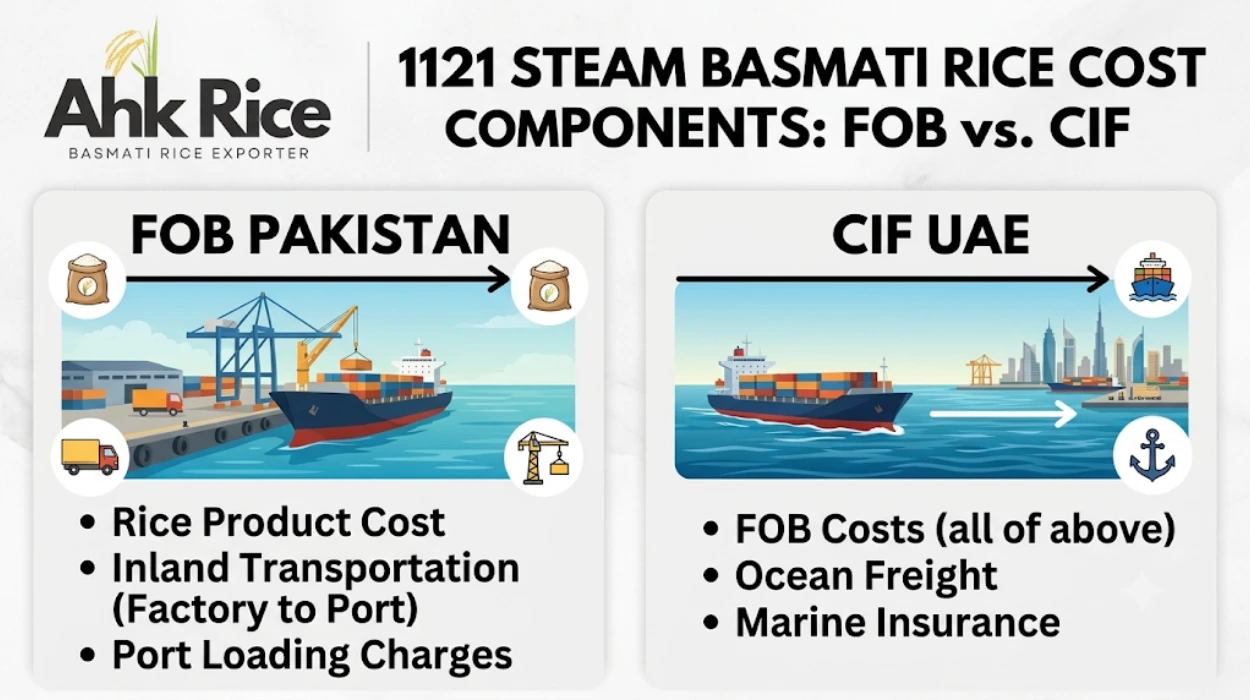
1121 Steam Basmati Rice FOB Pakistan vs CIF UAE: Cost Components Importers Should Understand
FOB pricing offers greater purchasing control, while CIF pricing provides predictable landed costs. Here is why: FOB allows buyers to select freight and insurance providers, whereas CIF combines the product, shipping, and insurance into one quotation. Understanding every cost component helps importers compare suppliers accurately instead of comparing incomplete prices.
International rice buyers often compare FOB and CIF quotations without identifying what each price includes. This creates misleading cost comparisons because identical rice specifications may appear cheaper simply because freight or insurance has been excluded.
Importers evaluating 1121 Steam Basmati Rice should first understand the export pricing structure before requesting quotations. Our complete guide on how Pakistani Basmati rice export pricing is calculated explains every pricing element from paddy procurement to export documentation.
AHK Rice’s 1121 Steam Basmati Rice Export Service supplies importers with export-grade rice processed in Punjab, Pakistan. AHK Rice mills, grades, sorts, inspects, certifies, loads, and exports 1121 Steam Basmati Rice with custom packaging, private labeling, and complete export documentation for buyers in more than 15 countries.
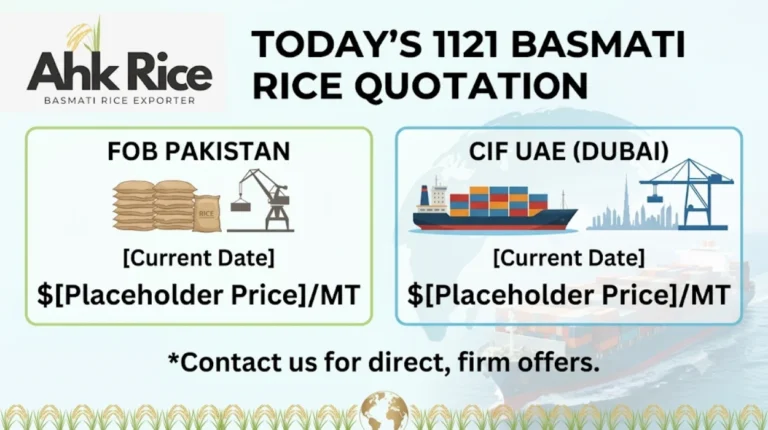
What is the difference between FOB Pakistan and CIF UAE pricing?
FOB includes the rice until loading at the Pakistani port, while CIF includes freight and marine insurance until the UAE destination port. FOB gives importers logistics flexibility. CIF offers predictable landed costs and simplifies purchasing for buyers without shipping arrangements.
What does FOB mean?
FOB stands for Free On Board. The exporter delivers cargo to the loading port, completes export customs clearance, and loads the container onto the nominated vessel.
The buyer assumes responsibility after loading. The buyer arranges ocean freight, marine insurance, destination customs clearance, inland transportation, and warehouse delivery.
FOB pricing gives experienced importers greater flexibility because freight rates change weekly. Buyers can negotiate directly with shipping companies and freight forwarders.
What does CIF mean?
CIF means Cost, Insurance, and Freight.
The exporter includes product value, freight charges, and marine insurance within one quotation.
Importers receive a simpler buying experience because transportation arrangements remain under one supplier.
Small distributors often prefer CIF because they avoid coordinating international logistics independently.
Specification Comparison
FOB Pakistan vs CIF UAE Specification Table
| Specification | FOB Pakistan | CIF UAE |
|---|---|---|
| Price Includes | Rice + Export Clearance + Loading | Rice + Freight + Marine Insurance |
| Ocean Freight | Buyer | Exporter |
| Marine Insurance | Buyer | Exporter |
| Risk Transfer | After loading vessel | Destination port |
| Logistics Control | High | Moderate |
| Cost Predictability | Medium | High |
| Best For | Large Importers | New Importers |
FOB quotations fluctuate primarily because shipping costs remain separate.
CIF quotations fluctuate because freight markets, bunker fuel costs, vessel availability, and insurance premiums change regularly.
Example Cost Breakdown
A shipment priced at USD 1,250/MT FOB Karachi may become USD 1,360–1,410/MT CIF Jebel Ali, depending on freight availability, insurance rates, and seasonal vessel demand.
For example:
- Rice Value: USD 1,250
- Ocean Freight: USD 90
- Marine Insurance: USD 8
- Documentation Adjustment: USD 5
Estimated CIF Price:
USD 1,353/MT
Freight increases during peak agricultural export seasons because container demand exceeds vessel capacity.
With FOB and CIF pricing defined, the next question becomes which purchasing approach creates better value for different importers.
Which purchasing method works better for different importers?
Large-volume buyers usually achieve lower total costs through FOB purchasing, while smaller distributors benefit from CIF because logistics remain consolidated under one supplier. Purchasing experience determines which option produces the lowest overall landed cost rather than the quotation alone.
Large Food Importers
Large importers generally negotiate annual freight contracts.
These agreements reduce transportation costs below standard market rates.
FOB purchasing allows these buyers to leverage their logistics network and optimize shipping schedules.
Bulk purchasing also enables container consolidation across multiple commodities.
Wholesale Distributors
Regional wholesalers frequently select CIF quotations.
One supplier manages product preparation, documentation, freight booking, insurance, and vessel scheduling.
This reduces operational complexity.
Although CIF pricing appears higher initially, administrative costs often decrease.
Supermarket Importers
Retail chains prioritize consistent delivery schedules over minor freight savings.
CIF shipments simplify inventory planning because arrival schedules remain coordinated by the exporter.
Product consistency also becomes easier to monitor through long-term supplier relationships.
Hospitality Buyers
Hotels, catering companies, and restaurant distributors purchase according to consumption forecasts.
These buyers frequently value supply continuity more than freight optimization.
CIF purchasing reduces procurement workload during seasonal demand peaks.
Regional Market Preference Comparison
| Market | Preferred Shipping Term | Common Grade Preference |
|---|---|---|
| UAE | Mostly CIF | 1121 Steam Premium |
| Saudi Arabia | FOB & CIF | 1121 Steam Extra Long |
| Oman | CIF | Super Kernel Steam |
| United Kingdom | FOB | Premium Long Grain |
| Canada | FOB | Private Label Steam |
(Source: REAP Export Data, FY2024–25)
The preferred shipping term often reflects importer size rather than product quality.
What cost components create the difference between FOB Pakistan and CIF UAE pricing?
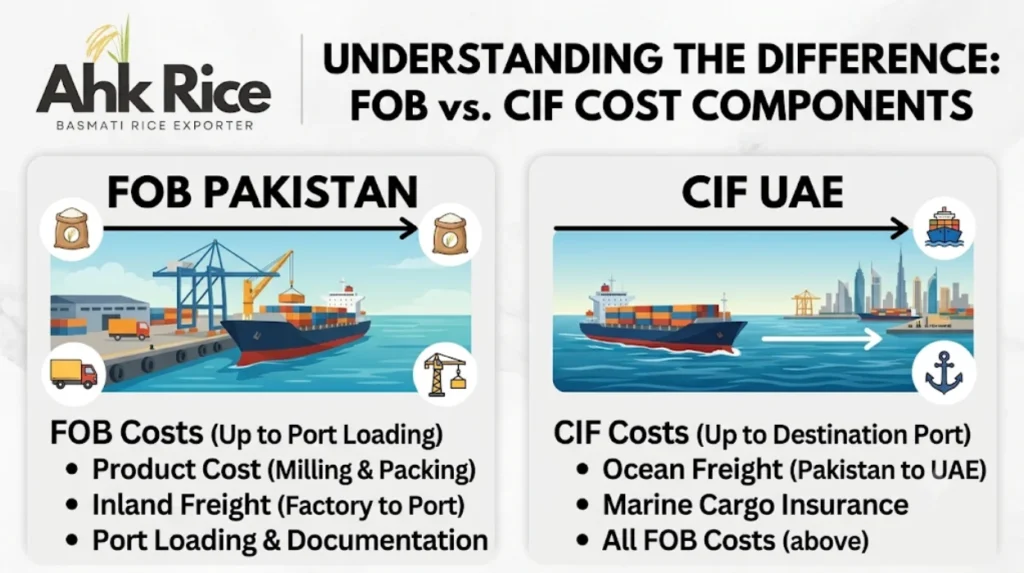
The largest cost differences come from ocean freight, marine insurance, port handling, and logistics management. Rice quality remains identical when specifications match. Importers should compare complete landed costs instead of comparing only the quoted price per metric ton.
Which costs are included in FOB pricing?
FOB pricing covers every export activity until the container is loaded onto the vessel in Pakistan. The exporter cultivates sourcing relationships, mills the paddy, grades the rice, inspects quality, completes export clearance, and loads the shipment.
Typical FOB cost components include:
- Paddy procurement
- Milling and polishing
- Length grading
- Color sorting
- Quality inspection
- Export packaging
- Container loading
- Export customs clearance
- Documentation
These costs remain under the exporter’s responsibility before the shipment leaves Pakistan.
Which additional costs are included in CIF pricing?
CIF pricing includes every FOB component plus international transportation expenses.
Additional CIF costs include:
- Ocean freight
- Marine insurance
- Destination port delivery
- Freight booking
- Shipping documentation coordination
Importers receive one consolidated quotation instead of arranging multiple service providers.
Typical Price Comparison per MT
| Cost Component | FOB Pakistan | CIF UAE |
|---|---|---|
| Rice Value | USD 1,240 | Included |
| Export Processing | Included | Included |
| Freight | Buyer | USD 85–120 |
| Marine Insurance | Buyer | USD 5–10 |
| Total Estimated Price | USD 1,240 | USD 1,330–1,370 |
Prices vary by season, freight availability, shipment volume, and destination port.
Freight costs increase during the peak export season because vessel space becomes limited. Freight costs usually decline after harvest when container availability improves.
(Source: REAP Export Data FY2024–25)
Understanding pricing components naturally leads to evaluating which option delivers better value for different markets.
Which option works best for UAE importers and other international buyers?
UAE distributors generally prefer CIF because it simplifies procurement, while experienced importers in Europe and North America frequently choose FOB to control freight costs. Buyer experience determines the best shipping term more than product specifications.
UAE Market Preference
The UAE imports premium Pakistani Basmati throughout the year. Many distributors purchase CIF because inventory moves quickly through wholesale markets and retail chains.
Preferred specifications include:
- Length after cooking: 18–22 mm
- Moisture: 12–13%
- Broken grains: 2–5%
- Double polished finish
- Sortex cleaned
Buyers serving hotels and restaurants also prefer reliable delivery schedules over small freight savings.
Europe and North America
Importers supplying supermarkets often negotiate annual freight contracts.
FOB purchasing allows these companies to:
- Reduce transportation costs
- Consolidate containers
- Select preferred shipping lines
- Schedule arrivals around warehouse capacity
These advantages become significant when purchasing hundreds of metric tons annually.
Shelf Life Comparison
| Grade | Shelf Life | Best Storage Condition |
|---|---|---|
| 1121 Steam Basmati | 12–18 months | Cool, dry warehouse below 25°C |
| 1121 Golden Sella | 18–24 months | Long-term commercial storage |
| Super Kernel Steam | 12–18 months | Retail distribution |
| 1509 Steam | 12–18 months | Fast inventory turnover |
Steam Basmati retains its aroma and cooking quality when warehouses maintain low humidity and proper ventilation.
(Source: Pakistan Standards & Quality Control Authority)
The right shipping term depends on operational priorities, which makes comparing advantages and disadvantages the next logical step.
What are the advantages and disadvantages of FOB and CIF?
FOB offers greater flexibility and potential freight savings, while CIF reduces operational complexity and creates predictable import costs. Neither option is universally better because purchasing objectives differ among importers.
Pros and Cons Comparison
| FOB Pakistan | CIF UAE |
|---|---|
| Lower quoted product price | Predictable landed cost |
| Greater logistics control | One supplier manages shipping |
| Better for experienced importers | Better for new importers |
| Easier freight negotiation | Less administrative work |
| Higher coordination responsibility | Less flexibility over carriers |
Example
A UAE wholesaler importing 25 MT every two months may benefit from CIF because logistics remain centralized.
A multinational importer purchasing 1,000 MT annually usually benefits from FOB because negotiated freight contracts reduce total landed costs.
Choosing between these options requires evaluating purchasing priorities rather than focusing only on price.
Which decision factors should importers evaluate before requesting quotations?
Successful buyers compare supplier capability, quality consistency, logistics expertise, documentation accuracy, and total landed cost before selecting FOB or CIF quotations. The purchasing decision should balance operational efficiency with overall import cost.
Decision Framework
| Buying Situation | Recommended Option | Reason |
|---|---|---|
| First import order | CIF | Simplified logistics |
| Experienced importer | FOB | Freight flexibility |
| Annual contract | FOB | Lower long-term costs |
| Small distributor | CIF | Lower operational workload |
| Multi-country importer | FOB | Easier shipment consolidation |
Professional importers also evaluate:
- Supplier certifications
- Processing consistency
- Container loading standards
- Packaging customization
- Export documentation accuracy
AHK Rice supports importers with end-to-end processing, custom packaging, private labeling, quality inspection, and export documentation for 1121 Basmati , Super Kernel Basmati, and 1509 Basmati supplied from Punjab, Pakistan.
The evaluation process naturally concludes with obtaining current market quotations before placing purchase orders.
FOB and CIF pricing represent two different purchasing strategies rather than two different rice qualities. FOB gives experienced importers greater logistics control and potential freight savings. CIF provides convenience, predictable landed costs, and reduced operational complexity for buyers who prefer a single supplier to manage international shipping.
Importers should compare complete landed costs, supplier reliability, processing standards, certifications, and logistics capability before making purchasing decisions. Evaluating the total supply chain instead of the quoted price alone leads to better procurement outcomes.
For buyers ready to compare current export quotations, continue with our guide on the latest FOB Pakistan and CIF UAE pricing for 1121 Steam Basmati Rice, which explains live market pricing, quotation structures, and exporter comparison criteria.
Frequently Asked Questions
What is the difference between FOB and CIF for rice imports?
FOB covers costs until the shipment is loaded onto the vessel in Pakistan. CIF also includes international freight and marine insurance to the destination port.
Is CIF more expensive than FOB?
Yes. CIF includes freight and insurance, so the quotation is higher. However, the total landed cost may be competitive because logistics are managed by the exporter.
Which option do UAE importers usually prefer?
Many UAE wholesalers choose CIF because it simplifies procurement and provides predictable landed costs.
Does FOB provide better value?
FOB generally benefits experienced importers who already have competitive freight agreements and logistics partners.
Does rice quality change between FOB and CIF shipments?
No. Rice quality depends on the agreed specification, processing standard, and inspection procedures, not the chosen Incoterm.