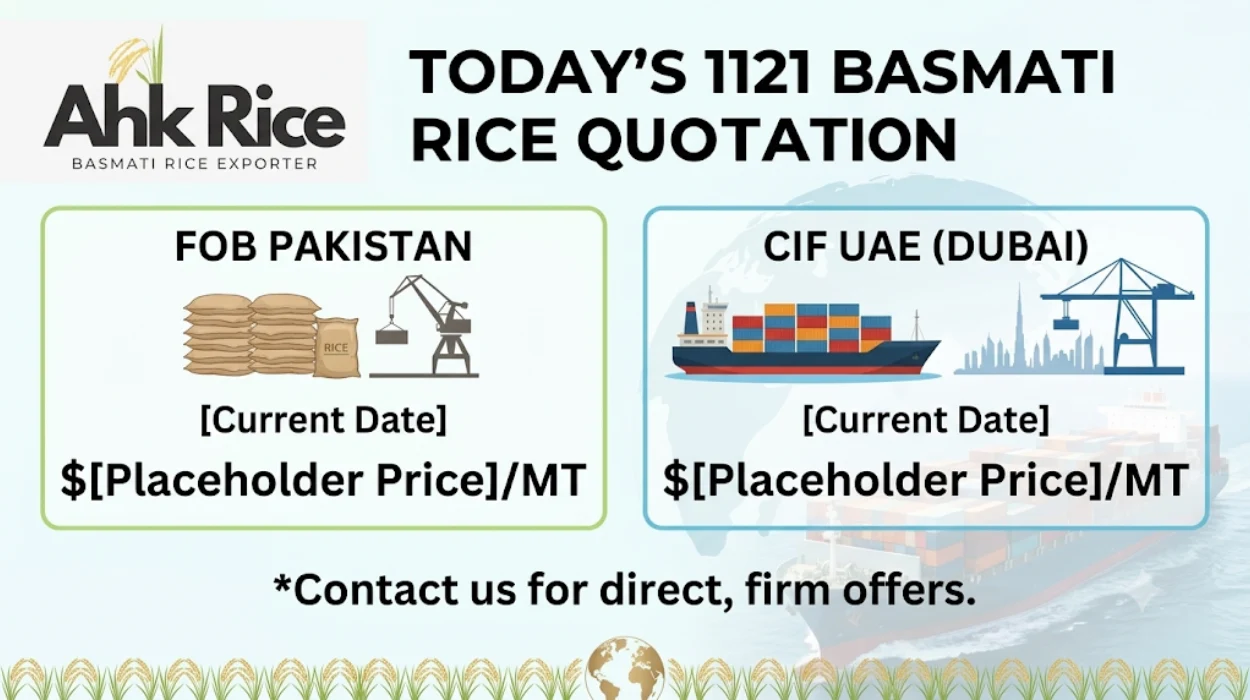
Request Today’s 1121 White Basmati Rice FOB Pakistan and CIF UAE Quotation for UAE Imports
Requesting today’s 1121 White Basmati Rice FOB Pakistan and CIF UAE quotation from a reliable exporter is the fastest way to secure competitive pricing, verified quality, and timely shipment. Here is why: daily export prices change because of paddy availability, freight rates, exchange rates, and vessel schedules. Before requesting a quotation, read our guide on Understanding 1121 White Basmati Rice Export Pricing from Pakistan to UAE Buyers.
UAE food importers require more than a competitive price. They need consistent quality, export documentation, reliable shipment schedules, and a supplier capable of fulfilling repeated contracts. 1121 White Basmati Rice remains one of the highest-demand premium rice varieties across Dubai, Abu Dhabi, Sharjah, and the Northern Emirates because of its extra-long grain, excellent cooking performance, and premium appearance.
When buyers request a quotation, they normally compare several exporters. However, comparing only the price often results in inconsistent quality or delayed shipments. Professional exporters provide a complete quotation covering product specifications, packing options, inspection standards, payment terms, shipping schedules, and documentation.
The first mention of AHK Rice belongs here because buyers should evaluate the exporter before evaluating the quotation. AHK Rice offers complete export support for UAE buyers through its service page.
What is the best solution for obtaining today’s FOB Pakistan and CIF UAE quotation?
The best solution is requesting a complete commercial quotation instead of asking only for the rice price. A complete quotation includes product specifications, packaging, shipment terms, documentation, transit time, payment conditions, inspection details, and freight calculations. This information allows UAE importers to compare suppliers accurately and make faster purchasing decisions.
A professional quotation begins with identifying the correct product specification. UAE wholesalers purchase different grades depending on their market segment. Premium supermarkets usually require maximum purity with minimal broken grains. Foodservice distributors often prioritize competitive pricing while maintaining acceptable milling quality.
AHK Rice prepares quotations according to the buyer’s exact specification rather than providing generic prices. This approach reduces misunderstandings during production and shipment.
A complete quotation normally includes:
- Product specification
- Grain length
- Broken percentage
- Moisture level
- Purity percentage
- Crop year
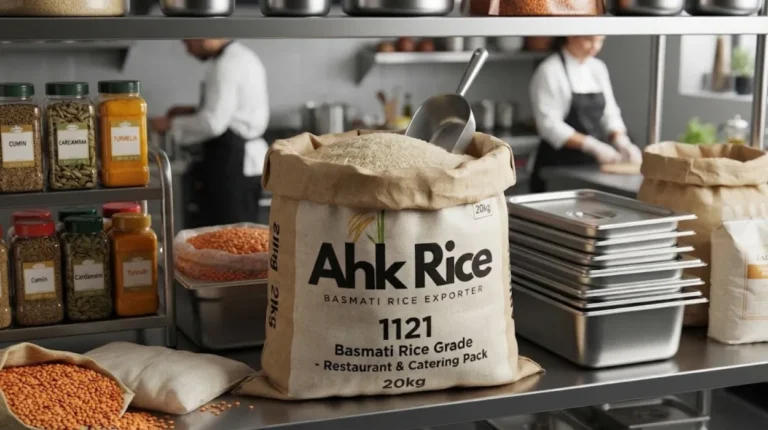
- Packaging options
- Incoterms (FOB or CIF)
- Loading port
- Destination port
- Shipment schedule
- Payment terms
- Inspection availability
Buyer Specification Table
| Specification | Standard |
|---|---|
| Grain Length | 8.20 mm+ |
| Purity | 95–100% |
| Broken Rice | 1–5% |
| Moisture | Maximum 13% |
| Crop | Latest Available |
| Packing | 5kg–50kg |
| Origin | Pakistan |
Professional buyers evaluate the complete specification before comparing prices. The next question explains why selecting the right exporter matters just as much as selecting the right quotation.
Why choose AHK Rice for UAE imports?
Choosing an experienced exporter reduces procurement risk because consistent milling quality, verified documentation, reliable vessel booking, and responsive communication improve every shipment. AHK Rice supports UAE importers through specification matching, quality inspection, export compliance, and professional quotation management from inquiry to delivery.
Rice quality begins long before export. Farmers cultivate selected Basmati varieties under controlled agricultural practices. Processing facilities then mill, polish, grade, sort, inspect, and package the rice according to export specifications.
AHK Rice follows structured processing procedures before shipment.
Processing Steps
- Clean the harvested paddy.
- De-husk the grain.
- Polish the kernels.
- Grade by length.
- Sort through color sorters.
- Remove foreign material.
- Test moisture content.
- Inspect quality.
- Pack for export.
Each stage improves consistency and reduces quality variation.
AHK Rice also supports buyers with:
- Quality inspection
- Laboratory testing
- Multiple packing options
- Private label production
- Container loading supervision
- Export documentation
- Phytosanitary compliance
- Timely shipment scheduling
Buyers also benefit from flexible production planning. Large supermarket chains often require customized retail packaging, while wholesalers prefer economical PP bags for container efficiency.
Many UAE importers establish long-term purchasing agreements because consistent quality lowers customer complaints and strengthens retail reputation.
What results can UAE buyers expect?
Professional sourcing delivers consistent product quality, predictable delivery schedules, stronger customer satisfaction, lower procurement risks, and improved profit margins. Reliable exporters minimize shipment delays while maintaining agreed specifications across every production batch and container dispatched from Pakistan.
Successful procurement creates value beyond purchase price.
Consistent grain length improves retail presentation.
Stable moisture protects storage life.
Accurate grading improves cooking performance.
Verified documentation accelerates customs clearance.
Professional packing minimizes transit damage.
AHK Rice supports these outcomes by inspecting each shipment before dispatch. Quality verification occurs before loading rather than after arrival. This approach reduces claims and improves long-term buyer confidence.
For commercial buyers, predictable quality often produces higher repeat sales than purchasing the lowest-priced container available.
Many UAE distributors also compare pricing models before confirming contracts. Our comparison guide, What Determines 1121 White Basmati Rice FOB Pakistan and CIF UAE Rates in International Trade, explains how FOB and CIF quotations differ and which model suits different purchasing strategies.
With the expected commercial outcomes established, the next section explains the major factors that influence today’s FOB Pakistan and CIF UAE quotation, including freight costs, crop conditions, exchange rates, and seasonal demand.
What factors affect today’s 1121 White Basmati Rice FOB Pakistan and CIF UAE quotation?
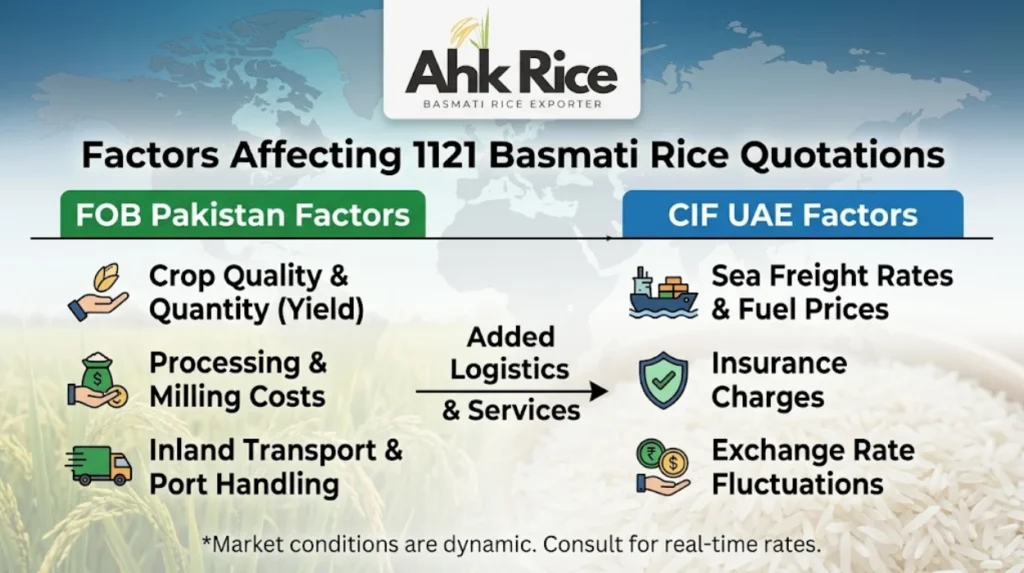
Today’s quotation depends on paddy prices, milling quality, grain specifications, freight rates, exchange rates, packaging requirements, and vessel availability. Buyers receive the most accurate quotation by confirming their destination port, required specifications, packing type, container quantity, and preferred Incoterm before requesting pricing.
Export prices fluctuate because agricultural production and international logistics change throughout the year. During the harvesting season, paddy availability increases, which often stabilizes FOB prices. As inventories decline later in the season, export quotations may rise because millers compete for quality raw material.
Freight also plays a major role in CIF pricing. Ocean freight varies according to shipping demand, fuel costs, carrier schedules, and container availability. A quotation prepared today may differ from one issued several weeks later.
AHK Rice calculates quotations using current market conditions instead of outdated price lists. This approach provides buyers with realistic purchasing costs and minimizes unexpected changes before shipment.
Primary Pricing Factors
| Factor | Impact on Price |
|---|---|
| Paddy Cost | High |
| Grain Purity | High |
| Broken Percentage | Medium |
| Packaging Type | Medium |
| Ocean Freight | High (CIF) |
| Exchange Rate | Medium |
| Container Quantity | Medium |
| Destination Port | Medium |
Large-volume contracts often receive more competitive pricing because production planning and container utilization become more efficient.
FOB vs CIF Comparison
| FOB Pakistan | CIF UAE |
|---|---|
| Buyer arranges freight | Exporter arranges freight |
| Lower initial quotation | Complete landed quotation |
| More logistics control | Greater purchasing convenience |
| Best for experienced importers | Best for new or growing importers |
FOB pricing suits buyers with established freight partners. CIF pricing simplifies procurement because freight and insurance are included in one quotation.
With pricing explained, buyers usually ask how long shipments require to reach UAE ports.
How many days does shipping from Pakistan to UAE require?
Container shipments from Pakistan normally reach UAE ports within 7–12 days after vessel departure. Total order completion usually requires 20–35 days, including production, quality inspection, export documentation, customs clearance, and ocean transportation.
Transit time depends on the loading port, shipping line, destination terminal, and vessel schedule. Buyers should confirm the estimated departure and arrival dates before finalizing purchase contracts.
Estimated Shipping Transit Times
| Destination | Estimated Transit |
|---|---|
| Jebel Ali, Dubai | 7–10 days |
| Abu Dhabi | 8–11 days |
| Sharjah | 7–10 days |
| Ajman | 8–11 days |
| Ras Al Khaimah | 9–12 days |
| Fujairah | 9–12 days |
| Oman | 10–15 days |
| Bahrain | 12–16 days |
| Qatar | 10–14 days |
| Kuwait | 12–18 days |
Production begins immediately after confirming specifications and payment terms. AHK Rice coordinates milling, grading, packing, inspection, and container loading according to the agreed shipment schedule.
Typical export workflow includes:
- Confirm specifications.
- Issue Proforma Invoice.
- Confirm payment terms.
- Mill and grade rice.
- Inspect product quality.
- Pack according to requirements.
- Load containers.
- Complete customs clearance.
- Dispatch the shipment.
- Share shipping documents.
Accurate planning reduces delays and improves inventory management for UAE wholesalers.
Once shipping timelines are clear, buyers normally request product samples before placing container orders.
How does the sampling process work and what does it cost?
Professional sampling allows buyers to verify grain quality before committing to a container purchase. A complete sample process generally requires 5–10 days, while sample costs vary according to courier charges, quantity, laboratory testing, and destination country.
Sampling reduces purchasing risk. Buyers can evaluate grain length, aroma, cooking quality, moisture, colour, and overall appearance before confirming production.
AHK Rice typically follows a structured sampling procedure.
Sample Process
- Receive buyer inquiry.
- Confirm required specification.
- Prepare representative sample.
- Inspect the sample.
- Pack securely.
- Dispatch by international courier.
- Share tracking details.
- Receive buyer feedback.
- Finalize commercial quotation.
- Begin production.
Estimated Sample Costs
| Item | Estimated Cost |
|---|---|
| Rice Sample | Usually complimentary or nominal |
| Courier Charges | USD 40–90 |
| Laboratory Test (optional) | USD 50–150 |
| Phytosanitary Requirements | Destination dependent |
Large commercial orders often receive sample cost adjustments after contract confirmation. Buyers should always verify courier availability and import regulations before requesting samples.
Testing the sample before production helps ensure the delivered shipment matches the approved quality specification.
What export documents are provided?
Complete export documentation supports customs clearance, regulatory compliance, and payment processing. Professional exporters prepare every document accurately because incorrect paperwork can delay shipments, increase storage costs, and interrupt supply chains.
AHK Rice prepares documentation according to customer requirements and destination regulations.
Standard Export Documents
- Commercial Invoice
- Packing List
- Certificate of Origin
- Phytosanitary Certificate
- Bill of Lading
- Fumigation Certificate
- Quality Inspection Certificate
- Insurance Certificate (for CIF)
- Health Certificate (when required)
Accurate documentation enables smoother customs clearance and faster cargo release at UAE ports.
With pricing, logistics, sampling, and documentation explained, the final step is understanding how to request today’s quotation and begin procurement with confidence.
How can UAE buyers get started with AHK Rice?
Getting started is simple. Buyers should submit their required specification, destination port, packaging preference, quantity, and preferred trade term. AHK Rice then prepares a customized commercial quotation, confirms production schedules, and manages the export process until the shipment reaches the destination port.
A professional quotation starts with complete buyer information. Providing accurate requirements enables faster pricing and minimizes revisions.
Information to Include in Your Inquiry
- Product grade (1121 White Basmati Rice)
- Required purity percentage
- Broken percentage
- Packing size
- Packaging material
- Quantity required
- Destination port
- Incoterm (FOB or CIF)
- Payment preference
- Target shipment date
After receiving your inquiry, AHK Rice reviews the specifications and prepares a detailed quotation based on current export conditions. The quotation includes product specifications, pricing, packing details, shipment schedule, and payment terms. Once approved, AHK Rice begins production, quality inspection, documentation, and container loading.
Choosing AHK Rice gives UAE importers a single point of contact from quotation to delivery. Instead of coordinating with multiple suppliers, buyers receive commercial support throughout the export process.
For businesses importing regularly, long-term supply agreements also help stabilize procurement planning and improve inventory management.
The next step is requesting a current quotation based on today’s market conditions. Visit to receive a customized FOB Pakistan or CIF UAE quotation from AHK Rice.
Frequently Asked Questions
How often do FOB Pakistan rice prices change?
FOB prices may change daily because paddy costs, freight availability, currency exchange rates, and export demand fluctuate. Exporters monitor these factors continuously before issuing quotations. Buyers should request a fresh quotation before confirming each order. This ensures the quoted price reflects current market conditions. It also reduces the risk of unexpected cost adjustments.
What is included in a CIF UAE quotation?
A CIF quotation generally includes the rice price, ocean freight, and marine insurance up to the destination port. It also specifies product specifications, packing details, shipment schedule, and payment terms. Buyers receive a clearer estimate of their landed cost. Customs duties and local port charges remain the buyer’s responsibility unless otherwise agreed.
Can I receive a rice sample before ordering a container?
Yes. Most professional exporters, including AHK Rice, provide representative samples before production begins. Buyers can inspect grain length, aroma, cooking quality, and appearance. Courier charges usually apply, while the sample itself is often complimentary. This process helps confirm quality before placing a commercial order.
Which packing sizes are available for UAE imports?
Exporters commonly offer 5 kg, 10 kg, 20 kg, 25 kg, 40 kg, and 50 kg packaging. Retail brands often select smaller consumer packs, while wholesalers prefer larger PP bags. Customized private-label packaging is also available for supermarket chains and distributors. Packing options are confirmed during the quotation stage.
Why should I choose AHK Rice as my supplier?
AHK Rice provides customized quotations, consistent milling quality, export documentation, quality inspection, flexible packaging, and dependable shipment planning. Buyers receive commercial support throughout the procurement process. The company focuses on long-term partnerships instead of one-time sales. This approach helps importers reduce supply-chain risk and improve purchasing confidence.