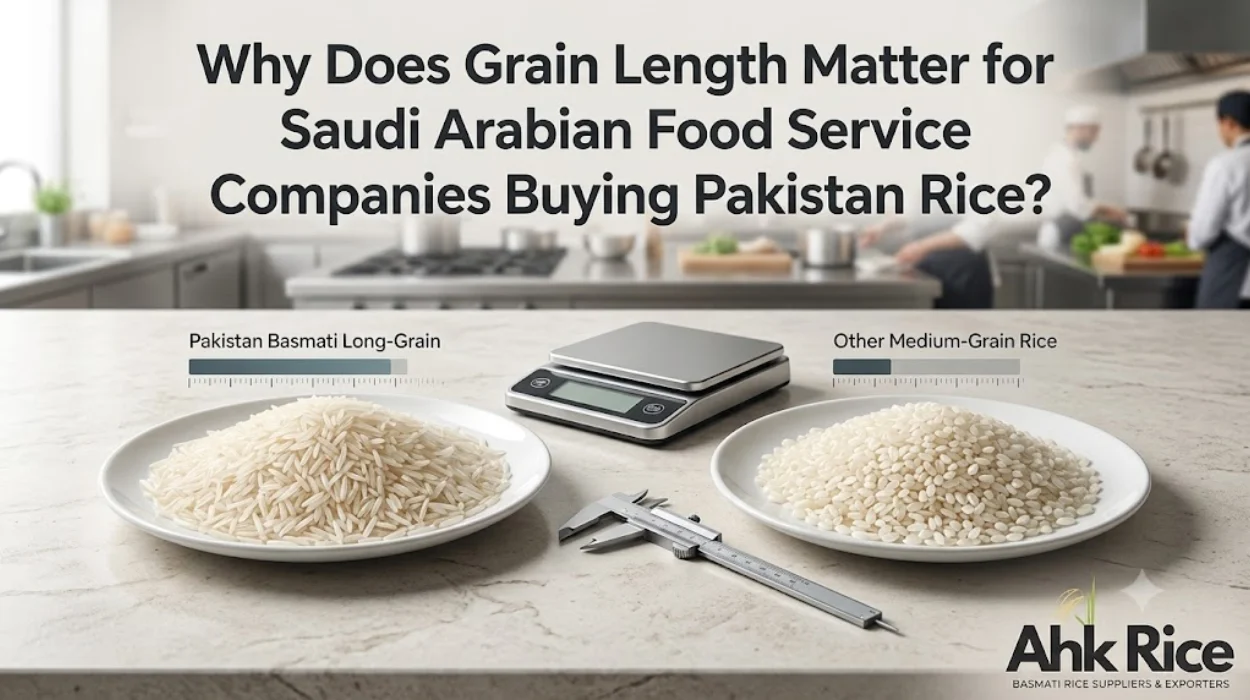
Why Does Grain Length Matter for Saudi Arabian Food Service Companies Buying Pakistan Rice?
Saudi Arabian food service companies prioritise grain length because longer grains deliver better plate presentation, higher cooked volume, stronger consumer acceptance, and more consistent performance across large-scale catering operations. Here is why: Pakistan’s premium Basmati varieties, particularly 1121 Basmati, achieve raw grain lengths above 8.3 mm and cooked grain lengths exceeding 20 mm, making them suitable for hospitality, catering, restaurant, and institutional food service applications.
Food service buyers evaluate rice differently from household consumers. A catering company serving 5,000 meals daily requires consistency in cooking performance, appearance, yield, and storage stability. Grain length directly influences all four factors.
Pakistan remains one of the world’s leading exporters of premium Basmati rice, supplying Saudi Arabia, the UAE, Iraq, Oman, Kuwait, and Qatar with multiple grain specifications (source: REAP export data, December 2025). Long-grain Pakistani Basmati continues to dominate premium hospitality segments because visual quality remains a major purchasing factor in Gulf food service markets.
What Is Grain Length in Pakistan Rice?
Grain length refers to the physical measurement of a rice kernel before cooking. Premium Pakistan Basmati grades typically measure between 7.4 mm and 8.5 mm, while elite 1121 Basmati grades regularly exceed 8.3 mm.
Grain length is one of the most important quality specifications in international rice trade. Rice inspectors measure kernels using calibrated grading equipment before export. Buyers use these measurements to compare grades and establish procurement standards.
Pakistan cultivates several export-oriented rice varieties. Each variety produces different grain dimensions after harvesting, milling, grading, and packaging.
Major Pakistan Rice Varieties by Grain Length
| Variety | Average Raw Grain Length |
|---|---|
| 1121 Basmati | 8.3–8.5 mm |
| 1509 Basmati | 8.2–8.4 mm |
| Super Kernel Basmati | 7.4–7.8 mm |
| PK-386 Long Grain | 6.8–7.1 mm |
| IRRI-6 Long Grain | 6.2–6.8 mm |
Saudi food service companies often specify minimum grain length requirements within procurement contracts because presentation standards vary across restaurants, catering firms, hotels, and institutional kitchens.
Grain measurement establishes the foundation for understanding cooking performance, which leads directly to how grain length affects food service operations.
How Does Grain Length Affect Cooking Performance?
Longer grains produce higher elongation ratios, better grain separation, larger serving appearance, and greater visual appeal after cooking.
Rice expands during cooking. Different rice varieties expand differently because kernel structure varies between varieties.
1121 Basmati is recognised globally for exceptional elongation. A raw grain measuring 8.4 mm can exceed 20 mm after cooking under controlled preparation conditions. This characteristic creates the long, separate grain appearance preferred throughout Saudi Arabia.
Grain Length and Elongation Process
Food service kitchens achieve optimal results through a defined cooking process:
- Measure grain length before preparation.
- Wash kernels to remove surface starch.
- Soak rice according to specification.
- Boil rice under controlled temperatures.
- Drain excess water.
- Steam rice until completion.
- Serve rice while preserving grain integrity.
Long grains retain visual distinction after cooking. Shorter grains appear denser and occupy less visible plate area.
Saudi buffet operators value elongation because food presentation influences customer perception. Wedding caterers, hotel kitchens, and banquet operators frequently select longer-grain Basmati for premium menu offerings.
Cooking performance explains operational value, while the next consideration examines why Saudi buyers specifically prioritise long-grain rice.
Why Do Saudi Arabian Food Service Companies Prefer Longer Rice Grains?
Long grains create premium presentation, improve customer perception, support traditional Gulf cuisine, and enhance profitability through stronger visual yield.
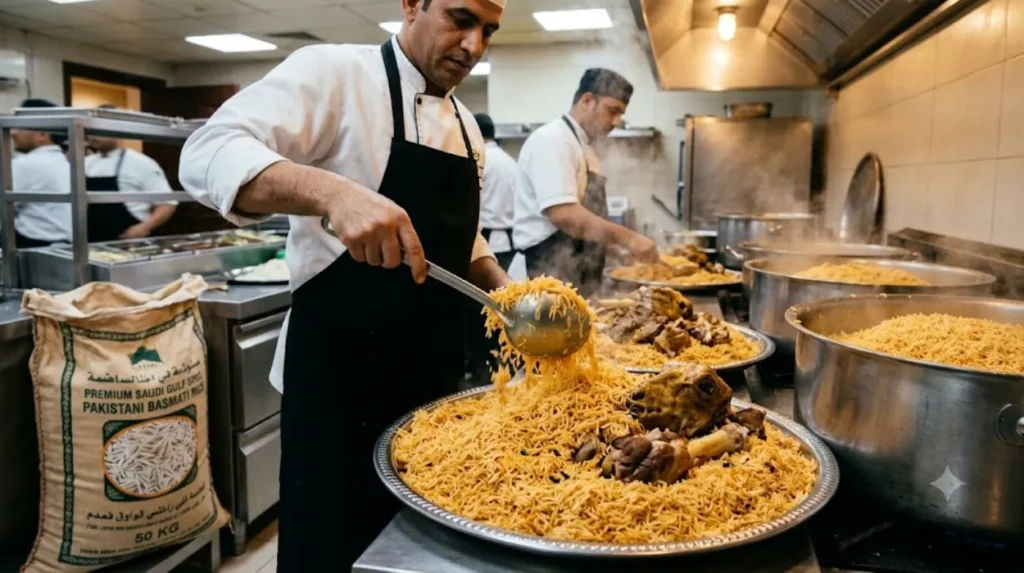
Saudi Arabian cuisine frequently incorporates rice as the centrepiece of a meal. Kabsa, Mandi, Bukhari rice, Madghout, and Zurbian all rely on visually attractive rice presentation.
Consumers associate long grains with premium quality. Restaurants understand this relationship and specify rice grades accordingly.
Presentation Standards in Saudi Food Service
Hotels require rice that remains separate after cooking.
Catering companies require rice that withstands bulk preparation.
Restaurants require rice that complements premium meat dishes.
Institutional kitchens require rice that maintains consistency across repeated cooking cycles.
Long-grain Pakistani Basmati satisfies these requirements because kernel integrity remains visible throughout preparation and service.
Saudi Arabia imports significant volumes of Pakistani Basmati annually because food service demand continues to favour premium long-grain specifications (source: Pakistan Bureau of Statistics, FY2024-25).
Consumer expectations explain demand, but processing methods also influence grain retention and final appearance.
How Is Long-Grain Pakistan Rice Processed?
Long-grain Pakistan rice undergoes harvesting, cleaning, drying, dehusking, milling, grading, sorting, inspection, and packaging before export.
Processing preserves grain integrity. Proper handling prevents breakage and protects export specifications.
Step-by-Step Rice Processing
- Harvest mature paddy from cultivated fields.
- Clean harvested paddy to remove impurities.
- Dry paddy to target moisture levels.
- Dehusk rice kernels mechanically.
- Mill kernels to remove bran layers.
- Polish rice according to grade specifications.
- Grade kernels by size.
- Sort grains through optical colour sorters.
- Inspect quality parameters.
- Package rice for export shipment.
Each processing stage affects final grain length retention. Poor handling increases broken kernels and reduces export quality.
Key Processing Components
- Moisture control
- Length grading
- Thickness grading
- Colour sorting
- Metal detection
- Laboratory testing
- Fumigation
- Export inspection
Export facilities across Punjab utilise advanced grading technologies to maintain specification consistency for international buyers.
Processing determines grain quality, while certification verifies that quality for importing markets.
Which Certifications Apply to Pakistan Rice Exported to Saudi Arabia?
Saudi Arabian importers commonly require phytosanitary compliance, food safety certification, quality inspection documentation, and export verification records.
Certification verifies compliance with importing country requirements.
Saudi authorities evaluate documentation alongside product quality. Exporters submit multiple certificates before shipment clearance.
Common Export Certifications
- Phytosanitary Certificate
- Certificate of Origin
- Fumigation Certificate
- Health Certificate
- Quality Inspection Report
- Packing List
- Commercial Invoice
- Bill of Lading
Food safety systems increasingly influence procurement decisions because institutional buyers require documented traceability.
Laboratory testing verifies moisture content, broken percentage, purity levels, and grain dimensions before shipment dispatch.
Certification validates quality claims, while rice grades determine which specification buyers select.
Which Pakistan Rice Grades Are Imported by Saudi Food Service Buyers?
1121 Basmati, Super Kernel Basmati, and 1509 Basmati represent the most commonly imported premium Pakistan rice grades for Saudi food service applications.
Food service procurement teams comparing processed 1121 variants often analyse how different parboiling methods affect grain retention, cooking stability, and catering performance in Saudi contracts.
Different sectors require different specifications.
Premium hotels often prioritise maximum grain length. Large institutional kitchens often balance grain length and procurement budgets.
1121 Basmati Rice
1121 Basmati delivers the longest grain profile among commercially traded Basmati varieties. Raw grain length regularly exceeds 8.3 mm.
1121 Basmati supports premium Kabsa and Mandi preparation because cooked grains remain long and visually distinct.
Super Kernel Basmati Rice
Super Kernel Basmati offers a traditional Basmati profile with raw grain lengths between 7.4 mm and 7.8 mm.
Super Kernel Basmati remains popular among buyers seeking authentic aroma and heritage characteristics.
1509 Basmati Rice
1509 Basmati combines long grain dimensions with strong productivity characteristics. Average grain lengths often exceed 8.2 mm.
1509 Basmati supports high-volume catering applications requiring consistency across large contracts.
Rice grades vary significantly, which creates several misconceptions about grain length and quality.
What Are the Most Common Misconceptions About Grain Length?
Longer grain does not automatically guarantee better quality because quality also depends on purity, breakage percentage, moisture control, ageing, and processing standards.
Many buyers focus exclusively on grain length. Professional procurement teams evaluate multiple specifications simultaneously.
Misconception 1: Longer Grain Always Means Better Rice
Long grain improves appearance. Quality still depends on milling standards, moisture control, and purity levels.
A poorly processed 8.4 mm grain performs worse than a properly processed 7.8 mm grain.
Misconception 2: All Long-Grain Rice Performs Identically
Different varieties produce different cooking results.
1121 Basmati elongates significantly during cooking. Super Kernel Basmati emphasises aroma and traditional characteristics.
Misconception 3: Grain Length Does Not Affect Yield
Long grains create greater visual volume after cooking.
Food service operators often perceive higher serving value because elongated grains occupy more plate space.
Understanding misconceptions helps buyers evaluate rice correctly. The final question concerns practical applications within Saudi food service operations.
Where Is Long-Grain Pakistan Rice Used in Saudi Arabia?
Hotels, restaurants, catering companies, institutional kitchens, banquet halls, and food manufacturing operations use long-grain Pakistan rice daily.
Food service organisations prioritise consistency. Long-grain Basmati supports standardised menu execution across multiple locations.
Hotels
Hotels utilise premium long-grain rice for buffet services, banquets, and fine-dining operations.
Catering Companies
Catering companies prepare thousands of portions per event. Grain retention remains essential for presentation quality.
Restaurants
Restaurants serving Kabsa, Mandi, and Bukhari rice depend on long-grain appearance to meet customer expectations.
Institutional Kitchens
Universities, hospitals, and corporate dining facilities require reliable cooking performance and predictable serving consistency.
Food Manufacturers
Food manufacturers incorporate long-grain rice into ready-meal products, packaged rice dishes, and food service ingredients.
Grain length influences every stage of food service performance, from procurement and storage to cooking and customer satisfaction.
Frequently Asked Questions
Why is grain length important for Saudi Arabian catering companies?
Grain length affects presentation, cooking performance, and customer perception. Longer grains create a premium appearance after cooking and suit traditional Saudi dishes such as Kabsa, Mandi, and Bukhari rice. Food service companies prefer long-grain rice because it delivers consistent visual quality across large meal volumes.
What is the average grain length of Pakistan 1121 Basmati rice?
Pakistan 1121 Basmati rice typically measures between 8.3 mm and 8.5 mm before cooking. After cooking, the grain can exceed 20 mm in length under proper preparation conditions. This elongation makes it one of the longest rice varieties traded internationally.
Which Pakistan rice varieties are commonly imported into Saudi Arabia?
Saudi Arabian importers commonly source 1121 Basmati, Super Kernel Basmati, and 1509 Basmati rice. Each variety offers different characteristics in grain length, aroma, cooking performance, and suitability for hospitality and catering applications.
Does longer grain rice provide better serving yield?
Longer grain rice creates a larger visual volume after cooking because the kernels elongate significantly. Food service operators benefit from improved plate presentation and a more premium dining experience. Visual yield is especially important for hotels, restaurants, and banquet caterers.
How is grain length preserved during rice processing?
Processors preserve grain length through controlled drying, careful milling, precision grading, optical sorting, and moisture management. Proper processing reduces kernel breakage and ensures the rice meets export-grade specifications required by international buyers.